


Whichever you choose, watch one trap: reward a single number and reps will game it. The table shows what each tool really rewards.
Best Sales Gamification Software for 2026: Comparison Table
| # | Tool | Best For | What It Rewards | Starting Price |
|---|---|---|---|---|
| 1 | Kendo AI Recommended | Skill-building and ramp | Skill: scored AI roleplay and call reviews | $55/seat/mo |
| 2 | Ambition | Coaching-integrated gamification | Activity and outcomes, routed into coaching | $45/user/mo |
| 3 | SalesScreen | Recognition on sales floors | Wins and milestones on TV displays | ~$25/user/mo* |
| 4 | SmartWinnr | Regulated, knowledge-heavy teams | KPIs plus product knowledge | Demo required |
| 5 | Spinify | Fast, AI-built competitions | Activity and wins in AI-built contests | Per user; Whale flat rate |
| 6 | Arcade | Frontline AI practice and coaching | Practice scores and readiness | Demo required |
| 7 | OneUp Sales | Sales and recruitment agencies | Placements and deals in one view | Quote required |
| 8 | Hoopla | Broadcast-style sales floors | Wins and head-to-head challenges | Demo required |
| 9 | LevelEleven | Salesforce-native field teams | Leading behaviors in CRM data | ~$45 to $55/user* |
| 10 | SetSail | Behavioral signals (now ZoomInfo) | Leading behaviors before the win | Quote required |
| 11 | Centrical | Enterprise contact centers | KPIs and quality scores | Custom |
| 12 | Flockjay | Enablement with light gamification | Learning and content use | Demo required |
| 13 | Plecto | Data-driven KPI dashboards | Live KPIs on dashboards | $24/license/mo* |
*SalesScreen and LevelEleven do not publish rates; the figures are third-party listings. Plecto bills per tracked license, annually, with a 10-license minimum. Kendo, Ambition, Plecto, SalesScreen and Spinify pricing was rechecked on their sites in October 2026; other vendor details reflect their sites as of June 2026. For the practice side of training, see the best AI sales roleplaying tools roundup.
Gamifying the Score vs Gamifying the Skill
Almost every tool here gamifies outcomes that already happened: calls dialed, meetings booked, deals closed. That builds effort and visibility. It does nothing for the rep who dials plenty and still loses the call.
- Gamifying the score rewards results after the call. Points and prizes motivate fast, fade fast and mostly light up the reps already on top.
- Gamifying the skill rewards how well a rep handles discovery or an objection before the call. It is harder to fake, and visible mastery gives the bottom half a game they can win.
Gartner has long argued that the best programs reward getting better, not just hitting a number, so they motivate the middle of the team too. The strongest tools below lean that way. The weakest just keep score.
The research backs the skill side: gamified learning had a large positive effect on learning outcomes (Hedges' g = 0.82), according to a 2023 meta-analysis in Frontiers in Psychology.
Kendo AI
★ Best overallGamifies the practice behind the number with scored AI roleplay and rep skill profiles, not just another leaderboard.

Every other tool on this list gamifies what a rep already did. Kendo gamifies whether the rep can actually do it.
Reps run AI roleplay against realistic buyers, and every session is scored out of 100 on a scorecard you define: discovery depth, objection handling, next steps.
Those scores build a skill profile per rep, with strengths, weaknesses and trends. That is the most durable game mechanic there is: visible mastery.


Kendo performance mockup, live calls Oct 13 to Nov 10, 2026: Maya Chen close rate 38%, Kendo avg 89, scorecard avg 87; Tyler Brooks close rate 26%, Kendo avg 78, scorecard avg 80; Sam Patel close rate 21%, Kendo avg 69, scorecard avg 72; Jordan Ellis close rate 30%, Kendo avg 81, scorecard avg 83. Jordan Ellis's average score trend is climbing after practice.
Kendo is not a TV-broadcast contest tool. If lighting up the floor with live rankings is the goal, pair it with a recognition platform below. Kendo makes sure that when a rep climbs the leaderboard, it is because they got better, not luckier.
Kendo vs. Traditional Gamification
| Dimension | Kendo AIRecommended | Leaderboard-First Tools |
|---|---|---|
| What it gamifies | The skill before the call | The result after the call |
| Game mechanic | Rising skill score per rep | Rank on a shared leaderboard |
| Gaming risk | Lower, scored on conversation quality | High if tied to one metric |
| Helps a struggling rep | Shows exactly what to drill | Shows they are losing |
| Feedback | After every session | Standings, not coaching |
Here is how that works in the product: a rep practices turning a brush-off into a measurable cost, then the manager reviews the scored attempt.
 Grant HollowayVP of Operations @ Software
Create Prospect. Step 3 of 3. Build a realistic prospect to practice your sales conversations. 1. Buyer Profile. 2. Scenario & Resistance. 3. Review & Launch. Prospect Type. Business (B2B). Consumer (B2C). Grant Holloway. VP of Operations @ Software. Conversation Type. Discovery call. Your Offer. Forecasting software for sales teams. Expected Objections. Not the decision maker. Already using a similar product. Wants to research more. Budget. Voice. Brian. Male. English. Busy, direct and short on time. Gives you ten minutes and tests whether you understand his team. Start Session.
Start Training for Grant Holloway (VP of Operations @ Software, Discovery call, B2B) with three training objectives: Uncover what the current process costs his team; Handle the loop in my CFO objection; Book a next step with the CFO on the call. The mode switches from Full call to Objections only, then Start Training.
Transcript. Show transcript. Agent. 10:02 AM. I've got ten minutes. Honestly, we already use a tool for that. You. Makes sense. What made you take the call anyway? 10:03 AM. My managers still chase forecast updates every Friday. Can you just send me some info? Happy to. So I send the right thing, how many hours does that Friday chase take? 10:04 AM. Six or seven across the team. Most of a day, really. But nothing moves without our CFO. I'd need to loop her in. 10:05 AM. Totally fair. Can we hold 20 minutes Thursday with her on the line? M mute · V camera. Speaking. Default mic.
Kendo scorecard: Jordan Ellis, SDR, Discovery call, passes all four criteria (Pain identified, Economic buyer, Decision process, Next step booked) and scores 84 out of 100.
Watch the recorded demo
Watch a rep rehearse a hard objection in a live Kendo roleplay before the real call.
The AI buyer presses on SOC 2, ISO 27001 and proof the tool cuts compliance work, and the rep has to answer on the spot. Those certifications are the buyer's questions in the scenario, not claims about Kendo.
Key Features
- Custom AI prospects. Build buyers that match your ICP, industry and personality, then drill against them on demand. To start fast, borrow from these sales roleplay scenarios.
- One scorecard for practice and live calls. Roleplays and real calls are scored against the same custom scorecard, so a rising practice score means the same thing on the phone.
- Automated call reviews. Summaries, sentiment, strengths and weaknesses, and scoring against your scorecard without manual grading. See how AI call reviews work.
- A leaderboard plus skill trends. Managers see scores, skill trends and rep profiles, so the bottom half has a game worth playing: their own improvement.
- Assign the next practice. Managers ask Kendo Agent, the AI sales manager, about the team in plain language and assign training from its dashboard.

United Insurance Pros cut time to its new-agent baseline from 45+ days to 14 days
“If you've got more than five agents, it's a no-brainer.”
A 500+ agent organization measuring the days from certification to baseline performance.
Kendo Pricing: Public, From $55 per Seat
| Plan | Price and access |
|---|---|
| Free Trial | $0 per seat/month. Trials of AI roleplay, AI call review and the AI Sales Manager. |
| Pro | $55 per seat/month. 180 minutes of AI roleplay and 25 hours of live call scoring per seat. |
| Max | $100 per seat/month. 480 minutes of AI roleplay and 100 hours of live call scoring per seat. |
| Enterprise | Custom. Done-for-you setup, advanced analytics and a dedicated account manager, from 10 reps. |
Pro and Max include AI call review, AI roleplay, metrics and the AI Sales Manager, with usage pooled across the team (Kendo's pricing page).
Ambition
Best for coachingThe rare gamification platform that wires competitions directly into a structured coaching cadence.
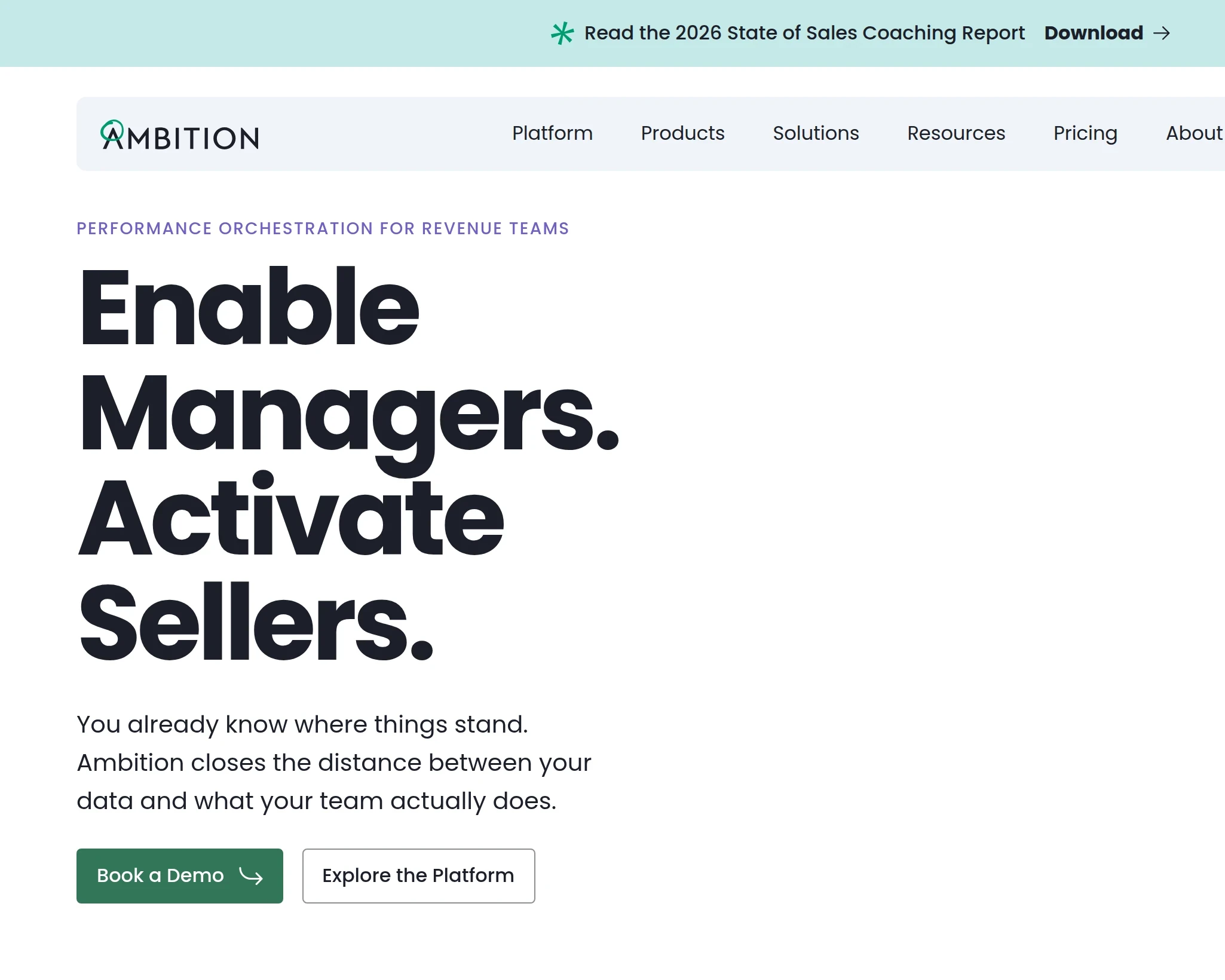
Ambition is a true gamification platform that does the thing most of its rivals forget: it connects the leaderboard to a coaching conversation.
Real-time leaderboards, scorecards, TV displays, and competition formats (Challenges and Fantasy) sit alongside a coaching engine that turns a slipping metric into a scheduled 1:1, not just a red number.
That pairing is what saves it from the gaming trap. When a rep's activity dips, the platform routes it to a coach instead of just publicly ranking them last. It is the closest thing on this list to motivation plus development in one tool. Pricing is refreshingly public.
Key Features
- Real-time leaderboards and competitions, with Challenge and Fantasy-football-style formats to keep the floor engaged.
- Coaching orchestration (Pro and Enterprise) that ties gamified metrics to a recurring 1:1 cadence and coaching analytics.
- Activity and objective scorecards plus a Productivity Quadrant to separate busy reps from effective ones.
- Native Salesforce, Slack, Zoom, and Webex integrations with API access on every tier.
Consider before choosing
- Coaching depth is gated. The strongest features, coaching orchestration and analytics, sit in the Pro and Enterprise tiers, so the entry plan is more leaderboard than coaching.
- Ambition lists Starter $45, Pro $65 and Enterprise $75 per user/month. AI Insights is $5 and AI Actions $4 per user/month; confirm the contract term.
SalesScreen
Polished visual recognition built to make a remote or hybrid sales floor feel alive again.

SalesScreen leans hard into the visual side of gamification, and it does it well.
Competitions, leaderboards, achievement badges, and SalesSurround TV displays turn closed deals into on-screen celebrations, which is exactly what a distributed team loses when nobody is ringing a bell in a shared room.
Its newer angle is Scout AI, which surfaces shaky performance early instead of after the quarter is blown.
The recognition is genuine gamification, not a dashboard, though the value tracks how religiously your team actually celebrates wins rather than letting the screens fade into office wallpaper.
Key Features
- Competitions and leaderboards across the metrics that matter, scaling from a handful to unlimited as you move up tiers.
- SalesSurround TV displays and celebrations that broadcast wins to in-office and remote teams alike.
- Achievement badges and recognition to reward milestones, not just the monthly top closer.
- Scout AI for early signals on slipping performance, included from the Scale tier up.
Consider before choosing
- Per-user rates are hidden. The pricing page shows tier structure and minimums (Scale needs 10 members, Pro needs 15) but lists placeholder prices, so you need a quote for exact numbers. Third-party listings put entry pricing around $25 per user per month.
- Coaching is an add-on. Scorecards and coaching are bolt-ons below Enterprise, so the core product is recognition first.
SmartWinnr
Best for regulated teamsGamification fused with knowledge reinforcement, built for pharma, finance, and other compliance-heavy industries.

SmartWinnr is the pick when what reps know matters as much as what they sell.
It turns KPIs into contests and leaderboards, then layers in microlearning, quiz-based knowledge reinforcement, and AI coaching, a combination that fits pharma, medical devices, banking, and insurance, where a wrong claim is a compliance problem, not just a lost deal.
This is gamification with a memory. Reps compete on activity and on product knowledge, which is a smarter balance than a pure activity leaderboard. Its homepage now leads with AI roleplay for regulated industries, so it overlaps with practice tools too.
SmartWinnr's homepage cites a 22% rise in sales productivity and 25% higher rep participation from its KPI gamification.
Key Features
- Points and leaderboards built on the KPIs you choose, with contest formats to drive participation.
- Knowledge reinforcement through repeated microlearning quizzes that keep product and compliance facts fresh.
- AI coaching and certifications for skill checks and role-specific readiness.
- Compliance-aware design for regulated industries like pharma, finance, and medical devices.
Consider before choosing
- No public pricing. SmartWinnr routes everything through a demo or sales conversation, so budgeting takes a call.
- Heavier than a pure leaderboard. The learning and certification layers add setup, which is the point for regulated teams but overkill for a simple SMB contest.
Spinify
AI-generated competitions and recognition you can stand up in a day, with a coaching agent riding along.

Spinify's pitch is speed: connect your CRM, let the Sidekick AI agent generate competitions, recognition, and real-time coaching nudges, and go live within 24 hours.
With 250+ competition designs, TV displays and a reward store, it is a complete gamification stack aimed at teams that do not want a six-week rollout.
The AI angle is the real differentiator: the platform proposes contests and celebrates wins so a busy manager does not have to. It is squarely a motivation-and-recognition tool, so treat it as the spark for effort, not a substitute for coaching the underlying skill.
Key Features
- AI agents (Sidekick and Recognition, with Coaching as an add-on) that auto-generate competitions and surface who needs a nudge.
- Leaderboards and TV displays with 250+ competition and recognition designs, unlimited on the higher tiers.
- Reward store for turning points into tangible incentives.
- Salesforce, HubSpot, and Microsoft Teams integrations for fast data hookup.
Consider before choosing
- Four service tiers. Sardine, Goldfish and Shark are billed per user per month; fully managed Whale is a monthly flat rate. A free trial is available.
- Recognition-first. The coaching agent nudges, but Spinify motivates behavior rather than building the skill behind it.
Hailie Miller runs one practice, score and leaderboard routine across three teams
“What doesn't get tracked doesn't get improved.”
Her cold callers practice one hour every shift in Kendo. Every Friday she shows the leaderboard and rankings, and for her coaching students she turns it into a competition.
Arcade
AI training, roleplay and coaching for call-center and retail frontlines.

Arcade is often filed under gamification, but in 2026 it is an AI coaching platform for the frontline, not a leaderboard tool.
It turns the playbooks and briefs a team already has into short, role-specific lessons on reps' phones, then has reps rehearse scored AI roleplay conversations before they face a customer.
That makes it a fit for sales onboarding as well as ongoing practice.
A manager co-pilot says who to coach next, on what and how, which puts Arcade closer in spirit to Kendo's skill-building than to a contest engine. It is built for call-center teams and face-to-face retail and field staff. If you want sales-floor rankings, this is not that tool.
Key Features
- Playbook-to-lesson training that turns existing briefs and decks into short, role-specific lessons on mobile.
- Scored AI roleplay so reps rehearse live conversations and prove readiness before a customer.
- A manager coaching co-pilot that flags who to coach next, on what and how.
- Readiness and gap views for leaders tracking teams across locations.
Consider before choosing
- Not a classic gamification engine. If you came for live team leaderboards and TV contests, Arcade's practice-and-coaching model is a different animal.
- No public pricing. Arcade does not list rates on its site, so pricing runs through a demo.
OneUp Sales
Best for agenciesThe gamification platform built equally for sales floors and recruitment agencies, with deep Bullhorn support.

OneUp is one of the few full gamification platforms built for recruitment agencies as well as sales teams. It runs live leaderboards, competitions, TV displays and real-time alerts, with native Bullhorn, Vincere and Loxo integrations alongside Salesforce and HubSpot.
That dual focus matters: a recruiter placing candidates and an SDR booking demos track different KPIs, and OneUp speaks both fluently in one real-time view. OneUp's homepage cites +43% more placements and ROI in four to five months.
Key Features
- Live leaderboards and competitions to drive both placements and closed deals.
- Custom TV displays and real-time alerts via Microsoft Teams to celebrate wins instantly.
- Recruitment-native integrations including Bullhorn, Vincere, and Loxo, plus Salesforce, HubSpot, and Aircall.
- Unified KPI dashboards blending CRM, VoIP, and timesheet data.
Consider before choosing
- No public pricing. OneUp routes through a "Get pricing" form and demo, with a free trial available.
- Activity-metric heavy. Like most leaderboard tools, it rewards visible activity, so define balanced KPIs to avoid reps chasing the easiest number.
Hoopla
The original sales gamification brand, built for broadcast-style energy on inside and hybrid floors.

Hoopla calls itself the #1 original sales gamification and recognition platform, and 16 years in, it knows the broadcast playbook cold.
Live leaderboards, head-to-head Faceoff challenges, automated win Newsflashes, and a rewards store turn the day's metrics into a sports broadcast across TVs, desktops, and phones.
It pairs that with a strong native Salesforce widget, so leaderboards live inside the CRM, plus a "go live in 24 hours" setup. The energy is its whole identity, which is great for a buzzy inside-sales room and less relevant if your team is heads-down on long enterprise cycles.
Key Features
- Live leaderboards and Faceoff challenges for head-to-head competition.
- Newsflash win announcements broadcast automatically to screens and devices.
- Rewards store where competition points convert to prizes.
- Native Salesforce, HubSpot, and Dynamics integrations, including an in-CRM leaderboard widget.
Consider before choosing
- No public pricing. Hoopla is demo-and-trial only, though it emphasizes fast setup and "zero financial risk" to start.
- Recognition, not development. Hoopla celebrates outcomes brilliantly but does not coach the skill behind them, so pair it with practice for lasting gains.
LevelEleven
Best for Salesforce teamsSalesforce-native gamification that ties contests and scorecards to the behaviors that move pipeline.

For Salesforce field teams, LevelEleven is the natural pick because it runs on your CRM data, so performance tracking and coaching reflect what is actually in the pipeline.
Competitions, real-time leaderboards, daily scorecards, and Channel11 TV broadcasts all live close to Salesforce, where it carries a 4.9-star AppExchange rating.
What lifts it above a vanity leaderboard is the focus on behaviors that convert, not just outcomes: custom formula metrics, coaching notes, and manager scorecards that catch gaps early.
Teams evaluating the operating system around those scorecards should compare platforms that connect coaching metrics with quota, territory, and incentives. Ascent Cloud, which now owns LevelEleven, says users improved tracked KPIs by 67% in their first quarter.
Key Features
- Salesforce-native gamification with competitions and leaderboards grounded in live CRM data.
- Daily scorecards and custom formula metrics that track the behaviors driving conversion.
- Channel11 broadcasts to keep performance visible across the field.
- Coaching notes and manager scorecards to spot gaps and outliers early.
Consider before choosing
- Best inside Salesforce. Its strength is CRM-native depth, so teams not standardized on Salesforce get less from it.
- Pricing is quote-based. LevelEleven no longer publishes rates; third-party listings commonly cite roughly $45 to $55 per user per month, so confirm directly.
SetSail
A behavioral-signal and incentive engine, more RevOps data platform than gamification tool.
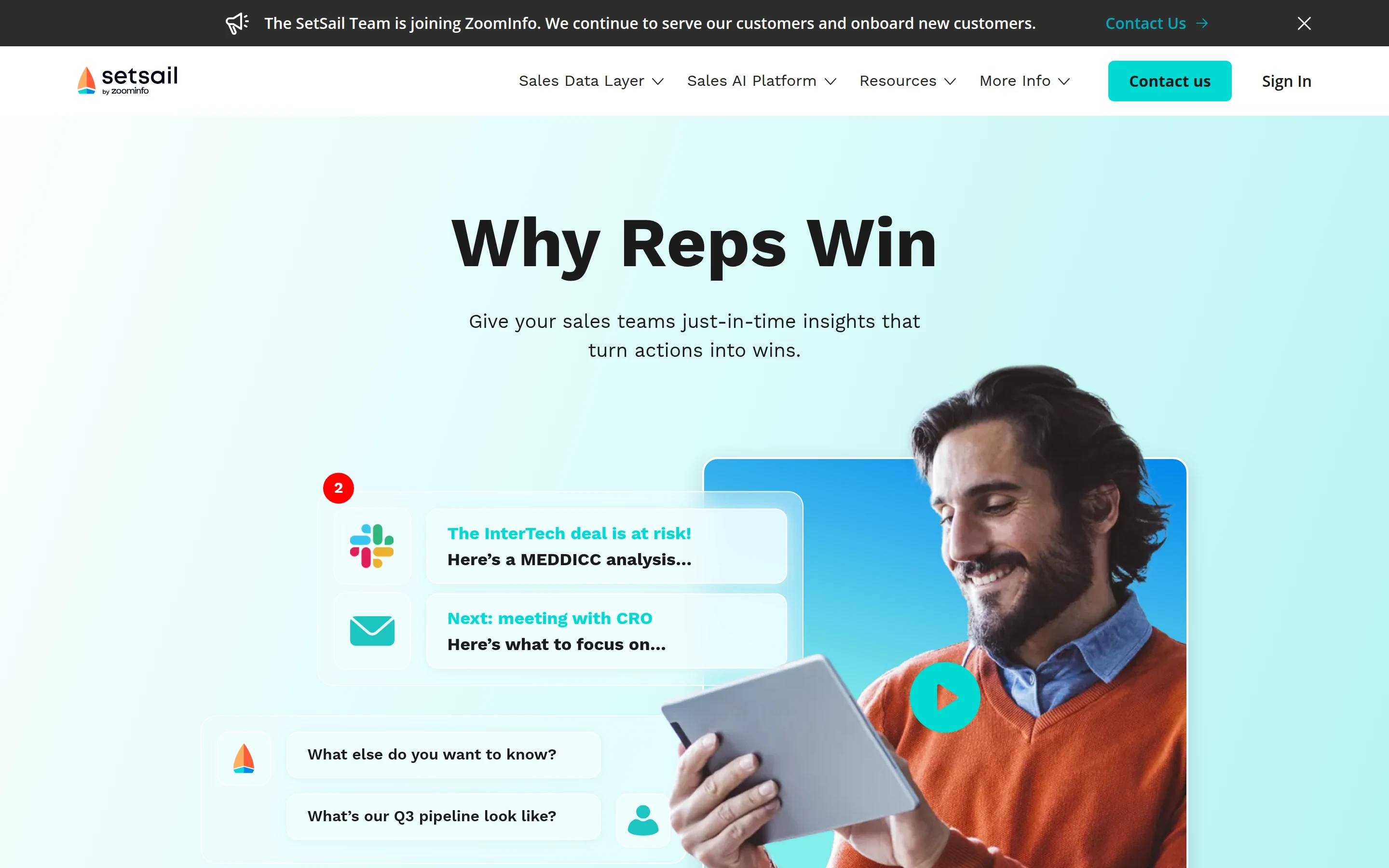
SetSail belongs on a gamification list with an asterisk.
Its original idea was sharp: reward the leading behaviors that precede a win, not just the closed deal, using AI to spot what top performers do differently.
That is a genuinely smart answer to the gaming problem, because it incentivizes the right activities rather than one lagging number.
In practice, though, it now reads as a RevOps signals and intelligence platform, capturing activity data, flagging deal risk, and pushing MEDDIC-style prompts via Slack.
The big change to note: SetSail was acquired by ZoomInfo and now operates as SetSail by ZoomInfo, as its own site states. If you want leaderboards and TV contests, look elsewhere; if you want behavioral analytics, it is interesting.
Key Features
- Behavioral signal capture across your GTM stack to identify winning patterns.
- AI deal-risk alerts and meeting prep delivered just-in-time via Slack and email.
- Incentives tied to leading behaviors rather than only closed revenue.
- ZoomInfo integration following the acquisition.
Consider before choosing
- Not a motivation-first tool. SetSail is analytics and signals, so a team that wants visible competition will find it abstract.
- Ownership changed. Now part of ZoomInfo, so weigh roadmap and bundling against your existing stack. Pricing is quote-only.
Centrical
Best for enterpriseEnterprise-grade gamification that ties competitions to coaching and KPIs for large contact-center floors.

Centrical is built for scale: large frontline teams such as contact centers. It now calls itself a workforce orchestration system for the hybrid frontline, with gamification as one module.
Its differentiator is discipline: it ties gamification directly to performance signals and coaching goals rather than rewarding mere participation, which is the right instinct for an enterprise floor with thousands of agents.
That outcome-linked design is a direct answer to the gaming problem. Competitions, recognition, nudges, and virtual rewards all hang off real KPIs and quality scores, so engagement stays tethered to results.
It is heavier and more enterprise than the SMB tools here, with the implementation to match. Contact-center leaders should also compare dedicated call center training software.
Key Features
- KPI-tied competitions and gamified goals that connect engagement to measurable outcomes.
- Microlearning and performance nudges to guide the next right action.
- Peer and manager recognition with virtual rewards.
- Enterprise performance management for large, multi-site frontline teams.
Consider before choosing
- Enterprise scope and effort. The breadth is built for big contact centers, so it is more than an SMB sales team needs.
- No public pricing. Centrical is demo-and-quote only, consistent with its enterprise positioning.
Flockjay
A sales enablement and learning platform where gamification is a feature, not the whole product.
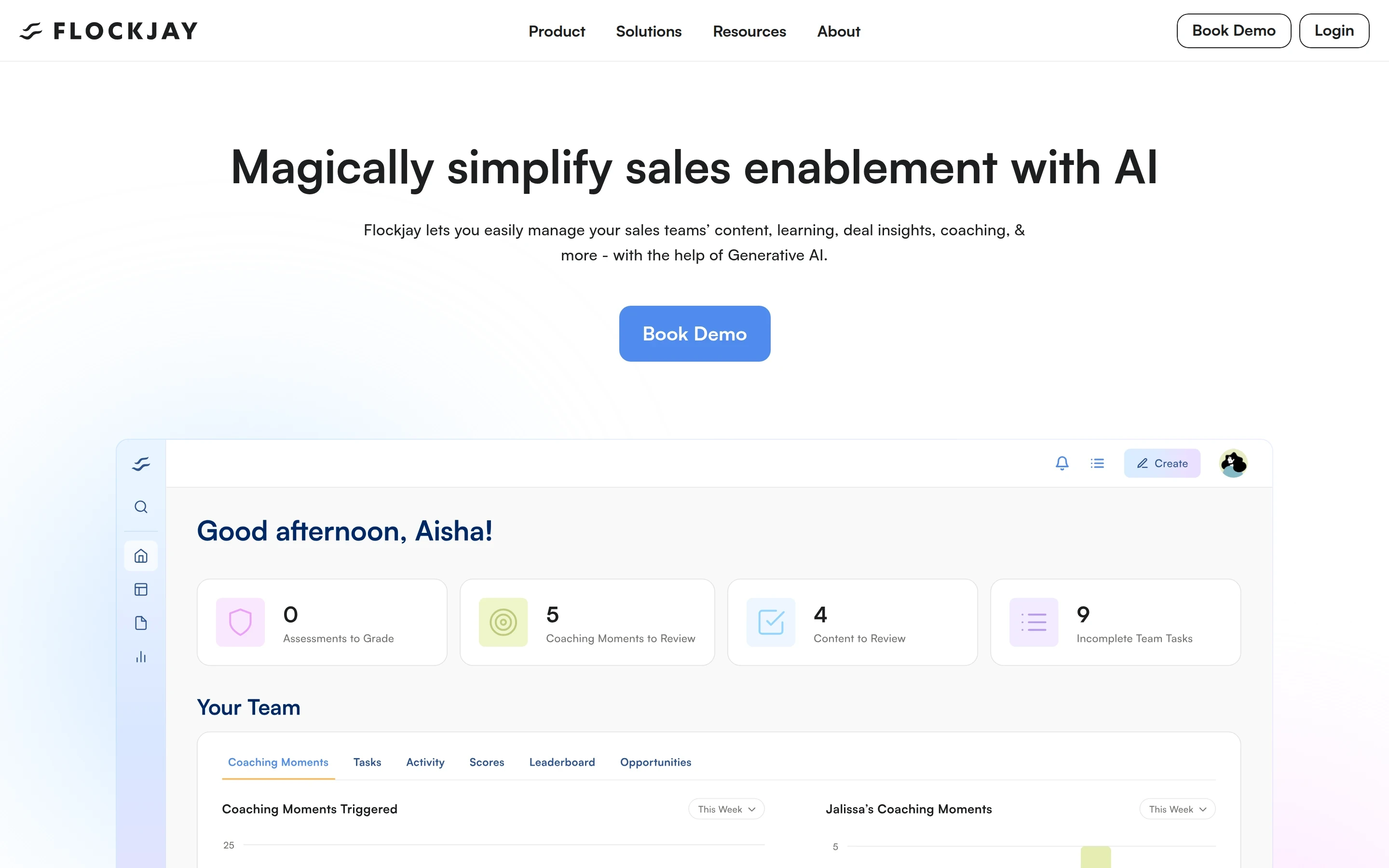
Flockjay shows up on gamification lists, but be clear on what it is: a modern learning and content management system with AI, where gamification is one use case among many.
The core is peer-to-peer learning, content with semantic search, deal-insight capture, and AI coaching, all aimed at making the right knowledge findable. It sits closer to AI sales enablement than to a contest engine.
For a fast-growing B2B team that wants enablement and light gamification in one place, it fits. For a team whose primary goal is competition and recognition, gamification is too far down Flockjay's priority list to lead with.
Key Features
- Unified learning and content management with AI-powered semantic search.
- Peer-to-peer knowledge sharing and deal-insight capture.
- AI coaching, call scoring, and pitch grading baked into the platform.
- 50+ integrations to fit existing stacks.
Consider before choosing
- Gamification is secondary. It is an enablement-and-learning platform first, so it is the wrong lead choice for a pure contest engine.
- No public pricing. Flockjay is demo-only, with no rates published on its marketing site.
Plecto
A real-time KPI dashboard tool with gamification layered on and fully public pricing.

Plecto is the most dashboard-forward option on the list. It builds real-time KPI visualizations on office TVs from 150+ integrations, then layers contests, achievements, leaderboards and a reward store on top.
That order matters. The numbers are the star and the game mechanics support them, which suits a data-driven RevOps team more than a floor that wants theater. Its biggest practical advantage: pricing is fully public, a rarity in this category.
Key Features
- Real-time KPI dashboards from 150+ integrations, built for TV and mobile.
- Contests, achievements, and leaderboards layered on top of the data.
- Reward store and notifications to keep targets visible and motivating.
- Coaching and training add-ons for teams that want development alongside dashboards.
Consider before choosing
- Dashboard-first, gamification second. If you want rich contest mechanics and celebrations, a recognition-led tool goes deeper.
- Clear, annual pricing. Medium is $24 and Large $37.20 per tracked license per month, billed annually, with a 10-license minimum and custom plans above that.
How to Choose the Right Sales Gamification Software
Make one decision before features and price: do you want to motivate the behavior, or build the skill behind it? Most tools here do the first. A couple do the second. The best teams run both.
Then match the tool to your actual constraint, not the flashiest demo:
| Your Situation | What to Prioritize | Strong Options |
|---|---|---|
| Reps lack skill, not effort | Scored practice and skill profiles | Kendo AI, Arcade |
| You want coaching tied to the game | Coaching orchestration | Ambition, LevelEleven |
| Remote floor feels flat | TV broadcasts and recognition | SalesScreen, Hoopla, Spinify |
| You live in Salesforce | CRM-native gamification | LevelEleven, Ambition, Hoopla |
| Recruitment or multi-office agency | Bullhorn and multi-KPI views | OneUp Sales, Spinify |
| Regulated, knowledge-heavy selling | Quizzes plus contests | SmartWinnr, Centrical |
| Enterprise contact center at scale | Outcome-tied, multi-site | Centrical, SmartWinnr |
| Data-driven RevOps team | Dashboards with a game layer | Plecto, SetSail |
Three buying notes:
- Expect hidden pricing. Only Ambition, Plecto and Kendo publish full per-user prices. Everyone else gates them behind a demo, so budget for negotiation and annual, sometimes multi-year, contracts.
- Check the integration first. Gamification is only as good as the data feeding it. Confirm native support for your CRM (Salesforce, HubSpot) or ATS (Bullhorn) before you fall for the leaderboard.
- Design the metric carefully. This is where most programs fail, not on software.
Don't Let Reps Game the Metric
The fastest way to ruin a gamification rollout is to reward one number. Economists call it Goodhart's Law: when a measure becomes a target, it stops being a good measure.
Crown the leaderboard by dials and you get voicemail spam. Crown it by revenue alone and you reward territory, not skill.
Three habits keep a program honest:
- Gamify a balanced set of metrics, not one. Mix activity, quality and outcomes so no single shortcut wins the game.
- Reward improvement, not just standing. A "most improved" category gives the bottom half a reason to play. Balance individual rankings with team goals so the middle of the board does not check out.
- Tie points to skill, not just speed. Rewarding call quality is the surest defense. Before you reward a jump in a skill score, listen to the conversation and test the rep on an unfamiliar scenario, so the score reflects the skill and not a memorized answer.
The Verdict: Which Sales Gamification Software Should You Pick?
The best tool is the one that changes behavior on your team, not the one with the slickest leaderboard. Most teams need two things working together: a way to motivate effort and a way to build the skill that effort relies on.
- Best for motivation and recognition: Ambition, SalesScreen, Spinify and Hoopla turn metrics into visible competition and celebration.
- Best for Salesforce field teams: LevelEleven keeps contests and scorecards native to your CRM data.
- Best for agencies and recruitment: OneUp Sales runs sales and placement KPIs in one gamified view.
- Best for enterprise and regulated teams: Centrical and SmartWinnr tie gamification to coaching, learning and outcomes at scale.
- Best for building the skill behind the score: Kendo AI gamifies scored AI roleplay so reps level up before they touch a live deal, from $55 per seat per month.
Leaderboards show you who is winning. Practice changes who wins next month. Pair a recognition platform for energy with Kendo for skill, or use Kendo's scores and skill trends as the game itself. See how Kendo helps sales leaders coach and rank reps on what matters, or book a demo.
To go deeper on what to measure, read the guide to sales KPIs that actually improve results, or compare platforms that build the skill itself in the roundup of the best sales training software.
Frequently Asked Questions
What is the best sales gamification software in 2026?
It depends on the behavior you want to change. For pure motivation and recognition, Ambition, SalesScreen, and Spinify lead with leaderboards, contests, and TV broadcasts. For Salesforce-native field teams, LevelEleven is the natural pick. For the layer most lists skip, building the skill before the call, Kendo AI gamifies deliberate practice with scored AI roleplay and rep skill profiles, starting at $55 per seat per month.
How much does sales gamification software cost?
Most vendors hide pricing behind a demo. The ones that publish it: Ambition runs $45 to $75 per user per month, and Plecto starts at $24 per tracked license per month, billed annually with a 10-license minimum. Kendo, the practice layer, starts at $55 per seat per month. SalesScreen and LevelEleven do not publish rates; third-party listings put them near $25 and $45 to $55 per user per month.
How big is the sales gamification software market?
The broader gamification market was valued near $29 billion in 2025 and is projected to pass $112 billion by 2031, a CAGR around 25%, with sales and marketing among the largest application segments, according to Mordor Intelligence. Sales gamification rides that wave because hybrid and remote teams lost the energy of a physical sales floor and need software to recreate it.
What is the best sales gamification software for Salesforce field teams?
LevelEleven (now part of Ascent Cloud) is the most Salesforce-native pick. It runs on CRM data, posts leaderboards and scorecards inside Salesforce, and broadcasts via Channel11, so field teams compete on the activities that actually move pipeline. Ambition and Hoopla also offer strong native Salesforce widgets.
Does sales gamification actually work, or do reps just game the metric?
Both can be true. Gamification lifts engagement, but if you only reward a single number, reps optimize for that number. It is Goodhart's Law: when a measure becomes a target, it stops being a good measure. The fix is to gamify a balanced set of behaviors and skills, not one vanity metric, and to reward improvement, not just the reps who already win.
What is the difference between sales gamification and AI sales roleplay?
Most gamification software scores results that already happened: calls made, deals closed, points earned. AI sales roleplay platforms like Kendo gamify the practice before the call, scoring how a rep handles objections and discovery against a realistic AI buyer. One motivates effort; the other builds the skill that effort depends on. Strong teams use both, and the roundup of the best AI sales roleplaying tools breaks down the practice side in detail.
Which sales gamification tools are best for agencies and recruitment teams?
OneUp Sales is built for both sales and recruitment agencies, with native Bullhorn, Vincere, and CRM integrations plus live leaderboards and TV displays. Spinify and SalesScreen also fit fast-moving agencies that want quick setup and visual competition across multiple offices.