

Softwares
Discover the leading platforms and solutions that help businesses accurately predict future sales performance, improve planning, and make smarter decisions with data-driven insights in 2026.

Sales leadership expert with 10+ years in B2B training and team development
10 Min
The average sales team misses their forecast by 27%. That's not just embarrassing—it's expensive. Poor forecasting leads to missed hiring windows, cash flow problems, and board meetings nobody wants to attend.
Stop relying on rep "gut feelings." Modern forecasting platforms leverage AI and real-time CRM data to replace optimism with mathematical precision. We’ve reviewed the top 9 tools and a proven framework to fix your pipeline visibility.
Here's what we'll cover:
9 top-rated sales forecasting tools with pricing, pros, and cons
The Forecast Quality Framework—why rep skills matter more than software features
Selection criteria to choose the right tool for your team size and budget
Read on to discover which platform fits your budget and how to finally master the human side of forecasting.
The Real Reason Your Forecasts Keep Missing
Traditional sales forecasting tools analyze your pipeline data—deal stages, historical win rates, engagement signals—to predict which deals will close. The problem? They’re predicting based on a fundamentally flawed input: undertrained sales reps.
Consider this scenario: Your forecasting tool shows Deal X has an 80% probability to close based on stage progression and engagement. But what the algorithm can’t see is that your rep hasn’t properly qualified the economic buyer, stumbles when handling the “we need to think about it” objection, and has never practiced the pricing conversation. That “80% deal” slips to next quarter—or disappears entirely.
P.S. This breakdown in the final stages of a deal is exactly why we created a library of sales roleplay scenarios specifically designed to test a rep's composure under pressure.
The solution isn’t better prediction algorithms. It’s better-prepared reps who can actually convert the opportunities in your pipeline. That’s why our #1 recommendation isn’t a traditional forecasting tool at all.
TL;DR – Best Sales Forecasting Tools
| # | Platform | Best For... | Primary Strength |
|---|---|---|---|
| 1 | Kendo AI Recommended | Improving Accuracy | Addresses the root cause of missed forecasts by using AI roleplay to prepare reps to actually close deals. |
| 2 | Clari | Enterprise RevOps | High-precision predictive health scores and automated rollups for complex organizations. |
| 3 | Gong | Conversation Intel | Forecasts grounded in real-world buyer behavior and sentiment analysis from live calls. |
| 4 | Avoma | Mid-Market Teams | Unified conversation and revenue intelligence with risk alerts for ghosting and churn. |
| 5 | Aviso | AI-First Analytics | Boasts 98%+ accuracy using specialized time-series AI and autonomous rollups. |
| 6 | Terret AI | Custom Data Modeling | Highly flexible reporting for complex revenue models like usage-based or PLG. |
| 7 | Weflow | Salesforce Power Users | Native Salesforce integration with granular, deal-by-deal forecast submissions. |
| 8 | HubSpot | Growing SMBs | User-friendly "Breeze AI" that generates revenue ranges without complex setup. |
| 9 | Salesforce | Deep Ecosystems | Massive scalability with Einstein AI for teams already built on Sales Cloud. |
Why Traditional Forecasting Tools Fall Short
Most forecasting platforms rely on outdated approaches: they review recorded calls after deals are lost, analyze engagement data that doesn’t capture conversation quality, and predict outcomes without improving the skills that drive those outcomes.
Kendo flips this model. Instead of your reps “burning leads” while learning, they practice against AI that throws the exact same objections they’ll face on real calls.
"Kendo matches or beats a human practice partner. The objections are the exact same as real calls."

1. Kendo AI — Best for Improving Forecast Accuracy Through AI Sales Training
Kendo's AI sales management software helps leaders connect call performance, coaching, and team visibility to forecast quality.
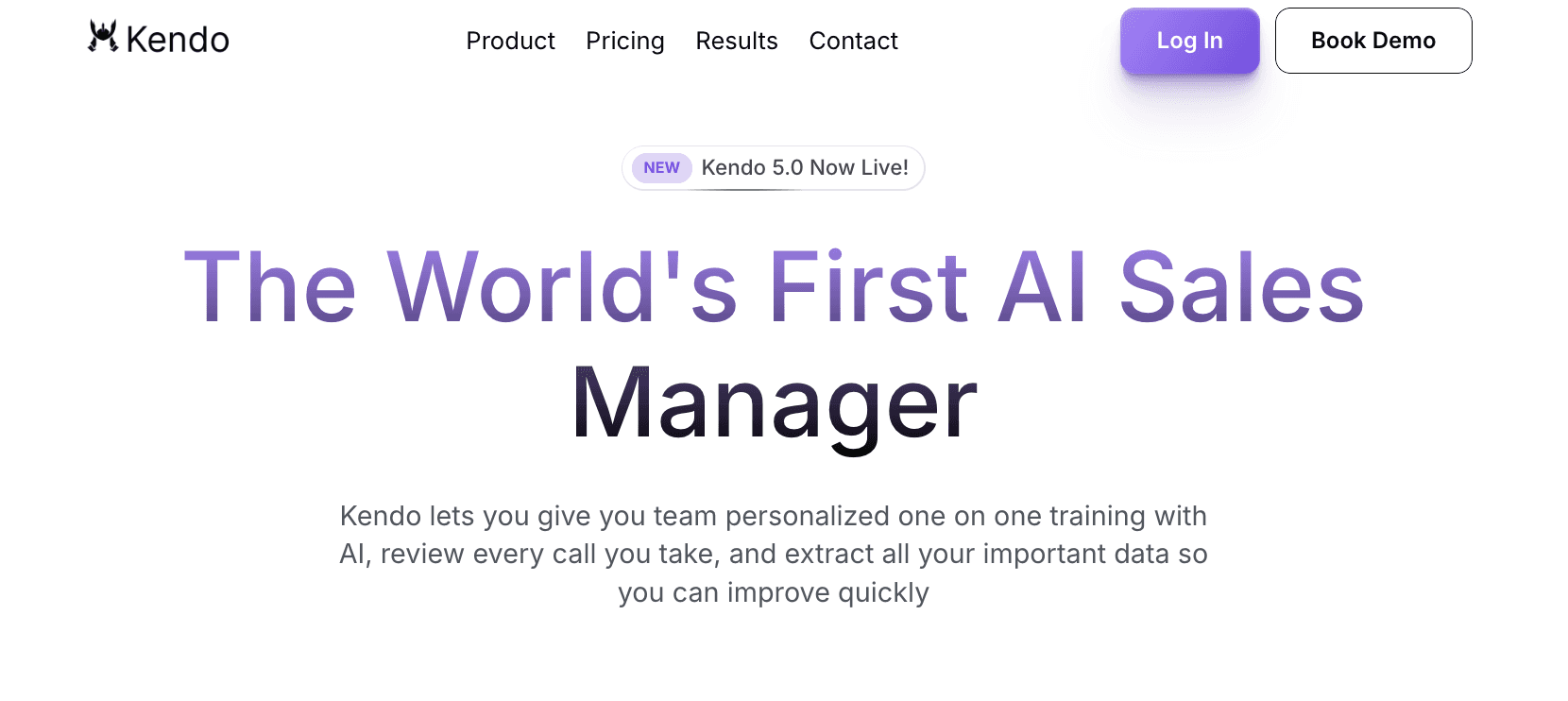
Kendo AI bills itself as “The World’s First AI Sales Manager,” and it’s earning that title. While other tools on this list predict outcomes, Kendo actually improves them by addressing the root cause of missed forecasts: reps who aren’t ready to close.
Why Kendo AI Impacts Forecast Accuracy
Traditional forecasting tools look backward at historical data to predict forward. Kendo takes the opposite approach: it prepares your reps to actually convert the deals in your pipeline through ultra-realistic AI roleplay, automated call scoring, and personalized coaching.
Core Features
AI Roleplay: Train against ultra-realistic AI prospects with cutting-edge voice technology. Create any scenario in seconds using natural language prompts.
AI Call Scoring: Every call your team takes gets reviewed automatically with industry-specific feedback. Instant feedback loop eliminates delays between mistakes and coaching.
Custom Scorecards: Build scorecards for each step of your sales process—cold calls, discovery, demos, negotiations.
AI Sales Manager: Ask Kendo anything about your team’s performance, data, metrics, or trends and get detailed answers instantly.
Analytics Suite: Individual and team-level data reports with detailed trends, patterns, and actionable insights.
"Kendo doubled our new hire close rates."

Pricing
Free: $0/month (AI roleplay, call reviews, metrics, storage integrations)
Pro: $55/user/month (includes AI Sales Manager & Coach, 180 roleplay minutes/month)
Enterprise: Custom pricing (custom AI models, custom scoring, account manager, VIP support)
Traditional Revenue Intelligence & Forecasting Platforms
The following tools focus on predicting outcomes based on pipeline data and engagement signals. They’re valuable for visibility and planning—but remember, their accuracy depends on having reps who can execute.
2. Clari — Best for Enterprise Revenue Operations
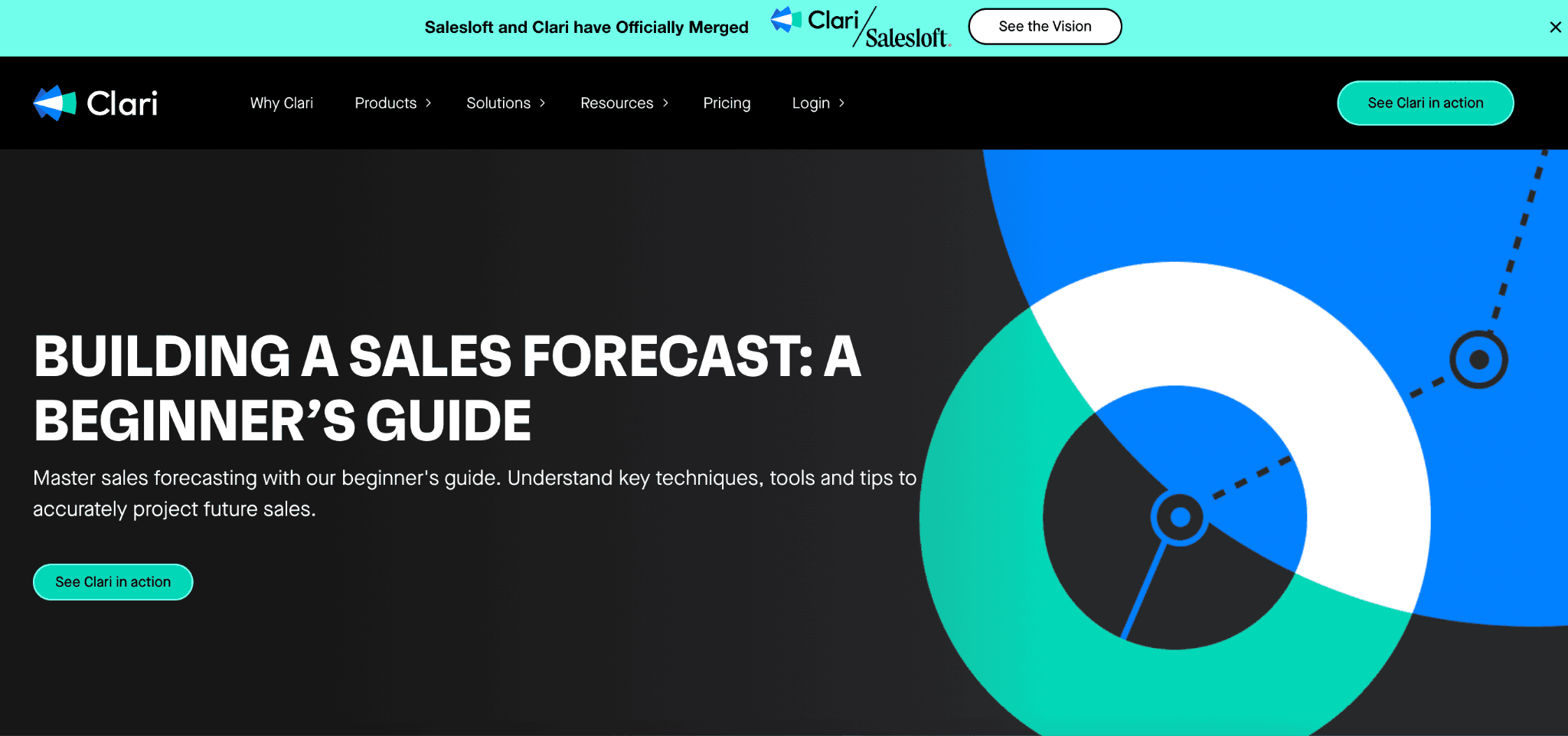
Clari is a leading AI-powered revenue intelligence platform built for B2B enterprise sales teams. It captures real-time data across your entire revenue process to deliver predictive forecasts with strong visualization capabilities.
Key Features:
RevAI Predictions: Leverages machine learning and real-time buyer signals to provide Commit and Most Likely outcomes with 95%+ accuracy.
Predictive Deal Health: Automatically flags at-risk deals due to stalled engagement or lack of multi-threading before they impact the quarter.
Automated Rollups: Eliminates spreadsheets by instantly aggregating forecasts across all territories and product lines.
Waterfall & Trend Reporting: Visualizes pipeline changes, showing exactly which deals slipped, increased in value, or were pulled in.
Clari Copilot Integration: Connects conversation intelligence to the forecast, allowing managers to hear the call recordings behind an AI Confidence Score.
Best For: Revenue operations teams and enterprise leaders where forecast precision is mission-critical and "quarterly surprises" are not an option.
Pricing: Not listed in public; custom pricing based on team size)
3. Gong – Best for Conversation Intelligence + Forecasting
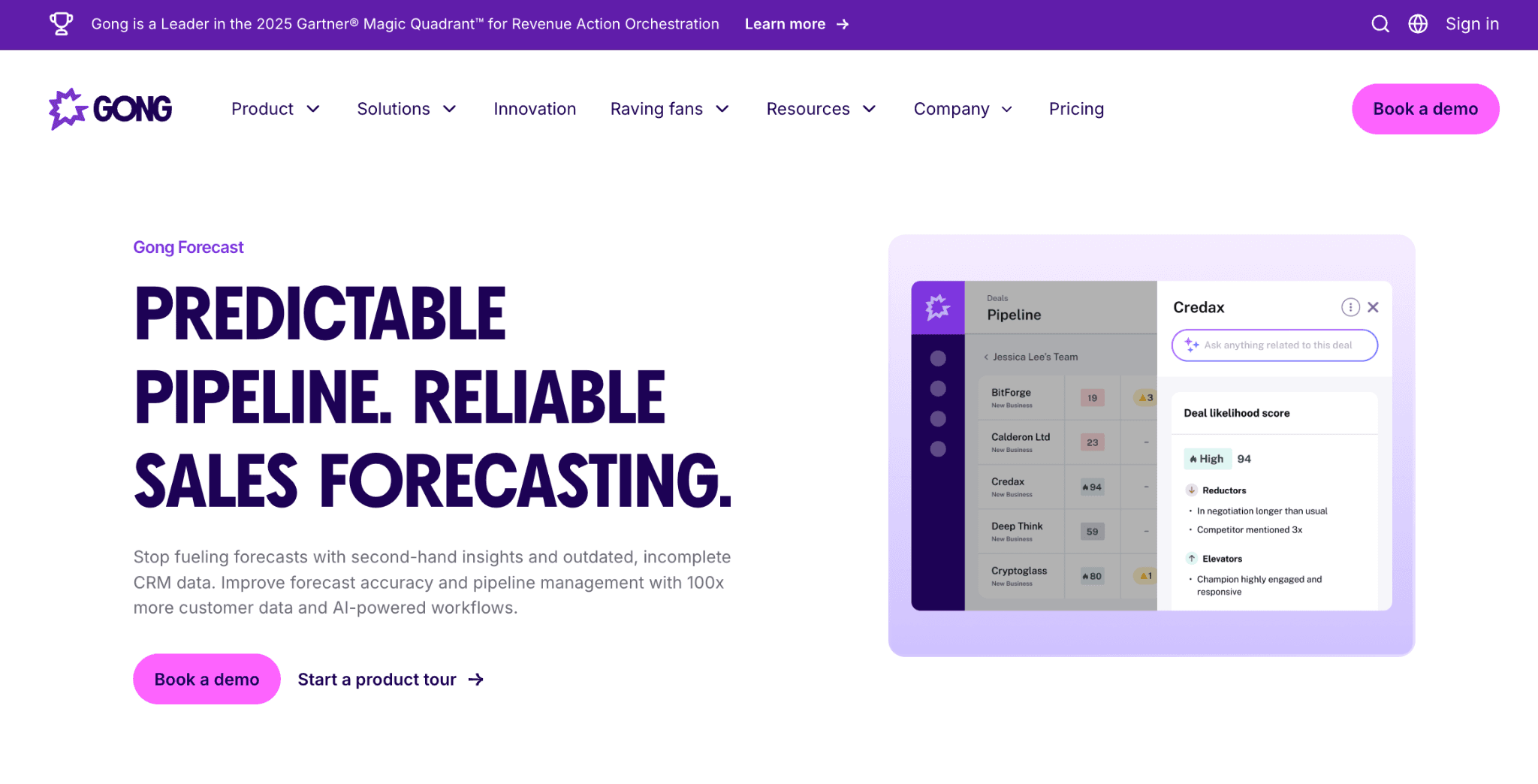
Gong combines conversation intelligence with revenue forecasting, analyzing buyer interactions across calls, emails, and contracts to provide deal insights and risk warnings.
Key Features:
Gong Forecast: Uses AI trained on 300+ live interaction signals to project revenue, pressure-testing rep commits against actual buyer engagement.
Deal Likelihood Scoring: Analyzes conversation sentiment and stakeholder participation to predict the statistical probability of a deal closing.
Risk Summarization: Automatically flags key deal risks—like a missing decision-maker or competitor mentions—and adjusts the forecast in real-time.
Rep Coaching Insights: Ties coaching directly to revenue by showing which talk tracks, such as pricing discovery, correlate with higher win rates.
Automated CRM Updates: AI agents update close dates and stage movements based on call outcomes, reducing the impact of manual entry errors.
Best For: Teams wanting forecasts grounded in real-world buyer behavior and conversation data rather than subjective CRM updates.
Pricing: Custom pricing, depending on team size.
If you're exploring this space but want to see how it stacks up against other revenue intelligence tools, we reviewed 14 top Gong alternatives.
4. Avoma — Best for Mid-Market Revenue Intelligence
Avoma is an AI-powered revenue intelligence platform that combines conversation analytics with CRM data to generate forecasts. It offers aggregated forecasting with best case, middle case, and worst case scenarios.
Key features:
AI Deal Health & Win Probability: Moves beyond gut feelings by analyzing interaction data—like email sentiment and engagement—to assign real-time health scores and probability to every deal.
Deal & Churn Risk Alerts: Proactive notifications for "ghosting" or negative sentiment, allowing managers to intervene before a deal slips or a customer churns.
Multi-Pipeline Tracking: A unified dashboard to monitor attainment and pipeline velocity across new business, renewals, and expansions simultaneously.
Automated CRM Updates: AI extracts insights from conversations to auto-fill CRM fields and sales methodologies (like MEDDIC), ensuring your forecast is always based on fresh data.
Best For: Mid-market teams seeking unified conversation and revenue intelligence.
Pricing: Starts at $19/user/month.
5. Aviso — Best for AI-Driven Forecast Accuracy
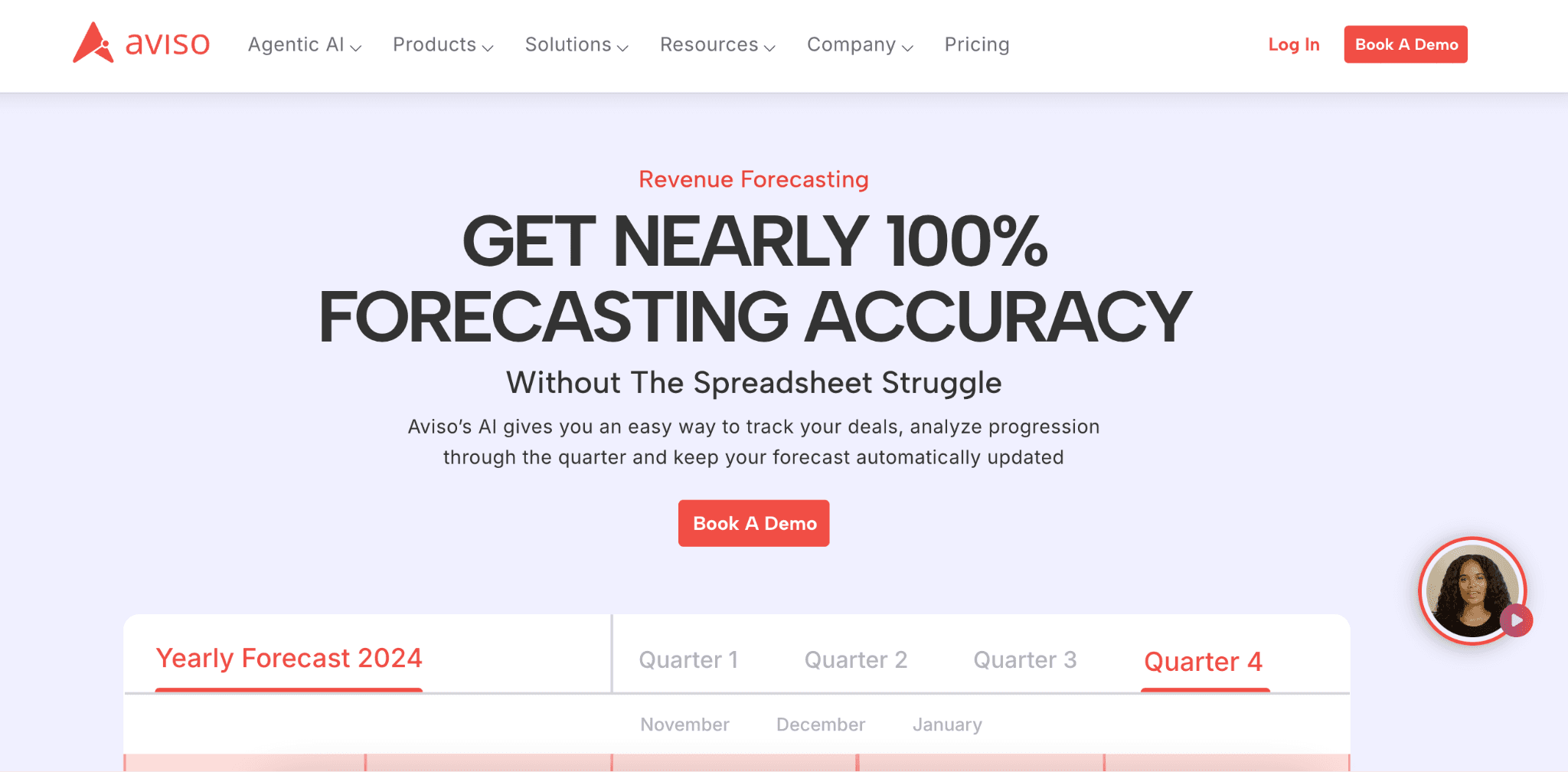
Aviso claims 98% forecast accuracy using a unified approach that combines human judgment with advanced predictive AI. It automatically consolidates forecasts across reps, categories, and teams.
Key Features:
Agentic Forecasting: Uses the MIKI AI Assistant to autonomously generate weekly forecast rollups and identify deal risks, reducing manual data compilation for managers.
Large Quantitative Models (LQMs): Employs specialized time-series AI to provide 98%+ accuracy for both current and out-quarter revenue predictions.
Role-Specific AI Avatars: Includes specialized agents for SDRs and Sales Coaches that proactively guide deals and execute GTM tasks based on real-time signals.
Scenario Modeling: Allows leaders to simulate the revenue impact of changes in headcount or market conditions using what-if analysis before making strategic shifts.
Native Revenue Intelligence: Built-in conversation and relationship intelligence directly informs deal win scores, providing a holistic view of pipeline health.
Best For: Enterprise teams looking to consolidate their sales stack into a single AI-first platform for deep predictive analytics.
Pricing: Quote based; custom pricing depending on sales team size.
Also read: 8 AI Sales Roleplaying Tools For Elite Sales Teams (2026 Picks)
6.Terret (formerly BoostUp.AI) — Best for Flexible Data Modeling
BoostUp.AI offers quick insights and trend analysis with a highly flexible data model. It extracts conversational data from emails, calendars, and calls to enhance pipeline management and forecasting.
Key features:
Multi-Dimensional Forecasting: Build custom business views to roll up revenue by any hierarchy—including sales team, product set, or complex revenue models like SaaS, PLG, and usage-based credits.
Machine Forecast: Leverages predictive AI to generate autonomous revenue projections at every organizational level, predicting deal-level outcomes (wins, losses, or slips) with up to 95% accuracy.
BoostBot AI Assistant: A proactive "Virtual Revenue Agent" that sends critical alerts on at-risk deals, automates CRM updates, and answers natural language questions about forecast health.
Engagement & Risk Scoring: Uses historical trends and real-time activity tracking to score deal risk, identifying stakeholder engagement gaps or execution "chores" that stall pipeline velocity.
Best For: Teams needing highly customizable forecasting configurations.
Pricing: Starts at $50/user/mo; plans with forecasting features starts at $80/user /mo
7. Weflow — Best for Salesforce-Centric Teams
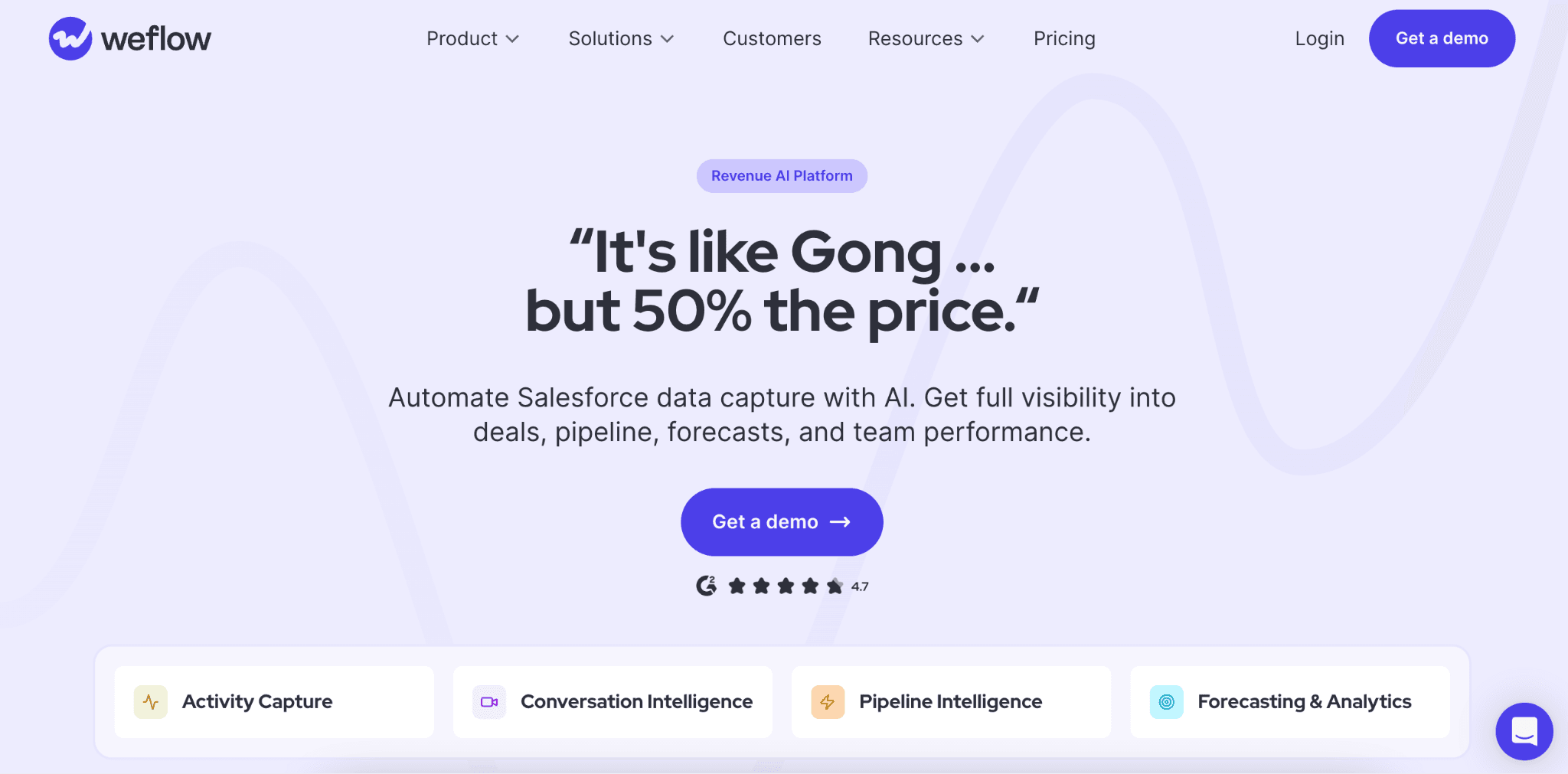
Weflow streamlines forecast submission and tracking directly within Salesforce. It automates syncing of sales activities and supports collaborative forecasting with strong data hygiene features.
Key features:
Deal-by-Deal Forecasts: Allows reps and managers to submit and track forecasts at the individual opportunity level for granular accuracy.
Automated Roll-ups: Instantly aggregates forecast calls across the entire organization, eliminating manual spreadsheet consolidation.
Quota Management: Tracks performance against revenue targets across specific time periods and pipeline categories like new logos or renewals.
AI Predictions: Uses historical snapshots and 300+ data points to predict forecast corridors and identify pacing gaps.
Pricing: Offers a free plan; pricing starts at $18/mo for Basic plan; scales up to $49/mo for Business plans.
Best For: Salesforce-heavy organizations wanting native integration.
CRM Platforms with Built-in Forecasting
If you’re already using a major CRM, you may have forecasting capabilities included. Here are the leading options:
8. Salesforce Sales Cloud — Best Enterprise CRM with Forecasting
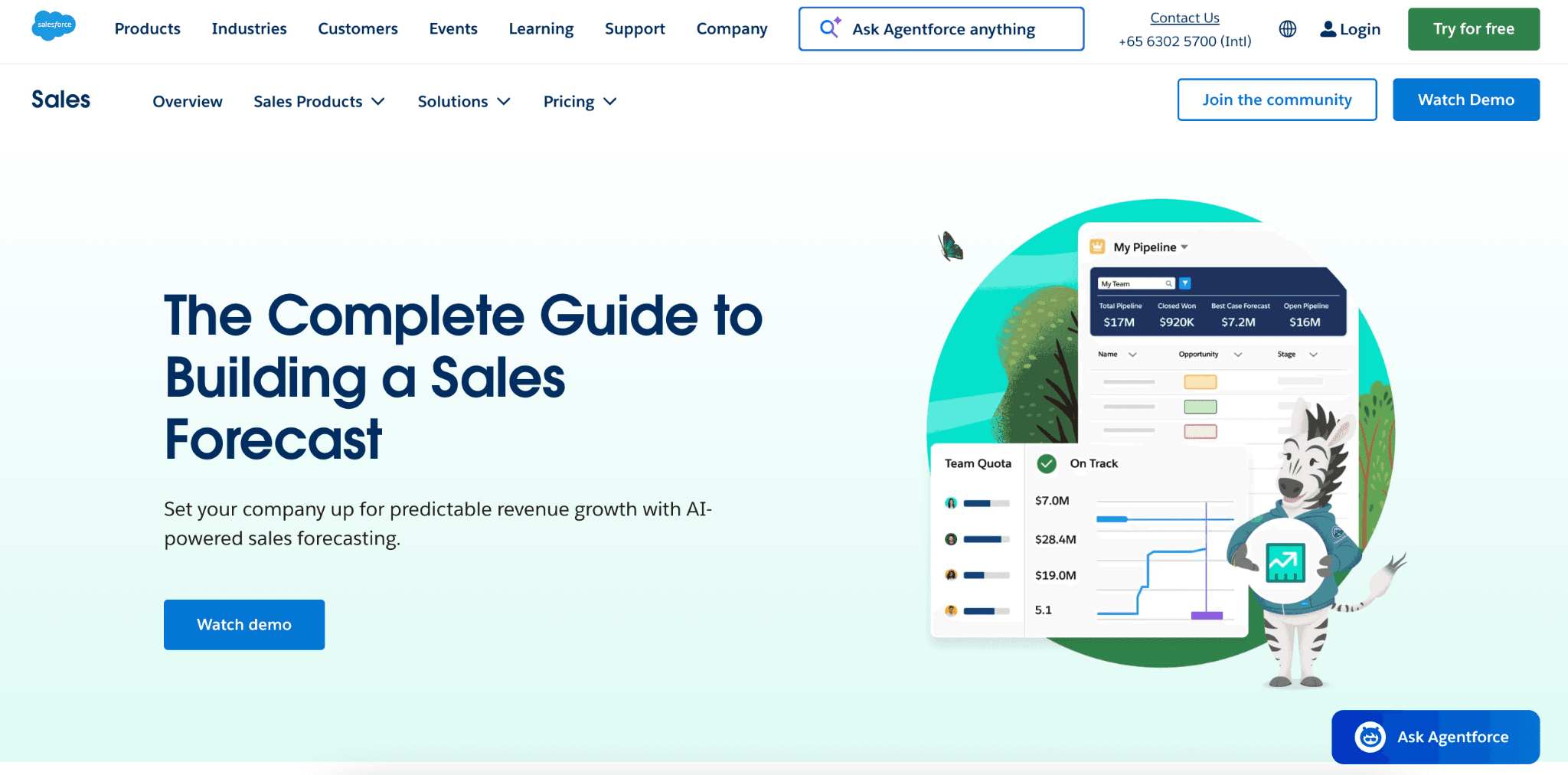
Salesforce Sales Cloud includes collaborative forecasting, customizable forecast categories, and Salesforce Einstein AI for predictive analytics.
Key Features:
Einstein AI & Predictive Forecasting: Automatically analyzes historical patterns and engagement signals to predict close dates and deal health with "Confidence Scores."
Collaborative Forecasts & Splits: Supports complex team structures, allowing you to split credit for revenue, overlays, and product families across multiple reps.
Agentforce Integration: New for 2026, AI agents can proactively nudge reps to update stalled deals or fix missing close dates, ensuring the forecast remains accurate.
Historical Trend Reporting: Easily visualize how your forecast has changed over the last 7, 30, or 90 days to identify where the "slip" is happening.
Enterprise Territory Management: Align forecasts with complex geographic or industry-based territory models.
Best For: Mid-market to enterprise organizations with complex sales hierarchies that need a "single source of truth."
Pricing: Starts at $25/user/mo and scales up to ~$165–$500+/user/mo for advanced AI forecasting and Einstein features.
9. HubSpot Sales Hub — Best for Growing Companies
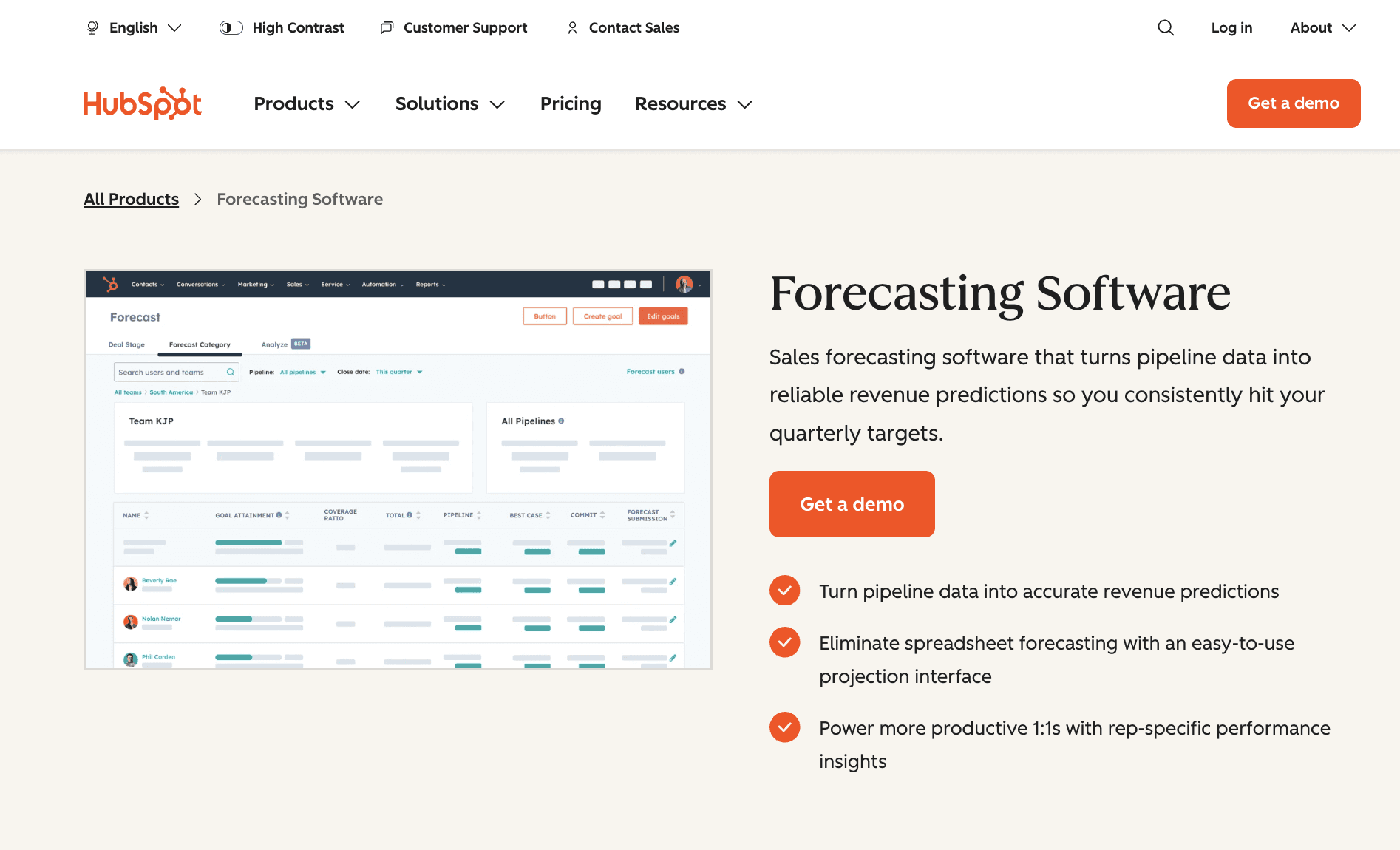
HubSpot’s forecasting software integrates with its CRM to provide automated forecasting based on deal stages and close probability.
Key Features:
Breeze AI Forecasting: Automatically generates "Most Likely" revenue ranges based on historical win rates.
Deal Health Signals: Sentiment tracking monitors email and call engagement to flag at-risk opportunities.
Breeze Data Agent: Automatically cleans data and merges duplicates to ensure forecast accuracy.
Team Rollups: Instant toggling between individual rep submissions and high-level management views.
Best For: SMBs and mid-market teams that need powerful predictive insights but don't want to hire a full-time developer just to manage their CRM.
Pricing: Free tier available; Pricing starts at $100/seat/mo, which includes forecasting; scales up to $150/mo for advanced features
HubSpot is a fantastic entry point for teams that want to integrate learning early; see how it fits into a modern sales onboarding software stack.
10. Pipedrive — Best Budget-Friendly CRM Forecasting
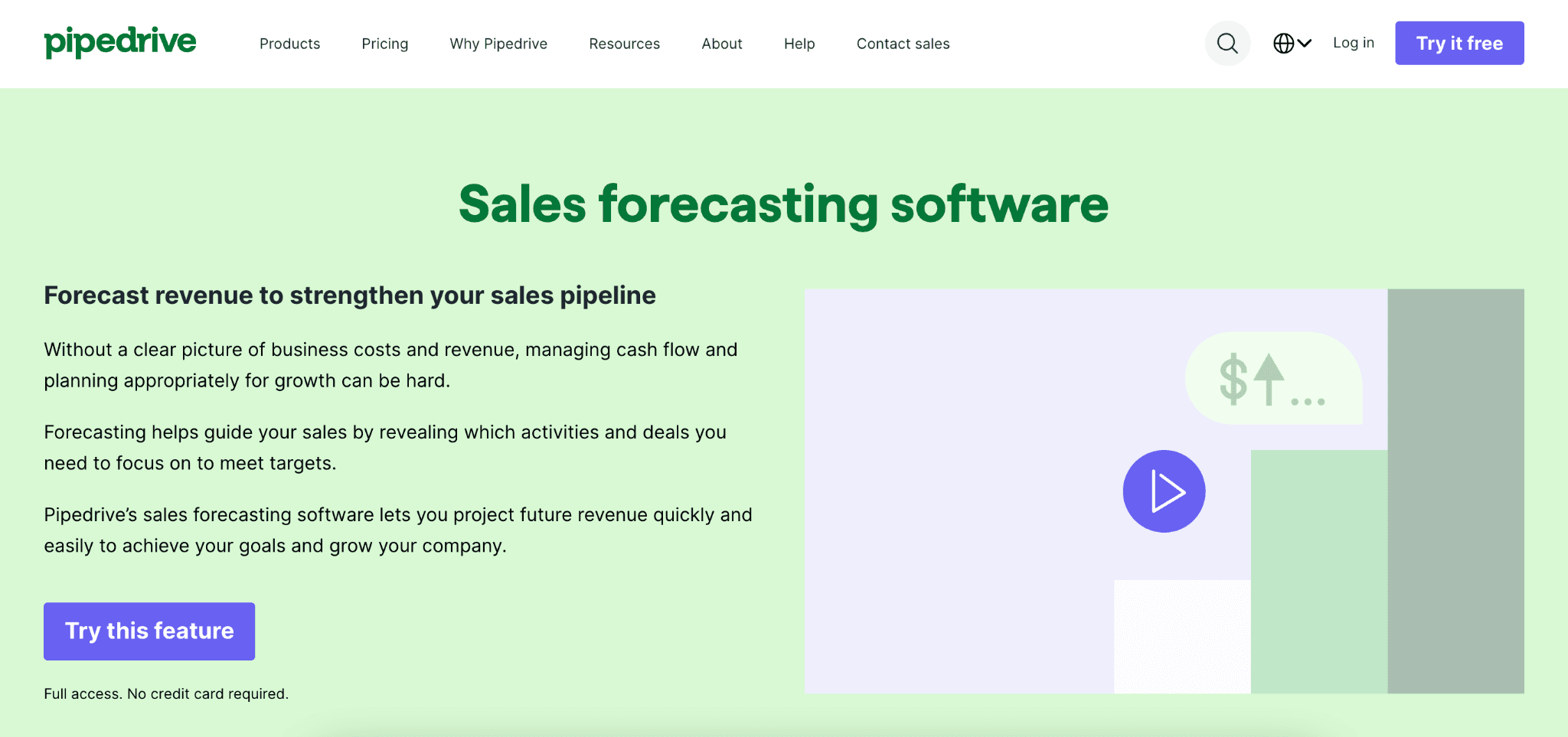
Pipedrive offers a visual pipeline with built-in forecasting, predictive analytics, and an AI sales assistant that analyzes patterns and provides recommendations.
Key Features:
Visual Sales Forecasts: Uses a Kanban-style interface to aggregate deal values by expected close date, giving managers an instant look at upcoming revenue.
AI Sales Assistant: Scans your pipeline to suggest which deals are most likely to close and flags those that have gone cold or lack recent activity.
Activity-Based Projections: Forecasts revenue based on rep behaviors (like calls made or meetings scheduled), helping you see if your team is doing enough to hit their targets.
Weighted Pipeline View: Automatically calculates expected revenue by multiplying deal values by the win probability of their current stage.
Mobile-First Forecasting: Provides a robust mobile app that allows field sales reps to update deal stages and close dates on the go, keeping the central forecast accurate in real-time.
Best For: Small teams and startups seeking affordable forecasting.
Pricing: Starts at $24/user/mo for plans with forecast reports; scales to $60/user/mo.
Specialized Forecasting & Planning Tool
11. Anaplan — Best for Enterprise Financial Planning
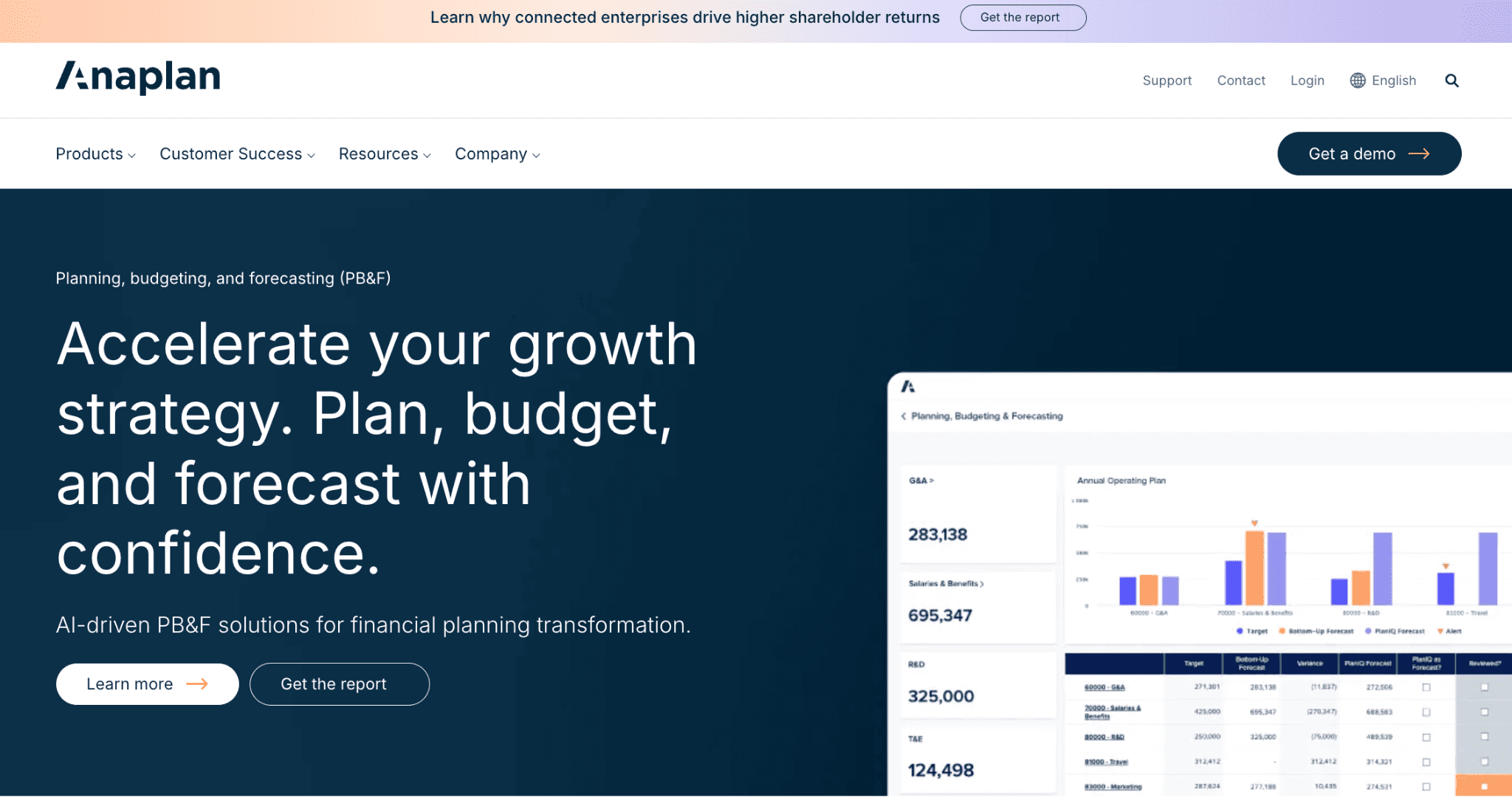
Anaplan is a connected planning platform for large enterprises needing to align sales forecasting with broader financial planning, budgeting, and supply chain operations.
Key Features:
Hyperblock Technology: A patented in-memory engine that enables real-time calculations across massive datasets, allowing for instant updates across thousands of products and territories.
AI Scenario Modeling: Leverages the CoModeler tool and built-in AI agents to run what-if simulations, helping leaders see the immediate impact of market shifts or headcount changes.
Connected Planning: Automatically aligns sales projections with financial budgets and supply chain requirements to prevent inventory gaps or over-hiring.
Predictive Insights: Uses statistical algorithms and third-party intent data to identify high-probability opportunities and refine top-down revenue targets.
Territory & Quota Optimization: Unifies forecasting with territory design and incentive compensation to ensure sales coverage is data-backed and equitable.
Best For: Global enterprises requiring high-level coordination between departments and complex multi-dimensional scenario modeling.
Pricing: Enterprise-level custom contracts.
12. Zoho CRM
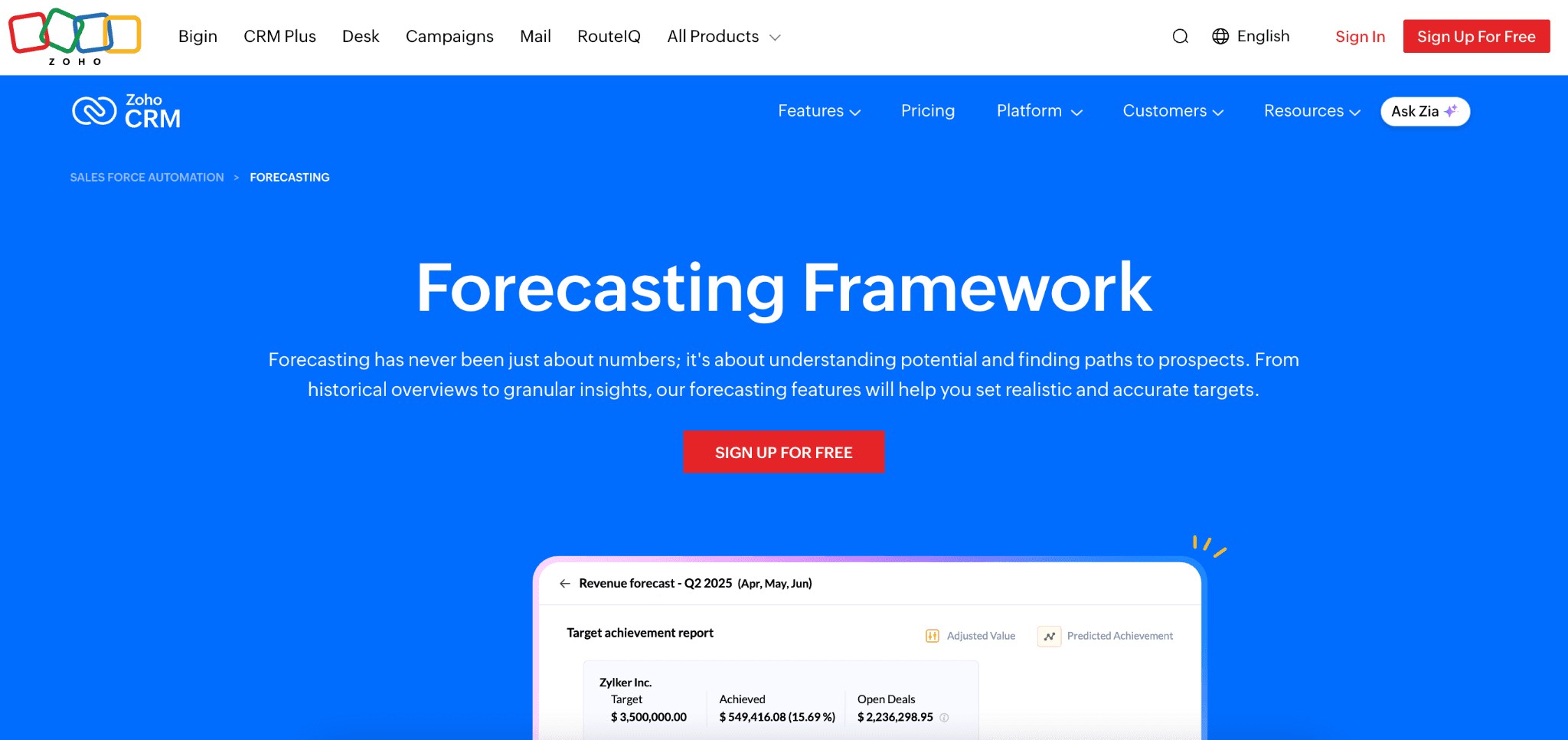
Zoho CRM is a highly customizable, all-in-one sales platform that balances affordability with sophisticated AI capabilities. It has shifted from a basic tool to an intelligent hub through the release of the Zoho One 2026 bundle, which features deeply integrated agentic AI and cross-app intelligence.
Key Features:
Zia AI Forecasting: Analyzes historical patterns and pipeline health to provide high-accuracy predictions while flagging anomalies that could derail a quota.
Ask Zia Analytics: Supports natural language queries to instantly generate charts and visualizations for projected revenue and performance comparisons.
Zia Agents: New for 2026, these autonomous agents handle multi-step tasks like qualifying leads or updating forecast categories based on buyer signals.
Continuous Data Enrichment: Automatically scans the web to fill in missing contact details, ensuring the forecast is built on high-fidelity data.
Blueprint Automation: Guides reps through mandatory sales cycle steps to ensure consistent data entry and forecast reliability.
Best For: Budget-conscious teams and mid-market organizations that want advanced AI forecasting without the typical enterprise price tag.
Pricing: Free tier available; pricing with forecasting features starts at $20/user/mo.
Key Features to Look for in Sales Forecasting Software
Feature bloat is a real productivity killer. To move the needle on your bottom line, prioritize these five pillars of a high-performance forecasting engine:
AI Sentiment & Predictions: Instead of relying on a rep’s gut feeling, AI digs into buyer engagement and deal activity. It flags when a rep’s optimism doesn't quite match the data, letting you spot at-risk revenue while you still have time to save it.
Native, Bi-Directional CRM Sync: In sales, yesterday’s data is already ancient history. You need a seamless, two-way connection with Salesforce or HubSpot. This keeps your data fresh without making your reps waste hours on manual entry—ensuring your source of truth stays, well, true.
Automated Risk Alerts: This is your early warning system. It pings you the second a deal stalls, a key stakeholder stops responding, or a close date slips. It’s all about giving you the lead time to course-correct before the quarter wraps up.
Methodology Alignment: Your tech should adapt to your sales motion, not the other way around. Whether your team runs on MEDDIC, BANT, or Sandler, your software should natively support those stages so everyone is speaking the same language.
Snapshot Analytics: By comparing today’s pipeline to the exact same day last quarter, you can see if your growth targets are realistic or just wishful thinking.
Cutting ramp time isn't just about software; it requires a comprehensive sales training program that prioritizes daily, deliberate practice.
The Human Element: Focus on Skill
Here’s the truth: even the best forecasting tool has a massive blind spot. It’s only as good as the data your reps feed it.
If your team hasn’t fully mastered Discovery or Objection Handling, they’re going to inadvertently plug inaccurate info into the CRM. The result? A "data-driven" forecast that is fundamentally broken.
This is why we built Kendo AI. We focus on making the humans behind the data as precise as the software analyzing it. By practicing high-stakes scenarios in our AI roleplay environment, reps develop the judgment to know the difference between a solid deal and a "hopeful" one.
With Kendo, you aren’t just forecasting better—you’re building a team that generates better data from the jump.
Note: Refining your team's foundational skills is a prerequisite for forecast accuracy. To see which curriculum fits your methodology, check out our guide to the 7 best sales training programs (2026 review).
5 Forecasting Red Flags to Watch
Relying on gut feel instead of data-driven predictions—emotions lie, numbers don't
Ignoring historical trends and seasonality patterns in your industry
Letting reps self-report deal stages without validation or consistent criteria
Using static forecasts instead of dynamic, real-time models that adjust to new data
Failing to account for rep skill variance in close rate assumptions across the team
Not integrating forecasting with coaching—use forecast data to identify training needs
If you need to justify the switch to AI-driven training to your leadership, our AI sales training ROI analysis provides the specific formulas you need.
The Bottom Line: Better Reps = Better Forecasts
Here’s what we’ve learned after analyzing dozens of forecasting solutions: the tools that predict outcomes are only as good as the reps executing on those opportunities.
Traditional forecasting platforms like Clari, Gong, and Aviso provide valuable visibility into your pipeline. They help you understand what is likely to happen. But they don’t change the fundamental input: rep performance.
That’s why we recommend a two-pronged approach:
Start with Kendo AI to ensure your reps can actually close the deals in your pipeline. The companies seeing doubled close rates and 75% faster ramp times aren’t just training better—they’re making their forecasts more reliable.
Add a forecasting platform for visibility and planning once you’ve built a team that can execute. Clari for enterprise, Avoma for mid-market, or your existing CRM’s built-in tools for smaller teams.
The most accurate forecast in the world is worthless if your reps can’t close. Fix the input, and the output takes care of itself.
Ready to improve your forecast accuracy from the ground up? Try Kendo AI for free and see why sales teams are cutting ramp time by 75% and doubling close rates.
Frequently Asked Questions
Is AI sales coaching only for new reps?
Does AI sales coaching replace managers?
What is the difference between AI sales coaching and conversation intelligence?
How should a team start with AI sales coaching?
Luke Alexander is a sales leadership expert with over a decade of hands-on experience in B2B sales management, team training, and revenue growth strategies. He specializes in building high-performing sales teams through data-driven coaching methodologies.
Related Articles
View all