


10 Best Insurance Sales Training Programs for 2026
A side-by-side look at the top insurance sales training companies, courses, and platforms, scored on how well each one fits the way agents actually sell: state licensing, price and need objections, the trust a policy demands, and how fast they ramp new producers.
Insurance selling is not generic sales. Your agents are selling a promise the buyer can't hold, inside state licensing rules, to someone deciding whether to name a beneficiary. The objections aren't "send me a deck," they're "I already have coverage" and "I need to ask my spouse," and most general sales courses leave that part to you.
The stakes make it worse. According to LIMRA, only about 15 of every 100 recruits are still in the business after four years [Source: LIMRA], with the heaviest losses in year one. The fix is rarely more theory. It's execution under pressure.
So we compared 10 of the best insurance sales training programs, from insurance-specific producer schools to AI practice platforms, and called which are built for insurance and which are general programs you adapt. Pricing and formats were verified against each provider's own site in June 2026.
What Makes Insurance Sales Training Different
Before the rankings, name the problem. Insurance selling carries dynamics that a generic "objection handling" module never touches:
- Licensing and compliance are part of the pitch. Agents sell inside state licensing, disclosure, and suitability rules. Training that ignores fair-conduct standards trains reps to create regulatory risk.
- Trust, not features, closes the case. Nobody names a beneficiary or insures their home off a feature list. The job is relationship selling, and the discovery has to earn the right to ask personal questions.
- The objections are price and need. "It's too expensive," "I already have a policy," and "let me think about it" decide most insurance calls. Reps need a worn-in answer, not a script they read once.
- The lines don't sell the same way. P&C, life, health, and annuities each carry their own suitability rules and objection patterns, and a captive agent and an independent agent run different motions. One-size training fits none of them well.
- The book is the business. Cross-sell and retention on the renewal is where agency profit lives, so training that only chases the first sale leaves money on the table.
Keep those five in mind as you read. The programs that win for insurance are the ones that engage this reality instead of selling you a general framework with the word "insurance" pasted on top.
Best Insurance Sales Training Programs for 2026: Comparison Table
| # | Program | Best For | Insurance Fit | Format | Starting Price | AI / Roleplay |
|---|---|---|---|---|---|---|
| 1 | Kendo AI RECOMMENDED | Agent practice & fast ramp | Insurance-ready | AI roleplay & call-review platform | $55/seat/mo | Yes |
| 2 | Anthony Cole | Banks & larger agencies | Insurance-native | Instructor-led + digital coaching | Custom* | Coaching |
| 3 | Agency Performance Partners | Agency sales systems | Insurance-native | Virtual classes + consulting | Course + consulting* | No |
| 4 | Insurance Sales Lab | Producing P&C / life agents | Insurance-native | Video masterclass + weekly coaching | Quote-based* | Video drills |
| 5 | Sandler Training | Consultative, trust-led selling | General + adapt | Ongoing program + coaching | Custom* | Coaching |
| 6 | Richardson | Large carriers & enterprises | General + adapt | Customized enterprise programs | Custom* | AI-enabled |
| 7 | MarshBerry Producer Academy | Validating new producers | Insurance-native | Classroom + facilitated cohorts | Custom* | Roleplay |
| 8 | Dynamics of Selling | An insurance-specific process | Insurance-native | 3-day live virtual + CE credit | $330/yr (CIRP) | Roleplay |
| 9 | Factor 8 | Inside & phone-based teams | General + adapt | Virtual selling skills programs | Custom* | No |
| 10 | InsuranceSales101 | Solo agents on a budget | Insurance-native | Self-paced online + community | Subscription* | No |
Pricing and formats verified against each provider's own site in June 2026. *Programs marked with an asterisk do not publish full pricing and require a quote, enrollment, or membership. Details may change after publication. Want the wider view beyond insurance? See our best sales training programs roundup.
Kendo AI
★ Best overallTurns insurance sales theory into repeatable execution through unlimited, realistic AI roleplay built around your lines and objections.
Full disclosure: we built Kendo, so we are biased. We built it because every insurance training program teaches agents what to say, then sends them to learn the rest on live, paid leads. Kendo is the practice layer that closes that gap. Instead of waiting on a manager ride-along, agents get on-demand AI roleplay, real-time coaching, and an automatic score after every call.
The insurance angle is the practice gap, the one thing most programs on this list leave to chance. You build AI prospects that mirror a real buyer: the spouse who has to be consulted, the prospect who already has a policy, the price objection on a term quote, then let agents drill it until the rebuttal is muscle memory. Agencies and IMOs run it through Kendo's insurance sales training setup.
It does not hand you a selling methodology or your state's compliance curriculum, so pair it with one of the producer programs below. What it does is make sure the lessons survive contact with a real prospect.
This is what practicing on Kendo looks like. The AI buyer pushes hard on SOC 2, ISO 27001, and proof the tool cuts compliance work, and the rep has to handle it on the spot, before any of it lands on a live deal.
Kendo vs. Traditional Insurance Training
| Dimension | Kendo AI | Traditional Training |
|---|---|---|
| Practice availability | 24/7 on-demand reps | Limited to scheduled sessions |
| Scenario customization | Any line, objection, or persona | Generic, or whatever the trainer knows |
| Feedback | Real-time, objective scoring | Subjective, days later |
| Where reps make mistakes | Against an AI prospect | On live, paid leads |
| Reinforcement | Built in, daily | Often a one-off workshop |
Key Features
- Custom Prospect Builder. Create AI buyers that match your exact line and ICP by personality, situation, and conversational style. To start fast, borrow from 20+ pre-built sales roleplay scenarios, including an insurance-team example.
- Dynamic objection library. Drill the real ones: "it's too expensive," "I already have a policy," "I need to talk to my spouse," plus custom objections for your market, instead of static script practice.
- Real-time AI coaching. Minute-by-minute guidance during a live simulation, not delayed post-call notes.
- Automated call scoring and review. Objective scorecards on discovery depth, talk ratio, and objection handling, with no manual manager grading. See how AI call reviews work.
- Global language support. 40+ languages for distributed agencies and multilingual books.
This is deliberate practice in action: state-of-the-art voice AI with ultra-low latency, prospects that push back and express real buying hesitation, and a setup that takes seconds rather than a planning meeting. It is not a chatbot reading a script.
"Not only has my team's production started to increase but they are becoming more confident on the phones and getting quicker at overcoming objections."
KCKendo customer · insurance sales leaderTry Kendo with a Free Roleplay, Pricing Starts at $55/mo
Kendo's per-seat plans include monthly AI training minutes with transparent overages. Insurance teams typically report a 5 to 15% lift in close rates, which usually covers the cost before a single batch of leads would have been burned. See full per-seat pricing.
| Pro $55/mo per seat | Max $100/mo per seat | Enterprise Custom |
|---|---|---|
| AI roleplay, AI call reviews, advanced analytics, AI sales manager + coach, 180 roleplay minutes/seat per month | Everything in Pro, 480 roleplay minutes/seat per month, for agencies that want maximum usage | Teams of 10+, custom AI models, custom scoring, DFY setup, dedicated account manager |
United Insurance Pros cut new-agent ramp from 45 days to 14
After rolling out Kendo roleplay, United Insurance Pros got brand-new agents to baseline performance in about 14 days instead of 45, while saving thousands per agent every month on training time and burned leads.
"Typically we would see about a 45-day period where people would dip their foot in the water and slowly improve and then level off. Now that's 14 days."
Waylon Artrip, Founder at United Insurance ProsAnthony Cole Training Group
Best for larger agenciesA 30-year insurance and banking specialist that trains producers and the managers who have to coach them.
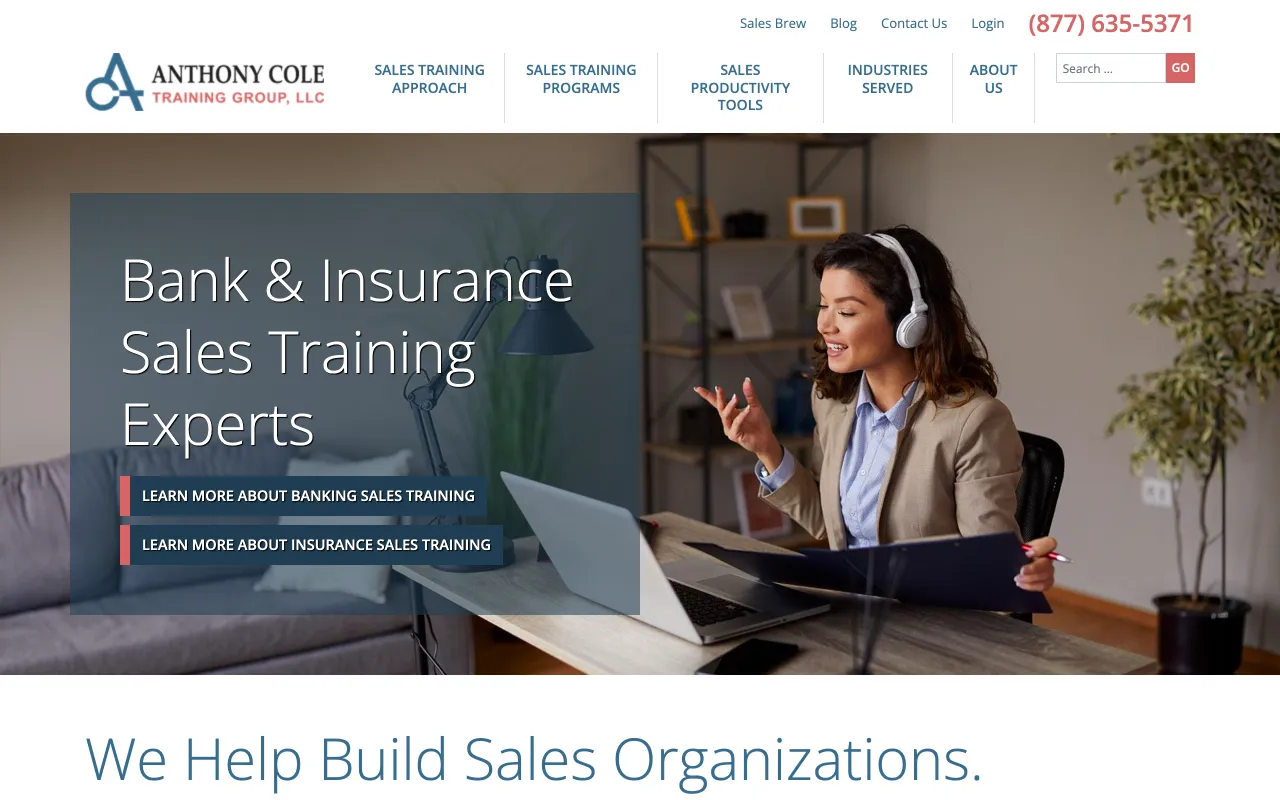
Anthony Cole has trained bank and insurance sales teams for more than 30 years, and the homepage says so plainly: "Bank & Insurance Sales Training Experts." That tenure is the draw. The frameworks, examples, and benchmarks are built on real insurance sales-management experience, not borrowed from a generic B2B playbook.
Where it separates from most of this list is the management layer. Their trademarked Sales Managed Environment trains producers and the managers who coach them, which is exactly the bottleneck that stalls a growing agency. If your problem is that one sales leader can't develop everyone, that focus matters.
What They Offer
- Sales Managed Environment (SME), a structured, management-driven framework for building consultative selling skills across producers and leaders.
- Flexible delivery, spanning instructor-led sessions, webinars, online modules, and phone coaching, so teams can mix formats.
- Insurance-specific content grounded in decades of work with banks and carriers, so the language fits the industry from day one.
Consider before choosing
- Instructor-led and scheduled. Coaching arrives on a human's calendar, not the second a call ends, so it can't deliver the unlimited, on-demand reps an agent needs to build muscle memory.
- No public pricing. Anthony Cole routes pricing through a consultative engagement rather than a published number. [Source: anthonycoletraining.com, June 2026]
Want managers to reclaim hours instead of running every roleplay? See the best sales coaching software.
Agency Performance Partners
Best for agency systemsBuilds repeatable agency sales and service systems so results stop depending on one star producer.
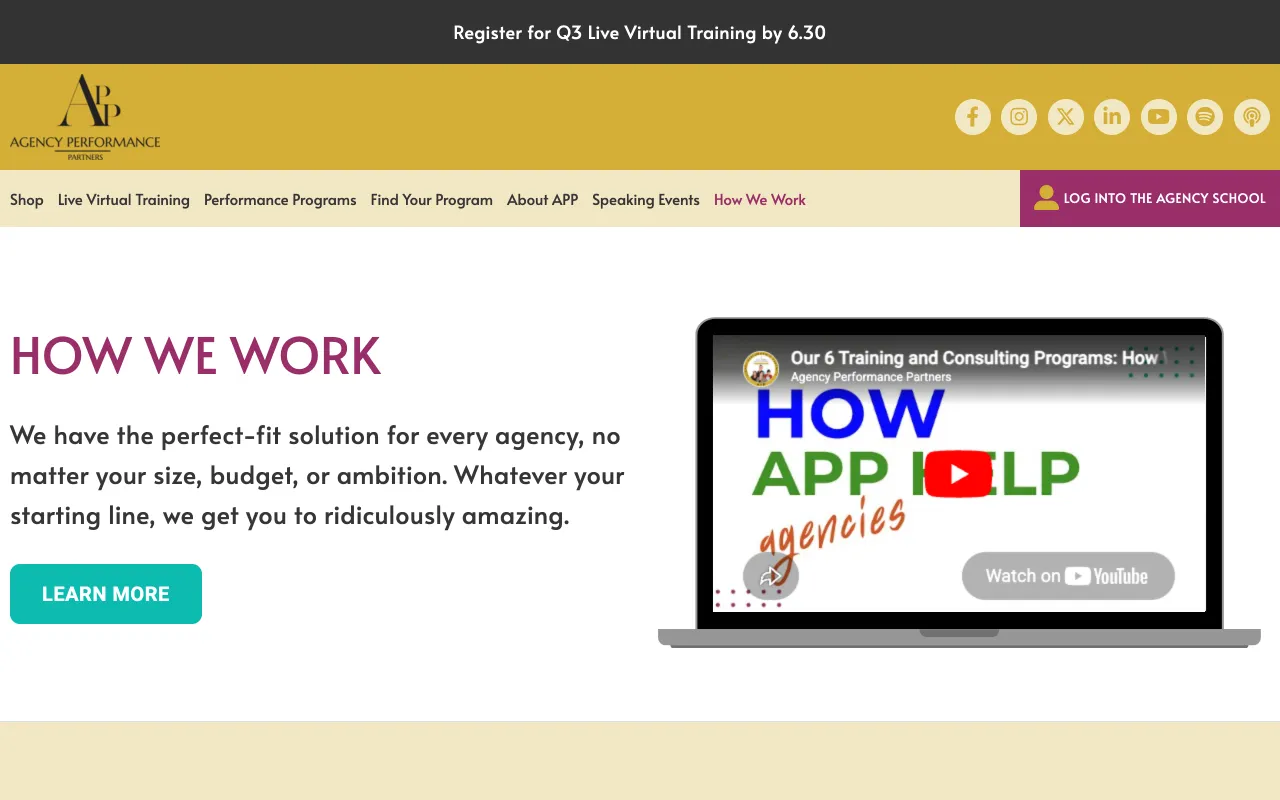
APP is built squarely for insurance agencies, and its angle is systems. If your results swing wildly from one producer to the next, APP targets that inconsistency directly, teaching agencies to win through a repeatable process rather than individual talent.
The flagship AppX e-course walks an agency through building a structured inbound sales process, with hands-on consulting to actually implement it. The emphasis on lead management and converting inbound opportunities fits personal and small-commercial agencies that generate leads but leak them on follow-up.
What They Offer
- AppX e-course, a step-by-step program for building a repeatable agency sales process from the ground up.
- Consulting and coaching to help agencies put the system into daily practice, not just learn it.
- Lead and pipeline discipline, tracking inbound opportunities and follow-up so quotes don't fall through the cracks.
Consider before choosing
- Process-first, not live-skills practice. APP sharpens the system around the sale. Agents still need a separate way to rehearse real-time objection handling out loud.
- Pricing is package-based. Training pairs an e-course with consulting and live virtual classes, quoted by scope rather than a single flat price. [Source: agencyperformancepartners.com, June 2026]
Insurance Sales Lab
Best for producing agentsBuilt by active, producing insurance agents, with a one-call-close focus and live weekly coaching.

Insurance Sales Lab has a credibility edge most programs can't claim: it's built by agents who are still selling, not career trainers. The content reflects what works on a real call this quarter, across Commercial, Life, and Personal Lines, rather than theory that aged out three renewals ago.
The center of it is the One-Call Close Masterclass, which is exactly the skill insurance reps live or die on. Add the daily morning roleplay drills and weekly live coaching where real call recordings get reviewed out loud, and you get a program that treats objection handling as a daily habit, not a one-time lesson.
What They Offer
- One-Call Close Masterclass, step-by-step video lessons with downloadable scripts for closing in a single conversation.
- Interactive morning roleplay drills agents run as part of a daily routine to stay sharp on objections.
- Weekly live coaching that reviews real sales calls, so agents learn from their own and others' actual conversations.
Consider before choosing
- Roleplay is video-based, not interactive AI. The drills are pre-recorded and the coaching is weekly, so reps don't get instant, post-call feedback after every attempt.
- Pricing isn't public. Insurance Sales Lab gates pricing behind a "Get Started" enrollment step rather than publishing it. [Source: insurancesaleslab.com, June 2026]
Sandler Training
A globally recognized system that shifts selling from a high-pressure pitch to a consultative, trust-first partnership.
Sandler's Selling System breaks a deal into clear stages, with hallmark concepts like Up-Front Contracts and the Pain Funnel, so reps qualify hard before they ever present. For insurance, the fit is the trust angle: the pain-first, consultative approach maps cleanly onto a needs-based life or P&C conversation where pushing a product backfires. For the framework in depth, see our guide to the Sandler sales methodology.
Its real differentiator is the ongoing reinforcement model that builds long-term behavior change rather than one-off enthusiasm, delivered through local training centers and online options.
What They Offer
- Consultative, pain-first approach that builds trust by uncovering the real reason behind a prospect's hesitation.
- Up-front contracts to qualify hard and filter for genuine need early, before time is wasted on a quote.
- Continuous reinforcement through ongoing sessions and coaching, not a single workshop.
Consider before choosing
- General, not insurance-native. The system is industry-agnostic. State licensing, suitability rules, and line-specific objections in life, health, or annuities are yours to layer on.
- Resource intensive. It asks for meaningful budget and a long-term commitment, and the mindset shift can cause a temporary dip before performance climbs.
- Custom pricing and franchise variability. Pricing is quote-based, and instruction quality can vary by local trainer or center. [Source: sandler.com, June 2026]
Richardson Sales Performance
Best for large carriersCustomized, trust-based consultative training built for large, complex insurance organizations.
Richardson is the pick for large carriers and brokerages that need a deeply customized program rolled out across a distributed sales force. With 40+ years behind it, the firm builds training around trust-based, consultative selling, which is the right spine for complex insurance relationships where a client is buying long-term protection, not a one-time transaction.
The company has leaned into AI-enabled, seller-personalized learning paths, and tailors content to an organization's specific products and markets. That customization is the value, and the reason it sits with the enterprise tier.
What They Offer
- Consultative selling framework centered on trust, risk discovery, and aligning recommendations to real client needs.
- Customized enterprise programs tailored to a carrier's products, markets, and sales process.
- Multi-format, AI-enabled delivery across live, virtual, and digital channels for large, distributed teams.
Consider before choosing
- Enterprise-oriented and custom-priced. It is a consulting-style engagement built for scale, which makes it overkill and out of budget for a small or solo agency.
- General provider, insurance-adapted. Richardson trains many industries and customizes for insurance rather than being insurance-only out of the box. [Source: richardson.com, June 2026]
MarshBerry Producer Academy
Best for new producersAn insurance-specific path that takes a new producer from day one to validated, consistent profitability.

MarshBerry is best known as an insurance M&A and consulting firm, and its Producer Academy attacks the industry's most expensive problem head-on: getting a new producer to the point where they're actually profitable. Given that the average four-year agent retention rate is brutal, a clear path to validation is worth real money.
The model gives brokerages defined milestones from a producer's first day through consistent production, blending classroom instruction with roleplay and coaching from leaders who have built their own books. It also helps the agency build the management infrastructure to develop producers repeatedly, not just train one cohort.
What They Offer
- Onboarding-to-validation framework with clear milestones that take a producer from hire to consistent profitability.
- Classroom training and roleplay that build skills progressively rather than in a single burst.
- Sales-management process building, so the brokerage can develop producers consistently over time.
Consider before choosing
- Scheduled and facilitator-led. The roleplay relies on peers and instructors on a set calendar, not unlimited on-demand reps an agent can run before a big call.
- Custom, consulting-style pricing. Producer development is part of a broader advisory relationship rather than a published course price. [Source: marshberry.com, June 2026]
Dynamics of Selling
Most insurance-specificThe only sales process developed and taught specifically for insurance, from the Risk and Insurance Education Alliance.
If you want a selling process that was born inside the industry, this is it. The Risk and Insurance Education Alliance (formerly the National Alliance for Insurance Education & Research) calls Dynamics of Selling "the only insurance-specific sales process developed and taught by successful sales leaders." [Source: riskeducation.org, June 2026]
It runs as a 3-day live virtual classroom taught by active insurance sales masters, reinforced with role-plays and real-world scenarios, and most states approve it for continuing-education credit. For 2026 the Alliance folded it into the new Certified Insurance and Risk Professional (CIRP) designation for new producers, five courses for $330 on a 12-month subscription, which makes it one of the better-value structured options here. [Source: Insurance Journal, January 2026]
What They Offer
- Insurance-specific selling process covering prospecting, qualifying, relationship building, objection handling, and closing, with no generic filler.
- Taught by working insurance agents, so every example and exercise is grounded in real cases.
- CE credit and the CIRP track, bundling Dynamics of Selling with four other courses aimed at new producers.
Consider before choosing
- Scheduled, cohort-based delivery. It's a defined 3-day course, not an always-on practice environment, so reinforcement after it ends is on you.
- Roleplay is instructor-driven. The drills are valuable, but they happen in class rather than on demand whenever an agent needs another rep. [Source: riskeducation.org, June 2026]
Comparing live and remote options? See our best virtual sales training programs roundup.
Factor 8
Best for phone teamsA virtual and inside-sales specialist for teams that sell insurance over the phone and video, not face to face.
Factor 8 fills a niche most training overlooks: selling by phone and video, not in a living room. For call-center and inside agencies, especially high-volume lines like Medicare, ACA, and auto, that focus on virtual selling skills is directly applicable in a way a face-to-face program isn't. Teams that need the software layer as well can compare platforms built for high-volume call practice, scoring, and coaching.
It also trains the managers, not just the reps, equipping leaders to coach a remote phone team. The content comes from people who have actually run inside sales floors, and the firm has deep financial-services experience.
What They Offer
- Virtual selling skills programs built for reps who sell by phone and video, not adapted from in-person training.
- Manager training that equips leaders to coach and run remote sales teams effectively.
- Practitioner-built curriculum from people who have sold and managed inside sales, with financial-services depth.
Consider before choosing
- General provider, not insurance-only. Factor 8 serves sales and financial-services teams broadly, so insurance-specific licensing and line nuances are layered on, not built in.
- Custom pricing. Programs are scoped and quoted rather than sold at a published price. [Source: factor8.com, June 2026]
InsuranceSales101
The most accessible entry point on this list, built for solo agents and small agencies on a budget.
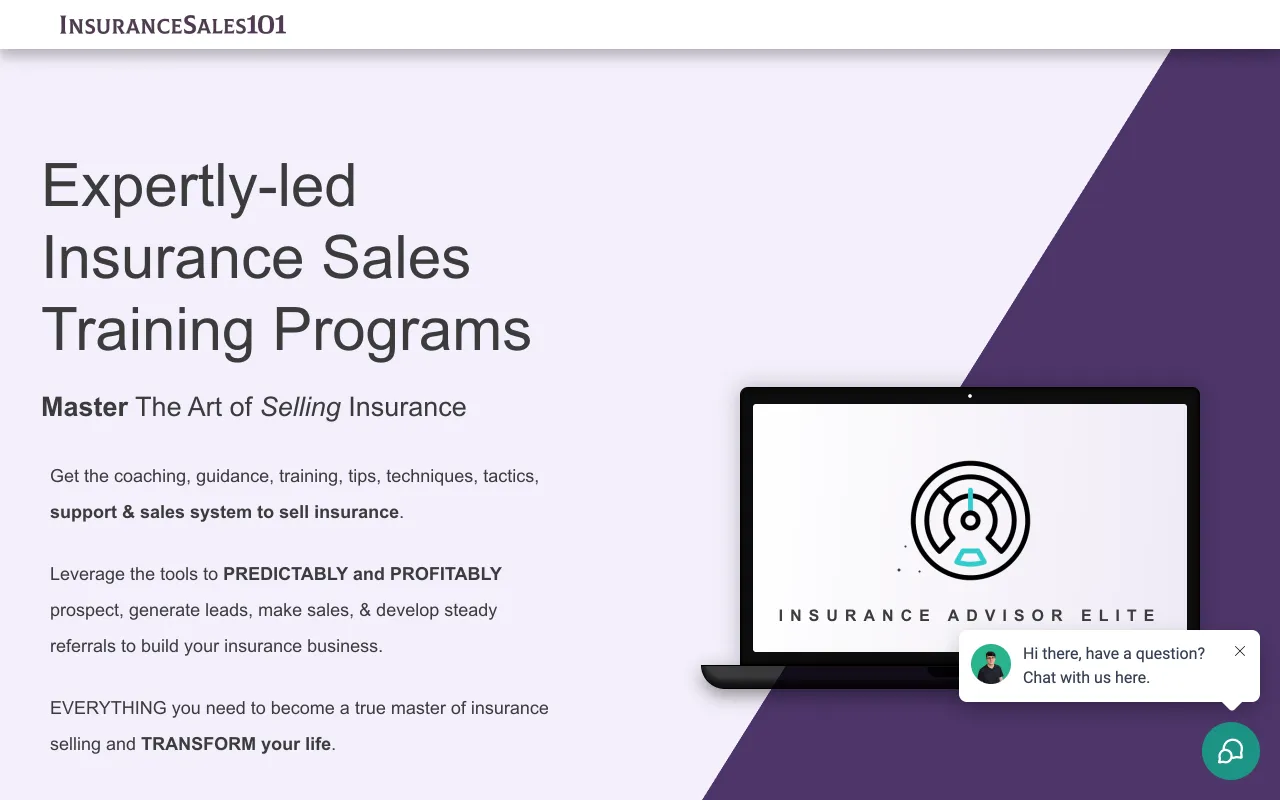
InsuranceSales101 is the low-barrier option, and it's unapologetically insurance-focused: "Master the Art of Selling Insurance." For a new agent or a small agency without a training budget, it provides a solid foundation, a sales system, and community support without a big upfront commitment.
The self-paced format suits agents who are already working and can't attend scheduled classes, and the community gives newcomers a place to compare notes with people learning the same ropes.
What They Offer
- Self-paced online training agents work through on their own schedule, ideal alongside an active book.
- Coaching, guidance, and prebuilt sales systems that reduce the guesswork of getting started.
- Community support and discounts on the tools a new agent needs to launch.
Consider before choosing
- No real-time feedback. Content is primarily self-paced video and text, so there's no live coaching or interactive practice to correct mistakes in the moment.
- Foundational by design. It's an on-ramp for newer agents rather than a system for an established team that needs deep, customized development. [Source: insurancesales101.com, June 2026]
How to Choose the Right Insurance Sales Training
One decision comes before the rest, and you should make it on purpose: are you buying an insurance-specific program or a general methodology you adapt for insurance?
Plenty of strong picks here are insurance-native. Anthony Cole, Agency Performance Partners, Insurance Sales Lab, MarshBerry, the Dynamics of Selling course, and InsuranceSales101 were all built around the way agents actually sell: licensing, needs-based discovery, price and need objections, and the renewal book.
Sandler, Richardson, and Factor 8 are excellent general programs. They are world-class at consultative selling, enterprise rollout, and phone skills, but the state licensing, suitability, and line-specific layer is yours to add. Know which of the two you are paying for, because the insurance-native picks save you that adaptation work.
From there, match the program to your team and your gap, not the loudest brand. A quick way to decide:
| Your Gap | What to Prioritize | Strong Options |
|---|---|---|
| Agents know the script but freeze on objections | Repetition, objective scoring, reinforcement | Kendo AI |
| New producers churning before they're profitable | A validation path and structured ramp | MarshBerry, Dynamics of Selling |
| Results swing from one producer to the next | A repeatable agency sales system | Agency Performance Partners, Anthony Cole |
| Producing agents who want a tighter close | One-call close and live drills | Insurance Sales Lab |
| Phone or call-center selling (Medicare, ACA, auto) | Virtual and inside-sales skills | Factor 8 |
| Large carrier rolling out a shared methodology | Customized, trust-based consultative training | Richardson, Sandler |
| Solo agent on a tight budget | Affordable foundations and community | InsuranceSales101 |
One pattern holds across every option: programs paired with reinforcement practice stick far better than one-off workshops. That is the gap a tool like Kendo is built to fill, and why we put practice at the center. To ramp new agents faster, see our playbook on how to reduce sales ramp time.
Courses vs. Programs vs. Practice
These words get used interchangeably, but they solve different problems, and buying the wrong format is how agencies overspend.
Courses like the Dynamics of Selling track or InsuranceSales101 are self-paced or cohort skill-building. They're the cheapest, fastest way for an individual agent to learn an insurance-specific process.
Programs from Anthony Cole, MarshBerry, Sandler, or Richardson give a whole team a shared methodology and a development path, usually with live instruction. This is where you go when process consistency, not individual tactics, is the problem.
Practice is the ongoing reinforcement that keeps either one from fading. A course teaches the play once; repeated reps are what turn it into a habit. This is the layer Kendo handles, letting agents drill the objections they'll actually hear long after the workshop ends. If you're weighing the practice layer on its own, our breakdown of the best AI sales roleplaying tools compares the options head to head.
The ROI of Letting Agents Fail Against an AI, Not a Lead
The math on insurance training is unforgiving, and it's the strongest argument for adding a practice layer.
Leads aren't cheap. Industry benchmarks put the blended average cost per business-insurance lead near $424 [Source: First Page Sage, 2026], and live-transfer or exclusive leads run higher. Every "rookie mistake" an agent makes on a paid lead is money that walked out the door.
Attrition compounds it. With only about 15% of recruits still in the business after four years [Source: LIMRA], and the heaviest losses in year one, the agencies that win are the ones that get agents productive before they burn through their early leads and their confidence.
That's the case for practice. When an agent's first 100 attempts at "I need to talk to my spouse" happen against a Kendo AI prospect instead of a $424 lead, they walk into the real call already sharp. United Insurance Pros turned that into a ramp cut from 45 days to 14. It's the same logic behind the wider AI sales training ROI case.
The Verdict: Which Insurance Sales Training Should You Pick?
The best program is the one your agents will actually use, paired with practice that makes the lessons stick. Most agencies need two things working together: a selling process and a way to rehearse it.
- Best insurance-specific process: the Dynamics of Selling course and Insurance Sales Lab are built by and for insurance, down to the one-call close.
- Best for new-producer development: MarshBerry and Anthony Cole give you a validation path and the management layer to coach it.
- Best for agency systems: Agency Performance Partners makes results repeatable instead of dependent on one star.
- Best general methodology to adapt: Sandler and Richardson bring world-class consultative selling for trust-led and enterprise teams.
- Best for the practice layer: Kendo AI turns any of the above into repeatable performance, with unlimited insurance roleplay and objective scoring from $55 per seat per month.
The process teaches the play. Practice closes the policy. If you want agents drilling real objections before they ever touch a paid lead, start a free Kendo roleplay or book a demo.
Bridge the Training Gap with Kendo AI
The programs above supply the essential insurance methodology. Kendo makes sure those skills survive a real call. By giving agents a low-stakes place for unlimited repetition, it bridges the gap between learning a process and closing a policy.
Ready to make your training measurable? Try Kendo AI and see how realistic AI roleplay scales your agency's performance.
Frequently Asked Questions
What is the best insurance sales training program in 2026?
It depends on the gap you are filling. For an insurance-specific selling process taught by working producers, Insurance Sales Lab and the Dynamics of Selling course lead. For agency-wide systems and producer development, Anthony Cole Training Group, Agency Performance Partners, and MarshBerry are strong. For the practice layer that turns any of them into repeatable performance, Kendo AI lets agents drill price and need objections against realistic AI buyers, starting at $55 per seat per month.
How much does insurance sales training cost?
It ranges widely. Self-paced and producer-built programs run from a few hundred dollars (the Dynamics of Selling CIRP track is $330 for a 12-month subscription) into low four figures for cohort courses. Enterprise consultative programs from Sandler, Richardson, and MarshBerry are quote-based and can reach five and six figures. AI roleplay platforms like Kendo start at $55 per seat per month, which is far less than the cost of one burned batch of leads.
What makes insurance sales training different from general sales training?
Insurance reps sell a promise, not a product the buyer can hold. They work inside state licensing and disclosure rules, handle price and need objections like "I already have coverage" or "I need to ask my spouse," and have to build enough trust for someone to name a beneficiary. Captive and independent agents face different motions, and lines like P&C, life, health, and annuities each carry their own compliance and objection patterns. General programs teach the fundamentals, but they rarely cover the licensing, suitability, and trust dynamics specific to insurance.
Which insurance sales training companies are actually insurance-specific?
Several on this list are built for insurance: Anthony Cole Training Group, Agency Performance Partners, Insurance Sales Lab, MarshBerry Producer Academy, and the Dynamics of Selling course from the Risk and Insurance Education Alliance, which calls itself the only insurance-specific sales process in the industry. Sandler, Richardson, and Factor 8 are excellent general programs you adapt for insurance. Kendo is the practice layer, since you can build AI prospects that mirror your exact lines, objections, and compliance constraints.
How do I train new insurance agents faster?
Get reps reps. New-agent attrition in insurance is brutal, with many agencies losing a large share of recruits in the first year and only about 15 percent of recruits still in the business after four years, according to LIMRA. The fastest-ramping teams replace trial-by-fire on live leads with repeated practice: agents drill discovery, suitability questions, and the objections they will actually hear before they ever dial a paid lead. United Insurance Pros used Kendo to cut onboarding from 45 days to 14.
Does AI roleplay replace insurance sales training?
No. Methodology and producer programs teach the selling process, the compliance basics, and how to think about a case. AI roleplay measures whether an agent can actually run discovery and handle a price or need objection out loud, with unlimited reps and objective scoring. The two work together: the program supplies the framework, and practice builds the muscle memory so reps stop learning on live leads.
What should insurance sales training cover that generic training misses?
State licensing and disclosure requirements, suitability and fair-conduct standards, the trust and relationship selling a beneficiary decision demands, and the specific objections in P&C, life, health, and annuities. It should also address cross-sell and policy retention, since the renewal book is where agency profit lives, and call reluctance for new agents. Strong insurance programs cover prospecting, needs-based discovery, value over price, objection handling, the one-call close, and keeping the book on the renewal.

Luke Alexander is the founder of Kendo AI, where he's helped train more than 5,000 sales reps, including insurance agencies and IMOs. He started in sales as a frontline closer, scaled a high-ticket sales-training company, and founded Closer Cartel and co-founded Closify before building Kendo to fix the tools he wished he'd had: realistic AI roleplay and automated call review for fast-moving sales teams. He writes about sales training, ramp speed, objection handling, and applying AI across the revenue org.