
12 Best Sales Onboarding Software Tools for 2026
A side-by-side look at the leading sales onboarding software, scored on the only two things that matter: how fast they ramp a new rep, and whether they prove that rep can actually sell. Verified pricing, plus where AI practice beats another content library.
The average new SaaS account executive now takes 5.7 months to ramp to full productivity, up from 4.3 months in 2020 [Source: The Bridge Group, 2024 SaaS AE Report]. That is nearly half a year of salary and leads before a hire pays for themselves.
Most onboarding software solves the wrong half of that problem. It is great at delivering content and tracking who watched it, and weak at proving a rep can run a live call.
So we scored these 12 tools on the two questions that actually move ramp: how fast they get a rep producing, and how they prove readiness before that rep touches a real lead. Teams that care more about the competency gate than the onboarding workflow should compare platforms that measure whether reps can actually execute. Pricing was verified against each vendor's own site in June 2026.
The Gap Between "Completed Onboarding" and "Ready to Sell"
Here is the trap most onboarding programs fall into. A new rep finishes the modules, passes the quiz, and the dashboard turns green. Completion looks like readiness. It is not.
A completion rate tells you a rep watched a video about objection handling. It tells you nothing about whether they can hold price when a buyer pushes back at minute 18 of a discovery call. Those are different skills, and only one of them closes deals.
That is why we split this category in two:
- Content and LMS tools deliver the curriculum. Courses, video libraries, certifications, drip schedules, and the reporting to prove a rep consumed it. Essential, but they measure activity, not ability.
- Practice and certification tools make the rep perform. They put a rep in a live conversation, score whether they actually executed, and gate "ready" behind a demonstrated rep, not a checkbox.
You almost always need both. The mistake is buying a second content library when the thing slowing your ramp is a lack of reps-on-target practice, not a lack of courses to assign.
Best Sales Onboarding Software for 2026: Comparison Table
| # | Tool | Best For | Type | Proves Readiness? | Starting Price |
|---|---|---|---|---|---|
| 1 | Kendo AI RECOMMENDED | Practice, certification & live-call coaching | Practice + scoring | Yes, by roleplay + scoring | $55/seat/mo |
| 2 | Allego | Video coaching & peer learning | Enablement | Partly, video review | Custom* |
| 3 | Seismic Learning | Enablement + content management | Enablement + LMS | Partly | Custom* |
| 4 | 360Learning | Collaborative content creation | LMS | No, content-led | $8/user/mo |
| 5 | SalesHood | Async team coaching & everboarding | Enablement | Yes, AI pitch practice | $45/user/mo |
| 6 | Docebo | AI content personalization at scale | Enterprise LMS | No, content-led | Custom* |
| 7 | TalentLMS | Budget-conscious SMB onboarding | LMS | No, quiz-based | Free / paid tiers |
| 8 | Continu | Progress tracking & reporting | LMS | No, completion-led | Custom* |
| 9 | iSpring Learn | In-house microlearning authoring | LMS + authoring | Scripted scenarios | ~$2.29/user/mo |
| 10 | WorkRamp | Automated onboarding workflows | LMS | No, workflow-led | Custom* |
| 11 | Wonderway | Post-call QA & CRM milestones | Call QA | Partly, post-call | Custom* |
| 12 | Bigtincan | Video assessment & delivery scoring | Enablement | Partly, delivery only | Custom* |
Pricing and features verified against each vendor's own site in June 2026. *Tools marked with an asterisk do not publish full pricing and require a quote; third-party figures are cited inline in brackets. Details may change after publication. For a wider view of training options, see our best sales training software roundup.
Kendo AI
★ Best overallThe practice and certification layer that proves a rep can handle live calls before they ramp.
Full disclosure: we built Kendo, so we are biased. We built it because of the exact gap this article is about. Every onboarding tool we used taught reps what to say, then sent them onto live calls to figure out execution at a 3% close rate while they burned real leads.
Kendo is the layer that proves readiness before that happens. A new rep drills discovery, objections, and closing against AI prospects that push back with real hesitation, and they have to hit a score before they get assigned live leads. That turns "ready" from a completed module into a demonstrated rep.
It does double duty during onboarding. Beyond roleplay, Kendo also reviews a new hire's first real calls automatically, so a manager is not the bottleneck on feedback in week two. Revenue teams run the whole loop, practice, certification, and visibility, in one place with Kendo for revenue teams.
What it is not: a course library or a compliance LMS. It does not store your curriculum, so pair it with one of the content tools below if you also need to deliver and track structured coursework.
This is what practicing on Kendo looks like. The AI buyer pushes hard on SOC 2, ISO 27001, and proof the tool cuts compliance work, and the rep has to handle it on the spot, before any of it lands on a live deal.
Kendo vs. a Traditional Onboarding LMS
| Dimension | Kendo AI | Traditional LMS |
|---|---|---|
| What it measures | Whether a rep can execute live | Whether a rep finished the module |
| Readiness gate | Score on realistic roleplay | Quiz score or completion % |
| Practice volume | Unlimited, 24/7, on-demand | Live roleplay only when scheduled |
| Feedback speed | Real-time + auto call scoring | Manager review, days later |
| First live calls | Rehearsed first, then leads | Learn on real leads |
Key Features
- Custom Prospect Builder. Spin up AI buyers that match your exact ICP, offer, and call type, with professional or casual styles. To stand up a fast onboarding curriculum, borrow from 20+ sales roleplay scenarios, from cold-call openers to closing.
- Certification by roleplay. Gate "ready to ramp" behind a passing score on a live simulation, so a rep proves the behavior instead of clicking through it.
- Automated call scoring. Objective 1-to-100 scorecards on discovery depth, talk ratio, and objection handling, applied to roleplay and real calls alike, no manual grading.
- Recorded-call review. Import a new hire's real calls from Zoom, Fathom, or the open API and Kendo scores them and flags gaps automatically.
- Global language support. 40+ languages for distributed and international onboarding.
This is deliberate practice, not a chatbot reading a script: ultra-low-latency voice AI, prospects that express real buying hesitation, and a setup that takes seconds instead of a planning meeting.
"Not only has my team's production started to increase but they are becoming more confident on the phones and getting quicker at overcoming objections."
KCKendo customer · sales leaderTry Kendo with a Free Roleplay, Pricing Starts at $55/mo
Per-seat plans include monthly AI training minutes with transparent overages. Because reps rehearse before they touch leads, teams typically report ramping new hires to baseline in days rather than weeks. See full per-seat pricing.
| Pro $55/mo per seat | Max $100/mo per seat | Enterprise Custom |
|---|---|---|
| AI roleplay, AI call reviews, advanced analytics, AI sales manager + coach, 180 roleplay minutes/seat per month | Everything in Pro, 480 roleplay minutes/seat per month, for teams that want maximum usage | Teams of 10+, custom AI models, custom scoring, DFY setup, dedicated account manager |
United Insurance Pros cut new-rep ramp from 45 days to 14
After rolling out Kendo roleplay, United Insurance Pros got brand-new agents to baseline performance in 14 days instead of 45, while saving thousands per agent every month on training time.
"Typically we would see about a 45-day period where people would dip their foot in the water and slowly improve and then level off. Now that's 14 days."
Waylon Artrip, Founder at United Insurance ProsAllego
Best for video coachingVideo-first revenue enablement built around peer learning and modeling top performers.
Allego's onboarding angle is video. New reps record practice pitches, get asynchronous feedback from managers or peers, and study a curated library of winning calls from the team's best closers. For a distributed team, that "watch what great sounds like" library is genuinely useful early in ramp.
Where it sits on our split: it leans toward readiness more than a pure LMS does, because reps actually perform on camera. But the practice is a recorded monologue judged on a human's timeline, not a live, two-way conversation with a buyer who interrupts. Reviewers also flag a UI that can be hard to navigate and reporting that takes work to read.
Key Features
- Video practice library for reps to record and submit pitches for manager or peer review.
- Peer knowledge sharing built around a searchable library of top-performer calls.
- Mobile-first access so field reps can train and review feedback on the go.
Consider before choosing
- Feedback runs on human time. Async video review introduces a lag between practice and coaching that live AI simulation removes.
- No published pricing. Allego quotes custom pricing based on team size and modules. [Source: allego.com, June 2026]
Want feedback the second a rep finishes, not days later? See the best sales coaching software.
Seismic Learning (Formerly Lessonly)
Structured learning paths wired into Seismic's broader content and enablement suite.
Heads up: Lessonly is now Seismic Learning. Seismic acquired it in 2021 and folded it into the wider platform, so onboarding content now sits alongside content management and buyer engagement. [Source: seismic.com, June 2026]
The pitch is integration. Reps train on the exact collateral they will use in the field, with personalized learning journeys and coaching analytics that tie completion to performance. That is the right reason to pick it: you are already a Seismic shop and want learning in the same system.
On our split it is enablement plus LMS, and it earns "partly" on readiness. The modules are interactive and the coaching analytics help, but the core motion is still content-driven rather than live-practice-driven.
Key Features
- Personalized learning journeys that adapt paths to a rep's role, experience, and performance gaps.
- Content integration with Seismic's platform so reps train on real field materials.
- Coaching analytics correlating learning activity with sales performance.
Consider before choosing
- Strongest inside the Seismic ecosystem. Much of the value depends on already using Seismic for content; as a standalone LMS it is less compelling.
- Custom pricing. Quotes scale with company size, needs, and complexity. [Source: seismic.com, June 2026]
Weighing the wider field? See our Lessonly (Seismic Learning) alternatives breakdown.
360Learning
Collaborative authoring that turns your top reps into the people who build onboarding content.
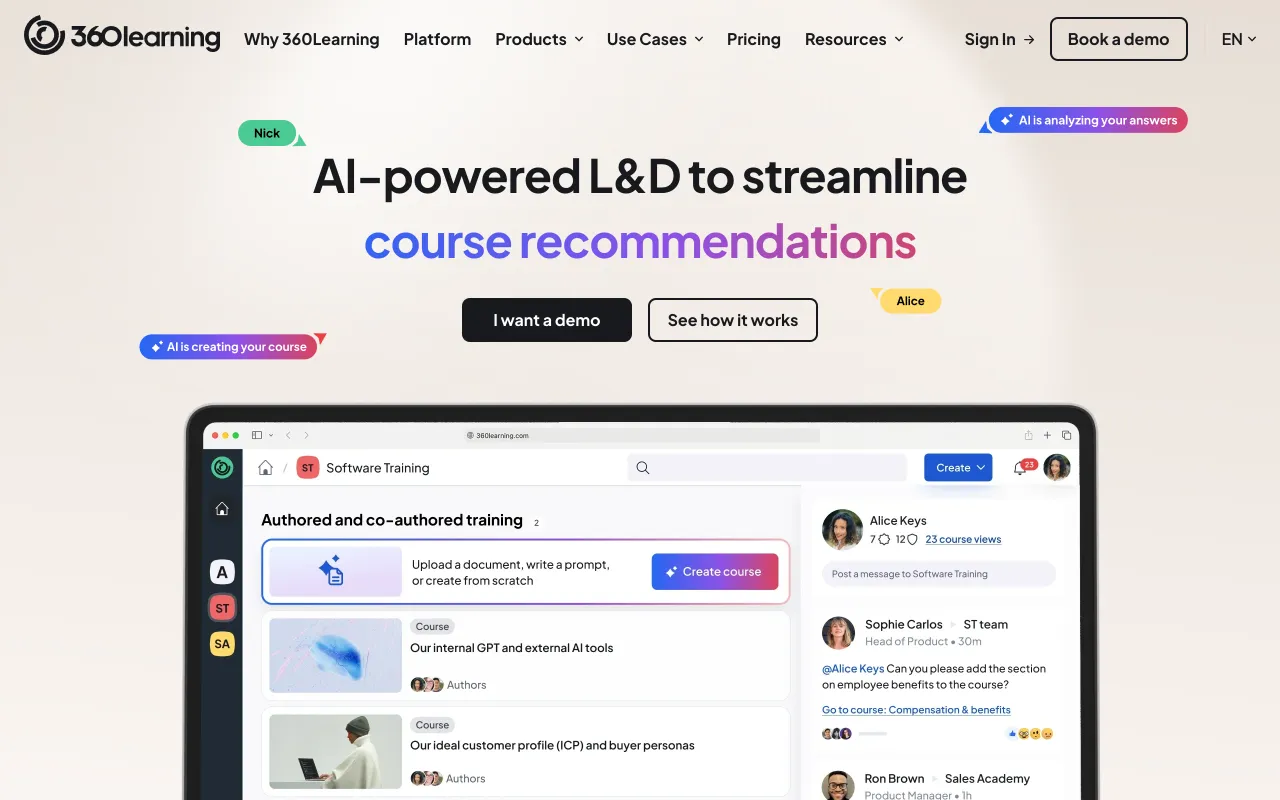
360Learning's differentiator is who creates the training. Instead of waiting on L&D, your best closers and managers co-author the onboarding content directly, and learners upvote what actually helps so the strongest material rises. For capturing tribal knowledge fast, that is a smart model.
It is squarely a content-led LMS, so on readiness it lands at "no." There is video practice with custom scoring, but the emphasis is authoring and assigning courses, not putting a rep in a live, adaptive conversation. The upside is transparent pricing, rare in this category.
Key Features
- Collaborative authoring that lets subject-matter experts build and update content without instructional designers.
- Crowdsourced feedback where learners upvote the most helpful material.
- Global support with full training in 30+ languages for distributed teams.
Consider before choosing
- Authoring-first, not practice-first. Great for creating content fast, lighter on live or AI-driven rehearsal than a dedicated practice tool.
- Verified pricing. The Team plan is $8 per registered user per month for up to 100 users, billed monthly with no annual lock-in; Enterprise is custom. [Source: 360learning.com, June 2026]
Want dynamic feedback beyond static content? We compared the 8 best AI sales roleplaying tools.
Across Kendo customers: 70% faster ramp, 5-15% higher close rates, and $3,000+ saved per rep.
See the results →
SalesHood
Best for everboardingAn enablement platform that swaps one-time boot camps for continuous, AI-assisted coaching.
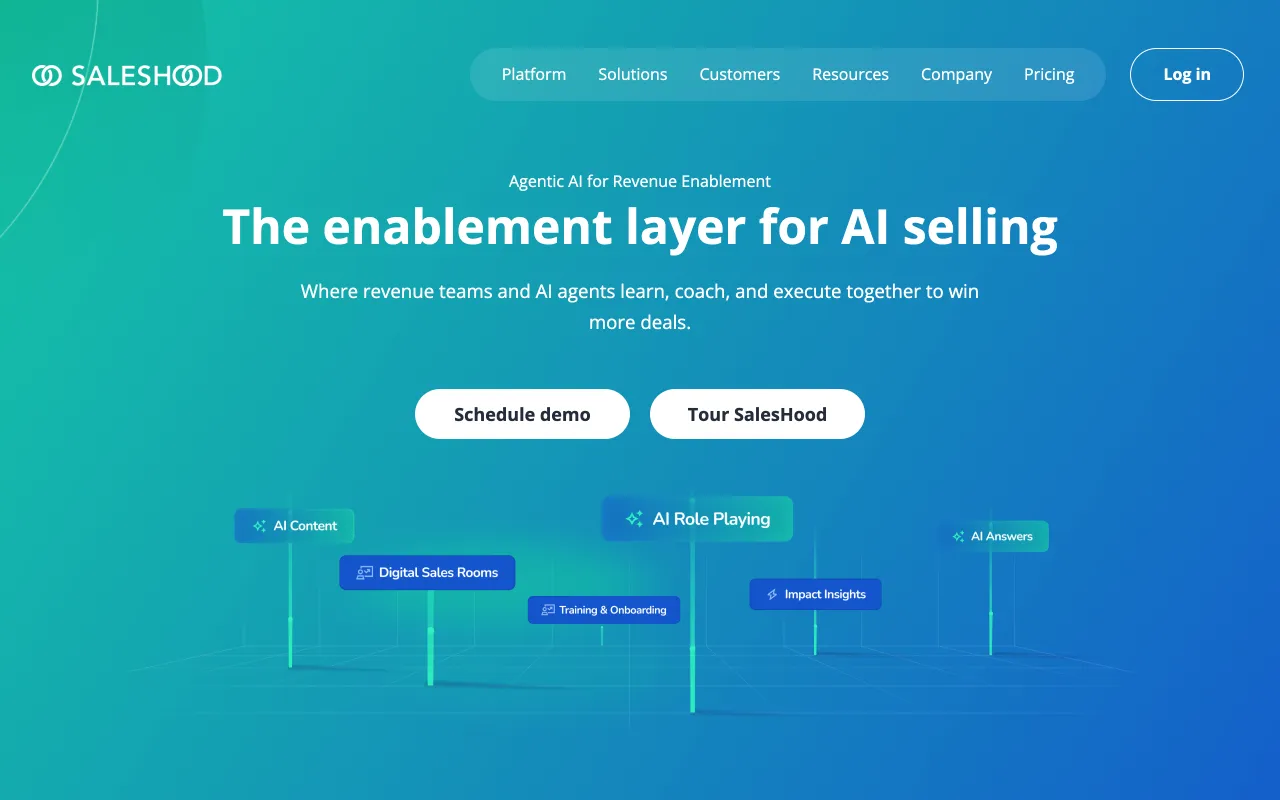
SalesHood treats onboarding as something that never really ends, what they call everboarding. New reps work through video lessons and pitch practice, then keep getting coaching huddles and reinforcement well past week one. Built by former Salesforce leaders, it lives inside the CRM and Slack where reps already work.
It is the closest enablement platform on this list to a readiness tool, because its AI pitch practice gives reps instant feedback on a practice call instead of waiting on a manager. The tradeoff is depth: practice is one feature inside a broader enablement suite, not the whole engine, and the async coaching model still introduces some lag.
Key Features
- AI pitch practice and AI roleplay with instant feedback, included on the Pro and Unlimited tiers.
- Coaching huddles that guide managers and teams through structured, self-paced reinforcement.
- Top-performer modeling plus a library that shows reps what great looks like.
Consider before choosing
- AI practice is capped on Pro. Pitch practice and roleplay are limited to 10 submissions per license on Pro and only unlimited on the top tier. [Source: G2]
- Verified pricing. Essential is $45, Pro $65, and Unlimited $85 per user per month, billed annually. [Source: saleshood.com, June 2026]
Docebo
An enterprise LMS with strong AI for content recommendation and personalization at scale.
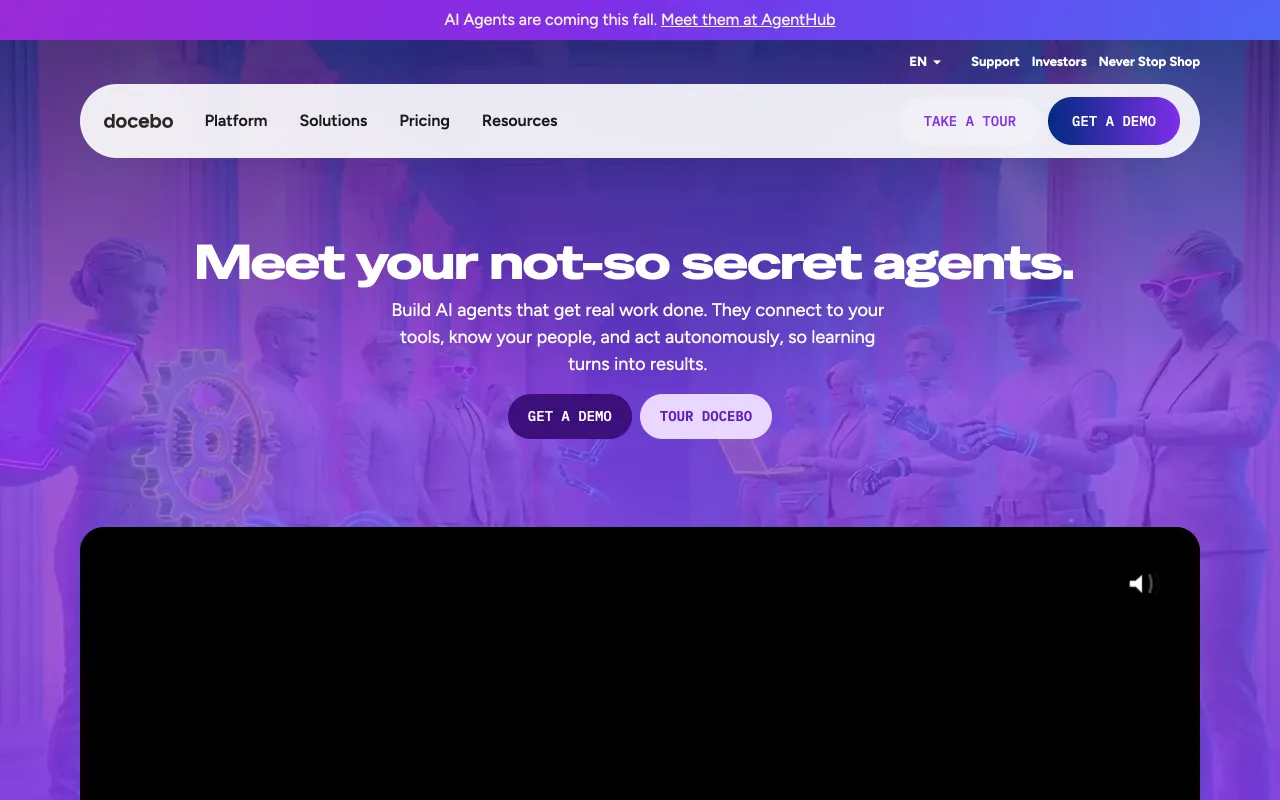
Docebo is a heavyweight enterprise LMS, and sales onboarding is one of several use cases it serves alongside employee and customer education. Its AI is genuinely good at personalizing learning paths and auto-converting documents into bite-sized lessons, which helps if you are managing a large content catalog across many teams.
But be clear about what you are buying. This is a content platform, full stop. On readiness it is a "no": reps consume learning, they do not practice against realistic resistance. If sales onboarding is your only goal, it is more LMS than you need.
Key Features
- AI content recommendations that build personalized paths from user behavior.
- Automated microlearning that turns PDFs and slide decks into interactive lessons.
- Advanced analytics correlating training completion with business outcomes.
Consider before choosing
- Content delivery, not practice. Excellent at personalization and reporting, but fundamentally measures consumption, not whether a rep can sell.
- Enterprise pricing. Custom and quote-based; third-party data commonly puts entry around $25,000 per year, climbing into six figures at scale. [Source: third-party]
TalentLMS
Best for SMB budgetsAn easy, affordable cloud LMS for teams that need structured onboarding without enterprise weight.
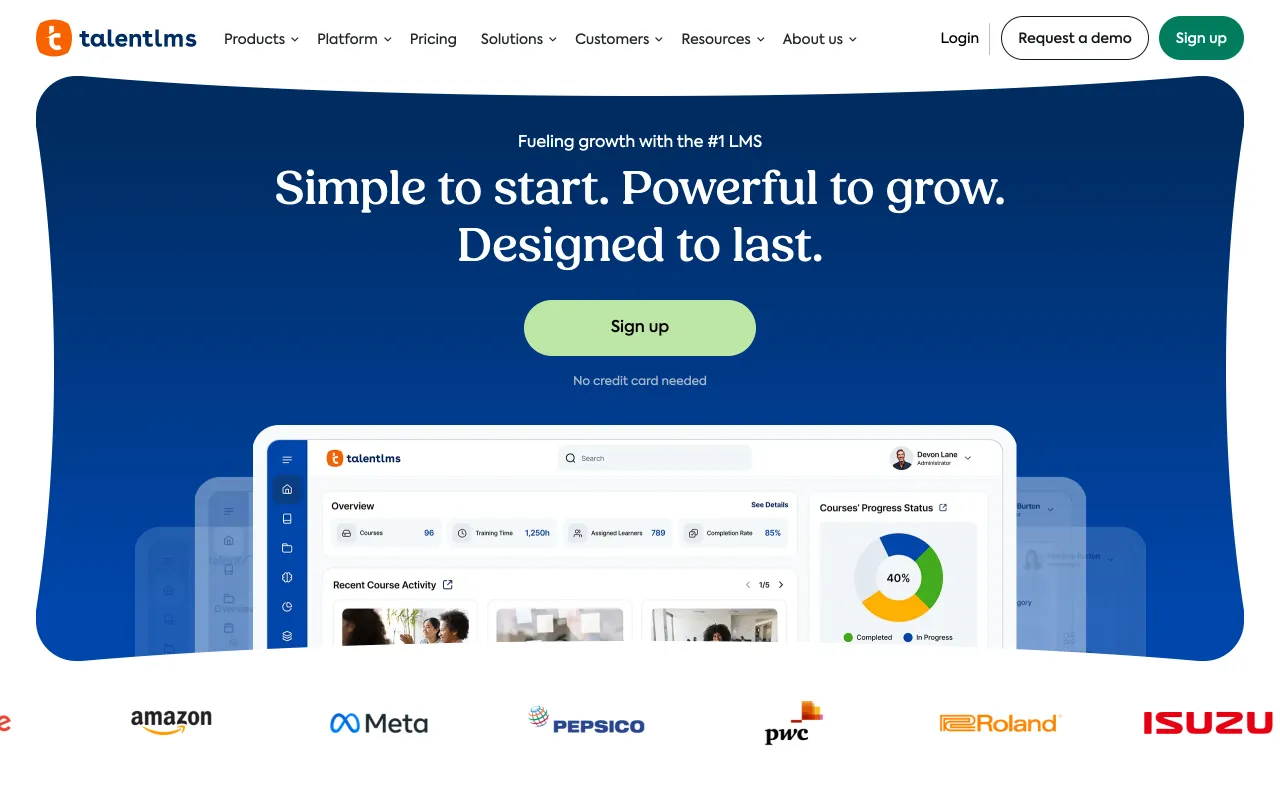
TalentLMS is the practical, low-cost pick. It is known for being easy to set up, and its drip-fed content delivery is a smart onboarding feature: new hires get material gradually instead of a day-one firehose, which helps retention. Gamification, built-in video conferencing, and a free tier round it out.
It is a straightforward LMS, so readiness is quiz-based, not performance-based. Reviewers note a UI that can feel dated and content that skews text-heavy. For a small team that needs structured courses and certificates on a budget, that tradeoff is easy to live with.
Key Features
- Drip-feed delivery that releases onboarding content gradually to prevent overwhelm.
- Built-in video conferencing for live virtual instructor-led sessions without extra tools.
- Gamification with leaderboards, points, and badges to drive completion.
Consider before choosing
- Concepts, not live reps. Strong for content delivery and tracking; it does not put a rep in a live conversation.
- Verified pricing. A free plan covers up to 5 users; paid tiers scale by user band, with annual billing discounted roughly 20%. [Source: talentlms.com, June 2026]
Continu
A modern LMS focused on automated training workflows and deep custom reporting.
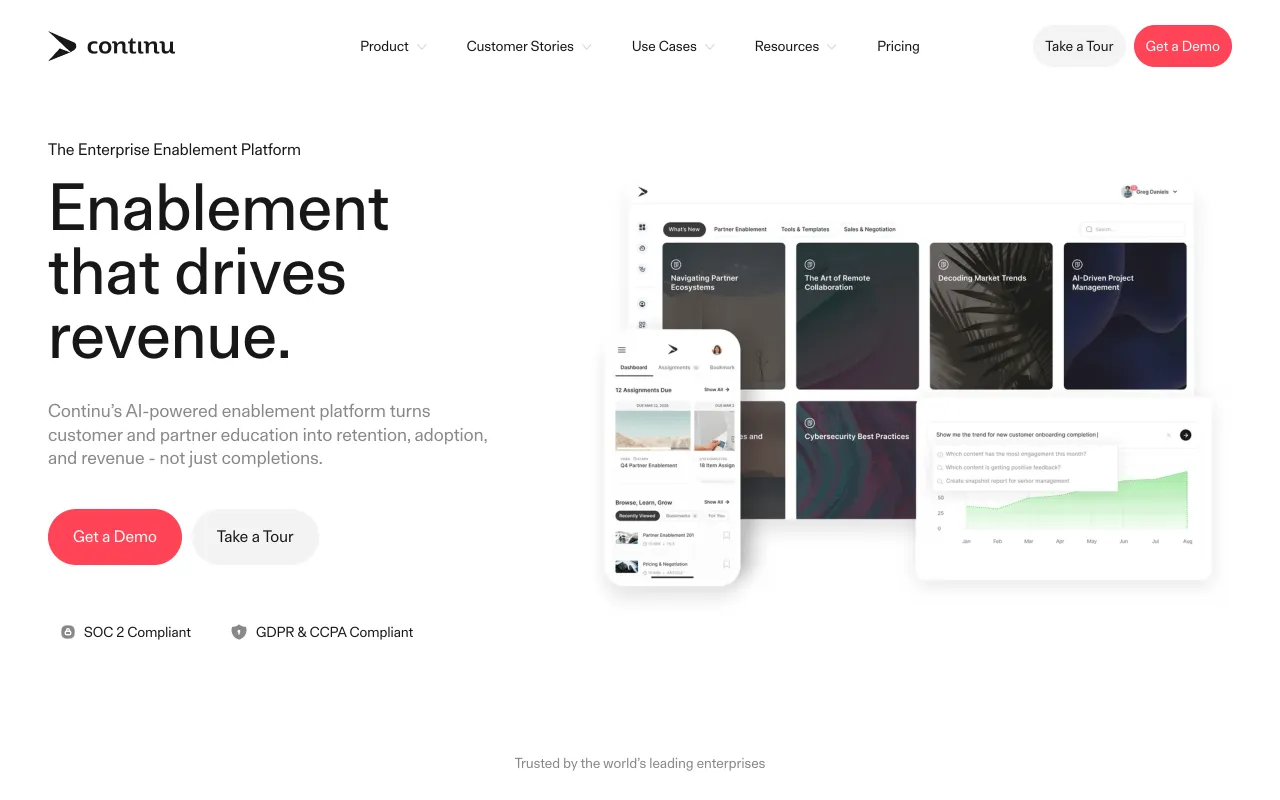
Continu's strength is automation and measurement. You can auto-assign different tracks by role or location and trigger time-sensitive content, day-1 materials, week-2 check-ins, 30-day certifications, without manual sorting. Its custom reporting builder is a real draw for ops teams that want to track exactly the onboarding metrics they care about.
The flip side is that all that tracking measures completion, not capability. On our split it is content-led, so readiness is a "no." Some users also report search and a thinner set of interactive features. Pick it when reporting and workflow automation are the priority, then add a practice layer for the readiness piece.
Key Features
- Automated training workflows that deliver milestone content on a schedule via triggers.
- Third-party content integration with libraries like Udemy, LinkedIn Learning, and Go1.
- Custom reporting builder for granular onboarding metrics from completion to skill progression.
Consider before choosing
- Tracking over interaction. Strong analytics, but lighter on interactive practice; readiness is inferred from completion.
- Tier-based pricing. Requires contacting sales; third-party sources cite roughly $6 to $16 per user per month depending on tier. [Source: third-party]
iSpring Learn
An LMS plus a serious authoring toolkit for teams that build their own onboarding content.
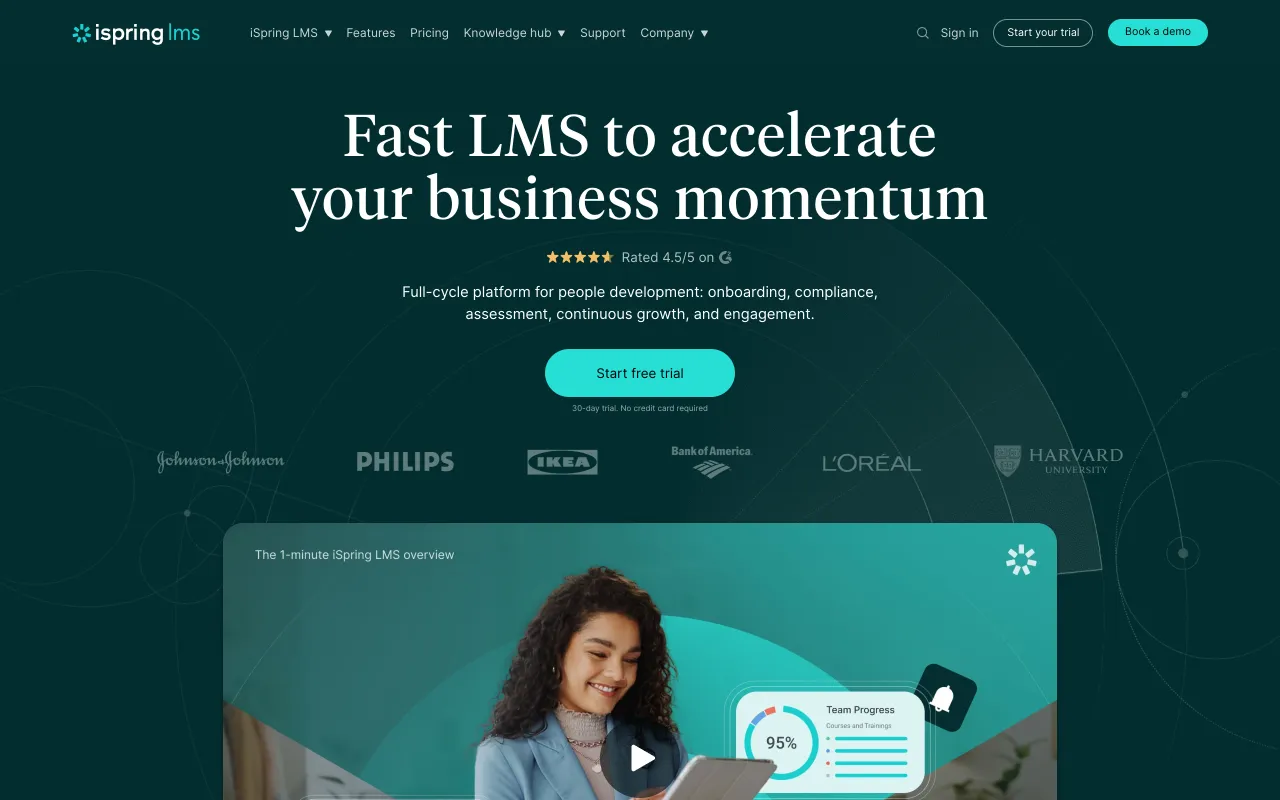
iSpring pairs an LMS with one of the better authoring toolkits in the category. If you have internal L&D muscle, you can build interactive microlearning, quizzes, and branching conversation scenarios without hiring external developers. That control is the appeal, and at volume it is one of the cheapest options here.
On readiness it is a half-step ahead of a plain LMS thanks to those branching scenarios, where a learner picks a response and sees the consequence. But the key limit is right there: those scenarios are pre-scripted decision trees, not AI that adapts to whatever a rep actually says.
Key Features
- Microlearning authoring toolkit for building interactive modules and branching scenarios in-house.
- Mobile learning with offline access so reps complete training anywhere and sync later.
- Skills-gap reporting that compares assessment results against job requirements.
Consider before choosing
- Scripted, not adaptive. Simulated scenarios are decision trees, not dynamic conversations that respond in real time.
- Verified pricing. Roughly $2.29 to $3.14 per user per month on annual billing at volume, and you pay only for active users. [Source: ispringsolutions.com, June 2026]
Ready to move past scripted bots? See how AI cold calling training gives reps unscripted practice.
WorkRamp
An AI-first LMS built to automate the logistics of onboarding across role-specific paths.
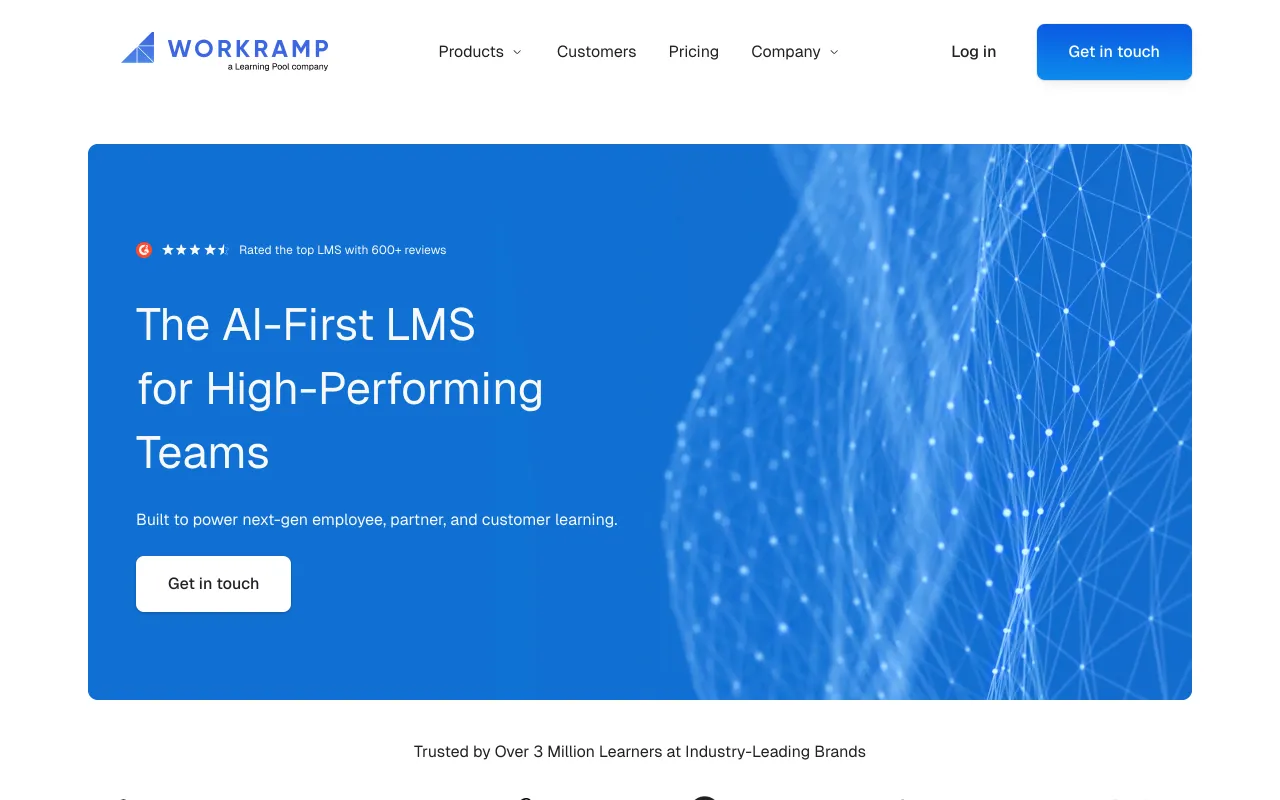
WorkRamp is built to take the coordination headache out of onboarding. New hires automatically get role-specific learning paths, with sessions and deadlines synced to their calendars and content assigned by trigger rules. For a team drowning in manual onboarding logistics, that automation is the selling point.
It is an LMS at heart, so readiness lands at "no", it automates the administrative side rather than testing live skill. Some users find the UI basic and content hard to locate. Choose it to reduce coordination overhead, not to prove a rep can run a call.
Key Features
- Role-specific learning paths auto-assigned by position, team, and responsibility.
- Calendar integration that syncs sessions and milestones to reps' calendars.
- Automated triggers that assign new content based on completion, time, or performance.
Consider before choosing
- Logistics, not live practice. Strong at automating onboarding admin; it does not put a rep in a conversation.
- No public pricing. Quote-based across Professional and Enterprise tiers; third-party estimates start around $50 per user per month. [Source: third-party]
Wonderway
Sales coaching automation that scores real calls and ties onboarding to CRM milestones.
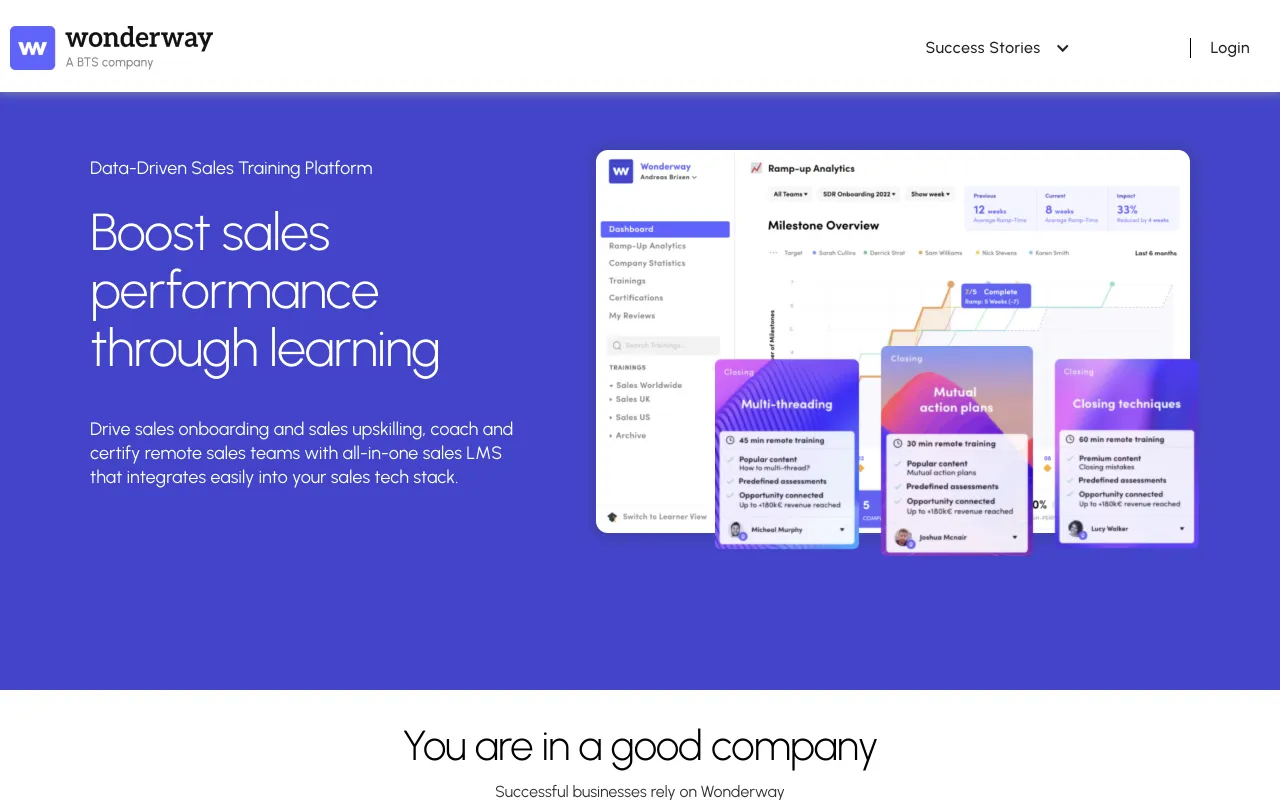
Heads up: Wonderway was acquired by BTS in mid-2024 and now operates as part of that group. [Source: bts.com, 2024] The product still centers on its AI Coach, which listens to recorded sales calls, auto-fills scorecards, and flags coaching gaps without manual QA.
Its onboarding strength is the part most tools skip: milestones tied to real outcomes like time-to-first-call and first opportunity, tracked through CRM integration. On readiness it scores "partly," but note the timing, the AI Coach grades calls after they happen. That makes it strong for ongoing QA and a different motion from rehearsing before a rep ever dials.
Key Features
- AI call analysis that scores recorded calls against your criteria automatically.
- CRM-connected milestones tied to first call, first opportunity, and first deal.
- Automated progress alerts when reps fall behind on training or milestones.
Consider before choosing
- Post-call, not pre-call. It analyzes real calls after the fact rather than letting reps rehearse first, so leads are still part of the learning curve.
- Custom pricing. Quote-based; pricing is not published. [Source: wonderway.io, June 2026]
Bigtincan (Formerly Brainshark)
Content authoring with machine-scored video assessments for pitch delivery.
Heads up: Brainshark is now Bigtincan, which also merged with Showpad's enablement business. Its onboarding hook is machine video scoring: AI analyzes a rep's recorded pitch and scores delivery mechanics like pace, filler words, and energy, giving objective feedback at scale.
That earns a "partly" on readiness, but with a real ceiling. Scoring how a rep sounds is not the same as testing whether they can handle a buyer who pushes back. Delivery polish matters; it is not the same skill as winning a two-way conversation. Useful for presentation drills, thin for live deal dynamics.
Key Features
- Machine video scoring on delivery mechanics like pace, filler words, and energy.
- Peer review workflows for collaborative feedback alongside manager evaluation.
- Multi-format authoring across webcam, screen capture, slides, and documents.
Consider before choosing
- Delivery, not dialogue. It grades how a rep presents, not whether they can adapt to a responsive buyer.
- Custom pricing. Quote-based across the Bigtincan suite. [Source: bigtincan.com, June 2026]
Replacing Brainshark specifically? See our Brainshark alternatives roundup.
How to Choose Sales Onboarding Software
One decision comes before features, and it decides everything after it: are you missing content, or are you missing practice? Most teams have plenty of courses to assign and a real shortage of reps-on-target reps, and that answer should anchor the wider sales enablement strategy you build around it.
A clean way to sort this list:
| Your Situation | What to Prioritize | Strong Options |
|---|---|---|
| New reps burn leads while they "learn on the job" | Practice + certification before live calls | Kendo AI, SalesHood |
| You need to deliver and track a structured curriculum | Course delivery, paths, completion reporting | Docebo, 360Learning, TalentLMS |
| You want reps learning on real field collateral | Enablement + content management | Seismic Learning, Allego |
| You build training content in-house | Authoring tools and microlearning | iSpring Learn, 360Learning |
| Onboarding logistics are a mess | Workflow automation and milestones | WorkRamp, Continu |
| You want to QA reps' real calls during ramp | Automated call scoring and CRM milestones | Kendo AI, Wonderway |
Score Every Tool on Two Things
Feature lists are noise. When you demo these, judge each one against the only two metrics that change ramp:
- Time-to-first-deal. Does this shorten the path from hire date to first closed deal, or just organize the content along the way? Drip schedules and dashboards feel productive without moving this number.
- Proof of readiness. How does the tool know a rep is ready, a completion percentage, or a demonstrated rep? If "ready" means "finished the modules," you have not measured readiness at all.
Build the program around 30/60/90 milestones tied to real outcomes (first call by day 7, first opportunity by day 30), and gate each stage behind a skill a rep has to show, not a video they watched. To go deeper on the mechanics, our playbook on how to reduce sales ramp time breaks down the certification and reinforcement steps that compress those 5.7 months.
One pattern holds across every option here: the teams that ramp fastest pair a content tool with a practice tool. The content delivers the knowledge. The practice proves the rep can use it. The same logic shapes a strong sales onboarding program end to end, from day-one content to certified readiness. That second half is the layer Kendo is built for, and the reason it tops this list.
If the practice half is your gap, the fastest way to compare your options is our roundup of the best AI sales roleplaying tools, which breaks down how each one puts a rep in a live, adaptive conversation.
The Verdict: Which Sales Onboarding Software Should You Pick?
The best onboarding software is the one that gets a rep producing fastest and proves they are ready before they touch a lead. For most teams that means a content layer and a practice layer working together.
- Best for proving readiness and cutting ramp: Kendo AI certifies reps through realistic roleplay and scores their first real calls, from $55 per seat per month.
- Best for enablement on real field content: Seismic Learning and Allego put reps on the exact materials and winning calls they will use.
- Best for delivering and tracking a curriculum: Docebo, 360Learning, and TalentLMS cover course delivery, paths, and completion reporting across budgets.
- Best for workflow and reporting: WorkRamp and Continu automate the logistics and measurement of onboarding.
- Best for post-call QA during ramp: Wonderway scores real calls and ties milestones to CRM outcomes. For the wider set of tools that grade live calls, see the best sales coaching software.
Completing onboarding is not the same as being ready to sell. If you want new reps drilling real objections and getting scored before they ever touch a live lead, start a free Kendo roleplay or book a demo.
Frequently Asked Questions
Can Kendo AI analyze recorded sales calls to coach reps and find performance gaps?
Yes. Kendo reviews recorded calls automatically, not just roleplay. You import real calls through native Zoom and Fathom integrations or push them in through the open API, and Kendo scores each call on a customizable 1-to-100 scorecard, writes a sales-focused summary of what happened and why, and builds a skill profile per rep that flags strengths, weaknesses, and missed opportunities. That makes it usable for live-call coaching during onboarding, not only pre-call practice.
What is the best sales onboarding software in 2026?
It depends on the gap you are closing. If new reps know the script but freeze on live calls, a practice-and-certification layer like Kendo AI ramps them fastest because they drill real objections against AI buyers before touching a lead, starting at $55 per seat per month. If your priority is content delivery, compliance tracking, and structured courses, an LMS or enablement platform like Seismic Learning, Docebo, or 360Learning fits better. Most strong programs pair the two.
How long should sales onboarding take?
The average new SaaS account executive now takes 5.7 months to ramp to full productivity, up from 4.3 months in 2020, according to The Bridge Group's 2024 SaaS AE report. Onboarding software shortens that by replacing passive video time with reps-on-target activities, certification gates, and 30/60/90 milestones tied to real outcomes. Teams that add live AI practice report ramping new reps to baseline in days rather than weeks.
What is the difference between an LMS, a sales enablement platform, and a sales practice tool?
An LMS (TalentLMS, Docebo, iSpring) delivers and tracks courses, quizzes, and certifications. The sales enablement layer (Seismic, Allego, Bigtincan) adds content management, video coaching, and the right collateral at the right moment. A sales practice tool (Kendo AI) makes reps rehearse live conversations against responsive AI buyers and scores whether they can actually execute. The first two prove a rep completed onboarding; the third proves a rep is ready to sell.
Does completing onboarding mean a rep is ready to sell?
No, and that gap is the core problem. A completion rate tells you a rep watched the modules and passed a quiz. It does not tell you whether they can run discovery, hold price, or handle a budget objection on a live call. Readiness is best measured by certification through realistic roleplay and objective call scoring, where a rep has to demonstrate the behavior under pressure before they get assigned live leads.
How much does sales onboarding software cost?
Pricing spans a wide range. Per-seat tools are transparent: Kendo starts at $55 per seat per month, SalesHood runs $45 to $85 per user per month, 360Learning is around $8 per registered user per month, and iSpring Learn is roughly $2.29 to $3.14 per user per month at volume. Enterprise LMS and enablement suites like Seismic, Docebo, WorkRamp, Continu, and Bigtincan use custom quotes, with Docebo commonly cited starting around $25,000 per year.
What should I look for in sales onboarding software?
Score every tool on time-to-first-deal and proof of readiness, not feature count. Look for role-based 30/60/90 paths, certification gated by realistic practice, objective call scoring, milestones tied to CRM outcomes like first call and first opportunity, and reinforcement that continues after week one. If a platform only delivers content and tracks completion, pair it with a practice layer that proves a rep can sell before they ramp.

Luke Alexander is the founder of Kendo AI, where he's helped train more than 5,000 sales reps. He started in sales as a frontline closer, scaled a high-ticket sales-training company, and founded Closer Cartel and co-founded Closify before building Kendo to fix the tools he wished he'd had: realistic AI roleplay and automated call review for fast-moving sales teams. He writes about sales onboarding, ramp speed, objection handling, and applying AI across the revenue org.