
11 Best Sales Training Software Platforms for 2026
A side-by-side look at the leading sales training platforms, sorted by what actually matters: not just whether they deliver content, but whether they build and prove a rep can sell. Verified 2026 pricing, real screenshots, and where AI roleplay practice fits.
Most "sales training software" lists treat eleven very different products as if they do the same job. They don't. Some deliver content, some manage content, and a few make reps practice. Buy the wrong category and you'll spend a year wondering why quota attainment never moved.
The stakes are real. Without reinforcement, learners lose most of what they're taught within weeks, a pattern documented since the 1880s as the Ebbinghaus forgetting curve, and 67% of reps missed quota last year [Source: Salesforce State of Sales]. A polished course library doesn't fix that, because reps don't lack information. They lack reps.
So we compared the 11 platforms below on the one question the feature tables skip: does this tool build and prove selling skill, or just store and serve content? Pricing is verified against each vendor's own materials, June 2026.
The Three Layers of Sales Training Software
Before the rankings, here is the lens that makes this list make sense. Sales training platforms fall into three groups, and they solve different problems:
- Content delivery (the LMS layer). Litmos, iSpring Learn, TalentLMS, SkyPrep, and Adobe Learning Manager. You author courses, push videos and quizzes, and track completion. Great for onboarding logistics and compliance. The catch: it proves a rep finished the module, not that they can run the call.
- Content management plus coaching (the enablement layer). Highspot, Seismic, Allego, and Brainshark. These organize the sales content reps use in live deals and bolt on video practice and readiness scorecards. Stronger on "what to say," lighter on rehearsing it live. If proving buyer readiness is the primary job, compare platforms built around assessment, certification, and skill verification.
- Practice (the simulation layer). Kendo. Instead of delivering or filing content, it puts reps in a live conversation with an AI buyer and scores how they actually perform. This is the layer that turns knowledge into skill.
None of these is wrong. But only the third layer measures execution, and execution is what 67% of reps are missing. Keep the three layers in mind as you read, because the right pick depends entirely on which one your team is short on.
Best Sales Training Software for 2026: Comparison Table
| # | Platform | Layer | Best For | Builds Skill By | Starting Price | AI Roleplay |
|---|---|---|---|---|---|---|
| 1 | Kendo AI RECOMMENDED | Practice | Rep practice, ramp & objection drills | Live AI roleplay + scoring | $55/seat/mo | Yes (core) |
| 2 | Litmos | Content delivery | Quick-deploy LMS with CRM tie-in | Courses, quizzes, gamification | Custom* | No |
| 3 | Brainshark (Bigtincan) | Enablement | Video coaching & readiness scores | Async video + scorecards | Custom* | No |
| 4 | Highspot | Enablement | Content library + sales plays | Content + training modules | Custom* | Roleplay add-on |
| 5 | Seismic | Enablement | Enterprise content + enablement | Content + Seismic Learning | Custom* | Coaching |
| 6 | 360Learning | Content delivery | Collaborative, peer-built training | Co-authored courses + video | $8/user/mo | No |
| 7 | SkyPrep | Content delivery | Streamlined onboarding logistics | Automated learning paths | Custom* | No |
| 8 | iSpring Learn | Content delivery | Traditional eLearning at scale | Courses + scripted branching | $3.58/user/mo | Scripted only |
| 9 | TalentLMS | Content delivery | Budget-friendly team training | Pre-built course library | $69/mo* | No |
| 10 | Allego | Enablement | Distributed video coaching | Async video + content sharing | Custom* | No |
| 11 | Adobe Learning Manager | Content delivery | Large-scale LMS infrastructure | Courses + certifications | ~$5/user/mo* | No |
Pricing verified against each vendor's own materials in June 2026. *Platforms marked with an asterisk price by active or registered user, by team size, or by custom quote; figures from third-party benchmarking are cited inline in brackets. Want methodology-led courses rather than software? See our best sales training programs roundup. If motivation, leaderboards, and recognition are the main gap, compare the best sales gamification software tools.
Kendo AI
★ Best overallThe practice layer: turns training content into proven skill through unlimited, realistic AI roleplay.
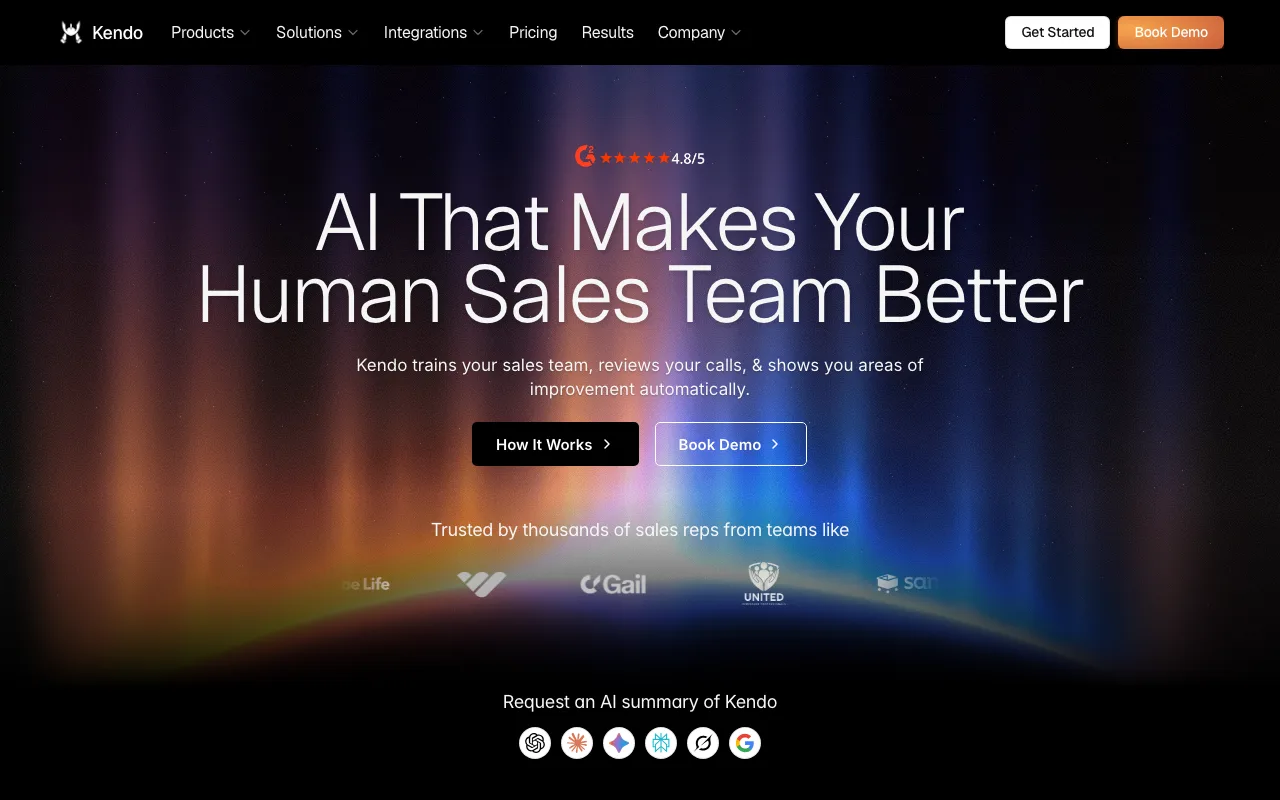
Full disclosure: we built Kendo, so we are biased. We built it because every LMS and enablement suite on this list is excellent at delivering or organizing content, then leaves reps to figure out execution on real deals. Kendo is the layer that proves a rep can actually do the job. Reps get on-demand AI roleplay, real-time coaching mid-call, and an automatic score after every session.
This is the answer to the question buyers keep asking software for and not getting: real-time field training with instant feedback. Reps practice live objections out loud against a buyer that pushes back, instead of reading a module about objections and taking a quiz. Teams can run onboarding, coaching, and performance visibility in one place with Kendo for revenue teams.
The other thing software usually misses is vertical fit. You build AI buyers that match your exact ICP, industry, product, and objections, so a SaaS rep, an insurance agent, and a medical-device seller each drill against a prospect that sounds like their real market. It does not hand you a course library or a methodology, so pair it with one of the platforms below for the content side.
This is what practicing on Kendo looks like. The AI buyer pushes hard on SOC 2, ISO 27001, and proof the tool cuts compliance work, and the rep has to handle it on the spot, before any of it lands on a live deal.
Kendo vs. a Traditional LMS
| Dimension | Kendo AI | Traditional LMS |
|---|---|---|
| What it measures | Whether reps can execute live | Whether reps finished the module |
| Practice availability | 24/7 on-demand reps | Read, watch, quiz |
| Objection handling | Live, out loud, scored | Multiple-choice recall |
| Scenario fit | Any ICP, offer, or objection | Generic or scripted branching |
| Feedback | Real-time, objective scoring | Pass/fail completion |
Key Features
- Custom Prospect Builder. Create AI buyers that match your exact ICP by role, industry, and personality, in professional or casual styles. To start fast, borrow from 20+ pre-built sales roleplay scenarios, from cold-call openers to late-stage negotiations.
- Dynamic objection library. Drill budget, timing, technical, and trust objections, or build custom ones for a niche vertical, instead of static script practice.
- Real-time AI coaching. Minute-by-minute guidance during the live simulation, not notes days later.
- Automated call scoring. Objective 1-to-100 scorecards on discovery depth, talk ratio, and objection handling, without manual grading. See how AI call reviews work on live calls too.
- 40+ languages. Multi-language voice simulations for distributed and global teams.
This is deliberate practice in software: state-of-the-art voice AI with ultra-low latency, prospects that push back and show real buying hesitation, and a setup that takes seconds rather than a planning meeting. It is not a chatbot reading a script.
"Not only has my team's production started to increase but they are becoming more confident on the phones and getting quicker at overcoming objections."
KCKendo customer · sales leaderTry Kendo with a Free Roleplay, Pricing Starts at $55/mo
Kendo's per-seat plans include monthly AI training minutes with transparent overages. Teams typically report a 5 to 15% lift in close rates, which tends to make it ROI-positive within the first month of consistent use. See full per-seat pricing.
| Pro $55/mo per seat | Max $100/mo per seat | Enterprise Custom |
|---|---|---|
| AI roleplay, AI call reviews, advanced analytics, AI sales manager + coach, 180 roleplay minutes/seat per month | Everything in Pro, 480 roleplay minutes/seat per month, for teams that want maximum usage | Teams of 10+, custom AI models, custom scoring, DFY setup, dedicated account manager |

United Insurance Pros cut new-rep ramp from 45 days to 14
After rolling out Kendo roleplay, United Insurance Pros got brand-new agents to baseline performance in 14 days instead of 45, while saving thousands per agent every month on training time.
"Typically we would see about a 45-day period where people would dip their foot in the water and slowly improve and then level off. Now that's 14 days."
Waylon Artrip, Founder at United Insurance ProsLitmos
A fast-to-deploy LMS that pairs course delivery with strong CRM integration and gamification.
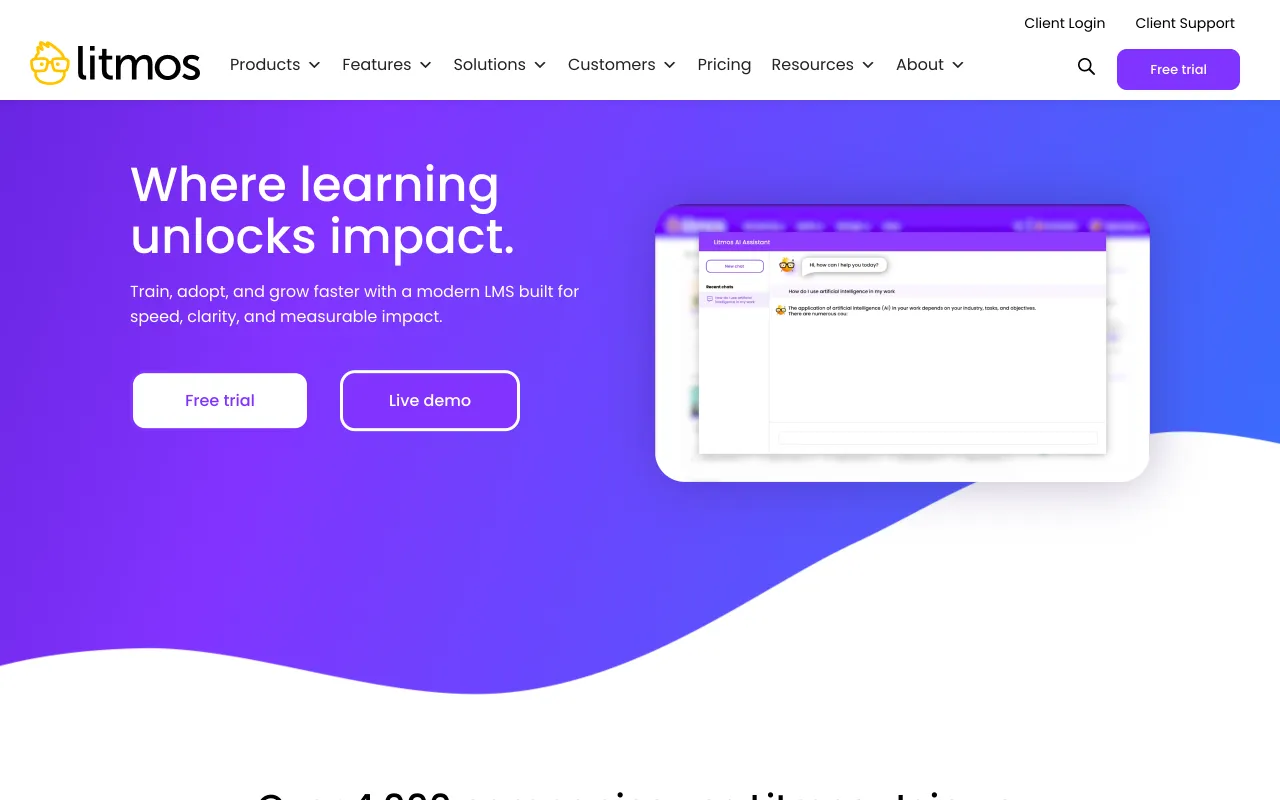
Litmos is one of the most established names in corporate learning, and its sales-enablement edition gets a team up and running quickly with a clean course builder, gamification, and 40+ integrations including CRM and HRIS. If your bottleneck is standing up structured onboarding and compliance training fast, it earns its spot.
Where it sits in our three-layer lens is squarely content delivery. Training is course-based and largely passive, and its video assessment is asynchronous, so reps absorb material and get graded later rather than practicing a live objection in the moment. It teaches the play well; rehearsing it is on you.
Key Features
- Built-in content authoring for building and updating courses without a separate tool.
- Gamification engine with points, badges, and leaderboards to lift completion.
- 40+ integrations across CRM, HRIS, and the rest of the stack, plus AI-assisted course creation.
Consider before choosing
- Delivery, not live practice. Strong for courses and tracking, but skill is measured by completion and quizzes, not by how a rep handles a live conversation.
- Quote-based, active-user pricing. Litmos does not publish a clean price list; LMS-plus-content tiers are commonly benchmarked around $6 to $15 per active user per month depending on volume and features. [Source: third-party LMS benchmarking, 2026]
Onboarding new hires is the most common use case here. See how the options stack up in our best sales onboarding software roundup.
Brainshark (Bigtincan Readiness)
Best for video coachingSales-readiness software built around video coaching and scorecards, now part of Bigtincan.
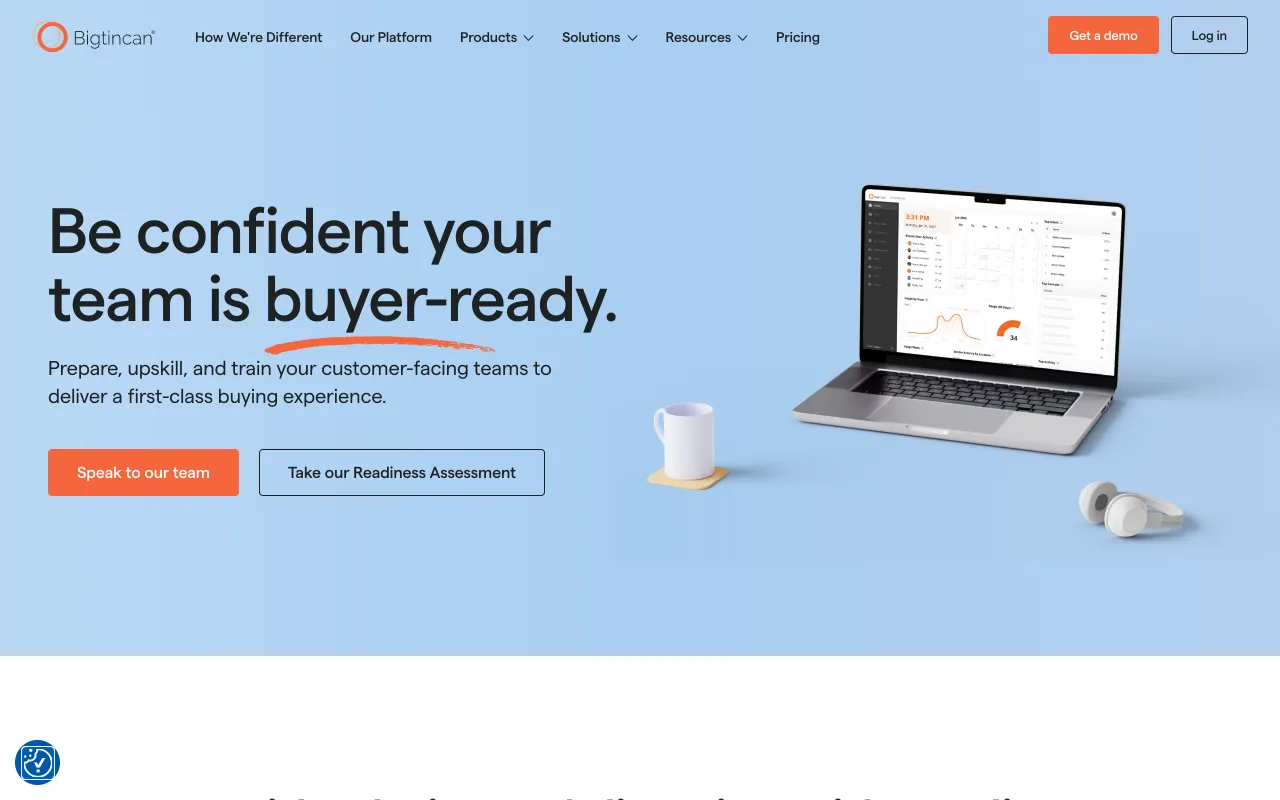
Heads up: Brainshark is now Bigtincan Readiness. The brand folded into Bigtincan, and the product still does what Brainshark was known for, helping teams "be confident your team is buyer-ready" through video-based coaching, readiness scorecards, and machine analysis of practice submissions. [Source: bigtincan.com, June 2026]
This is a genuine step up from a pure LMS because reps actually record themselves selling and get scored on it. The honest limitation: video practice is asynchronous, so a rep records into the void with no live resistance and no objection thrown back at them in real time. It builds delivery polish more than in-the-moment adaptability.
Key Features
- Readiness scorecards that benchmark whether reps are prepared to sell.
- Video coaching where reps submit recorded pitches for review and AI-assisted analysis.
- Content authoring and learning paths for structured, role-based onboarding.
Consider before choosing
- Async, not live. Recording a pitch alone is useful, but it does not replicate a buyer interrupting with a budget objection mid-sentence.
- Custom pricing, enterprise-weighted. Bigtincan does not publish Readiness pricing; third-party benchmarking puts average contracts around $92k/year, scaling well into six figures for large orgs. [Source: third-party benchmarking, 2026]
Highspot
Best for content + playsA sales enablement platform that unifies content management with training and AI-guided plays.
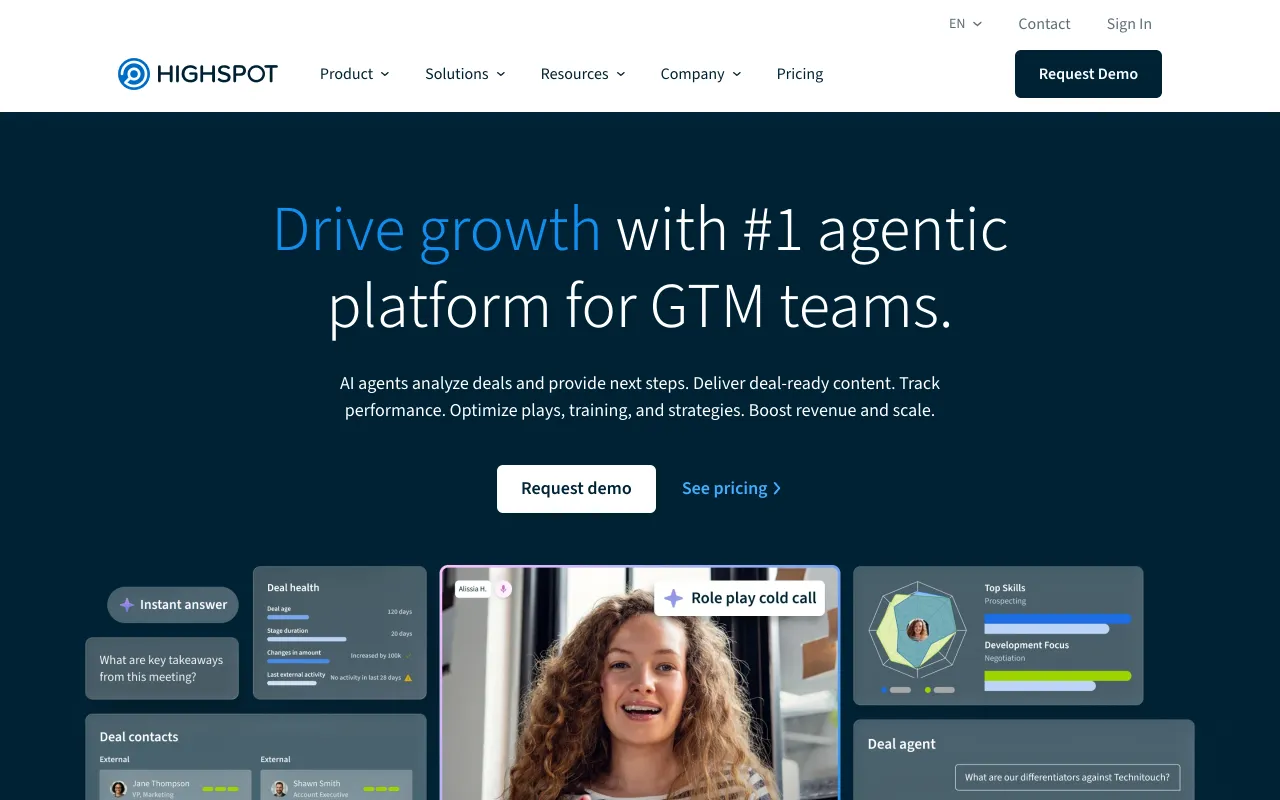
Highspot's core job is organizing the mountain of content a sales team uses in live deals, then layering training, sales plays, and AI on top. Reps find the right deck, the right case study, and the right play fast, and managers see what content actually drives revenue. The homepage now leans hard into AI agents that "optimize plays, training, and strategies."
It even ships a roleplay add-on, which is a real nod to the practice gap. But the platform's center of gravity is content discovery, not skill-building: reps learn what to say and where to find it, more than they rehearse saying it under pressure. As an enablement backbone it is excellent; as a dedicated practice engine it is secondary.
Key Features
- AI-powered content search so reps surface the right asset for any deal stage.
- Sales plays and training modules that pair guidance with the content reps need to run it.
- Content analytics showing which materials influence pipeline and revenue.
Consider before choosing
- Content-first by design. The roleplay is an add-on, not the heart of the product, so practice depth trails a dedicated simulation tool.
- Enterprise pricing, no public rates. Highspot routes pricing through a custom quote scoped to seats and modules. [Source: highspot.com, June 2026]
Weighing the big enablement suites against each other? Our best sales coaching software guide goes deeper on the coaching layer, and our Highspot alternatives roundup covers the platforms teams shortlist against it.
Seismic
An enterprise enablement suite that ties content personalization to learning and coaching at scale.
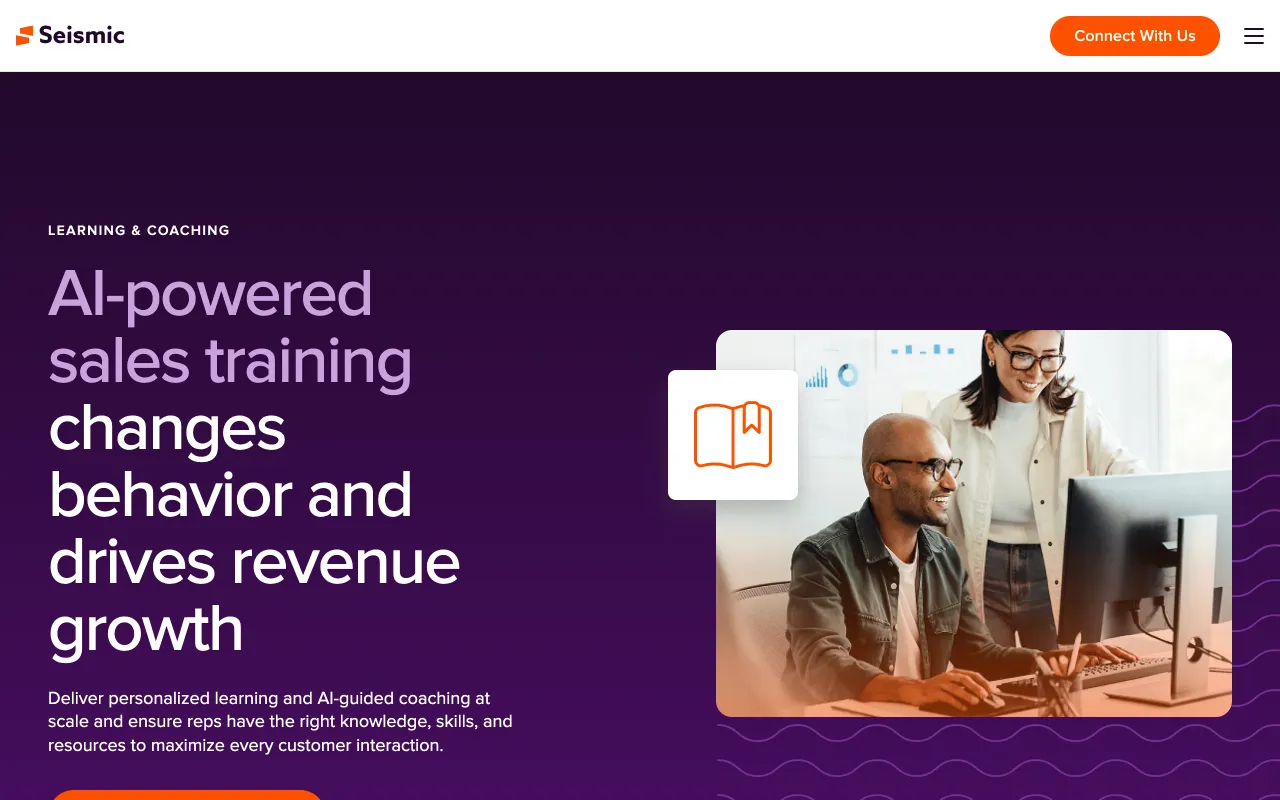
Seismic is the enterprise heavyweight, and to its credit it is the rare suite that frames the pitch around outcomes: its learning page leads with "AI-powered sales training changes behavior and drives revenue growth." Through Seismic Learning (the former Lessonly) plus LiveDocs and content personalization, it gives large GTM orgs one system for content and training.
The reality in our three-layer lens: training is one module inside a much larger content-and-enablement machine. Learning still leans content-based, so for teams whose single biggest gap is reps freezing on live calls, a focused practice tool will out-rehearse it. For teams that need content, personalization, and learning unified across thousands of sellers, few match its breadth, though our Seismic alternatives guide weighs the suites that come closest.
Key Features
- Seismic Learning for course delivery, coaching, and skill tracking inside the broader suite.
- Content personalization and LiveDocs that tailor materials to each buyer and deal.
- Enterprise analytics and integrations across the GTM stack.
Consider before choosing
- Training is one piece, not the focus. You are buying an enablement platform that includes learning, not a purpose-built practice engine.
- Custom enterprise pricing. Seismic prices by scope and seat count through sales, typically a significant annual commitment. [Source: seismic.com, June 2026]
Across Kendo customers: 5-15% higher close rates, 70% faster ramp, and $3,000+ saved per rep.
See the results →
360Learning
Best for peer learningA collaborative LMS that turns your own top reps into the training engine.
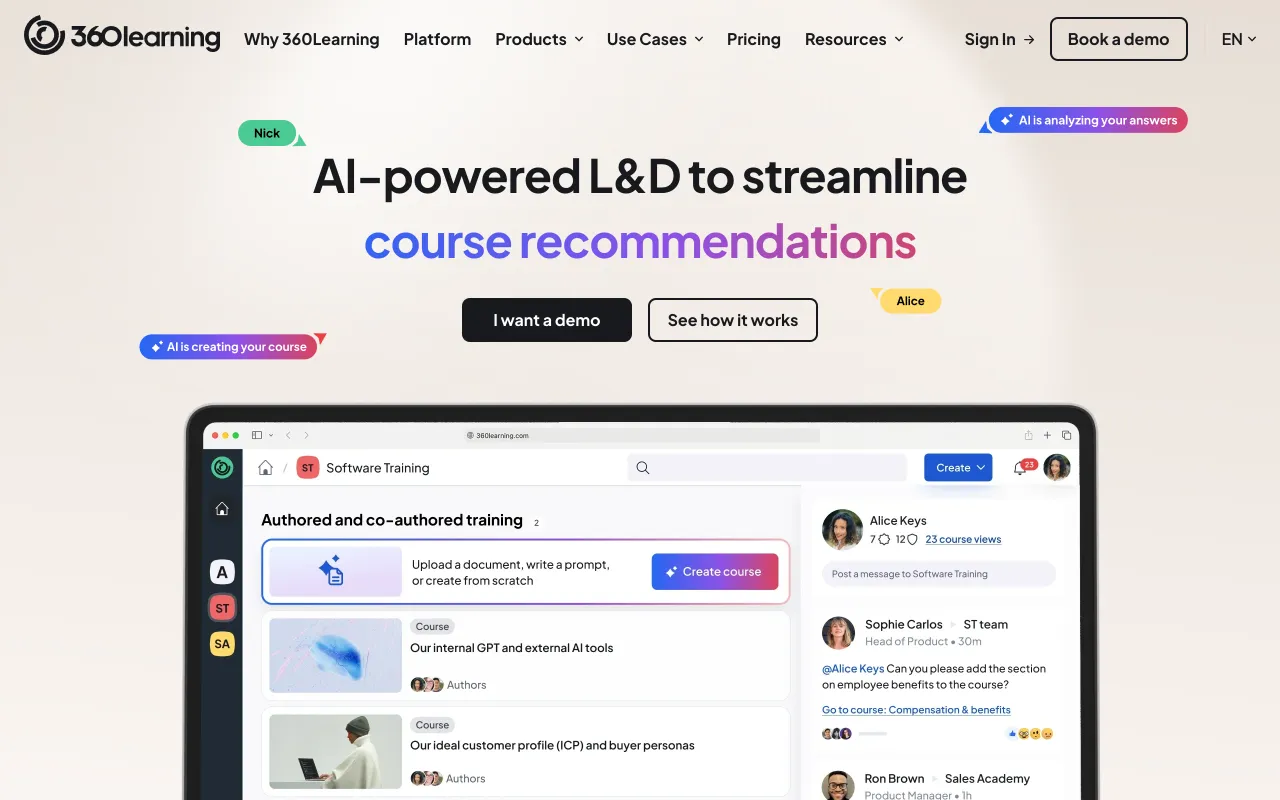
360Learning's angle is genuinely different: instead of buying generic courses, you capture the tribal knowledge of your best closers and turn it into training the whole team co-authors. For a sales org where your top reps already know what works and you just need to scale it, that is a smart model, and AI now helps draft courses and recommend next lessons.
It is still a content-delivery platform at heart, with video coaching and feedback bolted on rather than live simulation. And the model has a dependency worth naming: it only works if your team actually contributes. A disengaged org gets an empty course catalog. Of the LMS picks, though, it is the one publishing real per-seat pricing.
Key Features
- Collaborative course creation that captures expertise from your own top performers.
- Video coaching and feedback for asynchronous practice review.
- Native CRM integration and learning paths tied to role and ramp stage.
Consider before choosing
- Participation-dependent. The peer model is powerful when adoption is high and thin when it is not.
- Transparent entry price. The Team plan is $8 per user per month; Business and Enterprise tiers move to custom quotes with added security and integrations. [Source: 360learning.com, June 2026]
SkyPrep
A clean, no-friction LMS aimed at fast, automated onboarding.
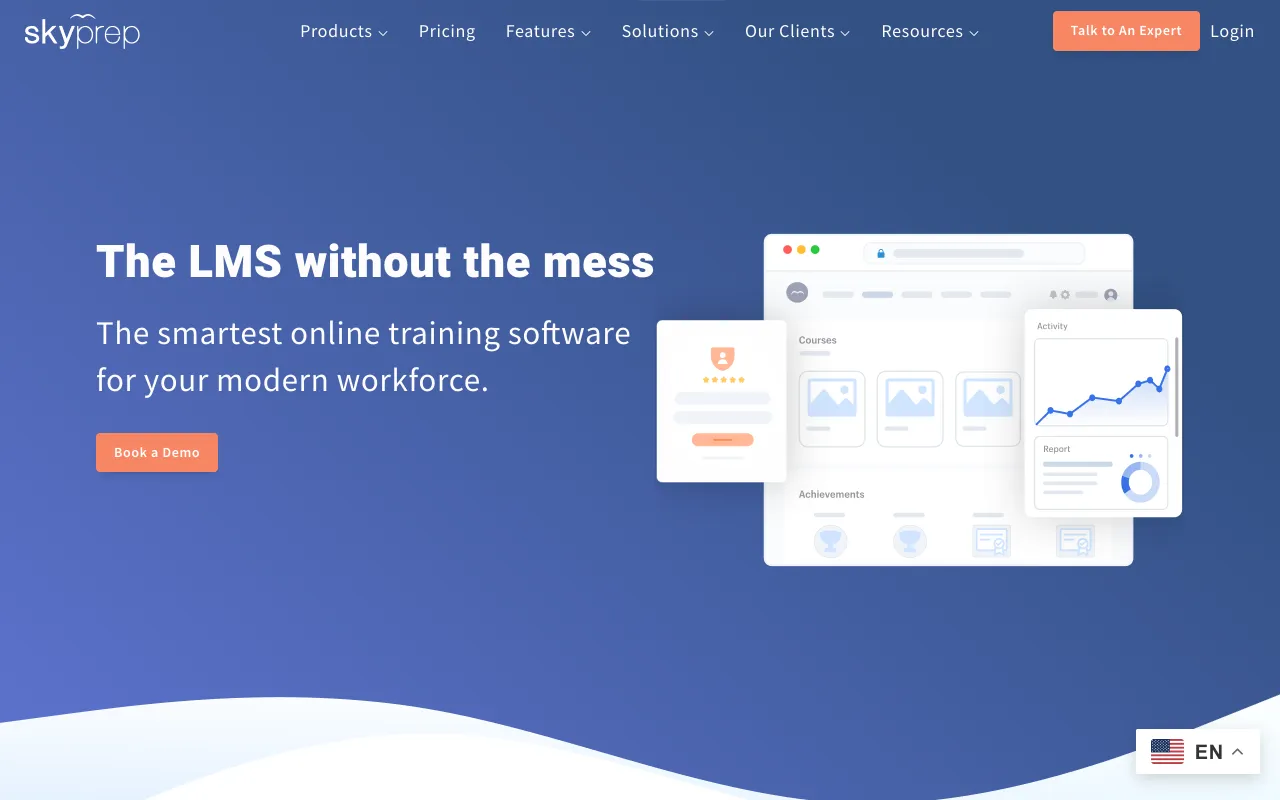
SkyPrep's whole promise is simplicity, and its homepage tagline, "the LMS without the mess," is fair. It is easy to set up, easy for admins to run, and strong on automated training paths and reporting, which makes it a tidy fit for teams that mostly need to get new hires through structured onboarding without fighting the software.
That simplicity is also the ceiling. It is a traditional LMS built around courses, videos, and quizzes, with no live simulation, so it handles the logistics of training well but does not test whether a rep can sell. Think of it as onboarding plumbing, not a skill-building engine.
Key Features
- Automated learning paths that route new hires through the right content in order.
- Clean, intuitive interface that keeps admin overhead low.
- Robust reporting plus SCORM and xAPI support for tracking and content portability.
Consider before choosing
- Logistics over skill. Excellent for delivering and tracking onboarding, silent on whether reps can run a real call.
- Quote-based pricing. SkyPrep finalizes pricing through a sales proposal across Lite, Premium, and Enterprise tiers, billed on active users. [Source: skyprep.com, June 2026]
iSpring Learn
Best value LMSAffordable, full-cycle eLearning with interactive course building at scale.
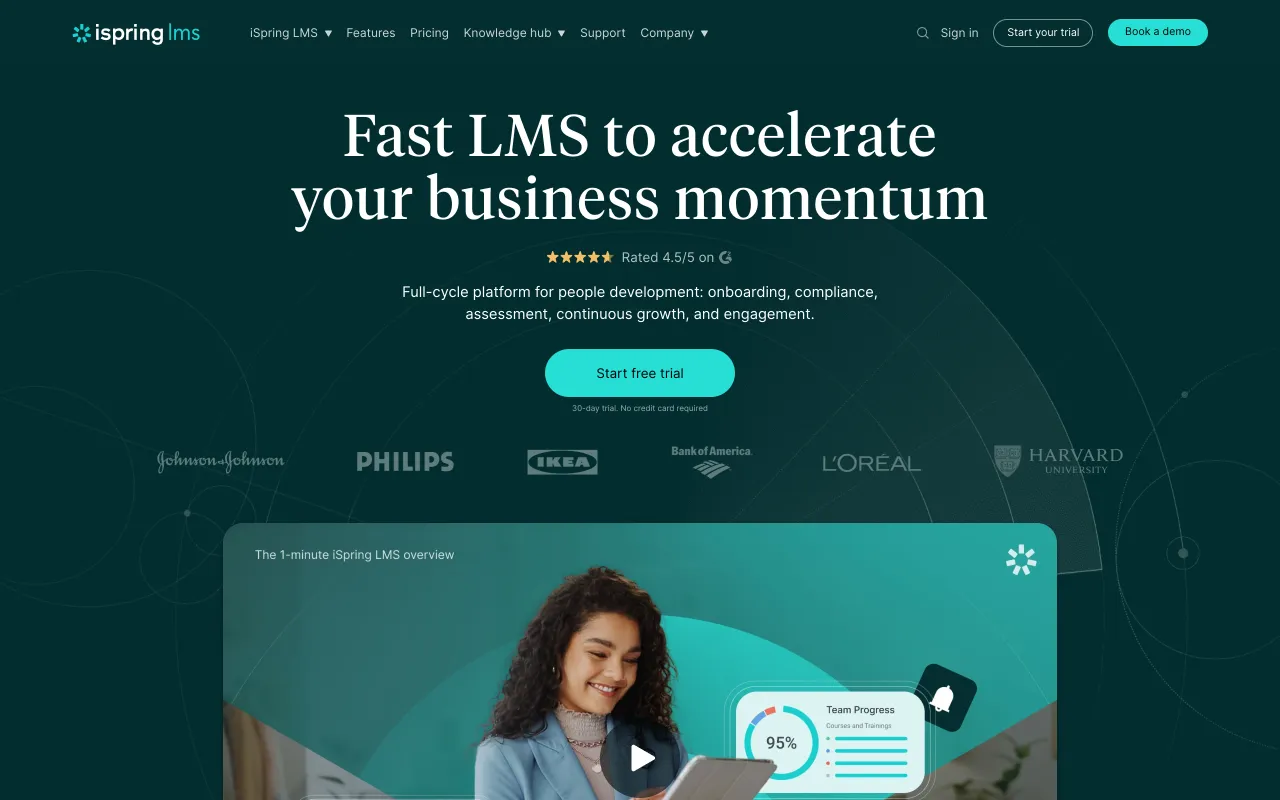
iSpring Learn is the value pick of the LMS layer, and it is good at what it does: a "fast LMS to accelerate your business momentum," with a genuinely strong authoring toolkit, learning paths, 20+ reports, and a Salesforce integration. For a team that wants to build polished, interactive courses cheaply and roll them out widely, it is hard to beat on price.
It does advertise role-play simulations, which sounds like the practice layer until you look closer. They are scripted, with predetermined branches, not dynamic AI conversations, so a rep clicks through choices rather than speaking to a buyer that reacts. Useful for teaching a process; not a substitute for live reps.
Key Features
- Interactive course authoring including scripted, branching role-play scenarios.
- Learning paths and 20+ reports for structured programs and detailed tracking.
- Salesforce integration and a mobile app with 360-degree feedback.
Consider before choosing
- Scripted roleplay only. Branching scenarios follow a fixed path; they do not improvise like a real prospect or score a live conversation.
- Verified pricing. iSpring Learn starts around $3.58 per user per month billed annually, with a Business tier near $4.46 and custom Enterprise pricing; you pay for active users only. [Source: ispringsolutions.com, June 2026]
TalentLMS
Best for small teamsA budget-friendly, no-fuss LMS with a big library of ready-made courses.
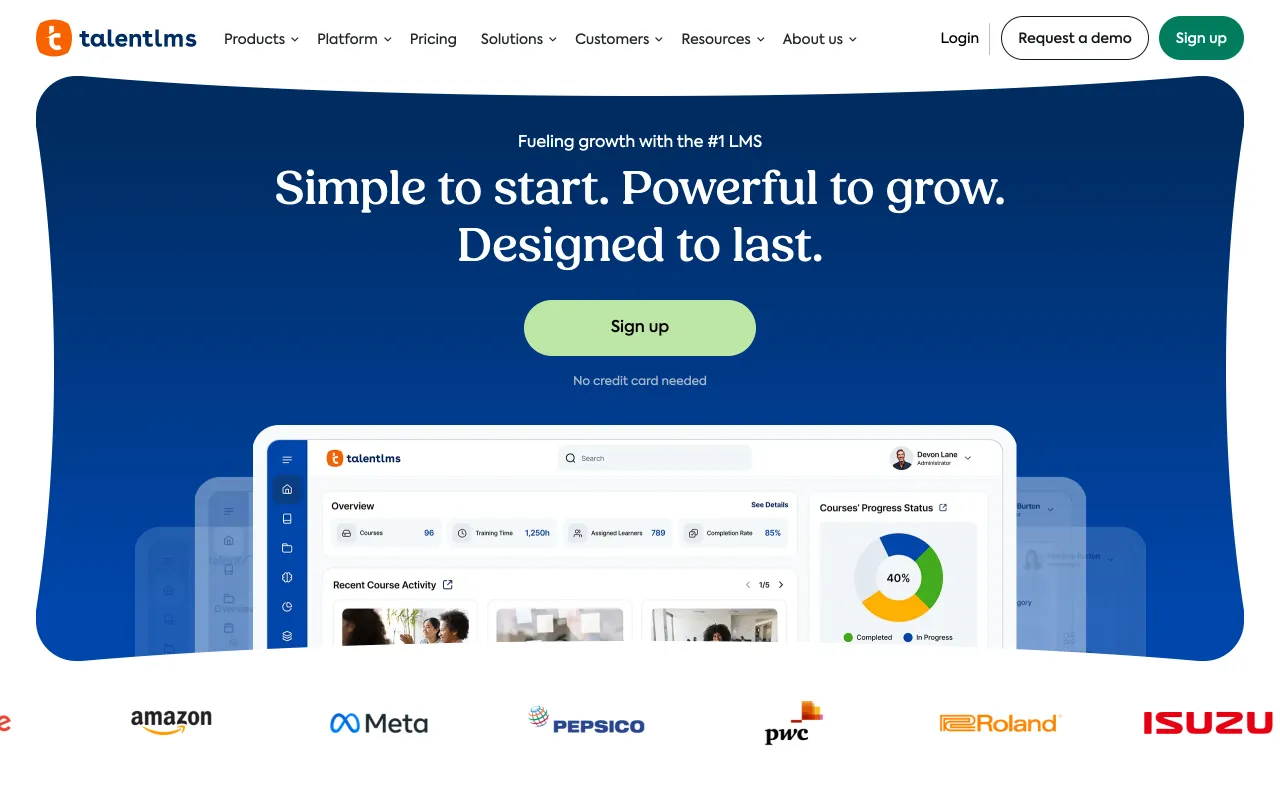
TalentLMS is built for the team that wants training live by next week without a procurement saga. "Simple to start. Powerful to grow" is the pitch, and the 1,000+ ready-made TalentLibrary courses plus a simple builder make it the path of least resistance for small sales teams and startups.
The tradeoff is familiar for this layer: training is course-based and passive, and pre-built content rarely matches your specific sales process, so reps learn general selling rather than your motion. It is a fast, cheap way to deliver fundamentals, not a way to prove a rep can run your call.
Key Features
- TalentLibrary with 1,000+ ready-made courses, including sales fundamentals.
- Simple course builder and gamification for fast setup and steady engagement.
- AI-assisted instructor and Salesforce integration to personalize and connect training.
Consider before choosing
- Generic content, registered-user billing. Pre-built courses may not fit your process, and you pay per registered user, not active ones.
- Verified pricing. Paid plans start at $69 per month (Starter) billed annually, with Core at $119 and Grow at $229; a free tier covers up to five users. [Source: talentlms.com, June 2026]
Allego
A mobile-first enablement platform centered on asynchronous video practice and content sharing.
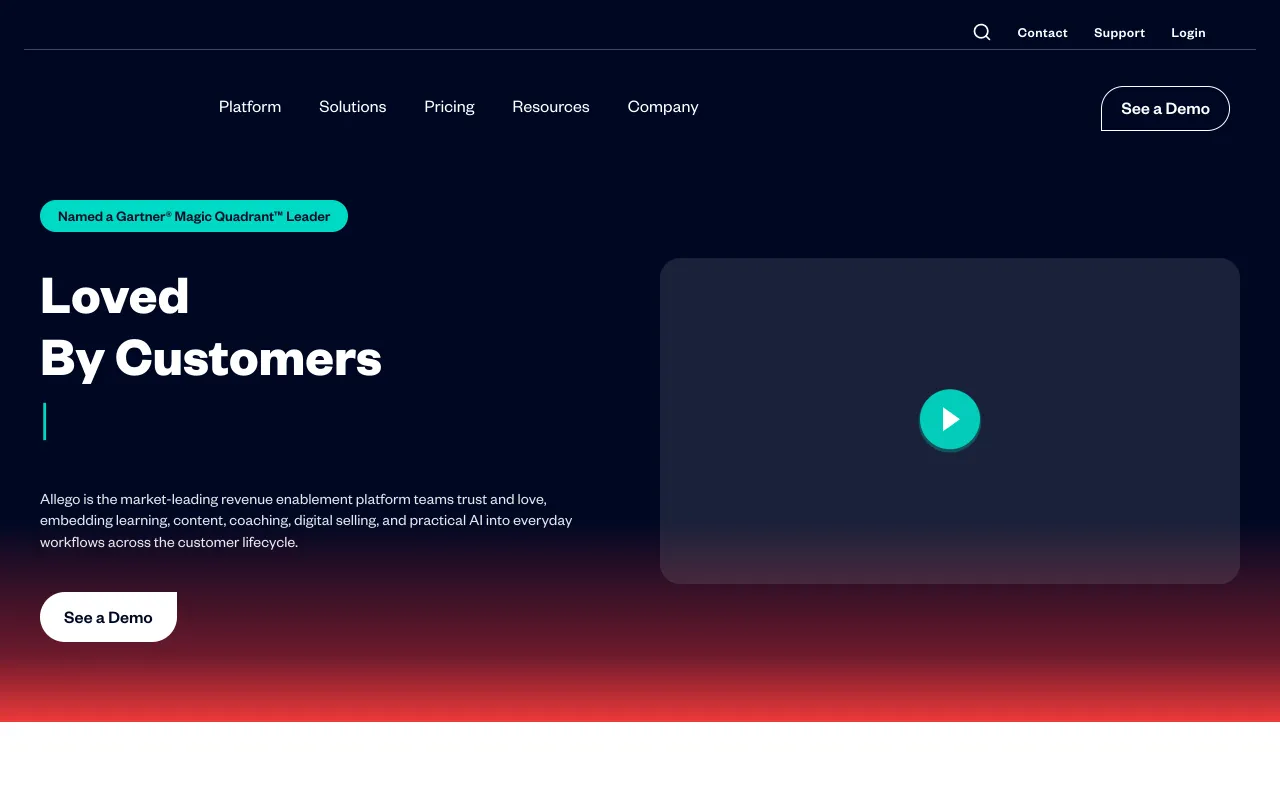
Allego built its name on video, and that is still the draw: reps record practice pitches, managers coach on their own schedule, and a mobile-first design fits field and distributed teams who are rarely at a desk. It folds in a content library and conversation intelligence, so it spans more than training alone.
The recurring theme applies here too. Video practice is asynchronous, so reps rehearse alone without live resistance or an objection thrown back in real time. For a spread-out team that needs coaching to scale across time zones it is a strong fit; for in-the-moment objection drills it is a half-step short of live simulation.
Key Features
- Video practice and feedback with manager coaching that fits async schedules.
- Content library and conversation intelligence alongside the coaching tools.
- Mobile-first design built for field and distributed sellers.
Consider before choosing
- Async by design. Recording solo builds delivery polish but not live adaptability against a buyer that pushes back.
- Custom pricing. Allego prices by team size and feature set through a quote rather than published rates. [Source: allego.com, June 2026]
Adobe Learning Manager
Enterprise LMS infrastructure for training employees, partners, and customers at scale.
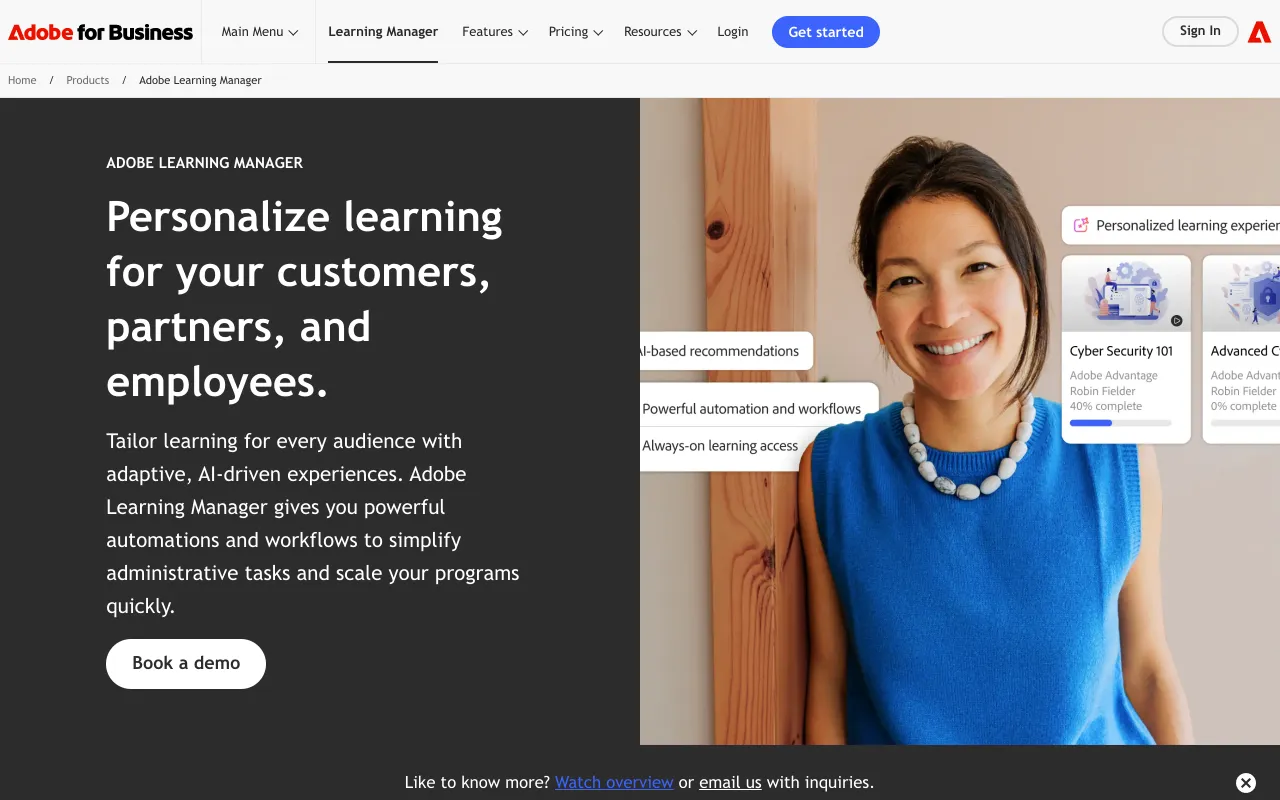
Adobe Learning Manager (the former Captivate Prime) is built for scale, with a headless architecture, multi-tenant support, and AI-driven recommendations that let a big organization run sales, partner, and customer training from one system. If you are standing up learning infrastructure across many audiences and regions, it is enterprise-grade.
It is also the most traditional LMS on this list. The focus is courses, certifications, and administration, not live sales practice, and the enterprise setup carries real implementation weight. Pick it when the priority is scalable, governed learning delivery, not rehearsing objection handling.
Key Features
- Headless, multi-tenant architecture for training employees, partners, and customers separately at scale.
- AI-powered recommendations that personalize learning paths by role and behavior.
- Mobile app with offline access and a large content marketplace.
Consider before choosing
- Infrastructure, not practice. A traditional LMS focused on courses and certifications, with no live simulation for reps.
- Two pricing models. Adobe offers registered-user and monthly-active-user licensing, starting around $5 per user per month, with full pricing scoped by quote. [Source: business.adobe.com, June 2026]
How to Choose the Right Sales Training Software
Skip the feature checklist for a second. The decision that actually matters is the one we opened with: which of the three layers is your team short on? Get that right and the shortlist picks itself.
If reps do not have structured content and onboarding at all, start with the content-delivery layer. iSpring Learn and TalentLMS are the value plays, 360Learning if you want your own reps to build the curriculum, Adobe Learning Manager or SkyPrep if you need enterprise-grade or onboarding-focused infrastructure.
If content exists but it is scattered and reps cannot find the right asset in a deal, you want the enablement layer. Highspot and Seismic lead content management at scale, while Allego or Brainshark fit when video coaching is the priority; our platform comparison shows how the wider field differs.
If reps know the theory but freeze on live calls, no amount of content fixes it. That is the practice layer, and it is where a tool like Kendo earns its place. Here is the quick version:
| Your Gap | The Layer You Need | Strong Options |
|---|---|---|
| No structured onboarding or course library | Content delivery (LMS) | iSpring Learn, TalentLMS, SkyPrep |
| Top reps' knowledge isn't scaled to the team | Collaborative LMS | 360Learning |
| Content is scattered; reps can't find assets | Enablement / content mgmt | Highspot, Seismic |
| Coaching needs to scale across a distributed team | Video coaching | Allego, Brainshark |
| Reps know the theory but freeze on live calls | Practice / simulation | Kendo AI |
| Enterprise learning across many audiences | LMS infrastructure | Adobe Learning Manager |
One pattern holds across every category: the tools that move quota attainment are the ones that force reps to practice, not just consume. Salesforce found reps coached against real-world scenarios are markedly more likely to improve attainment [Source: Salesforce State of Sales]. That is exactly the gap the practice layer fills, and why we put it at the center.
Ramping new hires faster is the payoff most teams are really after. Our playbook on how to reduce sales ramp time shows how practice and reinforcement compress that curve.
Real-Time Field Training and Objection Handling
One request comes up again and again from sales leaders evaluating these tools: "I need real-time field training that drills objection handling and competitive positioning, with instant feedback." It is worth answering directly, because most of this list cannot do it.
An LMS teaches objection handling as content. A rep reads the framework, watches a video, and answers a multiple-choice question. That builds recognition, not reflexes. When a real prospect says "you're more expensive than [competitor]," recall from a quiz three weeks ago rarely fires fast enough.
Video coaching gets closer: the rep at least says the words out loud. But it is still a monologue into a webcam. Nobody interrupts. Nobody pushes back. Nobody changes the subject when the rep fumbles the price.
Simulation is the only software category that delivers genuine real-time practice. In a Kendo roleplay, the AI buyer raises a budget freeze, name-drops a competitor, or stalls on timing, and the rep has to respond live while real-time coaching nudges them and an objective score grades how they handled it. That is as close to field training as software gets before a live prospect is on the line.
If practice is the layer you're missing, it's worth seeing the category on its own terms. Our roundup of the best AI sales roleplaying tools compares the platforms built specifically to drill live objections, so you can match the right simulation tool to your team.
The Verdict: Which Sales Training Software Should You Pick?
There is no single winner, because these eleven tools do not compete for the same job. The best pick is the one that fills the layer you are missing.
- Best for content delivery and value: iSpring Learn and TalentLMS deliver structured courses cheaply, with 360Learning if you want your team to build the curriculum.
- Best for enterprise content management: Highspot and Seismic unify a sprawling content library with training across thousands of sellers.
- Best for video coaching: Allego and Brainshark (Bigtincan Readiness) scale recorded practice and feedback across distributed teams.
- Best for enterprise LMS infrastructure: Adobe Learning Manager runs governed learning across employees, partners, and customers.
- Best for the practice layer: Kendo AI proves reps can execute, with unlimited live AI roleplay and objective scoring from $55 per seat per month.
Most teams already own a content or enablement layer and still watch reps stall on live calls. The content delivers the play. Practice proves they can run it. If you want reps drilling real objections before they ever touch a live opportunity, start a free Kendo roleplay or book a demo.
Frequently Asked Questions
What is the best sales training software in 2026?
It depends on the gap you are closing. For content delivery and certification, LMS platforms like Litmos, iSpring Learn, and TalentLMS lead. For content management plus coaching at enterprise scale, Highspot and Seismic are strong. For the practice layer that proves a rep can actually run the play live, Kendo AI lets reps drill objections and discovery against realistic AI buyers with objective scoring, starting at $55 per seat per month.
What platform provides on-demand sales training content?
Most LMS platforms here deliver on-demand content. Litmos, iSpring Learn, TalentLMS, SkyPrep, and Adobe Learning Manager host courses, videos, and quizzes reps can take anytime. Highspot, Seismic, and Allego add a searchable content library plus video coaching. If you want on-demand practice rather than on-demand content, Kendo gives reps unlimited AI roleplay they can run 24/7 instead of waiting for a scheduled session.
Which platform is best for real-time field training and objection handling?
Course-based LMS tools teach objection handling as content, then test recall with a quiz. To rehearse objections out loud with instant feedback, you need simulation. Kendo runs live voice roleplay where AI buyers raise budget, timing, trust, and competitive objections, and reps get real-time coaching plus an objective score on how they handled each one. That is the closest software gets to real-time field training before a rep faces a live prospect.
What is the difference between an LMS and AI roleplay software?
An LMS delivers and tracks training content: courses, videos, quizzes, and certifications. It proves a rep watched the material and passed a test. AI roleplay software measures whether the rep can execute under pressure, by having them run a live conversation against a realistic AI buyer and scoring the actual behavior. The LMS proves knowledge. Roleplay proves skill. Most teams need both.
How much does sales training software cost?
Pricing ranges widely by category. Self-serve LMS platforms start low: iSpring Learn from about $3.58 per user per month, Adobe Learning Manager from about $5, 360Learning at $8, and TalentLMS from $69 per month for a small team. Enterprise enablement suites like Highspot, Seismic, Brainshark, and Allego use custom quotes that commonly run into five and six figures a year. Practice platforms like Kendo start at $55 per seat per month.
Which sales training software works best for specialized verticals?
Most platforms ship generic content, so vertical fit comes down to how easily you can build your own scenarios. LMS tools let you author courses, but the practice still follows a fixed script. Kendo lets you build AI buyers that match your exact ICP, industry, product, and objections, so a fintech rep, an insurance agent, and a medical-device seller each practice against a prospect that sounds like their real market rather than a one-size-fits-all module.
Does sales training software actually improve performance?
Only when it changes behavior, not just completion rates. Decades of memory research, summarized by the Ebbinghaus forgetting curve, show learners forget most of what they're taught within weeks without reinforcement, so content alone fades fast. The software that moves numbers is the kind that builds reinforcement and practice in, tied to behaviors like objection-handling success, discovery depth, and ramp time. Teams that add repeated practice after a course retain far more than teams that run one-off workshops.

Luke Alexander is the founder of Kendo AI, where he's helped train more than 5,000 sales reps. He started in sales as a frontline closer, scaled a high-ticket sales-training company, and founded Closer Cartel and co-founded Closify before building Kendo to fix the tools he wished he'd had: realistic AI roleplay and automated call review for fast-moving sales teams. He writes about sales training, ramp speed, objection handling, and applying AI across the revenue org.