
Most teams still run the same old-school playbook: record a call, grab the transcript, and hope a manager finds time to review it.
By 2026, that reactive loop is too slow. Reps already spend just 28% of their week actually selling (Salesforce State of Sales), and most sales training fades within months without practice. So the best teams have flipped the order: they rehearse the call before the deal is on the line, not autopsy it after, which is why the category increasingly overlaps with the best AI sales training software.
We ranked the 14 best platforms below, led by Kendo AI. If practice is the part you want to nail, the companion roundup of the best AI sales roleplaying tools is the natural next read.
Why Proactive AI Training Beats Reactive Call Review
Most call analysis tools are fundamentally reactive. A rep fumbles a call, the software transcribes the disaster, and hours or days later a manager flags the mistake. By then the damage is done: the lead is burned, the objection was missed, and the opportunity is gone.
This "wait and see" model has three flaws:
- The lag time. By the time a rep gets feedback, they have already repeated the same mistake on five other calls.
- The manager bottleneck. Someone still has to review and coach. Most managers are already buried in meetings and cannot keep up.
- The cost of trial by fire. Learning on real prospects is expensive. Every botched call throws roughly $30 to $50 of lead spend in the trash.
Proactive AI training flips the script. Instead of learning from failure on live leads, reps build muscle memory against realistic AI prospects before they ever pick up the phone. You get faster ramp times and higher close rates because the practice happens in a simulator, not on your dime. We ranked every tool below on this shift: platforms that offer proactive simulation scored higher than those that only record the mistakes you have already made.
Key Features to Look For in Call Analysis Software
After analyzing the category and hundreds of user reviews, here is what separates a tool reps actually use from shelfware. (New to the category? Start with our guide to sales call tracking.)
- Scoring against your framework, not generic rubrics. The best tools grade calls against your actual sales process, scripts, and call types. A canned "you scored 72%" tells a rep nothing.
- Coaching that closes the loop. Analysis should not stop at "here is what went wrong." Look for tools that turn a flagged weakness into targeted practice or a clear next step.
- Fast time to value. If you need three demos, IT approval, and a 12-week rollout before a rep sees feedback, momentum dies. Self-serve tools win adoption.
- Transparent pricing. Know what you will pay upfront. Watch for platform fees, seat minimums, and "call us" pricing that hides five-figure contracts.
- Integrations that fit your stack. The tool should pull calls from where they already live, Zoom, Fathom, your dialer, or an open API, without forcing a rip-and-replace.
What Sales Call Transcript Analysis Should Surface
A raw transcript is just text. The point of sales call transcript analysis is to turn that text into a short list of things you can act on, not a wall of words to scroll. Before you trust a tool's analysis, check that it pulls out the signals that actually predict whether a deal moves.
- Talk-to-listen ratio. Who spoke more, you or the prospect, and when. Top B2B reps sit near 43:57 [Source: Gong research], so a transcript that flags a rep monologuing at 70:30 is flagging a coachable habit.
- Objection moments. The exact lines where price, timing, or a competitor came up, and how the rep responded, so you can drill the objection-handling rebuttals that keep stalling deals.
- Next-step commitments. Whether a concrete next step was actually agreed, and what it was. Calls that end without a committed follow-up are the ones that quietly die in the pipeline.
- Keyword and topic tracking. Mentions of competitors, pricing, features, and risk terms, surfaced and searchable across calls instead of buried in one recording.
- Sentiment. Where the prospect warmed up or cooled off, mapped to the moment it happened, so you can see what shifted the tone.
Most tools on this list read transcripts well for notes and search. For deeper sales signals, Gong leans on talk ratios, topic tracking, and competitor mentions, Clari's Copilot layers transcription and coaching onto its revenue view, and Fireflies.ai and tl;dv handle searchable, multi-language transcripts that feed downstream analysis. Teams that want call intelligence with a stronger coaching workflow can also compare the options buyers consider when Jiminny is not the right fit. The gap to watch for is the same one that runs through this guide: most stop at surfacing the signal and leave the fix to you. Kendo grades each transcript against your framework, then turns a flagged weakness into a targeted roleplay.
TLDR: Best Sales Call Analysis Software at a Glance
| # | Tool | Best For | Key Features | Pricing |
|---|---|---|---|---|
| 1 | Kendo AI RECOMMENDED | Proactive training + analysis | AI roleplay engine, live simulations, auto-scoring | Free or $55/mo |
| 2 | Gong | Enterprise intelligence | Deal tracking, revenue forecasting, deep analytics | Custom (~$5k+/yr*) |
| 3 | Claap | Collaborative prep | Meeting agents, CRM sync, video search | Free or €30/mo |
| 4 | Salesloft | Outbound teams | Sequences, dialer, conversation analytics | Custom (~$125/mo*) |
| 5 | Salesify | Coaching growth | Sentiment tracking, real-time tips, compliance | Free or $39/mo |
| 6 | Fireflies.ai | Cross-dept notes | Searchable transcripts, action items, 40+ apps | Free or $18/mo |
| 7 | CallRail | Marketing teams | Campaign attribution, AI call scoring, tracking | From $50/mo + usage |
| 8 | Balto AI | Live guidance | Real-time prompts, dynamic scripts, QA alerts | Custom |
| 9 | ExecVision | Skill gaps | Performance benchmarking, coaching scorecards | Custom |
| 10 | Observe.AI | Contact centers | Auto-QA at scale, VoiceAI agents, compliance | Custom |
| 11 | HubSpot CI | HubSpot teams | Native recording, keyword tracking, deal sync | $100 to $150/mo |
| 12 | Clari | RevOps / forecasting | Pipeline inspection, revenue leak detection | Custom (~$100/mo*) |
| 13 | Chorus | ZoomInfo users | Market data, talk-ratio analysis, deal intel | Custom (~$8k/yr*) |
| 14 | tl;dv | Affordable productivity | Meeting recorder, AI summaries, async clips | Free or $18/mo |
Pricing and features verified against each vendor's site as of June 2026. *Vendors marked "Custom" do not publish prices and require a demo; figures from third-party sources are cited inline in brackets. Details may change after publication.
Kendo AI: The Only Full-Loop Sales Call Analysis and Training Platform
★ Best overallAnalyze the call, find the weakness, then fix it in a live practice rep, all in one platform.
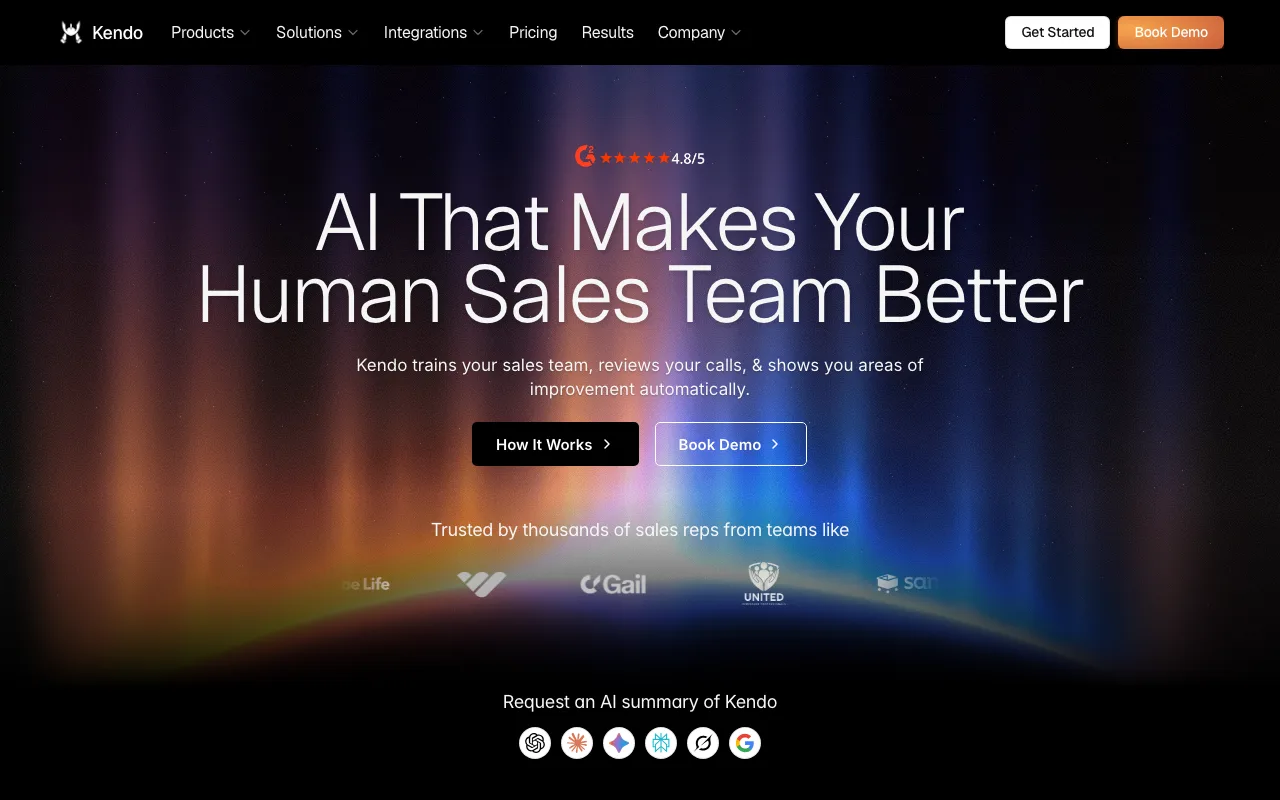
We will admit there is some bias here, we built Kendo. We built it because every other tool on this list treats sales call analysis as a post-mortem: it tells you what went wrong, hours after the deal is already cold. Kendo treats analysis as a continuous loop instead.
It is the only platform here that lets you analyze a call, identify a weakness, and immediately fix it in a safe practice environment. Kendo's AI roleplay engine spins up ultra-realistic prospects with custom objections, personalities, and buying scenarios in seconds. Reps train against human-like simulations with state-of-the-art voice AI instead of burning leads during onboarding. Then the platform auto-scores every real call like a world-class coach was sitting in.
This is what practicing on Kendo looks like. The AI buyer pushes hard on SOC 2, ISO 27001, and proof the tool cuts compliance work, and the rep has to handle it on the spot, before any of it lands on a live deal.
Kendo AI vs. reactive call review
| Capability | Kendo AI | Reactive call review tools |
|---|---|---|
| When you improve | Before the live call, in practice | After the call, once the lead is spent |
| Scoring | Grades 100% of calls against your framework | Transcribes and flags, scoring varies |
| The fix | Auto-triggers a targeted 10-min roleplay | Leaves the fix to a busy manager |
| Insights | Ask "Hey Kendo" in plain language | Dig through dashboards yourself |
| Pricing | Public, from $55/mo per seat | Often custom, demo-gated |
Most tools tell you what happened. Kendo tells you how to fix it, then gives the rep the reps to do it. By 2026 it has moved well past simple transcription into a closed-loop coaching system. Teams that need to operationalize that loop across every rep can compare platforms that connect call review, coaching priorities, and rep progress.
"A week after we got Kendo set up our sales doubled. Can't recommend them enough."
BMBrian Moran · Founder, SamCartKey Features
- Automated methodology scoring. Kendo does not just transcribe. It grades 100% of calls against your frameworks and pinpoints exactly where a rep nailed discovery or fumbled a key objection.
- "Hey Kendo" AI insights. Skip the dashboards. Ask the AI sales manager natural-language questions like "Which reps are losing deals at the pricing stage?" and get data-backed answers in seconds.
- The proactive correction loop. When analysis spots a skill gap, Kendo triggers a targeted 10-minute AI roleplay so the rep builds muscle memory before the next live deal.
- Custom scorecards. Tailor AI feedback to specific call types, from high-volume cold calls to complex enterprise demos.
- Zero-latency voice AI. Human-like simulations with sub-500ms responses, plus AI call reviews that turn every recording into summaries, scorecards, and coaching actions.
Pricing
Kendo keeps pricing public and per-seat, with a free roleplay trial to start. See full transparent pricing.
| Pro $55/mo per seat | Max $100/mo per seat | Enterprise Custom |
|---|---|---|
| 180 roleplay minutes/seat, 25 hrs live call scoring, custom scorecards, advanced analytics, standard support | 480 roleplay minutes/seat, 100 hrs live call scoring, everything in Pro, VIP support | Teams of 10+, DFY setup and customization, dedicated account manager, SSO and security |
Consider before choosing
- The native integration list is still growing. Kendo imports calls from Fathom, Zoom, Fireflies, Slack, and Zapier today, plus an open Push API for anything else. If you need a long tail of one-click connectors out of the box, confirm yours is covered first.
- Built for sales, not general meetings. Kendo is a sales training and call-analysis platform, not an all-hands note-taker. If you mainly want company-wide meeting notes, a transcription tool may fit better.
Gong: Enterprise Conversation Intelligence
The established leader in conversation intelligence for large, mature sales orgs.
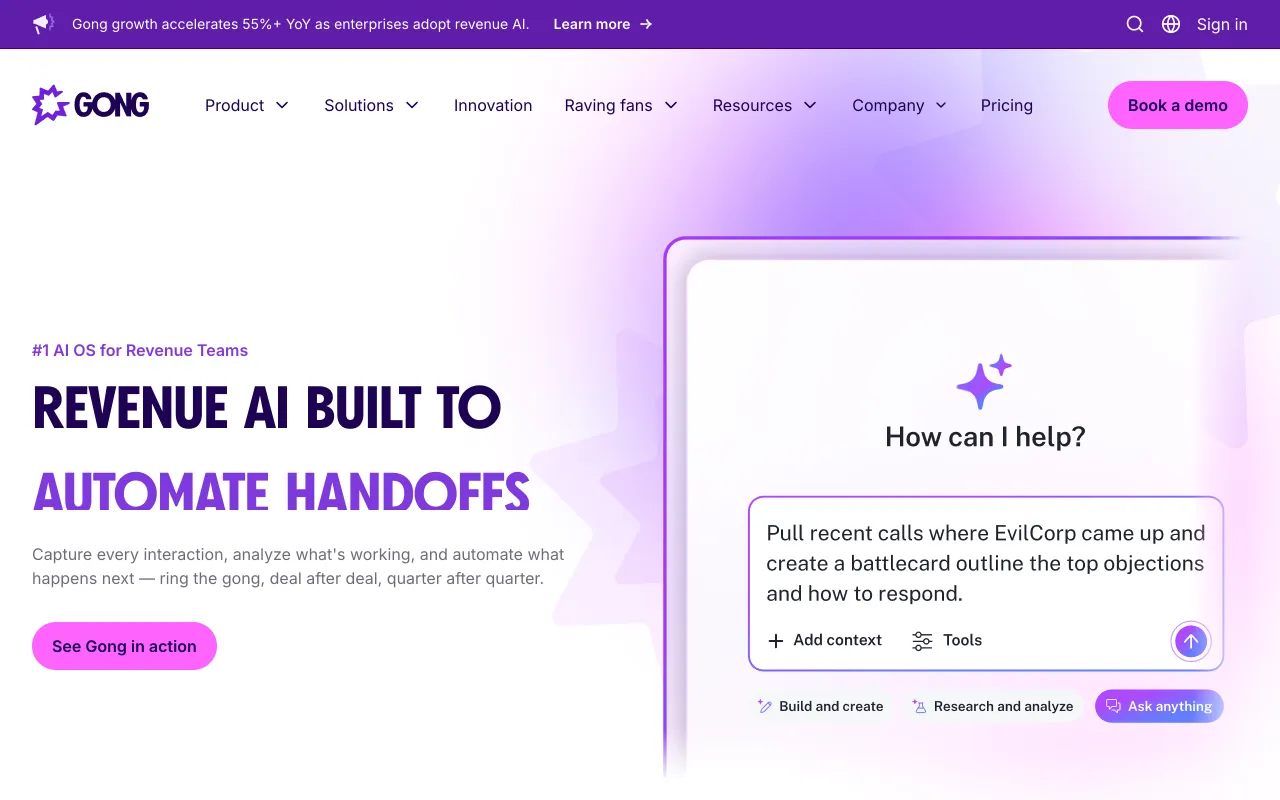
Gong captures and analyzes conversations across calls, emails, and meetings with powerful deal-tracking, revenue forecasting, and coaching dashboards. For organizations with 50+ reps and mature processes, it delivers granular insight few competitors match. If you are weighing the two directly, see the full Kendo vs Gong breakdown.
Key Features
- Call recording and transcription across calls, video meetings, and email for the whole team.
- Deal intelligence that tracks progression, flags at-risk deals, and gives pipeline visibility with AI risk alerts.
- Revenue forecasting with AI-powered pipeline analysis and predictions.
- Coaching dashboards showing talk ratios, topic tracking, competitor mentions, and rep scorecards.
Consider before choosing
- Purely reactive. Gong analyzes calls that already happened. There is no AI roleplay or pre-call practice, so the fix still lands on a manager.
- Expensive for small and mid teams. Pricing is custom and demo-only; third-party sources cite a platform starting around $5,000 per user per year plus a roughly $1,360 annual platform fee that scales with team size. [Source: third-party estimates]
Want training, not just dashboards? See 14 top Gong alternatives.
Claap: Collaborative AI Call Analysis
Lightweight call recording, AI meeting agents, and collaborative review without enterprise overhead.
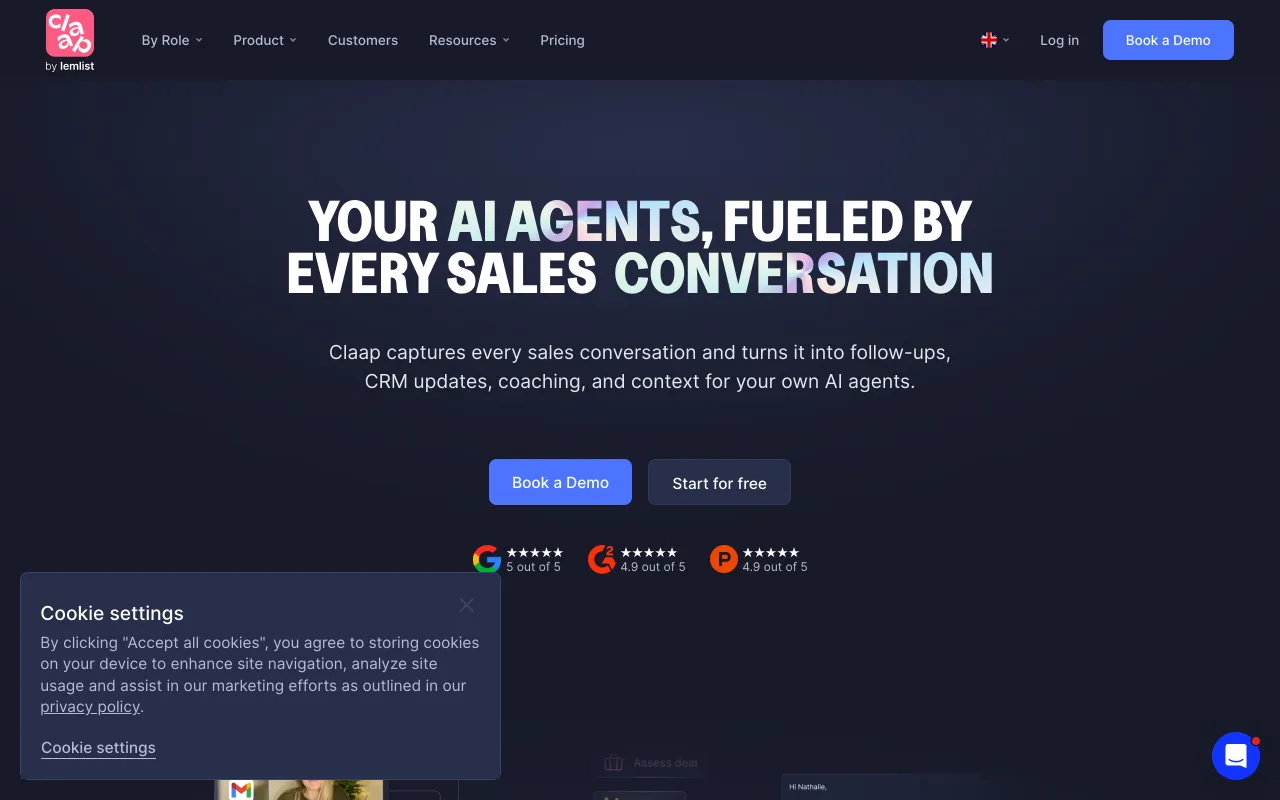
Claap pairs call recording with AI meeting agents, automatic note-taking, and coaching tools. Its flexible workspace structure and light interface make it appealing for teams that want actionable analysis without a heavy rollout.
Key Features
- AI meeting agents that record, transcribe, and generate structured summaries with action items.
- Sales coaching with call highlights, objection tracking, and performance feedback.
- CRM auto-complete that syncs meeting insights to Salesforce, HubSpot, and other CRMs.
- Searchable call library with AI-tagged moments, keywords, and bookmarks.
Consider before choosing
- Post-call only. Claap focuses on analysis and note-taking. There is no AI roleplay or simulation, so reps still learn on live calls.
- Per-license tiers. Basic is free; the Pro license is €30/license per month (€24 annual) and the sales-focused Business license is €60/month (€48 annual). [Source: Claap pricing page, June 2026]
Salesloft: Sales Engagement Plus Conversation Analytics
Outbound sequencing, a built-in dialer, and conversation intelligence in one suite.
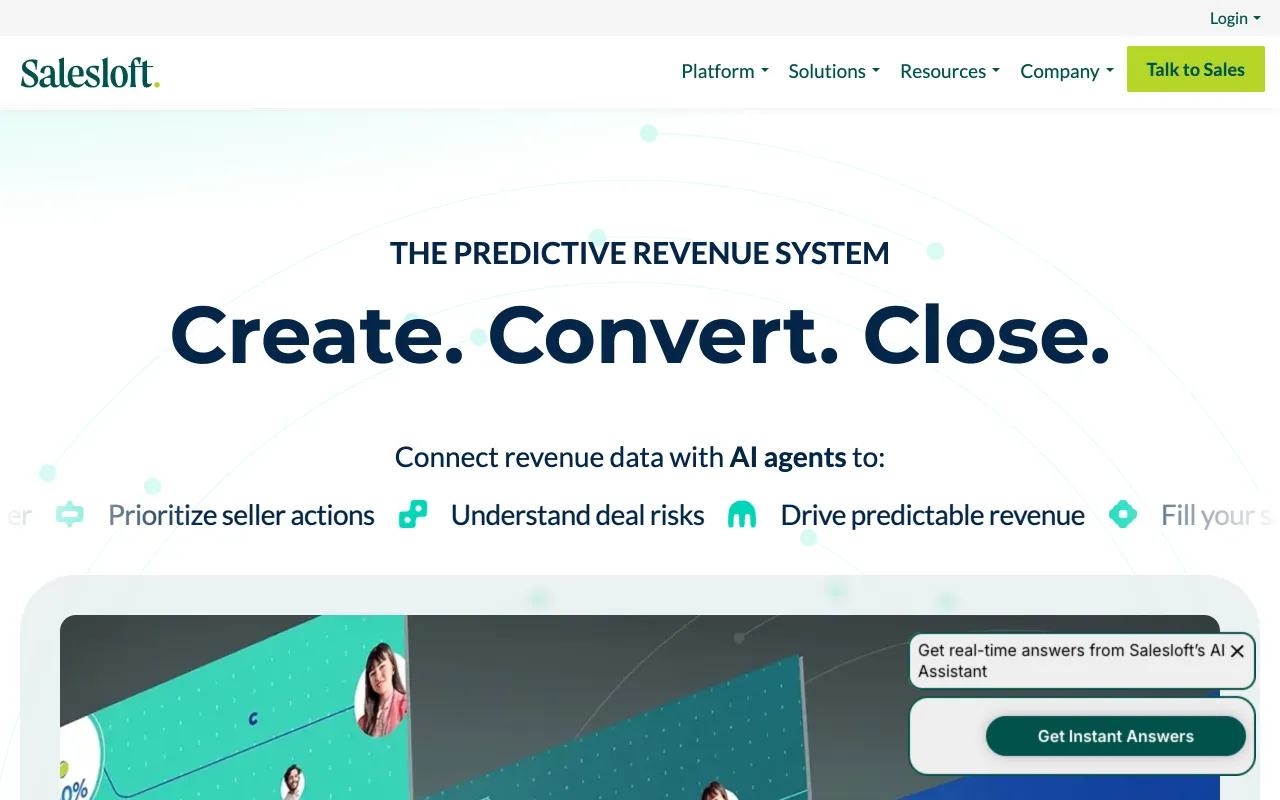
Salesloft combines multi-step cadences, a dialer, and conversation intelligence so outbound teams get call analytics in the same platform they prospect from. Note that Salesloft merged with Clari in August 2025, so the two product lines are converging.
Key Features
- Cadence and sequencing for structured multi-touch outreach across email, calls, and social.
- Built-in dialer with click-to-dial, recording, and local presence.
- Conversation intelligence with transcription and keyword and topic tracking.
- Deal intelligence and reporting with health scoring, activity tracking, and CRM sync.
Consider before choosing
- Coaching is a side feature. Conversation intelligence is one slice of a larger engagement platform, so depth lags dedicated tools. There is no roleplay or proactive simulation.
- Custom pricing, seat minimum. Not publicly listed; third-party sources cite roughly $1,000 to $1,500 per user per year for base access, climbing with modules, on a 3-seat minimum and annual contracts. [Source: third-party estimates]
Salesify: AI Call Monitoring and Coaching
Real-time call monitoring with personalized post-call coaching recommendations.
Salesify offers AI-driven call monitoring built around actionable coaching. It analyzes conversations in real time, tracks sentiment, and serves personalized recommendations afterward.
Key Features
- Real-time call analysis that tracks sentiment, keywords, and talk-to-listen ratios as the call happens.
- Personalized coaching tips generated after each call and tailored to the individual rep.
- Transcription and summaries with key takeaway extraction.
- Compliance monitoring with automated checks against industry rules.
Consider before choosing
- No pre-call practice. Salesify does not offer roleplay or simulation, so reps still build skills on live calls.
- Smaller, newer vendor. Freemium with a free demo and Pro from $39/mo per seat; independent review coverage is still thin, so validate fit in a trial. [Source: Salesify site]
 Across Kendo customers: 5-15% higher close rates, 70% faster ramp, and $3,000+ saved per rep.
See the results →
Across Kendo customers: 5-15% higher close rates, 70% faster ramp, and $3,000+ saved per rep.
See the results →
Fireflies.ai: Cross-Department Meeting Notes and Transcription
A versatile AI meeting assistant that records, transcribes, and summarizes across every team.
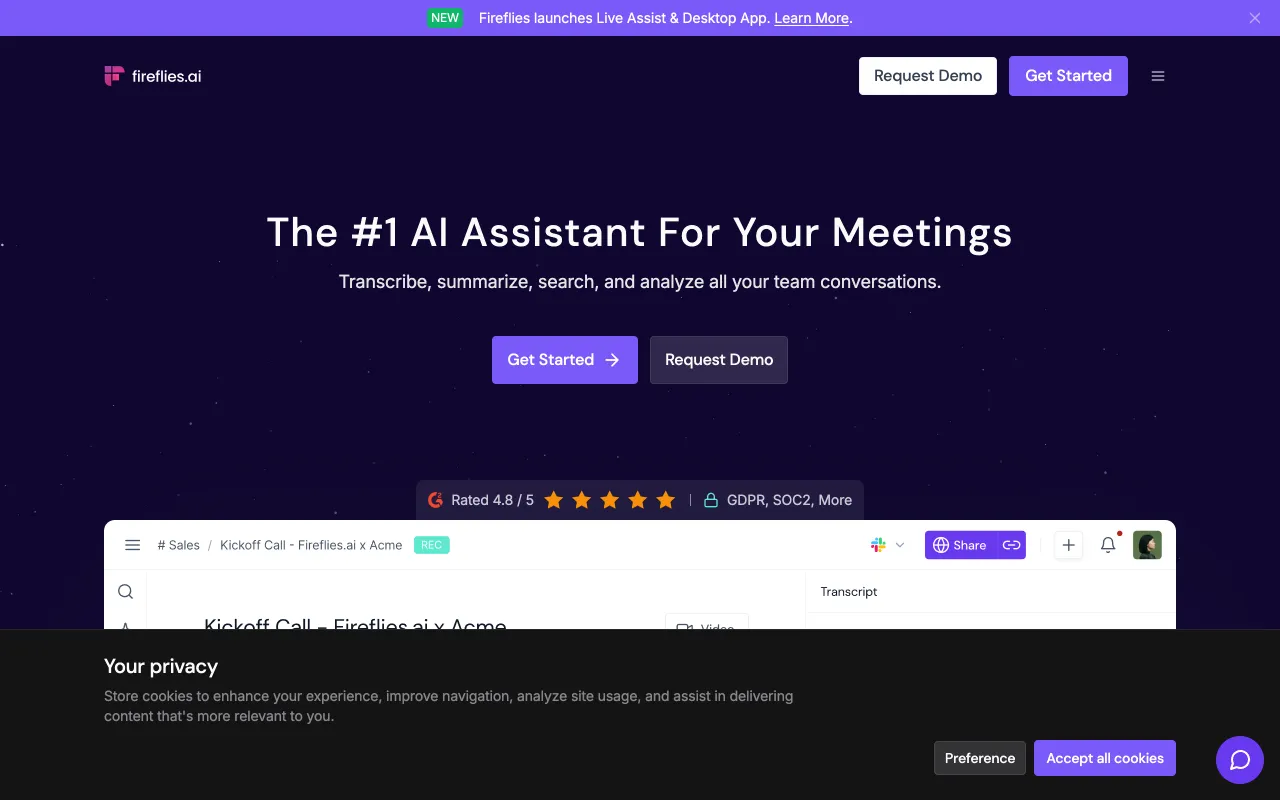
Fireflies records, transcribes, and summarizes meetings with searchable action items across sales, CS, product, and marketing. It is a popular single transcription layer for the whole company, and it integrates natively with Kendo for downstream call analysis.
Key Features
- Automated recording and transcription on Zoom, Google Meet, and Teams in 100+ languages.
- AI summaries and action items with automatic extraction and assignment.
- Searchable meeting library with full-text search by keyword, speaker, or topic.
- 40+ integrations including Salesforce, HubSpot, Slack, Notion, and Asana.
Consider before choosing
- Transcription, not coaching. At its core Fireflies is a note-taker. It lacks dedicated sales scorecards and has no AI roleplay or simulation.
- Tiered seats. Free forever; Pro from $18/seat per month ($10 annual), Business $29/month, Enterprise $39/seat annual-only. [Source: Fireflies pricing page, June 2026]
Curious how meeting tools stack up for sales? Compare meeting intelligence alternatives.
CallRail: Call Tracking, Scoring, and Marketing Attribution
Call tracking and AI scoring with deep ties to marketing analytics and lead attribution.
CallRail specializes in call tracking, AI call scoring, and keyword spotting tied to marketing performance. It helps teams see which campaigns drive phone calls and how those calls convert.
Key Features
- Dynamic number insertion that swaps tracking numbers by visitor source for accurate attribution.
- AI call scoring and keywords, with AI trained on 1.1M+ hours of voice data.
- Recording and transcription with searchable conversation data.
- Multi-touch attribution connecting calls to Google Ads, organic, social, and more.
Consider before choosing
- Built for marketing, not sales coaching. CallRail is an attribution tool first; it is not designed for rep development or proactive training.
- Usage charges stack up. Plans run roughly $50 to $150 per month, plus usage: extra numbers at $3 each, analysis minutes at $0.05 each, and transcription from $0.025 per minute. [Source: CallRail pricing page, June 2026]
Balto AI: Real-Time Call Guidance and Compliance
Live, in-call AI prompts that guide reps through objections and compliance as the conversation unfolds.
Balto is one of the few tools that actively assists during a call rather than only analyzing afterward. It listens to both sides and delivers real-time AI sales coaching, prompting reps live with the best next response.
Key Features
- Real-time agent prompts that surface the best responses live on every call.
- Dynamic checklists that track compliance and sales-process milestones in real time.
- Automated QA that scores 100% of calls, replacing manual reviews.
- Manager alerts when reps miss key points, enabling immediate intervention.
Consider before choosing
- In-call, not pre-call. Balto's strength is live guidance. There is no roleplay simulation, and the coaching model is reactive rather than proactive practice before the call.
- Custom pricing, contact-center focus. Pricing depends on seat count and contract length and is not published. [Source: Balto site]
ExecVision: Conversation Intelligence and Sales Coaching
A coaching-focused CI platform built around benchmarking and skill-gap analysis.
ExecVision offers transcription, AI coaching insights, and performance benchmarking to help managers spot skill gaps and track improvement over time. If the goal is to connect that rep-level evidence with quotas, incentives, and team planning, compare systems built for the wider performance-management job.
Key Features
- Transcription and analysis with AI-identified key moments, objections, and coaching opportunities.
- AI-driven coaching with recommendations based on individual performance patterns.
- Performance benchmarking against team averages and top performers.
- Game-tape libraries for onboarding and best-practice sharing.
Consider before choosing
- Post-call only. ExecVision runs entirely on completed-call data with no practice environment.
- Custom pricing, smaller footprint. Pricing is quote-based and not transparent, and market presence is smaller than Gong or Claap. [Source: ExecVision site]
Looking for a more active coaching tool? Compare the top ExecVision alternatives.
Observe.AI: Voice Intelligence for Contact Centers
AI voice intelligence built for high-volume contact centers and automated QA.
Observe.AI automates quality assurance, transcribes calls, provides real-time agent assist, and delivers coaching insights with a strong compliance focus, all tuned for contact-center scale.
Key Features
- Auto-QA at scale that scores 100% of interactions for quality, compliance, and script adherence.
- Real-time agent assist with next-best-action prompts and live call summaries.
- Post-interaction AI with targeted coaching and voice-of-customer insights.
- VoiceAI agents that handle routine inquiries before routing to humans.
Consider before choosing
- Contact center, not B2B sales. It is purpose-built for support and inside-sales centers and lacks roleplay capabilities.
- Heavier rollout. Custom pricing by agent count and modules; some users report 3+ month onboarding and mixed feedback on transcription accuracy. [Source: third-party reviews]
HubSpot Conversation Intelligence: CRM-Native Call Intelligence
Call recording, transcription, and keyword tracking built directly into Sales Hub.
HubSpot's Conversation Intelligence lives inside Sales Hub, recording and transcribing calls natively with automatic contact and deal association. For HubSpot-centric teams it removes the need for a separate CI tool.
Key Features
- Native CRM call recording with calls tied directly to contacts and deals.
- Keyword tracking with alerts when tracked terms like competitors or pricing appear.
- Coaching insights including talk-to-listen ratios and rep dashboards inside HubSpot.
- Pipeline integration that ties call context to deal records for reviews and forecasting.
Consider before choosing
- A feature, not a product. CI here is bundled into a CRM, so it has less depth than dedicated tools and no roleplay.
- Platform commitment required. CI ships in Sales Hub Professional at $100/user per month and full capabilities in Enterprise at $150/user per month (billed annually). [Source: HubSpot pricing, June 2026]
Clari: Revenue Intelligence and Forecasting
A revenue platform focused on forecast accuracy and pipeline visibility, with CI built in.
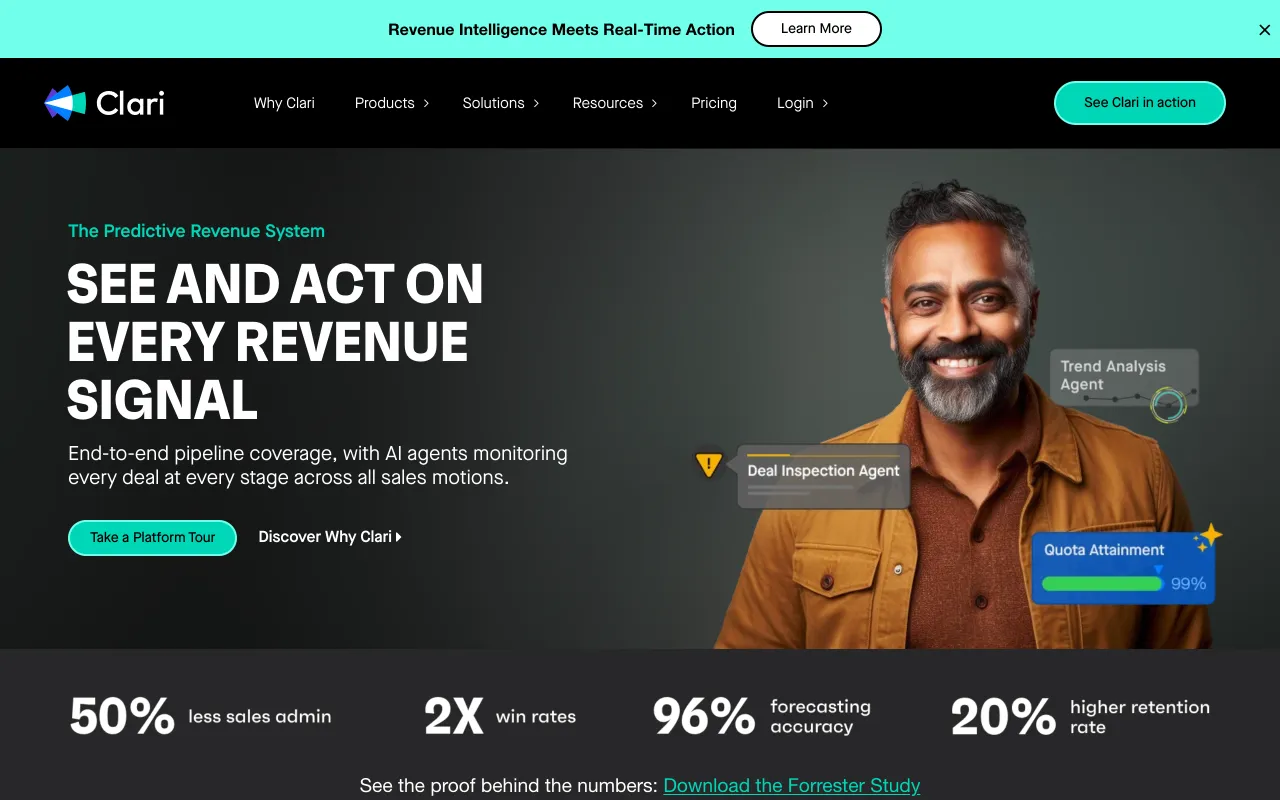
Clari aggregates signals from calls, email, CRM, and engagement to predict revenue and surface at-risk deals. Its Copilot adds conversation intelligence, though forecasting is the main event.
Key Features
- AI revenue forecasting with scenario modeling and confidence scoring.
- Deal inspection with activity tracking, engagement scoring, and risk alerts.
- Conversation intelligence (Copilot) with recording, transcription, and coaching.
- Revenue leak detection that flags gaps in process and deal execution.
Consider before choosing
- Forecasting first, CI second. If you mainly need call coaching, much of Clari's value sits in features you will not use.
- Expensive and complex. Custom pricing estimated near $100 to $120 per user per month for core forecasting, with implementation fees of $15K to $75K and an 8 to 16 week rollout reported. [Source: third-party estimates]
Comparing revenue platforms? See the best conversation intelligence software.
Chorus by ZoomInfo: Conversation Intelligence with Sales Data
A former standalone CI leader, now an add-on inside the ZoomInfo ecosystem.
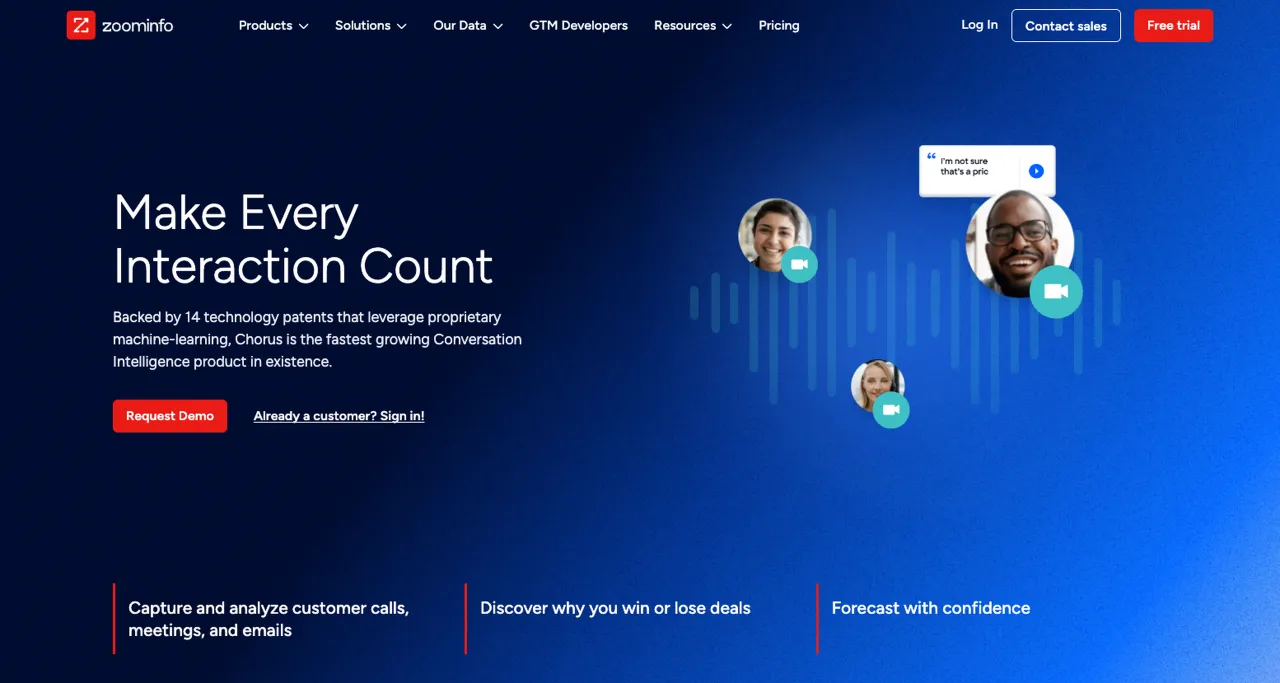
Chorus was a competitive standalone CI platform until ZoomInfo acquired it in 2022. It now functions mainly as an add-on to ZoomInfo's sales intelligence platform, pairing call analytics with B2B data.
Key Features
- Recording and transcription across Zoom, Teams, and Google Meet with searchable transcripts.
- Deal intelligence tracking stages, decisions, and account activity.
- AI-driven insights for topic tracking, competitor mentions, and talk-ratio analysis.
- ZoomInfo data integration bringing contact and company data alongside conversations.
Consider before choosing
- Innovation has stalled. Since the acquisition, Chorus is no longer a standalone product and has seen limited investment in new features.
- Bundled pricing. Quote-based and generally starting around $8,000 per year for a base of three users. [Source: third-party estimates]
Want CI without the ZoomInfo bundle? See the best Chorus alternatives.
tl;dv: Lightweight Meeting Recording and Notes
A simple, affordable meeting recorder with AI summaries and video bookmarking.
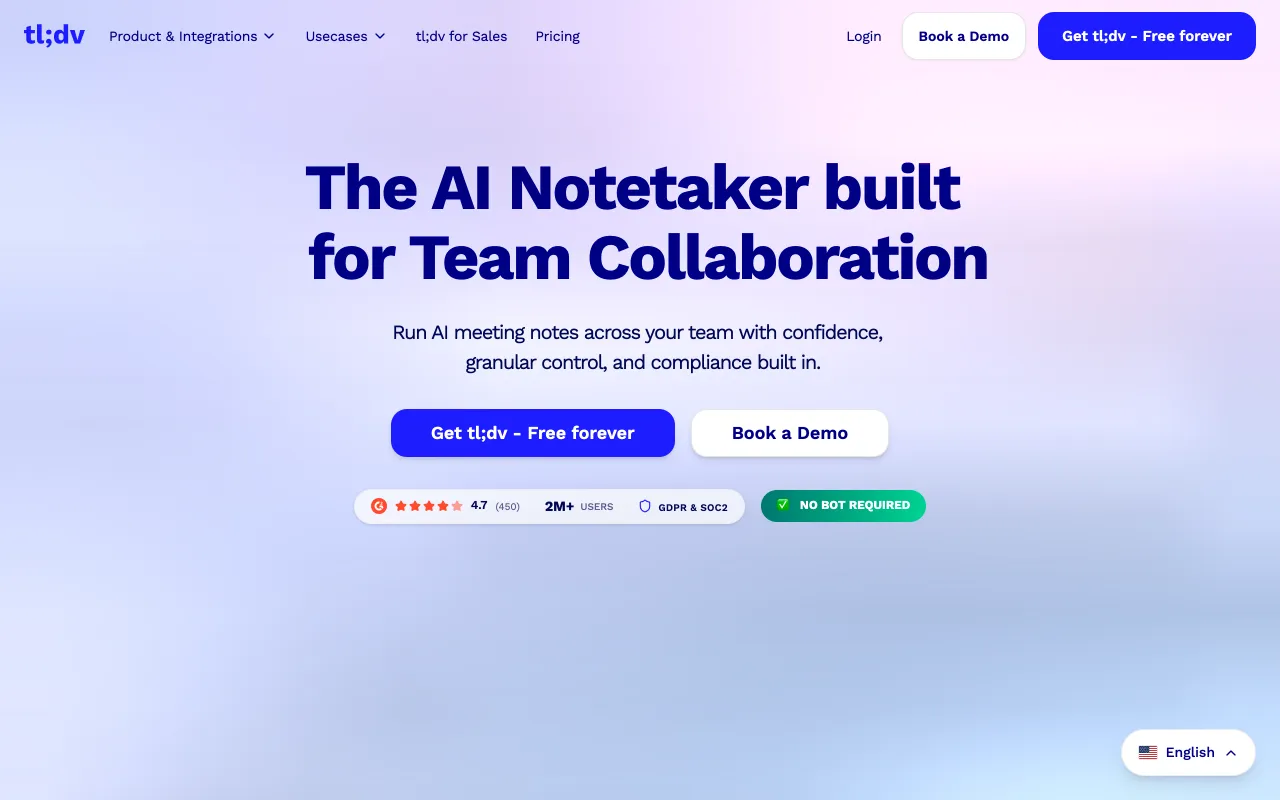
tl;dv records, transcribes, and summarizes meetings with video bookmarking, built for teams that want quick highlights without the weight of a full CI platform.
Key Features
- Recording and transcription on Zoom, Google Meet, and Teams in 30+ languages.
- AI meeting summaries with key takeaways and action items after every call.
- Video bookmarking to timestamp and share key moments for async review.
- CRM integration syncing notes to Salesforce and HubSpot.
Consider before choosing
- A productivity tool, not sales intelligence. There is no AI roleplay or simulation, and deeper coaching features sit on higher tiers.
- Limited free plan. Free forever but capped, with Pro from $18/user per month; free-plan recordings auto-delete after a set window. [Source: tl;dv pricing page, June 2026]
United Insurance Pros cut ramp from 45 days to 14 days
Reactive call review told their managers what new agents did wrong. It did not make the next call better. After adding Kendo roleplay so agents practiced objections before going live, ramp collapsed and wasted lead spend dropped.
"Typically we would see about a 45-day period where people would dip their foot in the water and slowly improve and then level off. Now that's 14 days."
Waylon Artrip, Founder at United Insurance ProsHow to Choose the Right Call Analysis Tool
Match the tool to the job your team actually has, not the longest feature list. Three questions sort the field fast.
1) What is the real job?
| Your main job | What to prioritize | Strong options |
|---|---|---|
| Train reps and lift close rates | Scoring plus proactive roleplay | Kendo ($55/mo) |
| Enterprise deal and revenue analytics | Forecasting, deal intelligence | Gong, Clari |
| Company-wide meeting notes | Transcription, search, integrations | Fireflies, tl;dv |
| Contact-center QA at scale | Auto-QA, live assist, compliance | Observe.AI, Balto |
| Marketing call attribution | Tracking, source attribution | CallRail |
2) Reactive or proactive?
Almost every tool here is reactive: it scores calls after they happen. Only a few connect analysis to AI roleplay so reps fix the gap before the next live deal. If improving performance, not just measuring it, is the point, weight proactive practice heavily.
3) What will it actually cost?
Transparent tools (Kendo, Fireflies, tl;dv, Salesify) let you start for $18 to $55 per seat with no demo. Enterprise CI (Gong, Clari, Chorus) is custom, demo-gated, and frequently lands in five or six figures a year once platform fees and implementation are counted. Price the rollout, not just the sticker.
A Simple Scorecard for Evaluating Call Analysis Tools
Score each shortlisted tool from 1 to 5 on the five factors that predict whether reps will actually use it and get better. Total out of 25. The tool reps use daily beats the powerful one that collects dust.
| Factor | The question to ask | 1-5 |
|---|---|---|
| Closes the loop | Does it turn a flagged weakness into practice or a clear fix? | __ / 5 |
| Scoring fit | Can it grade calls against our actual framework and call types? | __ / 5 |
| Time to value | Can a rep get useful feedback this week, not next quarter? | __ / 5 |
| Pricing clarity | Do we know the all-in cost, including fees and implementation? | __ / 5 |
| Stack fit | Does it pull calls from where they already live? | __ / 5 |
Run your top two or three through this and the winner is usually obvious. For most sales teams the highest "closes the loop" score is the one that moves revenue, because practice, not analysis alone, is what changes behavior. Top B2B reps also keep talk-to-listen near 43:57 [Source: Gong research], exactly the behavior a scorecard plus roleplay can drill.

Globe Life nearly doubled close rates for brand-new agents
By giving new hires unlimited reps against realistic objections before they touched a live lead, Globe Life lifted new-agent close rates from about 33% to over 60%, pure repetition, rebuttals, and practice.
"Our closing rate for brand new agents has been almost close to double with the use of Kendo, just because they're getting that repetition, the rebuttals, and the practice."
Jess Chang, Partner at Globe LifeThe Verdict: Stop Practicing on Your Leads
Every platform here has its strengths: Gong for data, Salesloft for engagement, HubSpot for CRM convenience, Fireflies for notes. But they share one catch: they analyze leads you have already burned and mistakes you have already made.
- Best overall: Kendo AI. The only tool that closes the loop, analyze the call, then fix the gap in a live roleplay, from $55/mo with transparent pricing.
- Best enterprise intelligence: Gong. Deepest deal and revenue analytics if you have 50+ reps and the budget, but purely reactive.
- Best budget note-taker: Fireflies or tl;dv. Affordable transcription across the company, though not built for sales coaching.
If you are over the "record and pray" model and ready to build a team that is sharp from day one, Kendo gives reps flight hours against realistic AI prospects before they go live. Book your personalized Kendo demo today. Want a wider lens on coaching tools? See our roundup of the best sales coaching software.
Frequently Asked Questions
What is sales call analysis software?
Sales call analysis software records, transcribes, and scores sales conversations so managers and reps can see what happened on a call, why it happened, and where to improve. Most tools are reactive, analyzing calls after they end. A smaller group, including Kendo, adds proactive AI roleplay so reps can practice before a live deal.
What is the difference between call analysis and conversation intelligence?
The terms overlap. Conversation intelligence usually refers to enterprise platforms like Gong and Chorus that capture every call, email, and meeting for deal and revenue analytics. Sales call analysis is the narrower job of scoring and coaching individual calls, which is what most reps and front-line managers actually need day to day.
How much does sales call analysis software cost?
Transparent tools range from free to roughly $18 to $55 per seat per month. Kendo Pro is $55 per seat per month. Enterprise conversation intelligence platforms like Gong and Chorus use custom pricing, with third-party estimates starting around $5,000 to $8,000 per year plus platform fees.
Can call analysis software actually improve close rates?
Analysis alone surfaces problems but does not fix them. Improvement comes from acting on the feedback. Teams that pair call review with deliberate practice, such as AI roleplay against realistic objections, report the largest gains. Kendo customers cite 5 to 15 percent higher close rates and up to 70 percent faster ramp.
Do I need a separate tool for call recording and coaching?
Not anymore. Platforms like Kendo import calls from Zoom, Fathom, and other tools through native integrations or an open API, then handle scoring, coaching, and practice in one place. You only need a separate recorder if your calls live in an unsupported system.
What should a sales call scorecard measure?
Score real call behaviors, not vanity metrics. Useful measures include talk-to-listen ratio, objection-handling success, discovery question quality, and adherence to your sales framework. Customizable scorecards let you grade calls against your actual process rather than a generic rubric.
How does AI analyze sales call transcripts?
AI first transcribes the call to text with speaker labels, then reads that text the way a coach would. It tags objection moments, tracks keywords and topics like pricing or competitors, calculates the talk-to-listen ratio, scores sentiment shifts, and checks whether a clear next step was agreed. Better sales tools then grade the transcript against your framework and flag exactly where a rep should improve, rather than just handing you a summary.

Luke Alexander is the founder of Kendo AI, where he's helped train more than 5,000 sales reps. He started in sales as a frontline closer, scaled a high-ticket sales-training company, and founded Closer Cartel and co-founded Closify before building Kendo to fix the tools he wished he'd had: realistic AI roleplay and automated call review for fast-moving sales teams. He writes about sales training, ramp speed, objection handling, and applying AI across the revenue org.