
12 Best Sales Coaching Software for 2026
Most coaching tools record reps. Far fewer actually improve them. We scored the 12 leading platforms on the line that matters: reactive call review versus proactive practice, plus verified pricing and the team each one fits.
Most sales coaching software is great at telling you what already went wrong, and weak at making the next call go right. It records the demo, transcribes the objection, and flags the talk ratio, all after the deal has cooled.
That gap is expensive. CSO Insights found teams with a formal, dynamic coaching process post far higher win rates than teams winging it, yet most still coach reactively.
So we scored these 12 platforms on one question: does it actually improve a rep, or just observe one? Some analyze calls after the fact, some let reps practice before they ever dial, a few do both. Pricing was verified against each vendor's own site in June 2026.
Reactive Call Review vs Proactive Practice
Before the rankings, the distinction that should drive your shortlist. Sales coaching tools fall into two camps, and most buyers do not realize they are choosing between them.
- Reactive coaching watches the game tape. Conversation intelligence records live customer calls, scores them, and surfaces patterns. It is genuinely useful for experienced reps on a big pipeline, but by the time a manager reviews the call, the prospect is gone and the rep is already repeating the mistake on the next one.
- Proactive coaching runs the practice. AI roleplay puts reps in front of a realistic buyer before the real call, so the budget objection and the technical curveball get handled in a simulation instead of on a live deal. Mistakes are free here. On a real prospect they cost a lead. For teams whose work happens mostly on the phone, compare training platforms that scale this rehearsal across an entire call floor.
You do not have to pick one forever. But you should know which leak you are plugging first: reps who do not know what went wrong need analysis, and reps who cannot execute under pressure yet need practice. Buy for the leak, not for the logo.
The PAR Model for Scoring a Coaching Tool
To keep the comparison honest, every tool below is scored against three jobs a coaching program actually has to do. We call it PAR: Practice, Analyze, Reinforce. A tool can be elite at one and absent at the others, so naming the three is how you avoid overpaying for half a solution.
| Pillar | What It Means | Tools That Lead Here |
|---|---|---|
| Practice (proactive) | Reps rehearse objections and discovery against a realistic buyer before the live call, on demand, as many times as they need. | Kendo AI, Hyperbound, Second Nature |
| Analyze (reactive) | Real customer calls are recorded, scored, and mined for patterns so coaching is grounded in what actually happened. | Gong, Chorus, Salesloft, Kendo AI |
| Reinforce (continuous) | Learning, scorecards, and in-flow nudges keep the skill alive long after the workshop, ideally where reps already work. | Mindtickle, Allego, Bigtincan |
The pattern worth internalizing: most platforms are strong on Analyze or Reinforce and weak on Practice. Practice is the pillar that builds the rep, and it is the one the market under-serves. Keep that in mind as you read.
Best Sales Coaching Software for 2026: Comparison Table
| # | Tool | Best For | PAR Focus | AI Roleplay | Starting Price |
|---|---|---|---|---|---|
| 1 | Kendo AI RECOMMENDED | Proactive practice + rapid ramp | Practice + Analyze | Yes | $55/seat/mo |
| 2 | Gong | Deep deal & call analytics | Analyze | No | Custom* |
| 3 | Chorus by ZoomInfo | Call analysis tied to prospect data | Analyze | No | Custom* |
| 4 | Mindtickle | All-in-one enablement at scale | Reinforce + Practice | Yes | Custom* |
| 5 | Hyperbound | Realistic AI cold-call practice | Practice | Yes | Custom* |
| 6 | Salesloft | Coaching inside the sales workflow | Analyze | No | Custom* |
| 7 | Allego | Async, video-based peer coaching | Reinforce | Sim | Custom* |
| 8 | Bigtincan | Regulated, vertical-specific teams | Reinforce | Sim | Custom* |
| 9 | Second Nature AI | Structured AI pitch certification | Practice | Yes | Custom* |
| 10 | FullyRamped | Practice built from real call data | Practice + Analyze | Yes | Custom* |
| 11 | Salesforce (Einstein) | Coaching native to Salesforce CRM | Analyze + Reinforce | No | $165+/user/mo |
| 12 | HubSpot Sales Hub | SMB & CRM-native coaching basics | Analyze | No | Free / $15+ |
Pricing and features verified against each vendor's own site in June 2026. *Vendors marked with an asterisk do not publish full pricing and route buyers through a quote or demo; figures from third-party sources are cited inline in brackets. "Sim" means scripted scenario simulation rather than free-form voice roleplay. Details may change after publication. Want the call-analysis lens specifically? See our best conversation intelligence software roundup.
Kendo AI
★ Best overallThe proactive practice layer: reps drill realistic AI buyers before live calls, then every real call gets scored automatically.
Full disclosure: we built Kendo, so we are biased. We built it because nearly every coaching tool on this list is reactive. It watches calls that already happened. Kendo coaches the rep before the call, then scores the real one after, which is why it sits in both the Practice and Analyze columns.
The practice side is the part the market keeps missing. Reps get on-demand AI roleplay against buyers built to match your exact ICP, with real-time coaching during the simulation and an automatic scorecard the moment it ends. No waiting three days for a manager to find a slot.
On the analyze side, AI call reviews score every live call against your own scorecard, so managers stop spot-checking and start coaching from data. For leaders running it across a team, Kendo for sales leaders rolls practice, scoring, and an AI sales manager into one place. Teams that also need quota, territory, and compensation workflows should compare the wider performance-management layer. Kendo does not do deep enterprise pipeline forecasting, so a Gong-style analytics suite is a fair complement for large, experienced teams.
This is what practicing on Kendo looks like. The AI buyer pushes hard on SOC 2, ISO 27001, and proof the tool cuts compliance work, and the rep has to handle it on the spot, before any of it lands on a live deal.
Reactive Call Review vs Kendo's Proactive Loop
| Coaching Job | Kendo AI | Reactive-Only Tools |
|---|---|---|
| When coaching happens | Before the call, then after | Only after the deal is over |
| Practice volume | Unlimited, 24/7 on demand | None, it only records live calls |
| Feedback speed | Real-time, objective scoring | Days later, often subjective |
| Cost of a mistake | Free, it is a simulation | A burned live lead |
| Scales coaching across a team | Same scorecard for everyone | Bottlenecked on manager time |
Key Features
- Custom Prospect Builder. Spin up AI buyers by role, industry, and personality in seconds, or borrow from 20+ pre-built sales roleplay scenarios, from cold-call openers to late-stage negotiation.
- Dynamic objection library. Drill budget, timing, trust, and technical objections, or build custom ones for a niche cycle, instead of practicing a static script.
- Real-time AI coaching. Minute-by-minute guidance during the live simulation, not a note three days later.
- Automated scorecards. Objective 1-to-100 scoring on discovery depth, talk ratio, and objection handling, on roleplays and real calls alike, with no manual grading.
- Distributed-team ready. Roleplay and scoring in 40+ languages, so a rep in another time zone gets the same coaching standard as one down the hall.
This is deliberate practice, not a chatbot reading lines: low-latency voice AI, buyers that push back and stall like real prospects, and a setup that takes seconds rather than a planning meeting.
"Not only has my team's production started to increase but they are becoming more confident on the phones and getting quicker at overcoming objections."
KCKendo customer · sales leaderTry Kendo with a Free Roleplay, Pricing Starts at $55/mo
Kendo's per-seat plans include monthly AI training minutes with transparent overages, which is rare on a list where most tools hide pricing behind a demo. Teams typically report a 5 to 15% lift in close rates, often ROI-positive inside the first month. See full per-seat pricing.
| Pro $55/mo per seat | Max $100/mo per seat | Enterprise Custom |
|---|---|---|
| AI roleplay, AI call reviews, advanced analytics, AI sales manager + coach, 180 roleplay minutes/seat per month | Everything in Pro, 480 roleplay minutes/seat per month, for teams that want maximum usage | Teams of 10+, custom AI models, custom scoring, DFY setup, dedicated account manager |

United Insurance Pros cut new-rep ramp from 45 days to 14
After rolling out Kendo roleplay across a 500+ agent organization, United Insurance Pros got brand-new agents to baseline performance in 14 days instead of 45, while saving thousands per agent every month on wasted leads.
"Typically we would see about a 45-day period where people would dip their foot in the water and slowly improve and then level off. Now that's 14 days."
Waylon Artrip, Founder at United Insurance ProsGong
Best for call analyticsThe deepest after-the-call analytics on the market: deal visibility, behavioral benchmarking, and revenue intelligence.
Gong is the category leader in pure analysis, and it earns it. It captures every customer interaction, then mines the patterns: which talk tracks correlate with closed-won, where deals stall, how a rep benchmarks against the team. For a VP coaching experienced reps on a large, multi-threaded pipeline, nothing reads the deal better.
The honest caveat for this list is that Gong coaches by hindsight. It tells you the discovery call went sideways; it does not give the rep a place to practice discovery so the next one does not. It improves your read on reps far more than it improves the reps themselves. Pair it with a practice layer and you have both halves.
Key Features
- Contextual trackers across 100+ languages that flag competitors, pricing talk, and risk language in live calls.
- Behavioral benchmarking that ranks rep behaviors against top performers on the team.
- Automated scorecards and a call library for manager review and onboarding reference.
Consider before choosing
- It needs data before it is smart. Gong typically wants 30 to 60 days of ingested calls before its insights sharpen, so value is not immediate. [Source: vendor and user reviews, June 2026]
- Analysis, not practice. There is no AI roleplay, so it diagnoses the gap without building the skill that closes it.
- Enterprise pricing. Gong does not publish pricing and quotes per seat with platform fees, which puts it out of reach for many SMBs. [Source: gong.io, June 2026]
Weighing Gong specifically? Our deeper Gong alternatives breakdown compares it tool by tool.
Chorus by ZoomInfo
Conversation intelligence wired into ZoomInfo's prospect data, so call analysis carries buyer context with it.
Chorus, owned by ZoomInfo, is most compelling for teams already living in the ZoomInfo ecosystem. Its edge is context: it fuses call recordings and transcripts with prospect intent and firmographic data, so a coach reviewing a call also sees who the buyer is and what signals preceded the conversation.
Like Gong, it is firmly in the Analyze camp. Deal-momentum tracking and AI call summaries are strong for spotting at-risk deals, but the coaching is still a review of calls that already closed or stalled. The value compounds if you already pay for ZoomInfo; on its own the case is thinner.
Key Features
- Integrated prospecting data that ties each recorded call to the buyer's profile and intent signals.
- Deal-momentum tracking that flags engagement gaps and stalls across the pipeline.
- AI call summaries and competitive-intelligence alerts drawn from conversation patterns.
Consider before choosing
- Best value only inside ZoomInfo. Pricing is bundled and custom, so standalone buyers rarely get the full benefit. [Source: zoominfo.com, June 2026]
- Reactive by design. No practice environment, so reps cannot rehearse the call it will later analyze.
Want call analysis without the ZoomInfo bundle? See our Chorus alternatives breakdown.
Mindtickle
Best for enterpriseAn all-in-one readiness platform that folds learning, coaching, content, and AI roleplay into one enterprise system.
Mindtickle's pitch is breadth. It replaces a separate LMS, coaching tool, and content portal with one platform, anchored by a Readiness Index that scores whether reps are actually prepared to sell. For a large enablement team that wants every motion under one roof, that consolidation is the real draw; our comparison of the broader platform field shows which vendors make the same tradeoff.
It is the rare tool strong on both Reinforce and Practice: its AI Role-Play Missions give reps scenarios to drill, and the content hub keeps the methodology alive between sessions. The tradeoff is weight. This is an enterprise commitment, not a quick win, and the roleplay is more structured-scenario than the free-form voice practice a dedicated tool delivers.
Key Features
- AI Role-Play Missions so reps practice scripted scenarios and get scored on delivery.
- Readiness Index that quantifies rep preparedness across skills and content.
- Sales content hub and digital sales rooms to keep enablement and buyer collateral in one place.
Consider before choosing
- Long implementation. A full rollout commonly runs 90 to 120 days, so it suits teams with a dedicated enablement function. [Source: vendor and user reviews, June 2026]
- Enterprise pricing and breadth. Custom quotes only, and the all-in-one scope can be more than a focused team needs. [Source: mindtickle.com, June 2026]
Comparing readiness platforms head to head? See Kendo vs Mindtickle.
Hyperbound
Best for AI cold-call practiceA practice-first platform whose AI buyers are realistic enough that reps say they feel like actual cold calls.
Hyperbound sits squarely in the Practice camp, and that focus is its strength. Reps build an AI bot in about two minutes and drill cold calls, discovery, and objection handling, with a simulated autodialer and multi-party scenarios that get close to the texture of a real call. For SDR and AE teams whose biggest leak is execution on the phone, it is a serious pick.
Because it concentrates on simulation, it leans on your existing stack for the analyze and reinforce layers. It builds the skill; it does not warehouse your real-call analytics or your LMS. For practice-led teams that is a feature, not a flaw, though it is the gap a both-pillars tool covers, as our Kendo vs Hyperbound comparison lays out.
Key Features
- AI bot builder with roughly two-minute setup for custom buyer personas.
- Simulated autodialer and multi-party calls that mirror real prospecting flows.
- Dynamic scorecards that grade each practice rep on the behaviors that matter.
Consider before choosing
- No public pricing. Plans are quote-based, so budget-conscious teams cannot self-serve a number. [Source: hyperbound.ai, June 2026]
- Practice-only by design. You will still bring conversation intelligence and a reinforcement system for the full loop.
Weighing Hyperbound specifically? Our Hyperbound alternatives review goes tool by tool, or see the wider best AI sales roleplaying tools roundup.
Across Kendo customers: 5-15% higher close rates, 70% faster ramp, and $3,000+ saved per rep.
See the results →
Salesloft
Coaching insights that live exactly where execution happens, inside the sales engagement workflow.
Salesloft's advantage is placement. Because coaching insights surface right inside the engagement platform reps already use to send sequences and dial, the feedback meets reps where they work instead of in a separate tab they forget to open. Its AI-powered scorecards and custom key moments make call review part of the daily flow.
It is an Analyze tool with a workflow twist. The Sales Strategist agent and methodology extraction help managers coach from real calls, but like the other conversation-intelligence picks, it reviews the call rather than rehearsing it. Best fit if your team is standardized on Salesloft for execution.
Key Features
- AI-powered scorecards applied to recorded calls inside the engagement platform.
- Custom key moments that auto-flag the parts of a call worth coaching.
- Sales Strategist agent that suggests next steps grounded in call and deal data.
Consider before choosing
- Best as a Salesloft-stack add-on. The coaching value is highest when you already run execution on Salesloft; standalone, it overlaps with dedicated CI tools. [Source: salesloft.com, June 2026]
- Custom enterprise pricing. No public per-seat number, and setup typically takes around 30 days to operational status. [Source: vendor and user reviews, June 2026]
Looking beyond sequences? See our Salesloft alternatives review.
Allego
Asynchronous, video-based coaching that turns top reps' calls into crowdsourced best practice for the team.
Allego has made its name in asynchronous, video-first coaching. Reps record themselves, peers and managers comment, and the best examples become a crowdsourced library of what good actually sounds like. For distributed teams that cannot get everyone in a room, that async model travels well across time zones.
It is a Reinforce tool at heart: strong on keeping skills alive and sharing peer knowledge, lighter on proactive practice against a live buyer. Its dialogue simulations add some practice, but the engine is video review and reinforcement, not free-form roleplay.
Key Features
- AI virtual coaching and dialogue simulations for guided skill reps.
- Crowdsourced best practices that surface and share top-rep calls.
- Digital sales rooms to align enablement with live deals.
Consider before choosing
- Reinforcement-led. Excellent for sharing and sustaining skill, but proactive practice is not the core strength.
- Enterprise pricing and rollout. Custom quotes, with deployment commonly around six weeks. [Source: allego.com, June 2026]
Bigtincan
Enablement and coaching built for regulated, vertical-specific teams that need compliance baked in.
Bigtincan's differentiator is vertical depth. It ships industry-specific learning paths and compliance-first automation, which is why it lands with regulated sellers in pharma, financial services, and similar fields where a generic coaching tool cannot speak the rules. Its RolePlayAI and VoiceVibes add guided practice and conversation insights on top.
For a life-sciences or financial-services team coaching reps on regulated, distributed selling, that specialization is the whole point. The flip side is the usual enablement-suite weight: broad, configurable, and a real implementation rather than a fast switch-on.
Key Features
- AI-guided practice (RolePlayAI) and conversation insights (VoiceVibes) for delivery coaching.
- Industry-specific paths with compliance built into the workflow.
- Content on the go via native mobile apps for field teams.
Consider before choosing
- Built for verticals. The compliance and industry depth are the draw, and overkill for a generic SaaS team.
- Custom pricing and 1 to 3 month setup. Modular options exist, but it is an enterprise engagement. [Source: bigtincan.com, June 2026]
Second Nature AI
Interactive AI avatars that act as virtual prospects for structured pitch practice and certification.
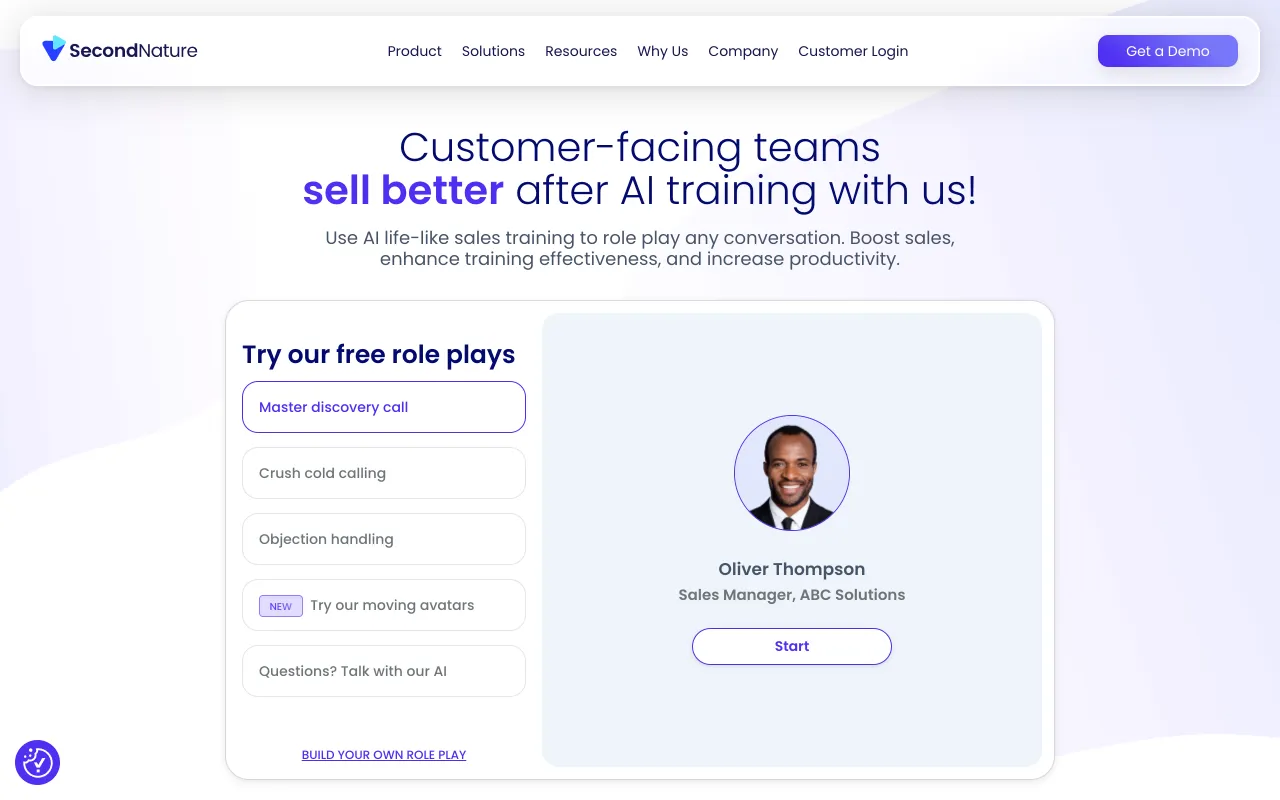
Second Nature is a Practice tool built around interactive AI avatars that play the prospect. Its sweet spot is structured, repeatable pitch certification: a manager defines the scenario and rubric, reps drill it, and the platform scores delivery consistently. Deployment can happen fast, sometimes within an hour, with native Salesforce and HubSpot hooks.
The avatar model is more guided than free-form, which is exactly what some enablement teams want for certifying a standard pitch. If you need looser, voice-led conversation that improvises like a real buyer, weigh that against the structure. It certifies the pitch well; it is less of an open sandbox.
Key Features
- Virtual pitch partner with interactive AI avatars as prospects.
- AI-powered scoring and manager insights for consistent certification.
- Rapid scenario creation plus Salesforce, HubSpot, and Workday integration.
Consider before choosing
- Structured over free-form. Great for certifying a defined pitch, less open-ended than voice-led roleplay.
- Enterprise pricing. Custom quotes only, with no public per-seat figure. [Source: secondnature.ai, June 2026]
Comparing avatar practice to adaptive AI buyers? See Kendo vs Second Nature.
FullyRamped
AI practice built from your real calls, syncing with Gong and Clari so reps drill against actual deal context.
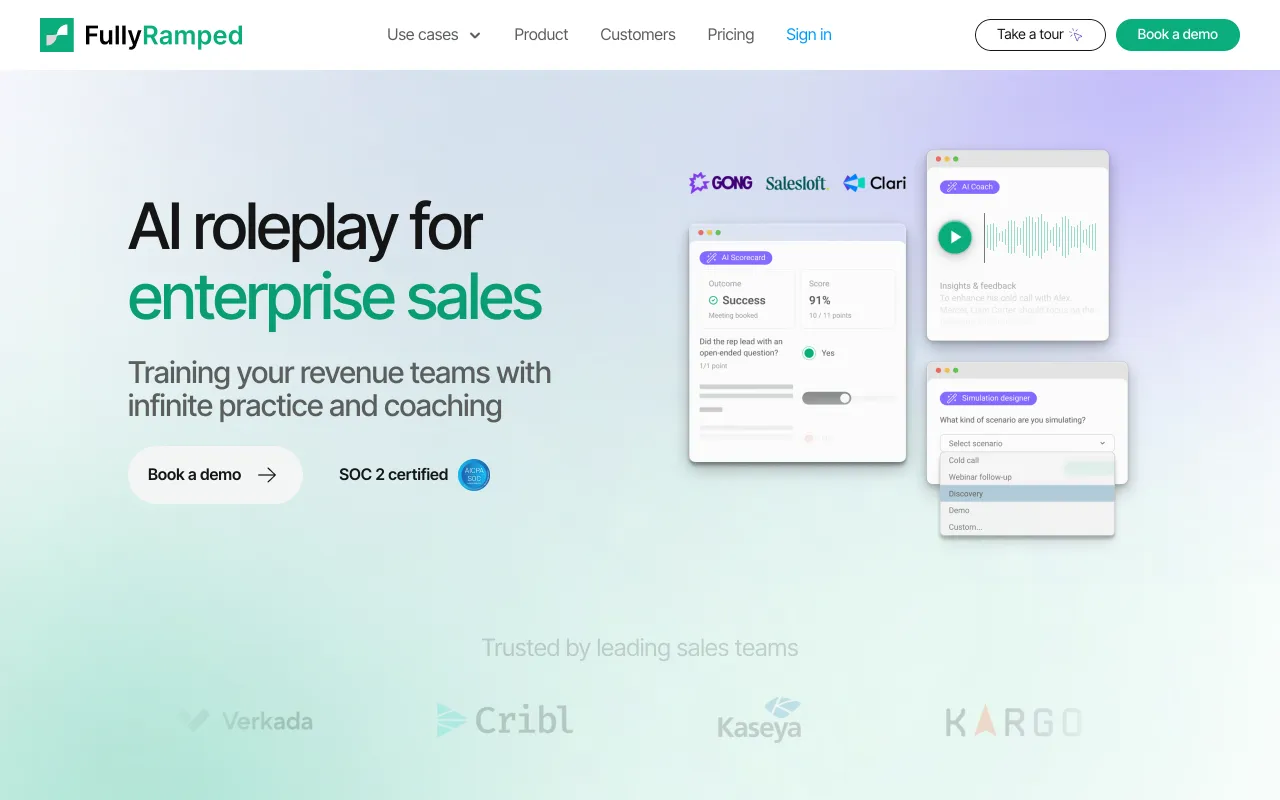
FullyRamped's clever idea is closing the loop between analysis and practice. It builds AI Twins from your actual recorded calls, then has reps drill against buyers modeled on real deals, syncing with Gong and Clari so the practice reflects what is genuinely happening in the pipeline. That puts it in both Practice and Analyze.
It is aimed at enterprise teams that already run conversation intelligence and want to turn that game tape into reps. If you do not already have rich call data feeding it, the AI-Twin advantage is muted, and there is a five-seat floor to start.
Key Features
- AI Twins generated from real call recordings for true-to-life practice.
- Conversation-intelligence sync with Gong and Clari for deal context.
- Automated certifications and a knowledge hub across the full sales cycle.
Consider before choosing
- Best with existing call data. The AI-Twin model shines when fed a mature CI stack; without it, the edge shrinks.
- Custom pricing, 5-seat minimum. No public price, with a rollout commonly around two to three weeks. [Source: fullyramped.com, June 2026]
See the practice tools compared in our FullyRamped alternatives review, or weigh the two head to head in Kendo vs FullyRamped.
Salesforce Sales Cloud (Einstein)
Coaching native to the CRM, using real-time deal data to trigger Einstein guidance where reps already work.
If your revenue org runs on Salesforce, the strongest argument for Einstein is gravity: coaching lives inside the CRM where the deal data already sits. Einstein Sales Coach and Conversation Insights pull from pipeline and call data to trigger guidance, and Pipeline Inspection ties it to live deal health.
The reality check is cost and setup. The AI coaching features often require a higher tier or the Agentforce bundle, list pricing starts around $165 per user per month and climbs, and a real deployment is measured in months, not days. It is a fit for committed Salesforce shops, not a quick standalone coaching buy.
Key Features
- Einstein Sales Coach that delivers AI guidance against real deal data.
- Einstein Conversation Insights for call analysis inside the CRM.
- Pipeline Inspection linking coaching to live deal health.
Consider before choosing
- Salesforce-dependent and pricey. Full AI coaching often needs the Agentforce 1 Sales bundle, pushing the real cost well above the entry tier. [Source: salesforce.com, June 2026]
- Long setup. Expect a 3 to 6 month implementation to get coaching fully live. [Source: vendor and user reviews, June 2026]
HubSpot Sales Hub
Best for SMBCRM-native coaching basics with a genuinely usable interface and the friendliest on-ramp for SMB teams.
HubSpot Sales Hub is the most accessible entry point on this list for a smaller team. Its conversation intelligence, sales playbooks, and coaching playlists run on the same Smart CRM reps already use, and the interface is famously approachable, so adoption rarely stalls on complexity.
For coaching it covers the basics rather than the depth. There is no AI roleplay, and the analysis is lighter than a dedicated CI suite. But for an SMB that wants coaching fundamentals without an enterprise contract, a free tier and a low Starter price make it the natural place to begin.
Key Features
- Conversation intelligence built into the HubSpot CRM record.
- Sales playbooks and coaching playlists for repeatable guidance.
- Breeze AI prospecting agent layered into the workflow.
Consider before choosing
- Basics, not depth. No AI roleplay and lighter analytics than specialist tools, so fast-scaling teams outgrow it.
- Free to start, climbs at the top. A free tier and ~$15 Starter are SMB-friendly, but Enterprise runs near $150 per user per month. [Source: hubspot.com, June 2026]
Real-Time vs After-the-Call Coaching: Which You Actually Need
Real-time sales coaching software is one of the most searched phrases in this category, and it hides two very different products. Get the distinction right and you will not overspend.
- In-call assist whispers suggested responses to a rep during a live customer call. It is powerful in high-volume call centers, but it can become a crutch and it only fires while a real prospect is on the line.
- On-demand practice is the more durable form of "real time." A rep who can summon a realistic buyer the moment they need to rehearse a tough objection is being coached in real time, just before the stakes are real instead of during them.
After-the-call coaching, the conversation-intelligence model, still matters for experienced reps and pattern-finding across a pipeline. The mistake is buying only that and wondering why ramp is slow. Analysis tells a rep what happened. Practice is what changes what happens next.
AI Coaching for Distributed Sales Teams
Distributed teams have a specific problem: the informal coaching that happens in an office, the overheard call, the quick desk-side correction, the ride-along, simply does not exist when everyone is remote. The software has to manufacture what the hallway used to provide.
That is where proactive AI practice earns its place. A rep in another country can drill the same scenario, in their own language, and get scored on the same rubric as a rep at headquarters. Managers coach from the data instead of from being in the room. Research backs the direction: companies that paired AI with sales training software saw 3.3x the year-over-year growth in quota attainment versus those deploying AI without the training to go with it [Source: ValueSelling Associates & Aberdeen Strategy & Research, 2024, n=610].
For regulated distributed fields, the nuance is the scorecard, not the practice engine. A life-sciences team coaching reps on virtual selling and compliant clinical discovery needs the rubric built around its own standards, then unlimited reps against buyers that behave like real clinical or procurement stakeholders. Kendo's custom scorecards and 40+ language support are built for exactly that spread, which is why distributed and multi-region teams tend to start there. For Marketplace agencies, our health insurance sales training guide separates conversation practice from licensing, certification and plan-year preparation.
How to Choose Sales Coaching Software
Skip the feature-checklist trap. The decision comes down to one diagnosis and a short matrix. First, name your biggest leak. Then buy the tool that plugs it, not the one with the longest feature list.
| Your Leak | What to Prioritize | Strong Picks |
|---|---|---|
| Reps know the theory but freeze on live calls | Proactive practice, unlimited reps, fast feedback | Kendo AI, Hyperbound, Second Nature |
| Slow ramp for new hires | Practice before live leads, objective scoring | Kendo AI, FullyRamped |
| Experienced reps, big pipeline, blind spots | Deep call analysis and deal visibility | Gong, Chorus, Salesloft |
| Distributed or multi-region team | On-demand practice, multi-language, shared rubric | Kendo AI, Allego |
| Regulated or vertical-specific selling | Compliance paths and industry content | Bigtincan, Mindtickle |
| SMB on a budget, lives in the CRM | Public pricing, CRM-native basics | HubSpot Sales Hub, Kendo AI |
| Standardized on Salesforce | Coaching inside the CRM | Salesforce (Einstein) |
Two practical filters cut the list fast. Public pricing separates the SMB-friendly tools (Kendo, HubSpot) from the enterprise-quote tools (most of the rest). And the PAR check stops you buying half a solution: if a tool only analyzes, ask where the practice comes from; if it only reinforces, ask what builds the skill in the first place.
One pattern holds across every option worth buying: teams that add practice to their analysis move close rates faster than teams that only review calls. To ramp new reps specifically, our playbook on how to reduce sales ramp time goes deeper, and for the analysis side, the best conversation intelligence software guide compares the recorders head to head.
The Verdict: Which Sales Coaching Software Should You Pick?
The best coaching tool is the one that actually changes a rep's next call, not just your read on the last one. Most teams that move the needle run two layers: practice to build the skill, analysis to refine it.
- Best for proactive practice and ramp: Kendo AI gives reps unlimited AI roleplay and objective scoring on practice and real calls alike, from $55 per seat per month.
- Best for deep call analytics: Gong reads a complex pipeline better than anything, for experienced teams that already practice elsewhere.
- Best for all-in-one enterprise enablement: Mindtickle consolidates learning, content, and coaching for teams with a dedicated enablement function, much like the broader SaaS sales training programs built for structured onboarding.
- Best for SMB on a budget: HubSpot Sales Hub delivers CRM-native coaching basics with a free tier and a low entry price.
- Best for distributed and multi-region teams: Kendo AI standardizes practice and scoring across languages and time zones.
Recording a rep is not coaching a rep. If practice is the layer you are missing, our best AI sales roleplaying tools roundup compares the practice-first options head to head. When you are ready to put reps in front of a real objection before they ever touch a live deal, start a free Kendo roleplay or book a demo.
Frequently Asked Questions
What is the best sales coaching software in 2026?
It depends on the gap you are coaching. For proactive practice that builds reps before live calls, Kendo AI leads with unlimited AI roleplay and automatic scoring from $55 per seat per month. For after-the-call conversation intelligence on a complex pipeline, Gong is the deepest. For all-in-one enablement at enterprise scale, Mindtickle. Most teams that move close rates pair a practice layer with a call-analysis layer rather than buying one and hoping.
What is the best real-time sales coaching software?
Real-time coaching splits into two kinds. In-call guidance that whispers to reps during a live customer call is best served by agent-assist tools and, inside Kendo, by minute-by-minute coaching during a live AI roleplay. The more durable real-time signal is practice on demand: Kendo and Hyperbound give reps a realistic buyer to drill against the moment they need it, instead of waiting days for a manager to review a recording.
What is the best AI coaching software for distributed sales teams?
Distributed teams lose the hallway reps and ride-alongs that build skill in an office, so the software has to manufacture practice and standardize feedback. Kendo AI fits well because reps anywhere can roleplay a realistic buyer in 40+ languages and get the same objective scorecard, and managers coach from data instead of presence. For regulated, distributed fields like life sciences, pair that practice with a scorecard built on your compliance and clinical-discovery standards.
What is the difference between sales coaching software and conversation intelligence?
Conversation intelligence (Gong, Chorus, Salesloft) records and analyzes real customer calls after they happen, so coaching is a post-mortem on deals already in motion. Proactive sales coaching software (Kendo, Hyperbound, Second Nature) lets reps practice against AI buyers before the real call, so mistakes happen in a simulation instead of on a live prospect. The first tells you what went wrong; the second builds the skill so it goes right.
What is the most affordable sales coaching software for SMBs?
For SMBs in 2026, the value picks are tools with public per-seat pricing instead of enterprise quotes. Kendo AI starts at $55 per seat per month with AI roleplay, call reviews, and scoring included. HubSpot Sales Hub has a free tier and a low Starter plan for CRM-native coaching basics. Most other coaching platforms on this list route SMBs through custom enterprise pricing, which usually means higher minimums and a sales call before you see a number.
Does AI sales coaching replace managers?
No. Like the best AI sales tools, it handles the parts that do not scale: unlimited practice reps, objective scoring on every call, and surfacing which objection keeps killing demos. That frees managers to do the part only a human can, which is judgment, motivation, and deal strategy in the 1:1. Teams that win treat AI as the volume layer and the manager as the leverage on top of it; tools built to operationalize that division of labor show how the model scales beyond a single coach.
How should a sales team start with coaching software?
Start where the leak is. If reps freeze on live calls and ramp is slow, begin with proactive practice so they build muscle memory before touching pipeline. If your pipeline is large and reps are experienced, start with call analysis to find the patterns. The most effective programs run both: unlimited AI roleplay to build the skill, then call review to refine it with real-world data.

Luke Alexander is the founder of Kendo AI, where he's helped train more than 5,000 sales reps. He started in sales as a frontline closer, scaled a high-ticket sales-training company, and founded Closer Cartel and co-founded Closify before building Kendo to fix the tools he wished he'd had: realistic AI roleplay and automated call review for fast-moving sales teams. He writes about sales coaching, ramp speed, objection handling, and applying AI across the revenue org.