
There is no shortage of sales training programs. There is a shortage of training that changes what a rep does on the next call. Reps forget roughly 70% of what they learn within a week [Source: Ebbinghaus forgetting curve], so a list of "best programs" is only half the answer.
This guide ranks the programs worth your budget in 2026 and sorts them by the job they actually do: teach a methodology, sharpen tactics, or build the reps to execute under pressure. Most teams need more than one.
We cover it all, from Sandler, SPIN, Challenger, and MEDDIC to the AI practice platforms reps drill on daily. Sell software specifically? Our best SaaS sales training programs list goes deeper on the recurring-revenue motion, while the B2B sales training programs guide focuses on complex buyer committees and non-SaaS B2B motions.
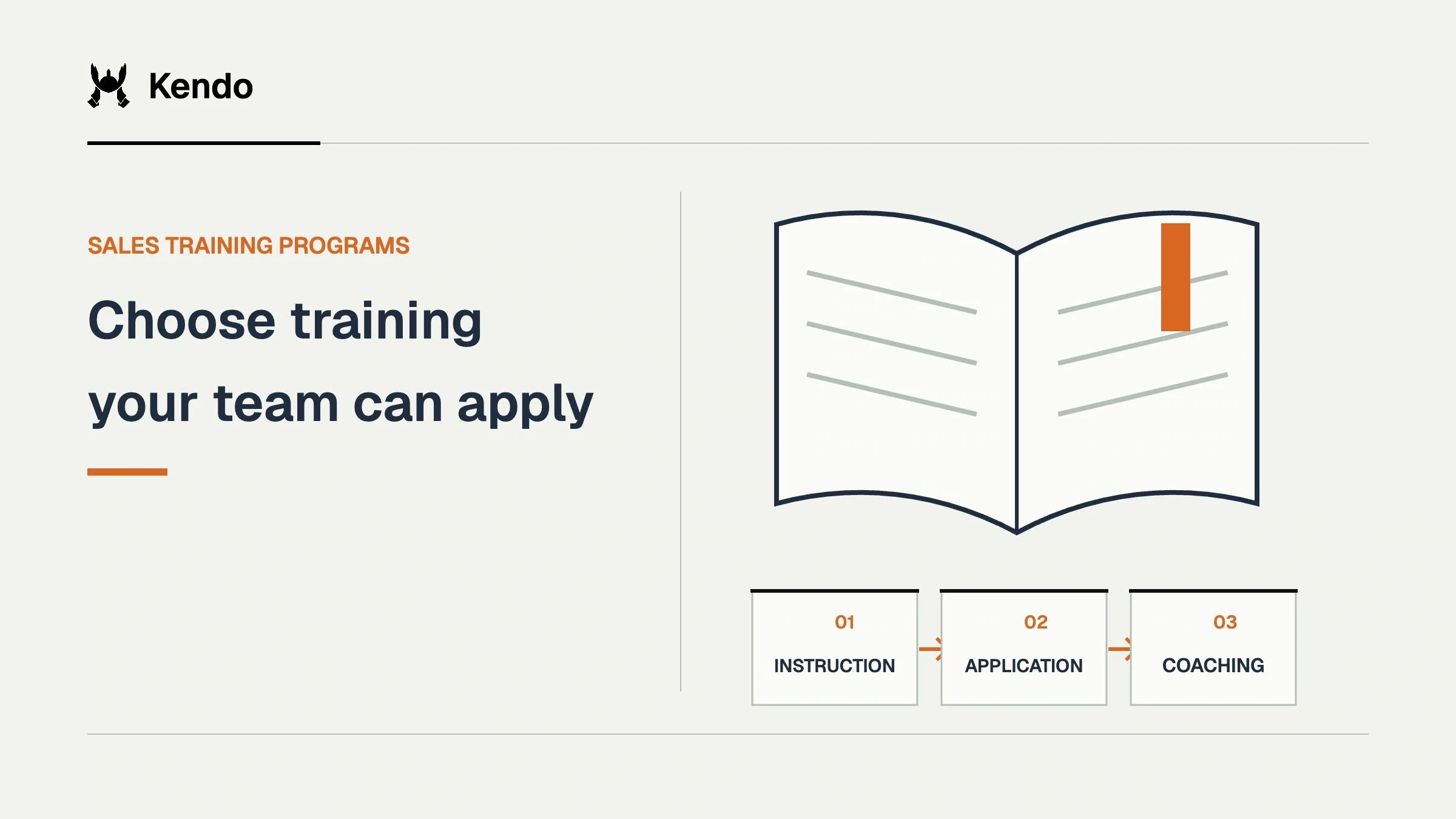
Methodology vs. Practice: The Split That Decides Everything
Before you compare a single vendor, get one distinction straight, because it is the difference between training that sticks and training that evaporates by Friday.
- A methodology is a framework. Sandler, SPIN, Challenger, and MEDDIC teach reps how to think about a deal and what to say at each stage. They are the playbook. Adoption matters: teams with high methodology adoption see +21% quota attainment and +15% win rates [Source: Korn Ferry / CSO Insights].
- Tactical training is the day-one play. JB Sales and 30MPC give reps a specific move they can run on the next call, lighter on theory and heavy on execution.
- Practice is where the play becomes a habit. AI roleplay platforms like Kendo and Hyperbound let reps rehearse the methodology against realistic buyers, with objective scoring, until it survives contact with a real prospect.
Here is the trap. Teams buy the framework and skip the reps. A two-day workshop teaches the play, everyone nods, and a week later most of it is gone. The fix is not a better workshop. It is reinforcement, the part traditional training has always done worst.
That is why we lead with the practice layer and weave it through every section below. Methodology teaches the play. Practice wins the deal.
Best Sales Training Programs for 2026: Comparison Table
| # | Program | Type | Best For | Format | Starting Price | AI / Roleplay |
|---|---|---|---|---|---|---|
| 1 | Kendo AI RECOMMENDED | AI Practice | Rep practice, ramp, call review | AI roleplay & call-review platform | $55/seat/mo | Yes |
| 2 | Sandler Training | Methodology | Consultative, qualification-first selling | Ongoing program + reinforcement | Custom* | No |
| 3 | SPIN Selling | Methodology | Discovery and questioning skill | Workshops + behavior change | Custom* | No |
| 4 | The Challenger Sale | Methodology | Insight-led, status-quo-disrupting selling | Programs via Richardson | Custom* | No |
| 5 | MEDDIC Academy | Methodology | Complex deal qualification | Self-paced + vILT + certification | $297-$597 | Certification |
| 6 | RAIN Group | Methodology | Full-curriculum behavior change | Blended programs + reinforcement | Custom* | No |
| 7 | Winning by Design | Methodology | Recurring-revenue GTM process | Live instruction + LMS | $500-$2,500/course | Cohort |
| 8 | JB Sales | Tactical | Day-one prospecting and deal plays | On-demand + live workshops | $497 (PRO) | Tools only |
| 9 | 30MPC | Tactical | Sharp, repeatable tactical plays | On-demand courses + team plans | Paid courses* | No |
| 10 | Hyperbound | AI Practice | AI roleplay for larger orgs | AI roleplay platform | Custom* | Yes |
| 11 | Allego | Enablement | All-in-one enablement at scale | Enablement + coaching platform | Custom* | AI-enabled |
Pricing and formats verified against each provider's own site in June 2026. *Programs marked with an asterisk do not publish full pricing and require a quote; methodology programs commonly land between $1,000 and $3,000 per person, with figures from third-party sources cited inline in brackets. Selling software specifically? The best SaaS sales training programs roundup goes deeper on the recurring-revenue motion.
Kendo AI
★ Best overallThe practice layer that turns any sales methodology into repeatable execution through unlimited, realistic AI roleplay.
Full disclosure: we built Kendo, so we are biased. We built it because every methodology on this list teaches reps what to say, then leaves them to figure out execution on live deals. Kendo is the practice layer that closes that gap. Instead of a workshop and a delayed manager review, reps get on-demand AI roleplay, real-time coaching, and an automatic call review after every session.
Why it sits at number one on a list full of respected institutions is simple. The other ten can teach a framework. None of them puts a rep on a thousand realistic calls before the real one. That is the variable most correlated with whether training shows up in the pipeline.
It is not a methodology, and we will not pretend otherwise. Pair it with one of the framework picks below. Kendo's job is to make sure the framework actually sticks: you build AI buyers that mirror your real pipeline, then reps drill discovery, objection handling, and closing until the moves are automatic.
This is what practicing on Kendo looks like. The AI buyer pushes hard on SOC 2, ISO 27001, and proof the tool cuts compliance work, and the rep has to handle it on the spot, before any of it lands on a live deal.
Kendo vs. Traditional Sales Training
| Dimension | Kendo AI | Traditional Training |
|---|---|---|
| Practice availability | 24/7 on-demand reps | Limited to scheduled sessions |
| Scenario customization | Any ICP, offer, or objection | Generic, or whatever the trainer knows |
| Feedback | Real-time, objective scoring | Subjective, days later |
| Reinforcement | Built in, daily | Often a one-off workshop |
| Languages | 40+ for distributed teams | Usually one |
Key Features
- Custom Prospect Builder. Create AI buyers that match your exact ICP by role, industry, and personality, in seconds. To start fast, borrow from 20+ pre-built sales roleplay scenarios, from cold-call openers to late-stage negotiations.
- Real context, not generic scripts. Kendo pulls from your company info, scripts, frameworks, CRM data, calls, and emails so practice mirrors your actual deals, and connects to Zoom, Fathom, Fireflies, Slack, Zapier, plus an open Push API.
- Real-time AI coaching. Minute-by-minute guidance during a live simulation, not post-call notes you read three days later.
- Automated call scoring and review. Objective scorecards on discovery depth, talk ratio, and objection handling, without manual manager grading.
- Global language support. 40+ languages for distributed teams practicing the same scenarios across time zones.
This is deliberate practice in action: state-of-the-art voice AI with ultra-low latency, prospects that push back and stall like real buyers do, and a setup that takes seconds rather than a planning meeting. It is not a chatbot reading a script.
"My guy said, 'My call on Kendo with Mary was the exact same as my real call,' and then he closed the deal."
KSKody Skvarla · Insurance team leaderTry Kendo with a Free Roleplay, Pricing Starts at $55/mo
Kendo's per-seat plans include monthly AI training minutes with transparent overages. Teams typically report a 5 to 15% lift in close rates, making it ROI-positive within the first month of consistent use. See full per-seat pricing.
| Pro $55/mo per seat | Max $100/mo per seat | Enterprise Custom |
|---|---|---|
| AI roleplay, AI call reviews, advanced analytics, AI sales manager + coach, 180 roleplay minutes/seat per month | Everything in Pro, 480 roleplay minutes/seat per month, for teams that want maximum usage | Teams of 10+, custom AI models, custom scoring, DFY setup, dedicated account manager |
United Insurance Pros cut new-rep ramp from 45 days to 14
For teams selling policies, Medicare, final expense, or P&C products, the insurance sales training programs guide breaks down the category more specifically.
After rolling out Kendo roleplay, United Insurance Pros got brand-new agents to baseline performance in 14 days instead of 45, while saving thousands per agent every month on training time.
"Typically we would see about a 45-day period where people would dip their foot in the water and slowly improve and then level off. Now that's 14 days."
Waylon Artrip, Founder at United Insurance ProsSandler Training
Best methodology overallA globally recognized system that shifts selling from a high-pressure pitch to a consultative, qualification-first partnership.
If you can only teach your team one framework, Sandler is the safe default. Its Selling System breaks a deal into clear stages, with hallmark concepts like Up-Front Contracts and the Pain Funnel, so reps qualify hard before they ever present a solution. The whole point is to stop chasing deals that were never going to close.
What separates it from a one-off course is the model. Sandler is built around ongoing reinforcement, not a single workshop, which is exactly the habit most training programs lack. For the framework in depth, see our guide to the Sandler sales methodology.
Key Features
- Consultative, pain-first approach that builds trust by uncovering the root cause of a prospect's problem before pitching.
- Up-front contracts to qualify hard and filter out low-value opportunities early.
- Continuous reinforcement through ongoing sessions and coaching, the model most one-off programs miss.
Consider before choosing
- Reinforcement still happens in scheduled sessions. The model is built on repetition, but the reps still need somewhere to practice between sessions, which is where an AI roleplay layer earns its keep.
- Resource intensive with a learning dip. It asks for real budget and a long-term commitment, and the mindset shift can cause a temporary performance dip before it climbs.
- Custom pricing and franchise variability. Pricing is quote-based, commonly cited at roughly $1,000 to $3,000 per person, and instruction quality can vary by trainer or franchise location. [Source: third-party, G2 and franchise data]
SPIN Selling (Huthwaite International)
Best for discoveryThe research-backed questioning method that taught a generation of reps to sell by asking, not pitching.
SPIN is the methodology behind the question most reps ask badly: discovery. Built on Huthwaite's analysis of thousands of real sales calls, it gives reps a sequence, Situation, Problem, Implication, Need-payoff, that walks a buyer from a vague pain to wanting your solution. Huthwaite International still runs the official program, framed around measurable behavior change.
If your team's deals stall in discovery, this is the fix. The catch is that SPIN is a questioning discipline, not a full deal system, so it pairs with a qualification framework rather than replacing one. And questioning is a pure skill, which means it is only as good as the reps you put in.
Key Features
- The SPIN question sequence that moves a buyer from surface symptoms to a felt need, grounded in observed-call research rather than theory.
- Behavior-change focus with verbal-behavior analysis, so training targets what reps actually do on calls.
- Negotiation and communication tracks alongside the core selling program for full-cycle coverage.
Consider before choosing
- Discovery is a perishable skill. A questioning method is exactly the kind of thing reps lose without repetition, so it benefits more than most from drilling between sessions.
- Narrow by design. SPIN sharpens questioning, not qualification or closing, so most teams layer it onto a broader system.
- Quote-based pricing. Huthwaite routes pricing through a conversation rather than publishing it. [Source: huthwaiteinternational.com, June 2026]
Want reps drilling SPIN-style discovery on live calls? Pair it with the best sales coaching software.
The Challenger Sale (Richardson)
Insight-led selling that teaches reps to teach, tailor, and take control instead of waiting for the buyer to define the problem.
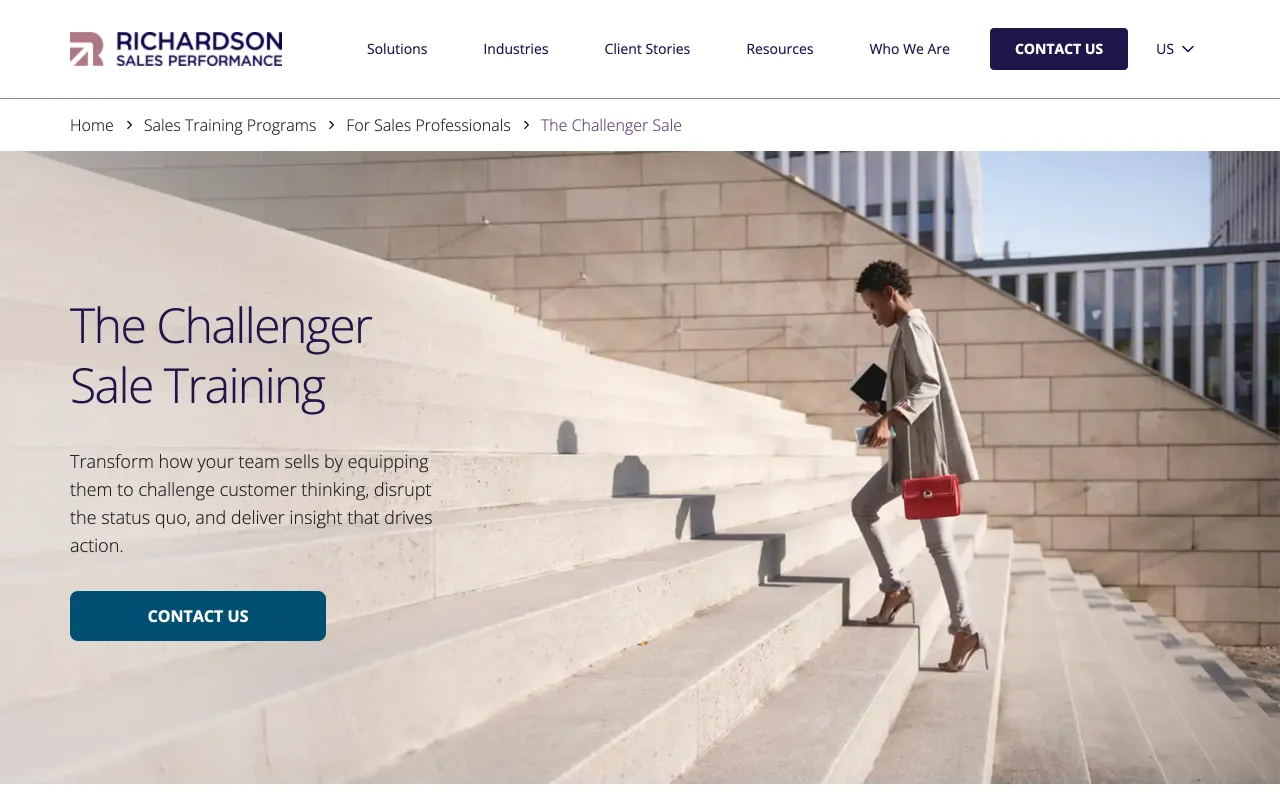
Heads up: Challenger is now part of Richardson Sales Performance, which acquired it in late 2024 and now delivers The Challenger Sale as part of its training catalog. [Source: richardson.com, June 2026] The methodology itself is unchanged: reps win by bringing the buyer a provocative insight, not by being the friendliest vendor in the room.
It fits teams selling into a hard status quo, where the real competition is "do nothing." Challenger reps teach the customer something about their own business, tailor it to the stakeholder, and take control of the conversation. Done well it is powerful. Done badly it sounds arrogant, which is the whole risk: it demands real skill, so reps need to practice the insight-led pitch before they try it on a live economic buyer.
Key Features
- Teach-Tailor-Take Control model that reframes the buyer's thinking instead of just responding to stated needs.
- Commercial insight design so reps lead with a point of view that challenges the customer's assumptions.
- Richardson delivery and analytics combining the Challenger approach with role-based curricula and reinforcement tooling.
Consider before choosing
- High skill ceiling. The line between "challenging" and "abrasive" is thin, so this is one of the methodologies that most needs rehearsal before reps run it live.
- Best for considered, complex deals. It can overpower a simple transactional sale where the buyer just wants a quick answer.
- Custom pricing. Delivered through Richardson as a quote-based engagement rather than a published price. [Source: richardson.com, June 2026]
Across Kendo customers: 5-15% higher close rates, 70% faster ramp, and $3,000+ saved per rep.
See the results →
MEDDIC Academy
Best for qualificationSpecialized training in the MEDDIC and MEDDPICC® qualification framework for complex, multi-stakeholder deals.
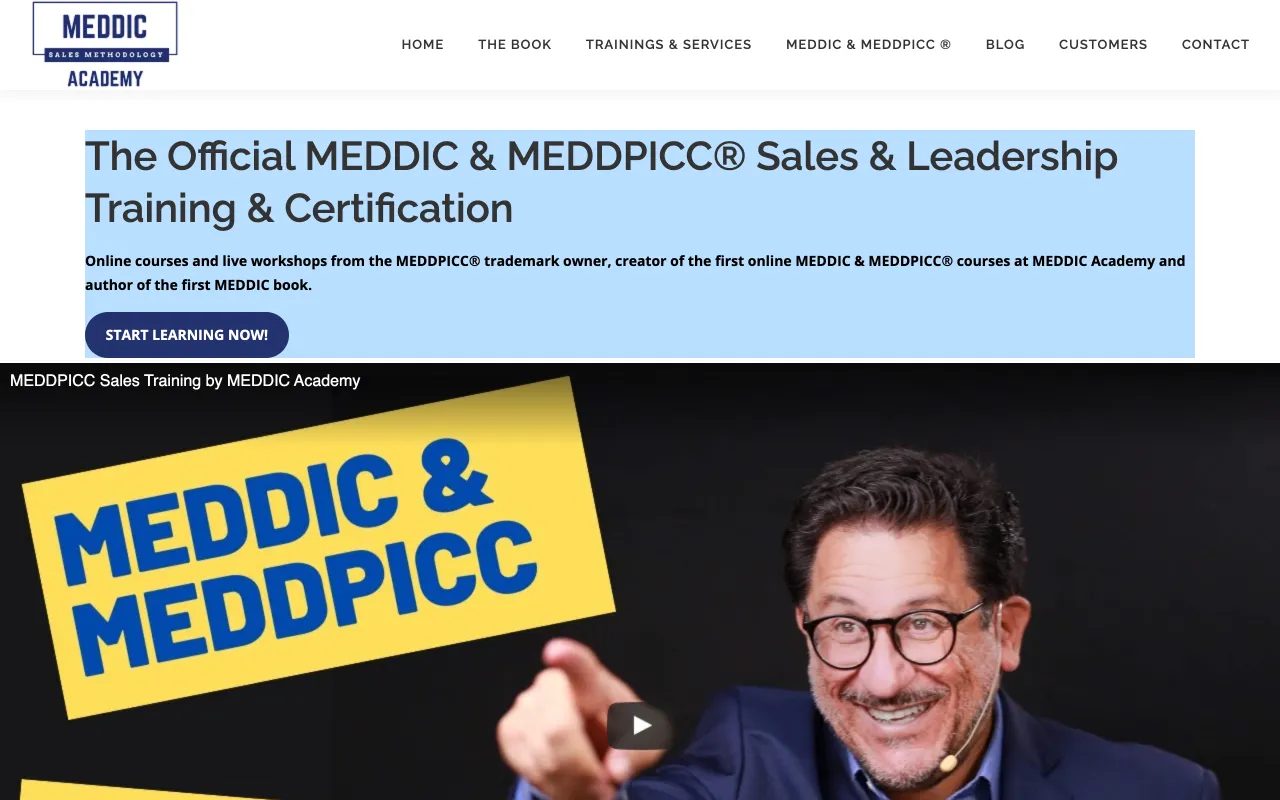
Where Sandler and SPIN shape the conversation, MEDDIC governs the forecast. It teaches reps to eliminate deal uncertainty by spotting red flags across the lifecycle: who the economic buyer is, whether you have a champion, what the decision criteria and paper process really are. MEDDIC Academy was the first to offer test-based certification and covers MEDDIC, MEDDICC, and MEDDPICC.
This is the qualification language of complex B2B, and it is refreshingly affordable to start because it publishes self-paced pricing. The depth is all in qualification rigor, not discovery or closing technique, so it is overkill for transactional or self-serve teams and best paired with a conversational method. For the framework in detail, see our MEDDIC sales training guide.
Key Features
- Structured curriculum spanning self-paced courses, virtual instructor-led training, and certification.
- Deal-risk focus on developing champions, building ROI cases, and knowing when to walk away.
- Predictable forecasting grounded in evidence over gut feel.
Consider before choosing
- It scores the deal, not the conversation. MEDDPICC tells a rep what they still need to learn, not how to have the call that uncovers it, so reps still need to practice the discovery that fills in each pillar.
- Effortful to maintain. Tracking every pillar per deal is time-consuming and can hurt CRM adoption without automation.
- Verified pricing. Full MEDDPICC® is $297 and Advanced is $597, with manager and enterprise bundles priced higher. [Source: meddic.academy, June 2026]
RAIN Group
A full-curriculum, research-backed training firm built around durable behavior change rather than a one-day event.
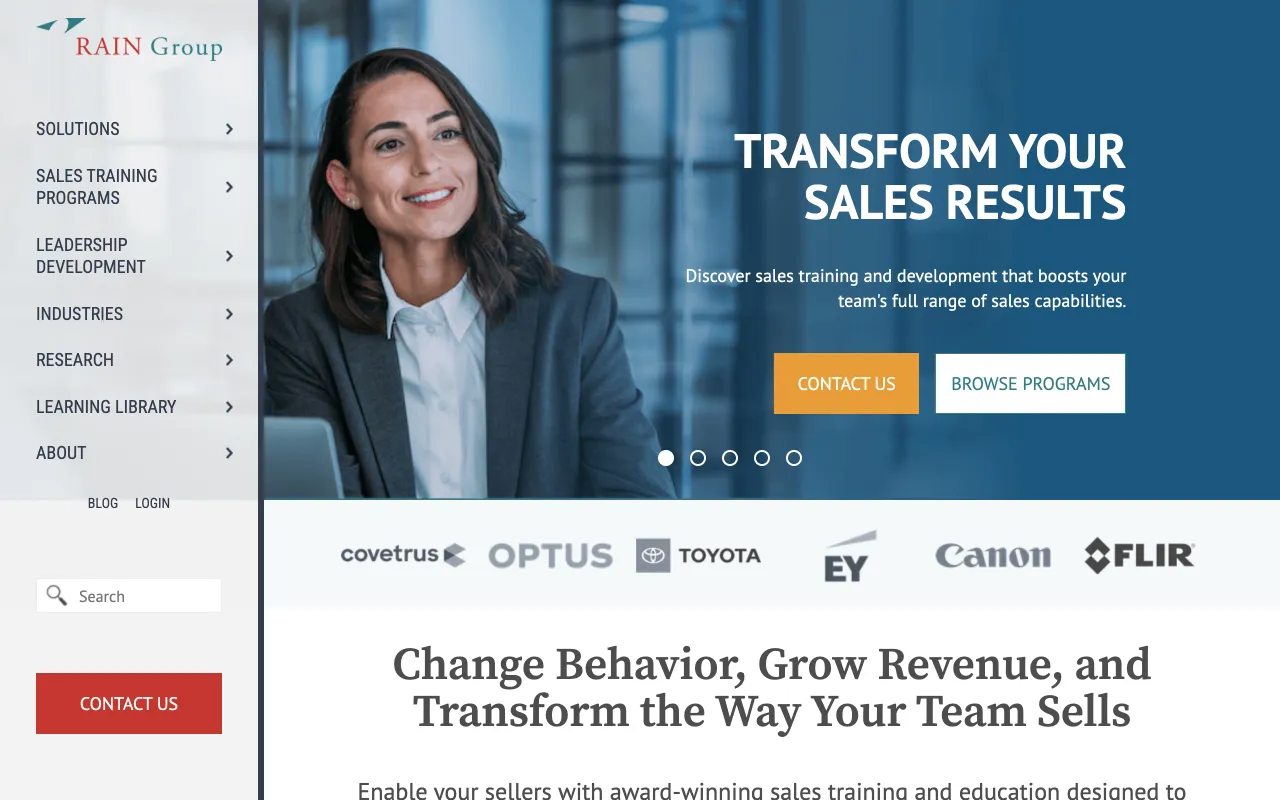
RAIN Group is the pick when you want a single provider to handle the whole curriculum, from prospecting to negotiation to account growth, rather than stitching together point methods. Its programs are built explicitly around reinforcement and measurable behavior change, which is the right instinct given how fast untrained habits revert.
It is genuinely broad, which is both the strength and the caveat. You get a coherent system across the full sales motion, but breadth means each topic goes less deep than a specialist like MEDDIC or SPIN. For an enterprise standardizing one vendor across a large team, that tradeoff usually makes sense.
Key Features
- End-to-end curriculum covering consultative selling, opportunity management, key-account growth, and sales management.
- Reinforcement and coaching baked into delivery, not sold as a separate add-on.
- Research-backed content from its Center for Sales Research, with role-based learning paths.
Consider before choosing
- Reinforcement still needs a practice surface. The curriculum is strong on follow-up, but reps drilling between sessions is where an AI roleplay layer complements it.
- Broad over deep. A specialist framework will go further on its single topic than a generalist curriculum.
- Custom pricing. Engagements are quoted to scope, commonly landing in the per-person range typical of methodology firms. [Source: raingroup.com, June 2026]
Winning by Design
Best for revenue processScience-based, data-driven methodology for building a repeatable revenue engine across the whole GTM org.
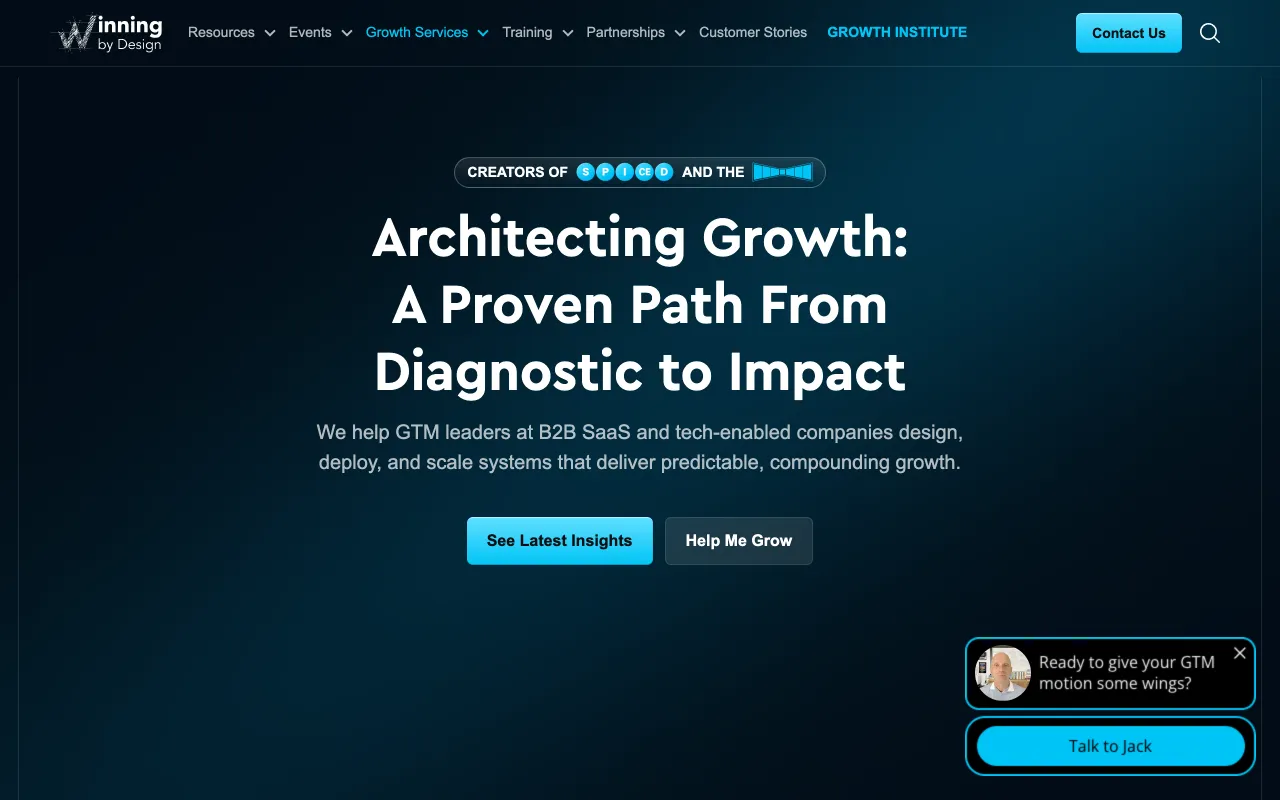
Winning by Design is the methodology shop for teams that think in process, not just technique. Its SPICED discovery framework and Bowtie revenue model give sales, marketing, and customer success one shared language, which is why it shows up so often in modern, subscription-driven orgs.
It is the most process-oriented pick here, and that is the point of difference. No other option on the list is built so squarely on the full revenue lifecycle, from first touch through expansion. What it does not own is live execution, so the SPICED call still has to be rehearsed somewhere. It leans toward recurring-revenue businesses more than one-time transactional sales.
Key Features
- Role-based paths for SDRs, AEs, CSMs, managers, and executives, from prospecting to Revenue Architecture.
- SPICED and Bowtie frameworks that align the full GTM org around one language for cleaner hand-offs and retention.
- Blended delivery pairing live instruction with LMS reinforcement.
Consider before choosing
- Strong on blueprint, lighter on reps. Moving from a clean process map to daily execution takes internal effort and a place to practice the calls.
- Time and discipline intensive. Lengthy sessions can be hard to fit during peak quarters.
- Pricing scales fast. Individual courses run $500 to $2,500, with team engagements starting near $25,000. [Source: winningbydesign.com, June 2026]
JB Sales (JBarrows)
Best for tacticsTactical, high-energy training from John Barrows focused on plays reps can run on the next call.
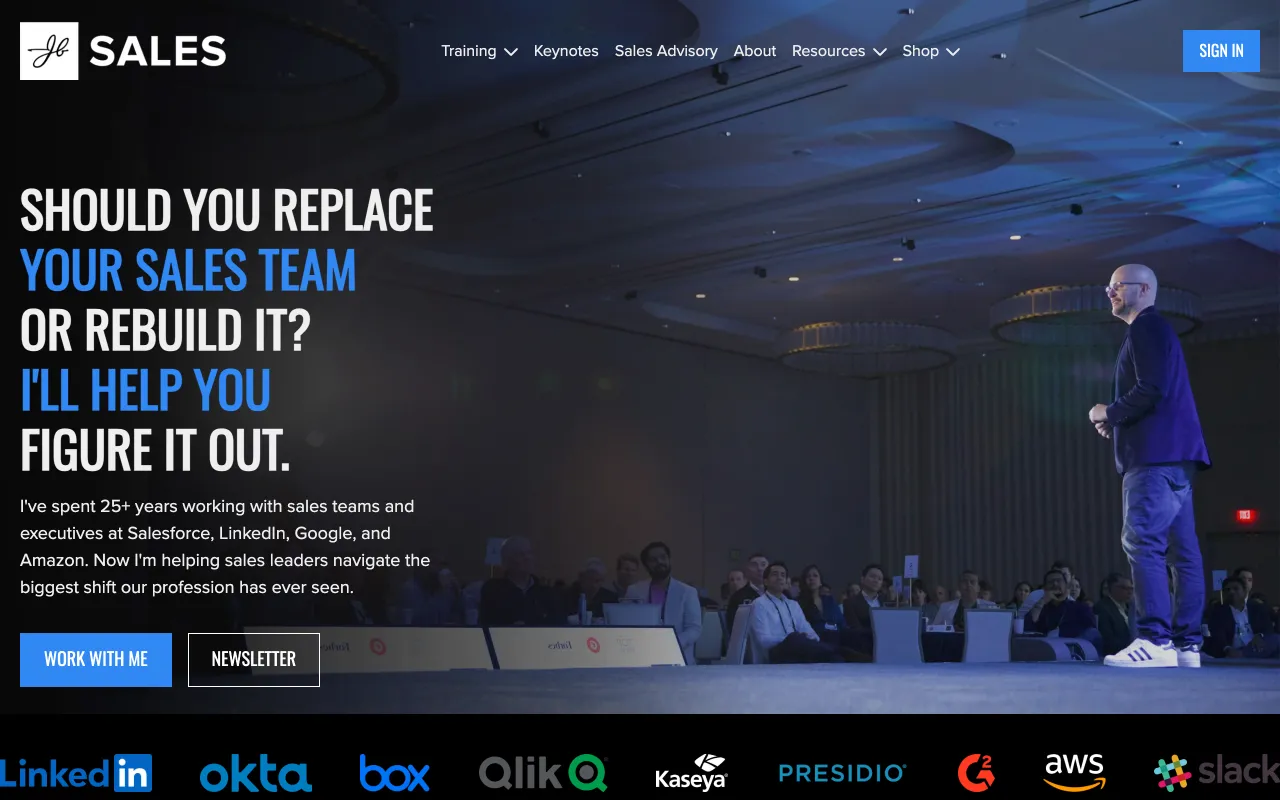
Methodology answers "how should we sell?" JB Sales answers "what do I do on this call, today?" Flagship programs like "Filling the Funnel" and "Driving to Close" are built for reps who want a no-nonsense play they can use 15 minutes after watching, and the membership now bundles SalesGPT tools for folding AI into research and messaging.
Treat it as an execution layer, not a complete system. The tactics sharpen prospecting and deal control, but the broader strategy and qualification sit outside the scope, which is fine if you already have a framework and just need reps executing it sharper.
Key Features
- On-demand programs covering prospecting, objection handling, and deal control, with certifications for the core courses.
- SalesGPTs for automating research and message creation.
- Live workshops and a full tactical content library updated for current buyer behavior.
Consider before choosing
- Results hinge on the reps doing the reps. The content is rich, but it only pays off if reps actively practice and apply it, not just watch.
- Tactics, not a system. It is an execution layer, so a team with no underlying methodology will still have a consistency problem.
- Updated pricing. PRO membership is $497, and the ELITE mentorship with 1:1 time runs $749/month. [Source: learn.jbarrows.com, June 2026]
30 Minutes to President's Club
A tech-sales-native brand serving sharp, day-one tactical plays for AEs and SDRs through courses and team training.
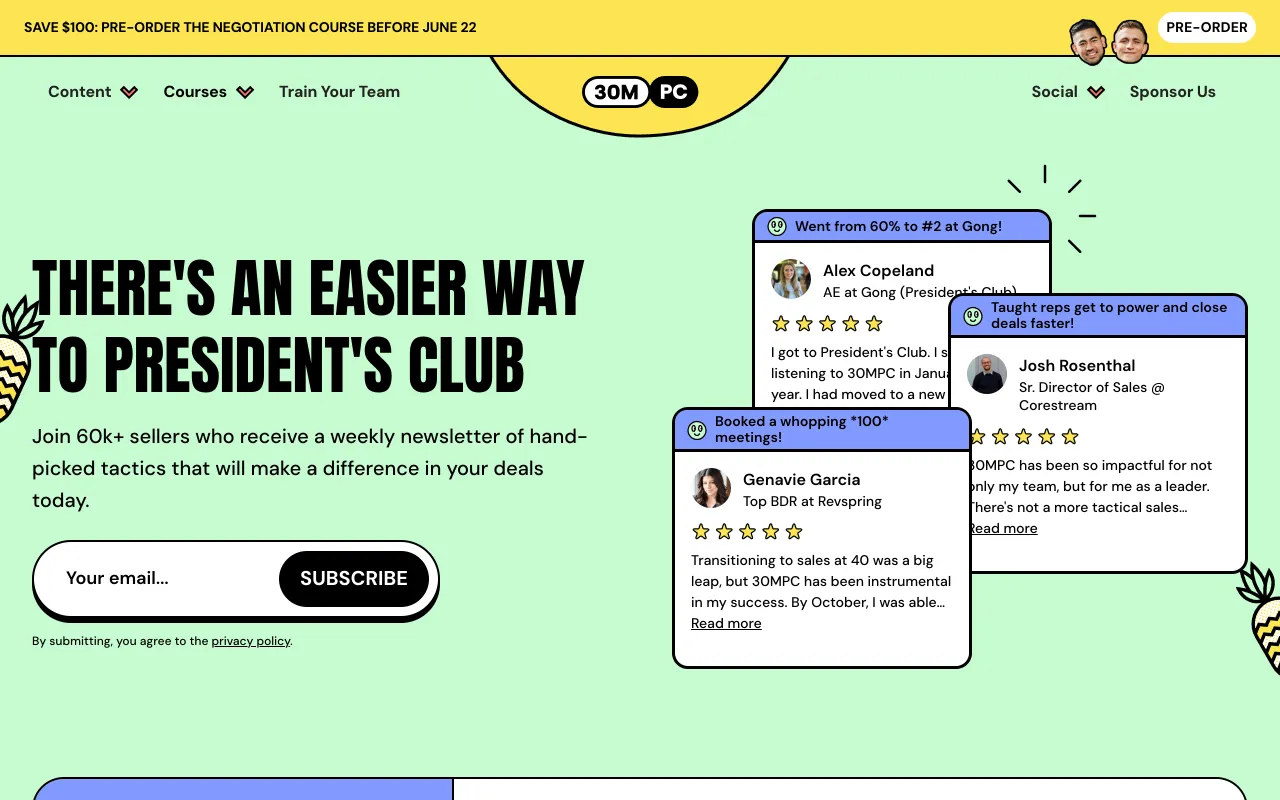
30MPC, from Nick Cegelski and Armand Farrokh, reaches more than 60,000 sellers through its newsletter and turns that audience into paid courses on cold calling, discovery, negotiation, and multithreading, plus a "Train Your Team" option. [Source: 30mpc.com, June 2026]
It is the modern, no-fluff alternative to a classic methodology institution. The plays drop straight into cold calls, discovery, and getting to power, and reps tend to actually use them because they are specific. What you do not get is a complete system, so long, complex deal strategy stays thin and reinforcement is on you.
Key Features
- Tactical courses on cold calling, discovery, objection handling, negotiation, and multithreading reps can apply on the next call.
- Train Your Team option to roll the same plays out across an SDR or AE team.
- Top-ranked podcast and newsletter reaching 60,000+ sellers, with a steady stream of current tactics.
Consider before choosing
- Modular, not a complete system. It sharpens specific plays, but the reinforcement and the underlying framework are on you.
- Lighter on complex enterprise strategy. Strongest on tactical execution, less so on long multi-stakeholder deal architecture.
- Paid courses with team plans. 30MPC sells individual courses plus team plans rather than a single flat price. [Source: 30mpc.com, June 2026]
Hyperbound
An AI roleplay and revenue-activation platform aimed at larger orgs that want full-cycle simulation.
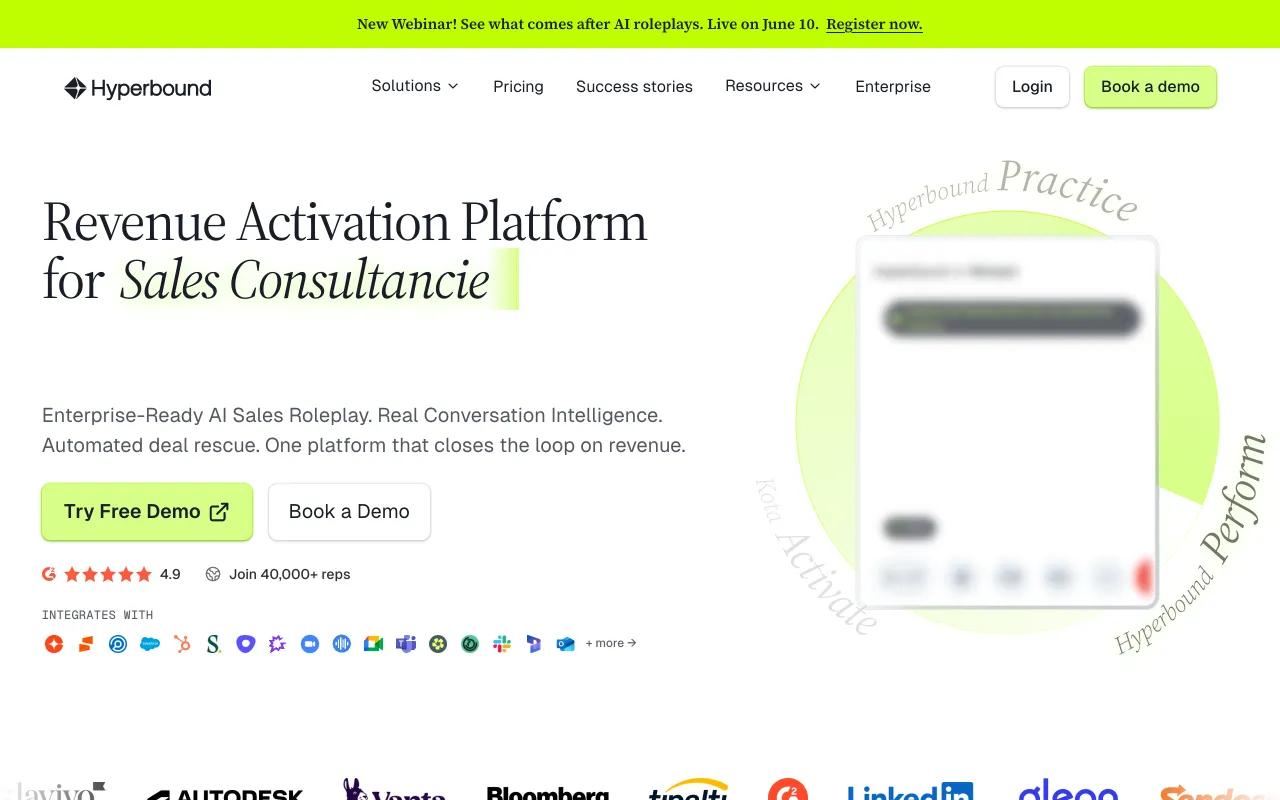
The clearest sign that practice is now its own category: there is more than one serious AI roleplay platform. Hyperbound is the other one worth knowing. It positions as a revenue activation platform with AI roleplay, real conversation intelligence, and automated deal rescue, and it has real traction with 40,000+ reps.
For a large org that wants AI practice plus a heavier enablement wrapper, it is a credible pick. The honest comparison, since we make a competing tool: Hyperbound leans enterprise and quote-based, while Kendo publishes per-seat pricing and is faster to self-serve. If you want to weigh them properly, see the full Kendo vs Hyperbound breakdown, or compare the wider field of Hyperbound alternatives for AI roleplay.
Key Features
- AI roleplay simulations for cold calls, discovery, and objection handling with automated feedback.
- Conversation intelligence layered on top of practice to connect drills to live-call performance.
- Broad integrations for slotting into an existing enterprise sales stack.
Heads up · Based on user reviews
- Enterprise-leaning setup. The heavier platform can mean more configuration than a smaller team wants before reps are practicing.
- Quote-based pricing. Hyperbound routes pricing through sales rather than publishing per-seat rates, which slows quick comparisons. [Source: hyperbound.ai, June 2026]
Allego
An all-in-one revenue enablement platform that folds learning, content, and AI coaching into one system.
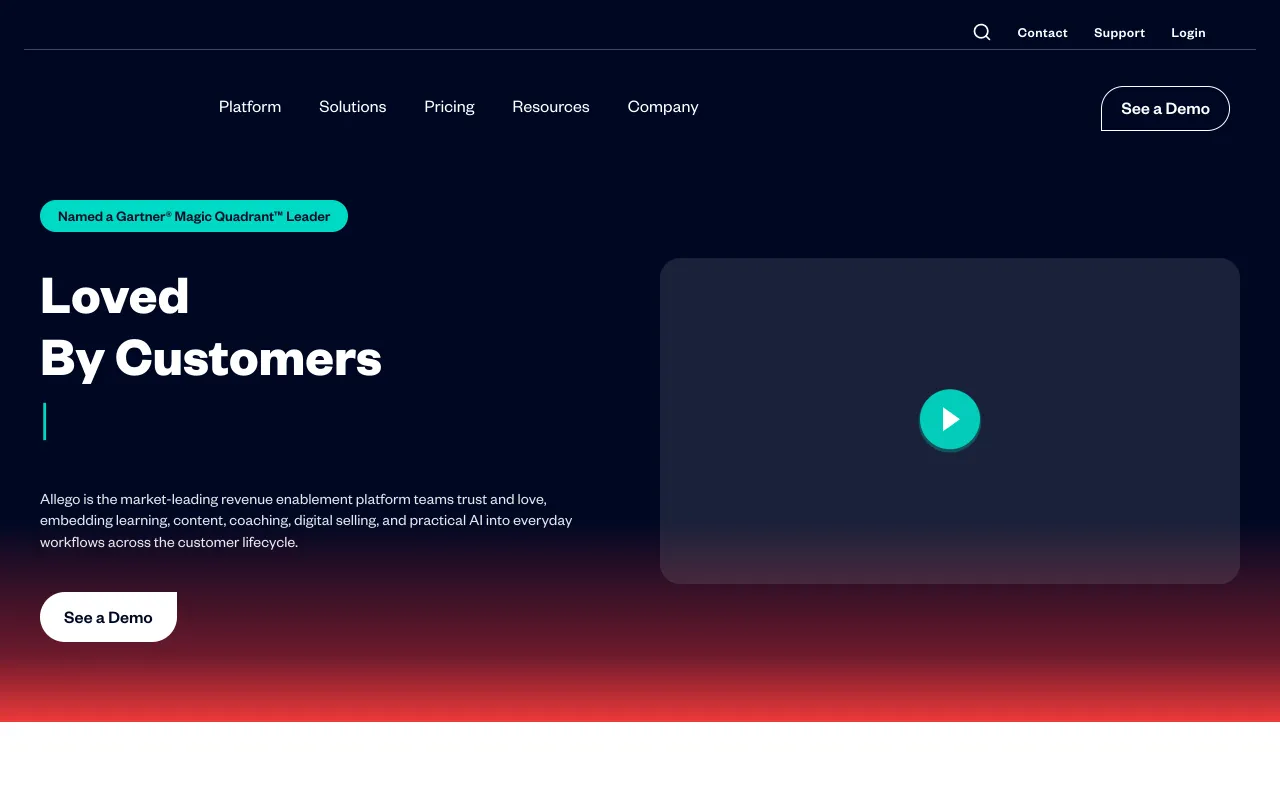
Allego is the heavyweight enablement platform on this list, a Gartner Magic Quadrant Leader that embeds learning, content, coaching, and digital selling into one system used across distributed teams. If your problem is "we have content and training scattered everywhere," this consolidates it.
It is the enterprise-platform answer rather than a methodology or a focused practice tool. The breadth is the value and the cost: it is powerful but complex, with longer implementation than a focused tool. Smaller teams that just want reps practicing tomorrow will find it heavier than they need. For the narrower category, see our best sales training software comparison.
Key Features
- Learning and content in one platform, so reps find the right material and training in the flow of work.
- AI-powered coaching and practice with feedback, plus digital sales rooms for buyer collaboration.
- Enterprise-grade analytics across onboarding, readiness, and content engagement.
Heads up · Based on user reviews
- Complexity and ramp. The all-in-one scope means a longer rollout and more admin than a focused practice tool. [Source: G2]
- Custom pricing. Allego routes pricing through a sales conversation rather than publishing it. [Source: allego.com, June 2026]
Onboarding new reps specifically? See our guide to reducing sales ramp time.
How to Choose the Right Sales Training Program
Skip the "which brand is best" debate. The better question is which gap is hurting your number right now, then match the program to it.
| Your Gap | What to Prioritize | Strong Options |
|---|---|---|
| Reps know the theory but freeze on live calls | Repetition, objective scoring, reinforcement | Kendo AI, Hyperbound |
| Inconsistent process and no shared language | One methodology across the team | Sandler, Winning by Design, RAIN Group |
| Deals stall in discovery | A questioning discipline | SPIN (Huthwaite), Sandler |
| Forecast is unreliable, deals slip | Rigorous qualification | MEDDIC Academy |
| Selling against a hard status quo | Insight-led, point-of-view selling | The Challenger Sale (Richardson) |
| Reps need tactics they can use this week | Day-one plays | JB Sales, 30MPC |
| Scattered content and tooling at scale | Consolidated enablement | Allego |
Notice the pattern. Most of these are frameworks, and exactly one row solves the execution problem. That is not an accident. The methodology market is crowded; the practice market is where the actual behavior change happens.
So the realistic answer for most teams is two purchases working together: a methodology that fits your deals, and a practice layer that makes reps run it. Buy the framework from the rows above. Then make it stick, because the average AE now takes 5.7 months to ramp [Source: The Bridge Group, 2024], and every week of that is burnt leads if reps are learning live.
Methodology, Tactics, or Practice: Which to Buy First
If you have no shared framework, start with a methodology. Process consistency is the foundation everything else sits on.
If you have a framework but reps execute unevenly, you do not need another course. You need reps and reinforcement, which is the practice layer.
If individual reps just need a quick, specific fix, a tactical membership like JB Sales or 30MPC is the cheapest, fastest on-ramp. Match the spend to the gap, not to the loudest brand.
Where AI Roleplay Fits: The Practice Layer Every Methodology Needs
One category has changed the most in the last two years, and it is the one buyers ask about most: AI sales roleplay. It deserves its own framing because it is not a competitor to Sandler or MEDDIC. It is the missing half.
Here is the logic. A methodology teaches the play. But reps forget roughly 70% of training within a week [Source: Ebbinghaus forgetting curve], and you cannot give a whole team meaningful 1-on-1 practice with a human trainer. So reps get certified, jump on real calls, and burn through their first 30 to 50 conversations figuring it out live.
AI roleplay closes that loop. Reps practice the exact discovery call or objection on demand, against a buyer that pushes back, and get objective scoring afterward. It is the reinforcement engine methodology training has always lacked. If you want to compare the category head to head, our roundup of the best AI sales roleplaying tools breaks down how the main platforms stack up.
- Kendo AI is the pick for most teams: fully custom AI prospects, real-time coaching, automatic call review, and transparent pricing from $55 per seat per month. It also pulls your CRM data, scripts, and frameworks so scenarios mirror your live pipeline.
- Hyperbound suits larger orgs that want AI practice inside a heavier enablement wrapper, with quote-based pricing.
- FullyRamped focuses on onboarding-stage roleplay, turning real calls into practice reps. See how it stacks up in Kendo vs FullyRamped.
If you are deciding between practice tools and conversation intelligence like Gong, the distinction is timing. Gong analyzes calls that already happened; Kendo lets reps rehearse before the call that matters. The strongest setups use both, so reps practice ahead and managers review what actually happened. For the full category, see the best virtual sales training programs.
The Verdict: Which Sales Training Program Should You Pick?
The best program is the one your team will actually use, with practice that makes the lessons stick. Most teams need two things working together: a methodology and a way to rehearse it.
- Best methodology overall: Sandler, for its qualification-first system and built-in reinforcement model.
- Best for discovery and qualification: SPIN (Huthwaite) for questioning, MEDDIC Academy for deal qualification.
- Best for complex, insight-led deals: The Challenger Sale, now delivered through Richardson.
- Best for a full revenue process: Winning by Design and RAIN Group give the whole GTM org one system.
- Best for tactics this week: JB Sales and 30MPC deliver plays reps can run on the next call.
- Best for the practice layer: Kendo AI turns any of the above into repeatable performance, with unlimited AI roleplay and objective scoring from $55 per seat per month.
Methodology teaches the play. Practice wins the deal. If you want reps drilling real objections before they ever touch a live opportunity, start a free Kendo roleplay or book a demo. To see how elite sellers turned specific skills into repeatable systems, study the greatest salespeople of all time. To ramp new reps faster, our guide to reducing sales ramp time shows how teams cut weeks off onboarding.
Frequently Asked Questions
What are the best AI sales roleplay platforms for sales teams?
The strongest AI roleplay platforms for sales teams in 2026 are Kendo AI, Hyperbound, and FullyRamped. All three let reps practice live calls against AI buyers with automated scoring. Kendo leads for teams that want fully custom AI prospects, real-time coaching during the call, and automatic call review afterward, starting at $55 per seat per month. The practice layer is what turns a methodology like Sandler, SPIN, or MEDDIC into repeatable performance, instead of a workshop reps forget within a week.
Can Kendo AI sales roleplay integrate with your CRM and sales engagement platforms?
Yes. Kendo uses your real context to build practice scenarios, pulling from company information, scripts, frameworks, CRM data, calls, and emails so reps drill against buyers that mirror your actual pipeline. It connects to Zoom, Fathom, Fireflies, Slack, and Zapier, and offers an open Push API to send calls in from HubSpot, Salesloft, Aloware, or any internal system. That means roleplay scenarios reflect your live deals, not generic scripts.
Is Kendo better than FullyRamped or Gong for sales coaching?
It depends on what you are solving. Gong is conversation intelligence, built to analyze calls that already happened, so it is reactive coaching. FullyRamped and Kendo are practice platforms, so reps rehearse before the live call. Kendo combines both: proactive AI roleplay plus automatic review of real calls, with fully custom AI prospects and transparent per-seat pricing from $55 per month. Teams that want practice plus measurement in one tool tend to land on Kendo.
What is the difference between a sales methodology and a sales training platform?
A methodology like Sandler, SPIN, Challenger, or MEDDIC is a framework: it teaches reps how to think about a deal and what to say at each stage. A practice platform like Kendo is where reps build the muscle memory to execute it under pressure, with unlimited reps and objective scoring. Methodology supplies the play. Practice is how the play survives contact with a real buyer, which matters because reps forget roughly 70% of training within a week without reinforcement.
How much do sales training programs cost in 2026?
It ranges widely. Tactical course memberships run a few hundred dollars (JB Sales PRO is $497). Methodology programs from Sandler, SPIN, Challenger, RAIN Group, and Winning by Design are typically quote-based and commonly land between $1,000 and $3,000 per person, climbing into five and six figures for full team engagements. MEDDIC Academy publishes self-paced pricing from $297. AI practice platforms are the most transparent: Kendo starts at $55 per seat per month.
What is the best sales training program for distributed or remote teams?
Distributed teams need training that works asynchronously and scales without a trainer in the room. AI roleplay platforms fit best because reps practice on their own time and managers review the scored calls later. Kendo supports 40+ languages and on-demand practice, so a remote team across time zones can drill the same scenarios and managers see objective scorecards. Pair it with a methodology delivered virtually, such as RAIN Group, Sandler, or Winning by Design, for a shared framework.
Is AI sales training suitable for experienced reps or just new hires?
Both. New hires use AI roleplay to ramp faster and burn fewer real leads while they learn, and the average AE now takes 5.7 months to ramp, so cutting that pays off quickly. Experienced reps use it to drill a specific weak spot, like a pricing objection or a multi-threaded discovery call, before a high-stakes opportunity. Because practice is unlimited and private, veterans can rehearse without the awkwardness of roleplaying in front of peers.

Luke Alexander is the founder of Kendo AI, where he's helped train more than 5,000 sales reps. He started in sales as a frontline closer, scaled a high-ticket sales-training company, and founded Closer Cartel and co-founded Closify before building Kendo to fix the tools he wished he'd had: realistic AI roleplay and automated call review for fast-moving sales teams. He writes about sales training, ramp speed, objection handling, and applying AI across the revenue org.