

 vs
vs

Kendo vs PitchMonster
Kendo connects live-call review to targeted practice. PitchMonster leads with three roleplay modes and a Socratic coaching debrief.
The short answer for a buying committee
Both platforms are credible. The strategic split is whether your operating model should center on a closed loop from live calls to targeted practice, or broader practice modes with a reflective coaching sequence.
Choose Kendo to…
- Standardize coaching across teams. Kendo reviews and scores every ingested call, then identifies who needs intervention.
- Connect training to live performance. Practice and real calls use the same scorecard, so skill change can be measured against business outcomes.
- Scale manager oversight. Flagged calls, rep profiles, and targeted assignments reduce the hours required to find coaching moments.
- Pilot against your own sales motion. Configure buyers, objections, call types, and scorecards around the conversations your teams actually run.
- Keep cost and expansion visible. Published team pricing creates a baseline; larger rollouts can add implementation, support, and custom configuration.
Choose PitchMonster to…
- Rehearse the whole sales motion, not just the call. Practice runs in phone, face-to-face video avatar, and screen-share presentation modes.
- Make reps diagnose their own mistakes. A Socratic AI Coach asks reflection questions after every roleplay before the score is revealed.
- Build practice from your real pipeline. Scenarios generate from your own files, recordings, Gong calls, or Salesforce opportunities, then roll out by group.
What each stakeholder needs to validate
Roleplay quality is only one part of the decision. Long-term fit also depends on measurable value, workflow coverage, governance, and a rollout the organization can support. Smaller teams can use the same criteria at a lighter depth.
Kendo's case is the closed loop: live calls become coaching signals and targeted practice. Validate impact against your current ramp, conversion, and manager-time baseline.
PitchMonster has the stronger documented mode breadth and reflective debrief. Kendo connects practice directly to live-call behavior. Validate scenario governance, scorecards, assignments, and readiness requirements.
Kendo offers native call sources, webhooks, and a Push API. PitchMonster uses Salesforce and Gong data to generate practice and publishes outbound webhook workflows. Validate API access, automation, and export requirements in technical discovery.
Ask both vendors for current security evidence and data terms. Kendo publishes its architecture and states SOC 2 Type II is in progress. PitchMonster claims completed SOC 2 and EU data residency, with supporting documents available on request.
How they stack up
| | |
|---|---|---|
| Product scope | Reviews every call, then trains reps on what they missed. Roleplay, scorecards, coaching, analytics, and candidate screening in one tool. | Runs sales practice sessions and coaches reps afterward. AI roleplay, uploaded call analysis, scorecards, assignments, team hierarchy, analytics, and hiring simulations. |
| Public pricing | Yes. Pro $55/seat/mo (180 roleplay min) · Max $100/seat/mo (480 min) · Enterprise custom | Not publicly disclosed. Per-seat licensing with volume tiers; standard 12-month contract, 3 or 6 months possible for qualifying teams |
| Free trial | Free trial including AI roleplay, call review, and the AI Sales Manager | Trial available after a demo request; no self-serve trial length or usage limits published |
| Languages | 40+ languages, 15+ voice models | 29 languages (PitchMonster's own figure) |
| Call ingestion | Zoom, Fathom, Fireflies, Slack, Zapier + open Push API for any source | Manual upload of audio or video for analysis, enabled on request; Salesforce and Gong feed roleplay creation |
| G2 rating | 4.8/5 (G2) | 4.9/5 · 12 reviews (accessed August 2026) |
United Insurance reached baseline in 14 days instead of 45+
The published case study also reports onboarding setup reduced from 30 days to 24 hours.

"Kendo saved us $3,000 per new hire and has cut our ramp time from a month to only 7 days. It's a no brainer for any sales team."Waylon Artrip · Founder, United Insurance Pros
Published materials use two ramp measures: 14 days to full baseline in the case study and a quoted seven-day ramp from the customer. Both are shown as published; confirm the cohort, definition, and baseline during a reference review.
Where each platform actually wins
Compare the criteria that determine long-term fit: call ingestion, practice modes, coaching workflow, administration, security, rollout effort, and total cost. Open any row for the evidence and tradeoffs, including where PitchMonster has the stronger case.
Automatic review of every ingested call: summary, sentiment, strengths, weaknesses, and outcome, scored on your rubricReal-call analysis with scorecard scoring from uploaded audio or video files, stored in a call libraryNative Zoom, Fathom, Fireflies, Slack, Zapier; webhooks; open Push API for any recorder, dialer, or CRMSalesforce and Gong scenario inputs, outbound webhooks, and LMS support; no public inbound call-ingestion API documentation foundWeighted criteria and subcriteria mapped by call type, applied to live calls and practice calls alikeCompany scorecard templates with metrics, points, context, and pass criteria, shared across roleplays and uploaded callsOpen a rep's call analytics, assign a specific AI prospect with a score or time target, notify, and track completion; Training Paths; Ask Kendo agentAssignment by email, join link, bulk invite, group, and CSV, with pass bars, deadlines, reminders, and retakesPublic: Pro $55/seat/mo, Max $100/seat/mo, Enterprise custom, with stated roleplay and call-scoring limitsNo public price. Per-seat licensing with volume tiers on a standard 12-month termShare a roleplay link; the candidate completes one screening call with no account, and results land in your call libraryDedicated hiring use case: assign a roleplay and assess research, questioning, process, product knowledge, and coachabilityPublic architecture detail: Vercel application delivery; customer data on Google Cloud and Firebase; TLS 1.3; AES-256; MFA; RBAC; audit logs; SOC 2 Type II in progressVendor-claimed completed SOC 2, EU data residency, GDPR compliance, encryption, SSO, and a 99% uptime SLA; reports available on request40+ languages, 15+ voice models, more available on request29 languages, with language-specific scorecard templatesText or voice roleplay, full-call or objections-only, with fast and slower thinking reply modesThree modes: face-to-face video avatar, phone, and screen-share presentation, across four difficulty levelsAI Coach, rep skill profiles, manager feedback with notifications, live-call recommendations, and a manager-facing agentSocratic AI Coach offered after every roleplay: reflection questions and strengths discussed before the score is revealedTeam roles and permissions; SSO/SAML on EnterpriseNested groups and subgroups with regional or functional visibility, and manager access scoped to assigned groupsDescribe the buyer, call type, and objective in plain language; Enterprise adds AI prospects built from your real recordingsGenerate scenarios from documents, transcripts, recordings, websites, Gong calls, or Salesforce opportunitiesLive-call and training scores in one view, trends, leaderboards, revenue tracking, and rep skill profilesActivity, average scores, an 80% threshold view, progress over time, group and date filters, CSV and PDF export2h critical response target, in-app chat; Enterprise adds an account manager and done-for-you setupChat and email support included; CSM-guided onboarding, a recurring positive in its G2 reviewsWhat users and customers report
on G2
★★★★★
- Requests for more voice variety
- Requests for additional call-review features
on G2
· 12 reviews (accessed August 2026)
★★★★★
- Upfront scenario and scorecard setup requires iteration
- Scenario management can become manual at scale
- Requests for smoother provisioning and reporting workflows
From ~33% to 60%+ in 6 months of scored practice before live calls.
Read the storyAgents reach baseline in 14 days instead of 45+, saving $3,000+ per agent monthly.
Read the storyTop performers roughly doubled monthly production, saving 10–20 hours per agent.
Read the storyWhat the loop looks like in the product
Inside the product: roleplay, call review, and the training loop.
Practice against the buyers your reps will face tomorrow
Kendo builds the exact prospect your reps struggle with, then scores their practice like a real call.
- Any buyer imaginable: industry, persona, objections, B2B or B2C
- Full-call or objections-only practice modes for your team
- 40+ languages and 15+ voices
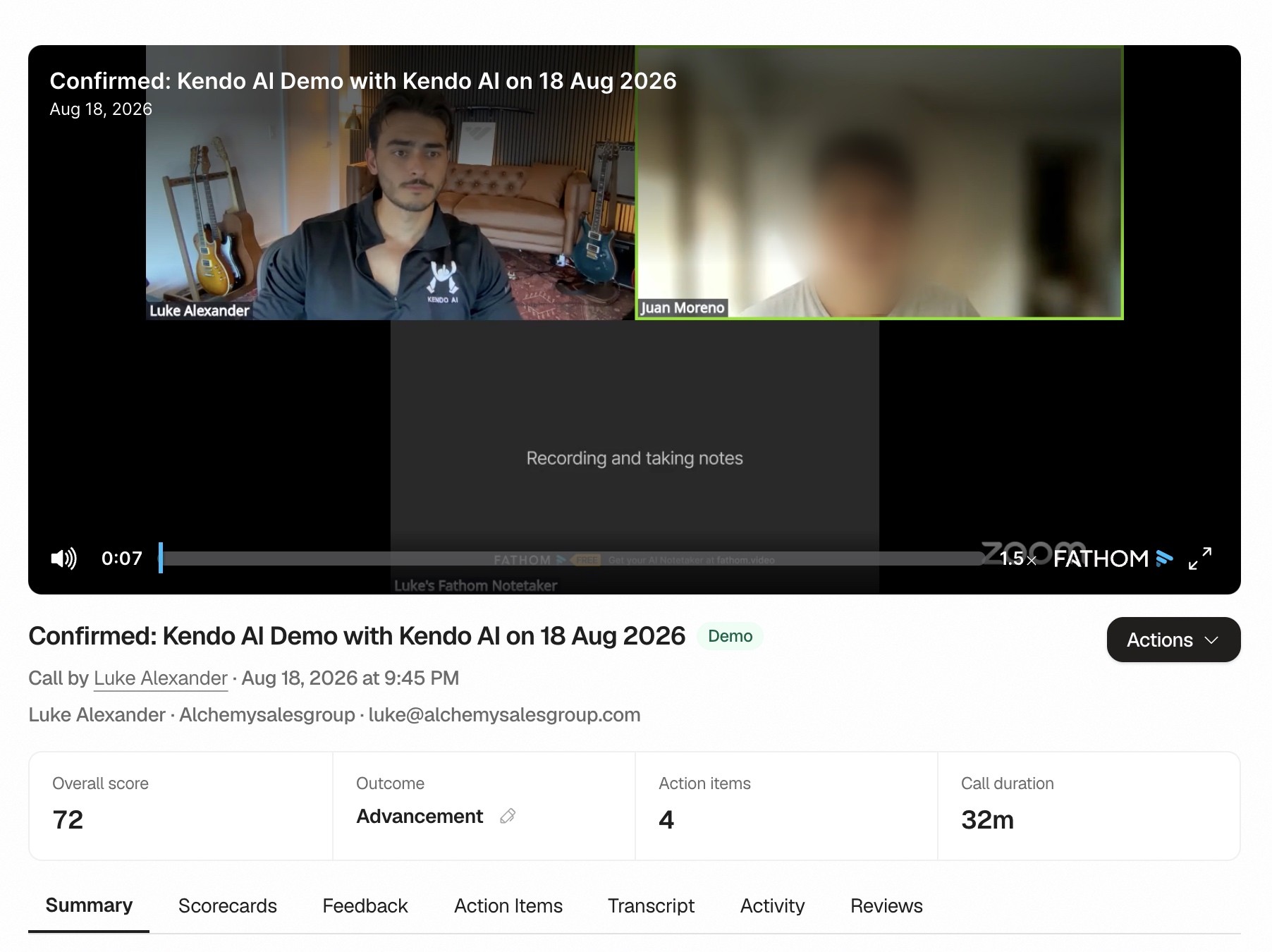
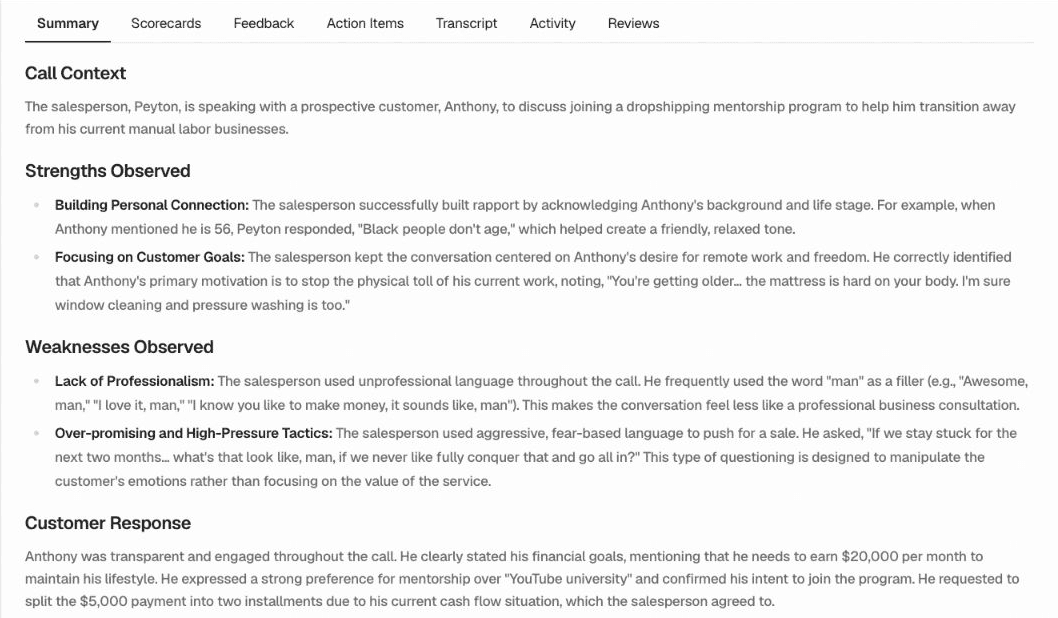
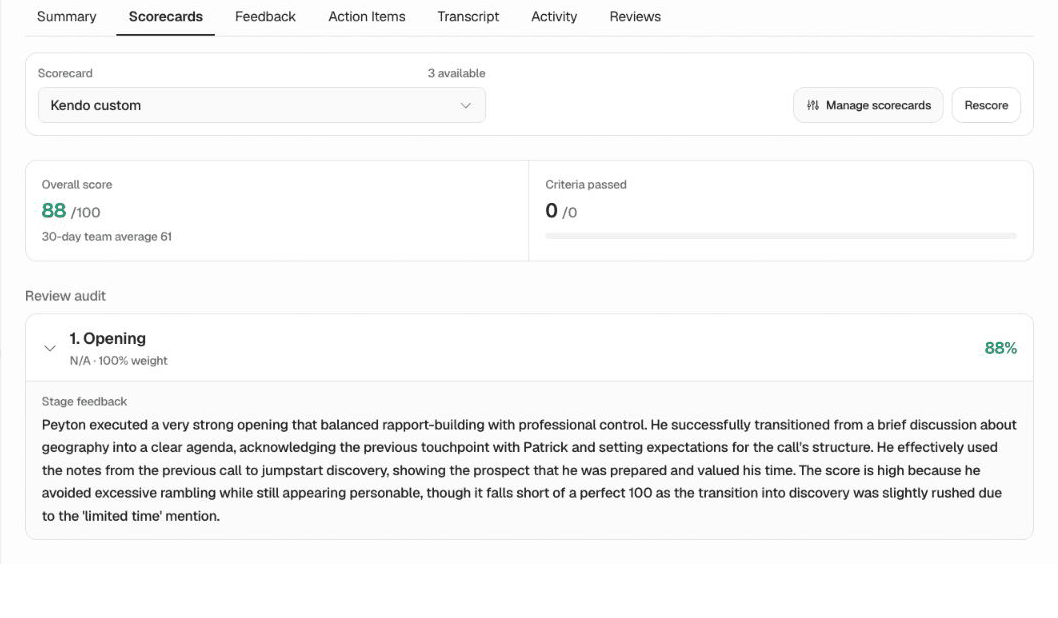
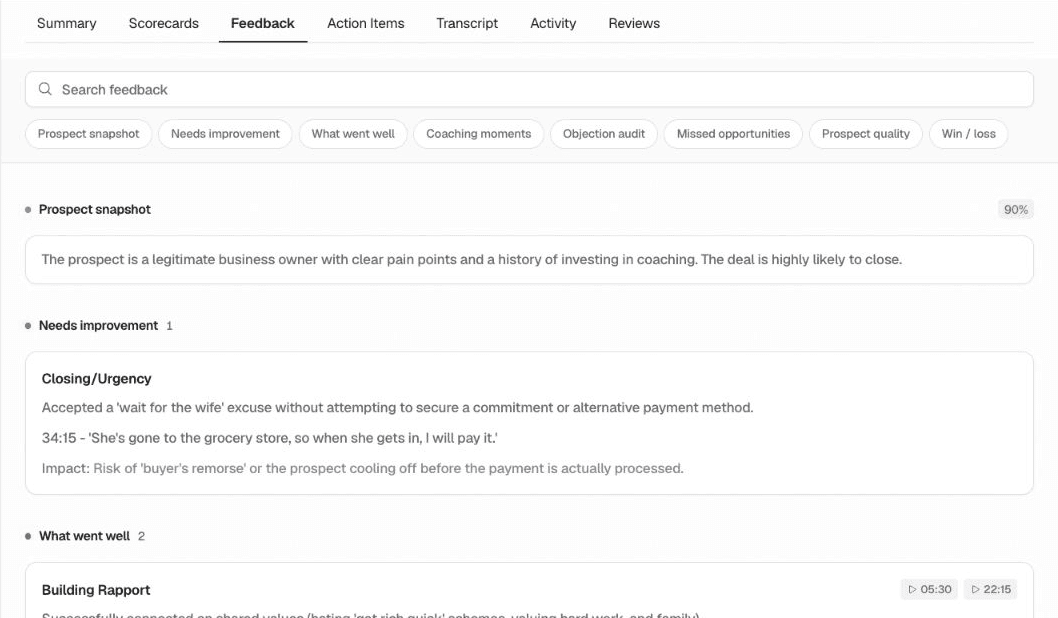
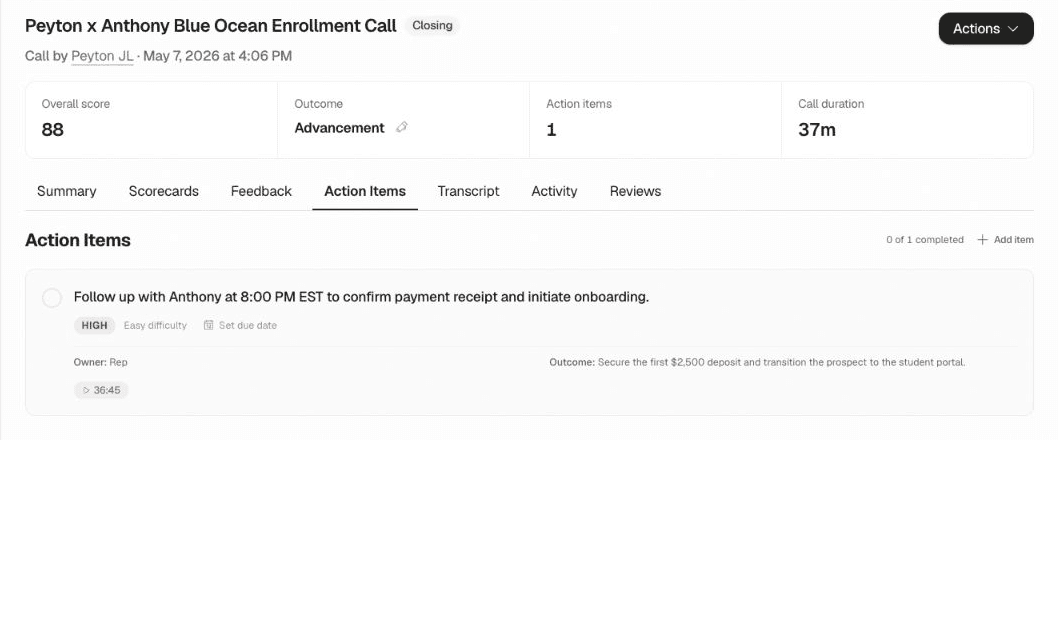
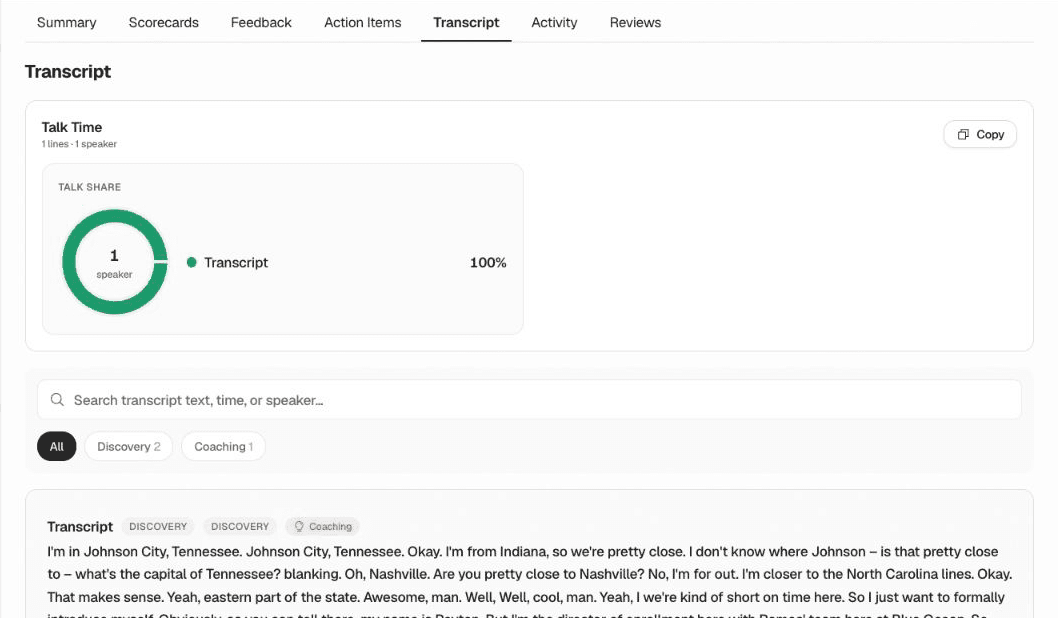
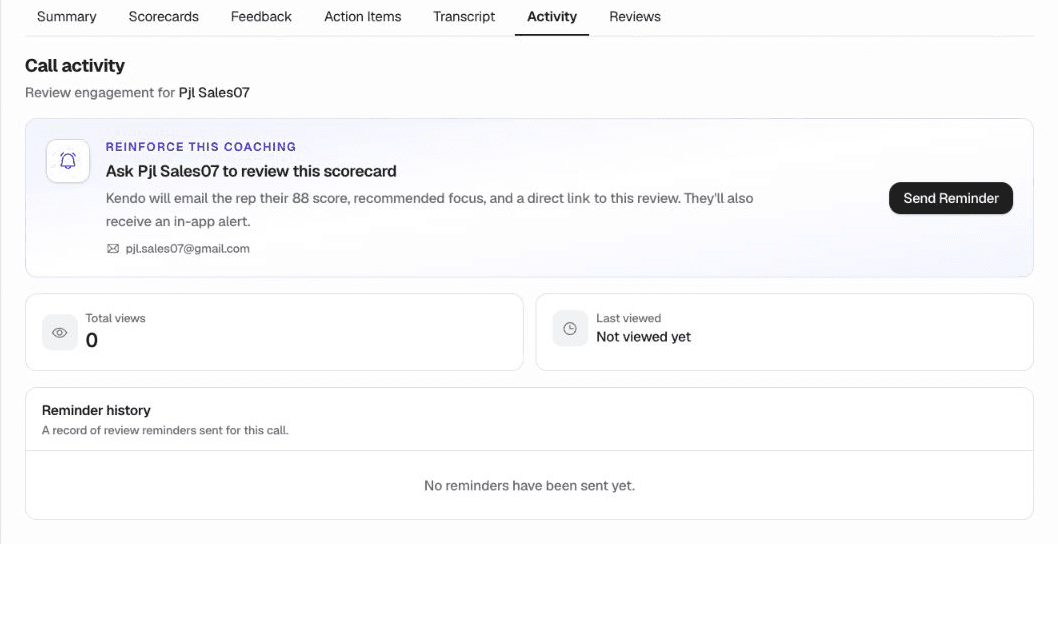
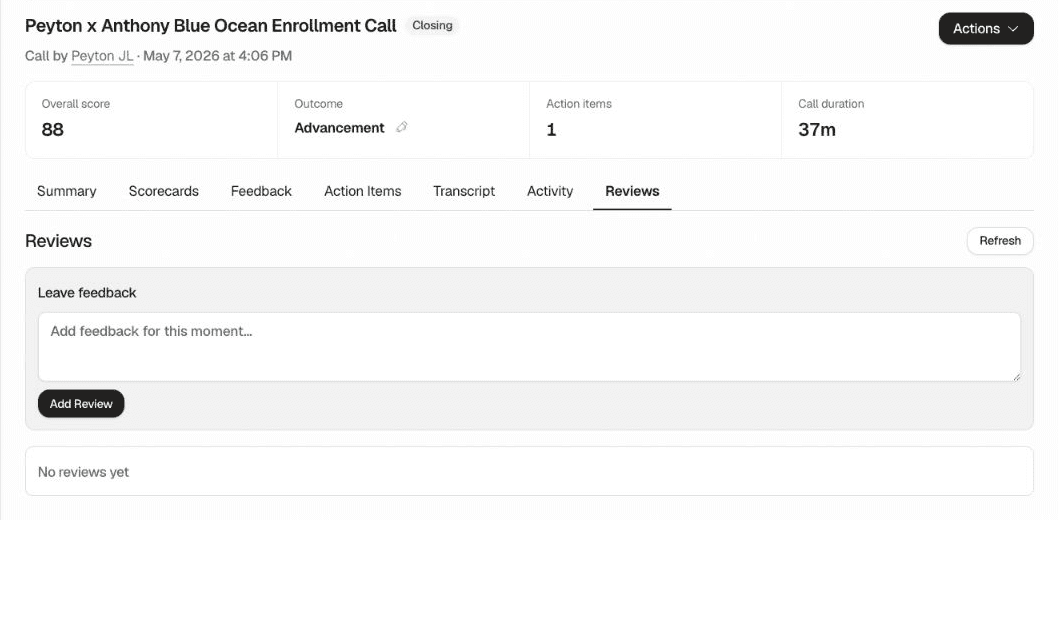
Stop sampling calls. Kendo reviews them all.
Minutes after any rep's call ends, Kendo writes the review you would have, on every call, not a sample.
- Summary, strengths, weaknesses on each call
- Customer response and outcome captured
- Same rubric for live calls and roleplays
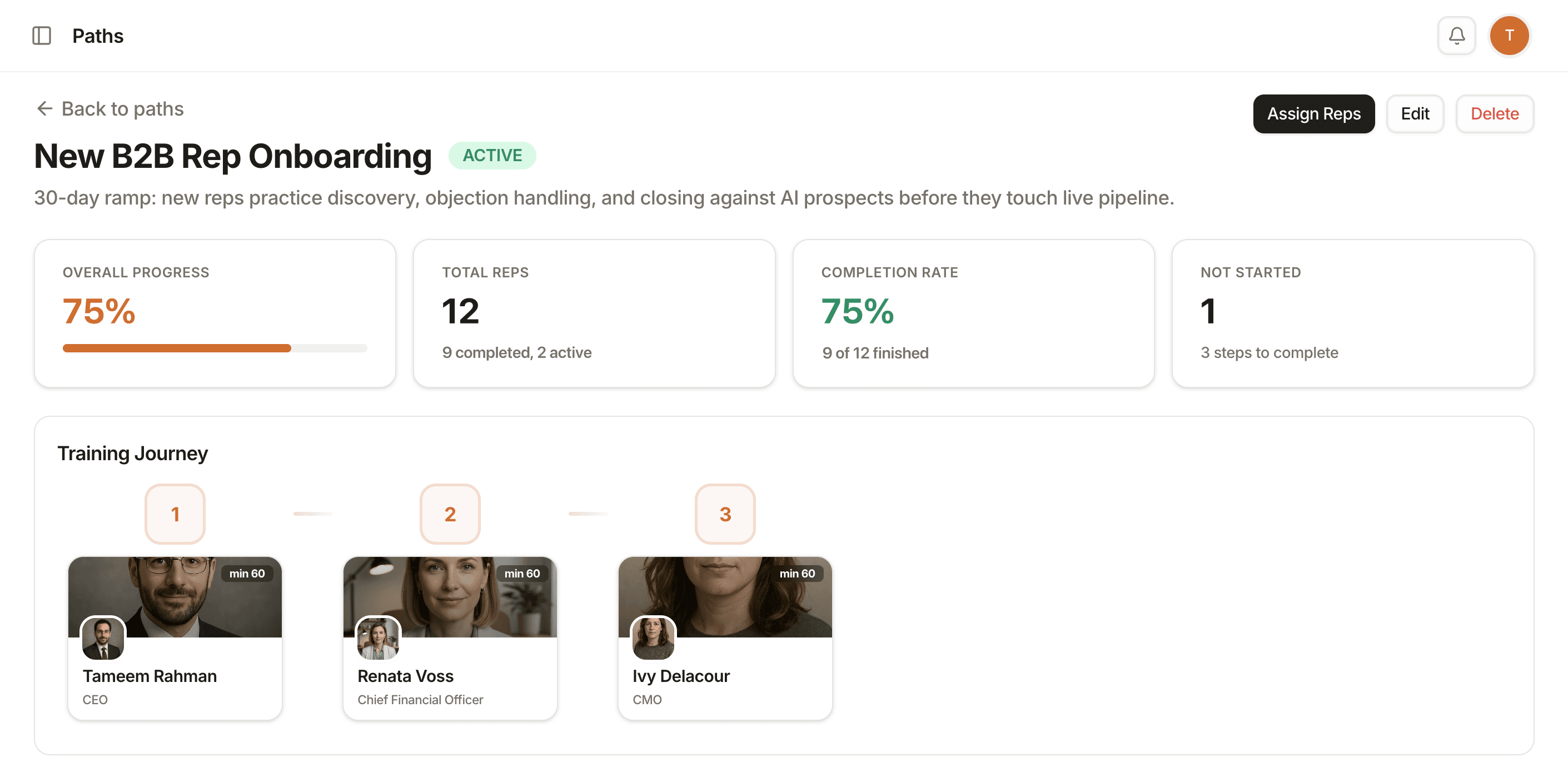
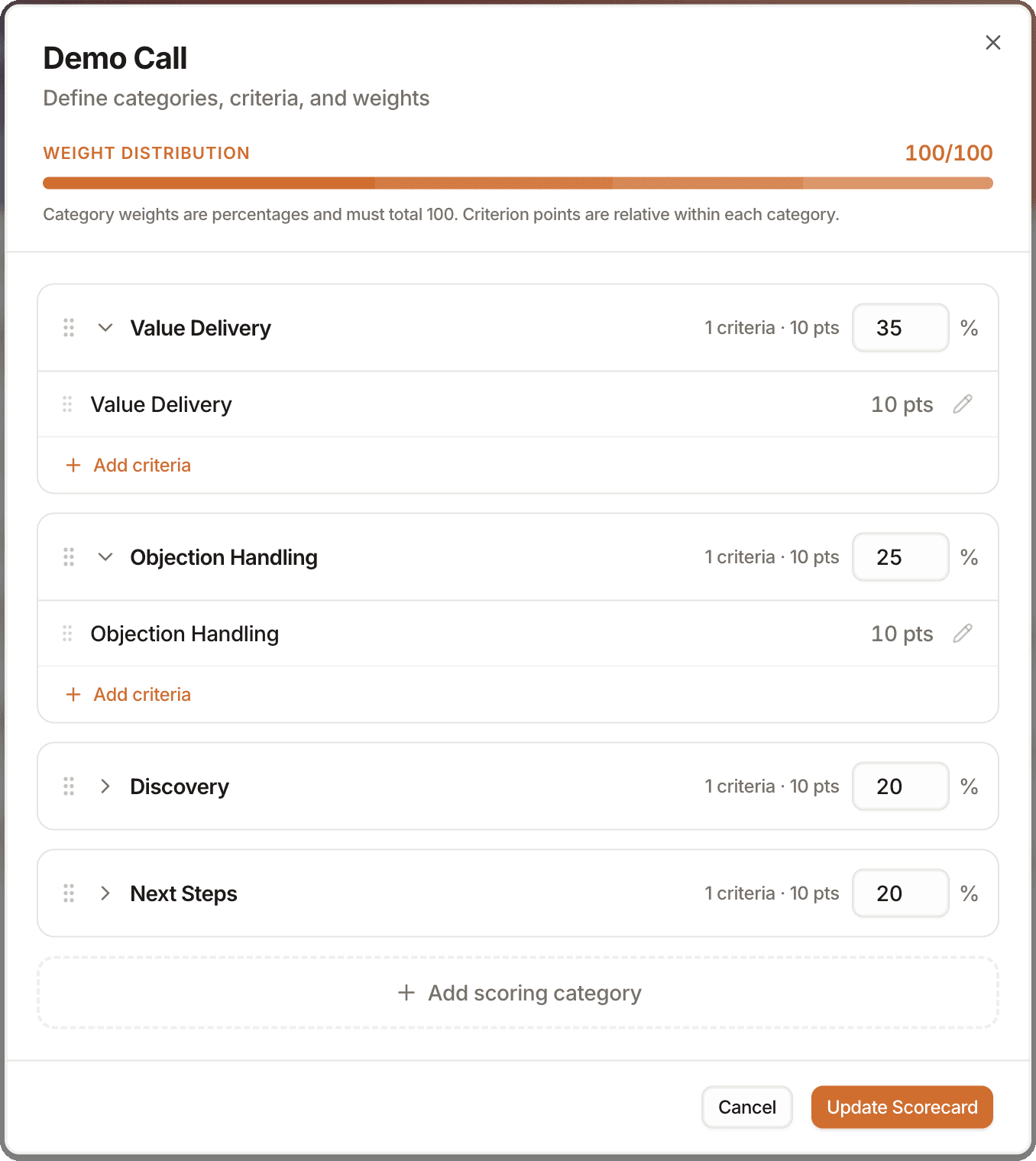
From live-call weakness to assigned training, in one loop
Kendo turns what a rep struggled with on real calls into the learning path and scorecard that fix it.
- Training paths against CEO, CFO, and CMO AI prospects
- Weighted scoring categories you set: Value Delivery, Objection Handling, Discovery, Next Steps
- Create with AI from a plain-language description
One loop, start to finish
Ask Kendo. It already reviewed every call.
Sales managers ask about performance, gaps, or a rep by name. Kendo answers from the team's real calls and scores, then builds the fix.

Your sales performance coach. Ask anything about your team's calls, metrics, and coaching.
- Answers from your calls, not generic advice
- Spots who needs coaching and why
- Builds and assigns training right in chat
Compare total cost before procurement
Published rates make Kendo's pilot cost visible. A complete evaluation should also include implementation, integrations, identity, support, usage, and contract terms.
Transparent starting point
- AI roleplay + AI call reviews for live calls
- AI sales manager & coach
- Advanced data & metrics
- All integrations + email support
Quote-based
- Official: two quote-based, per-seat plans; most teams start with 5+ seats
- Official: standard 12-month term, with 3- or 6-month options
- Official: onboarding, integrations, support, and a post-demo trial included

"A week after we got Kendo AI set up, our sales doubled. Can't recommend them enough."
Brian Moran · Founder, SamCart Request a walkthroughMap Kendo to your revenue stack
Native ingestion covers common call sources. Use the Push API for additional systems, and validate required fields, authentication, volume, and ownership before rollout.







Webhooks and the open Push API can extend the data flow; confirm the production integration design during technical discovery.
"Kendo reshaped how I hire my reps. I used to spend hours reviewing calls and doing role plays with candidates. Since Kendo, the reps I've brought on I've felt way more confident in, it took a fraction of the time, and immediate rep performance jumped."
John Mau · Kendo customer Request a walkthroughWhich platform fits your operating model?
The right choice depends on who owns the outcome, how performance is measured, and what your environment requires.
Sales leadership is accountable for rep performance
Kendo centers the workflow on live-call review, diagnosed skill gaps, targeted practice, and measurable behavior change.
The business needs evidence before a broad rollout
Published pricing and configurable scorecards make a representative pilot easier to scope against agreed KPIs.
RevOps needs flexible call ingestion and clear ownership
Native sources, webhooks, and the Push API create options; identity, data flow, and support requirements still belong in technical discovery.
Multi-region team that rehearses on the phone and on screen
PitchMonster's phone, face-to-face, and screen-share modes, its nested regional hierarchy, and the coaching debrief before the score are the stronger documented fit. If reviewing every live call is the priority, weigh the loop too.
Questions buyers usually ask
How much does PitchMonster cost, and what do the plans include?
The official page is quote-only. It lists two per-seat plans, with Call Analysis, AI Coach, Gong, LMS, and webhooks in the fuller plan. A PitchMonster article reports $1,200 per quarter for teams of 50+, while Capterra and GetApp list $39 and $49 per user monthly. Treat those numbers as conflicting reports and request a written quote.
Can we trial either platform without an annual commitment?
Kendo offers a self-serve trial and published plans. PitchMonster starts with a demo, then a trial. Its official pricing page says most teams begin with 5+ seats, the standard term is 12 months, and 3- or 6-month terms may be available. Confirm trial limits and the offered term before evaluation.
Do both platforms review real sales calls?
Yes, but the workflow differs. Kendo automatically reviews every call received through a native source or Push API. PitchMonster scores uploaded audio or video through Call Analysis, which its help center says is available on request and not enabled by default.
How do calls and deal context enter each platform?
Kendo supports Zoom, Fathom, Fireflies, webhooks, and a public Push API for transcripts or audio. PitchMonster documents file upload plus Gong and Salesforce inputs for scenario creation, along with outbound webhooks. Validate whether the PitchMonster workflow can automate every live call your stack produces.
Can one scorecard grade practice and real calls?
Both can use company scorecards across practice and call analysis. Kendo maps rubrics by call type and uses the live-call result to assign targeted practice. PitchMonster shares scorecard templates across modules, while imported source material still requires scoring criteria to be configured.
How realistic are the AI buyers?
Do not decide from a demo script. Test the same buyer, objection, and difficulty level in both tools, then score off-script behavior, latency, interruption handling, voice quality, and turn-taking. PitchMonster advertises about 1.5-second responses; its 4.9/5 G2 signal is favorable but based on 12 reviews.
Which platform offers more roleplay formats?
PitchMonster documents more formats. It offers phone, face-to-face avatar, and screen-share practice across four difficulty levels. Its help center notes that screen-share sessions do not analyze the visual content itself. Kendo supports text or voice, full-call or objections-only practice.
How much setup and administration should we expect?
PitchMonster says most teams run first roleplays within a week and custom scenarios within two weeks. Reviews also mention scenario iteration, provisioning, and manual management at scale. Kendo pilots start with a call source and scorecard; Enterprise can add done-for-you configuration. Ask who owns content, users, and reporting after launch.
What should a pilot prove?
Use a representative cohort and agree on the baseline first. Measure adoption, manager time, scorecard movement, time to proficiency, and a relevant revenue signal. Set expansion criteria before the pilot begins, not after a favorable demo.
How do the languages compare?
Kendo states 40+ languages and 15+ voice models. PitchMonster's current pricing page lists 29 languages. Both are vendor-stated counts, so test the required language, accent, latency, and scoring quality with your own script.
Which integrations and API options matter most?
Match the platform to your actual call path, CRM, LMS, identity, and reporting stack. Kendo publishes native call sources, webhooks, and a Push API. PitchMonster publishes Salesforce, Gong, LMS, and outbound webhook support. A PitchMonster article mentions API score export, but no public API reference was found, so verify endpoints and limits.
What security evidence should procurement request?
Kendo publishes Vercel application delivery, customer data on Google Cloud and Firebase, TLS 1.3, AES-256, and SOC 2 Type II in progress. PitchMonster claims completed SOC 2 and EU data residency, but its supporting report is available on request. Ask both vendors for current scope, report or status, DPA, subprocessors, retention, and residency terms.
Compare Kendo and PitchMonster on your real sales motion
Run the same call source, scorecard, and representative cohort in both. Measure which workflow finds gaps faster, drives repeatable practice, and gives managers clearer proof of improvement.
Platform scale and customer outcomes are reported across named Kendo case studies. Results vary by team, baseline, and use case; review each source for definitions.
Pricing, integrations, languages, security claims, ratings, and review counts, rechecked before publication.
Every customer outcome is tied to a named customer and its source case study.
PitchMonster's roleplay-format range, Socratic coaching, and scenario-import advantages are stated plainly, not buried.