
12 Best PitchMonster Alternatives for 2026 (Here's #1)
We compared 12 PitchMonster alternatives for AI sales roleplay on the things that actually decide a deal: buyer realism, call scoring, scenario customization, languages, onboarding speed, and whether the pricing is public. Here is where we landed.
PitchMonster is a genuinely good AI roleplay tool. It is well reviewed, the gamification keeps reps coming back, and the "sales Grammarly" coaching is a nice touch. If you are here, you want a better fit, not reasons to bash it.
The reasons teams shop around are consistent: pricing you cannot see without a demo, a quarterly minimum and team-size gate that lock out smaller teams, templates you outgrow, and a tool that practices reps but never reviews their real calls.
The whole point of AI roleplay is to close that gap with reps, not add another dashboard. Decades of memory research, going back to Ebbinghaus's forgetting curve, show people lose a large share of newly learned material within days unless they reinforce it. So we judged every option on realism, call scoring, customization, languages, onboarding, and transparent pricing. New here? Start with the best AI sales roleplaying tools, how AI sales roleplay works, and the wider landscape of best AI sales tools.
The 12 Best PitchMonster Alternatives at a Glance
| # | Tool | Best For | Starting Price | Key Advantage |
|---|---|---|---|---|
| 1 | Kendo AI RECOMMENDED | Teams who want realistic roleplay + call review with public pricing | $55/mo per seat | Fully custom AI buyers, call review, 40+ languages, fast ROI |
| 2 | Hyperbound | Enterprises wanting roleplay + call scoring in one | Custom* | Both loops, 40+ countries, multilingual on top tier |
| 3 | Second Nature | Teams that prefer visual avatars | Custom* | Avatar roleplay across 20+ languages |
| 4 | Mindtickle | Enterprise revenue enablement suites | Custom* | Full readiness platform (roleplay is one module) |
| 5 | Allego | Enablement + video coaching at scale | Custom* | Learning, content, coaching, and AI roleplay in one |
| 6 | Quantified | Fortune 500 / regulated industries | Custom (enterprise)* | 92% realism rating, enterprise-only |
| 7 | FullyRamped | Teams that want to drill real calls | Custom (10-seat min)* | AI twins of your hardest recorded calls |
| 8 | Rehearsal | On-camera, video-delivery practice | From $439/mo | Video roleplay + enterprise L&D, public pricing |
| 9 | Luster | Predictive enablement | Custom* | Forecasts skill gaps before live calls |
| 10 | UneeQ | Face-to-face / reading non-verbals | Custom* | Lifelike digital humans you talk to in-browser |
| 11 | Yoodli | Budget-conscious individuals | Free → $11/mo | Cheapest entry, but general communication focus |
| 12 | Gong | Teams that mainly want call analysis | Custom* | Best-in-class call intelligence (no roleplay) |
Pricing and product status verified against first-party sources as of June 2026. *Vendors marked "Custom" do not publish prices and require a demo; reported third-party figures are cited inline in brackets. PitchMonster itself does not publish per-seat pricing (from $1,200/quarter, per its pricing page). Details may change after publication.
Where PitchMonster Falls Short According to Users Online
Let's be fair first. PitchMonster is a capable, well-liked roleplay tool, with a 4.9-star average on G2 (from a smaller review base) and reviewers who say it ramps new reps faster and closes the gap between training and live appointments. We are not pretending it is a bad product.
But when we reviewed its own pricing page and public feedback from G2, Capterra, and Reddit, the same friction points came up repeatedly, especially for smaller and mid-market teams. Here is what users and buyers most often flag:
- Pricing is demo-gated. PitchMonster does not publish per-seat rates. Its pricing page says pricing "depends on a few factors specific to your team, so we need to get in touch," and you book a demo for a quote. [Source: PitchMonster pricing page, June 2026]
- A quarterly minimum and a team-size gate. Pricing starts at $1,200 per quarter, and the buying flow screens out teams it considers too small before quoting. Reddit users report effective rates around $21 per user per month at scale. [Sources: PitchMonster pricing page; Reddit]
- Standard 12-month contract. The default term is 12 months, with 3- or 6-month options only for teams that qualify, so most buyers commit for a year up front. [Source: PitchMonster pricing page]
- You outgrow the templates. The 48 pre-built scenarios are a fast start, but reviewers note that building and managing role-plays at scale becomes repetitive and manual once you move past them. [Sources: PitchMonster product pages; G2]
- It practices, it does not review. PitchMonster scores practice sessions, not your real recorded calls. Teams that also want conversation intelligence on live deals need a second tool. [Source: PitchMonster product scope]
- Language coverage is unclear. PitchMonster does not state multi-language support on its site, which matters if you are training a global team. [Source: PitchMonster site, no stated language list]
What to Look for in a PitchMonster Alternative
The right replacement depends on why you are leaving. A team that just wants cheaper practice needs something very different from an enterprise that wants roleplay, call review, and SSO in one contract. These are the criteria that separated the best AI sales training software in the list below:
- A buyer that pushes back. The AI should express real hesitation, interrupt, and change its mind, not read a script. If the objections feel canned, reps stop taking it seriously.
- Voice, text, or avatar. Most sales happens on the phone, so low-latency voice roleplay matters most. Avatars and on-camera video are useful if you sell face-to-face or train presence.
- Coaching, not just a score. "You scored 72%" is useless on its own. Look for feedback that names the moment you lost the buyer and what to do differently, plus call scoring on real behaviors like talk-to-listen ratio (Gong's data puts the winning ratio near 43:57).
- Customization to your actual buyers. You should be able to build prospects that match your real ICP, titles, and objections, not pick from generic "Budget Bob" templates.
- Languages and onboarding speed. Global teams need real multi-language support, and reps should be able to start the same day, not after an implementation project.
- Transparent pricing. If you are leaving PitchMonster over a demo-gated quote, do not replace it with another black box. Know what you will pay before you sign.
Kendo AI: The #1 PitchMonster Alternative for Results-Driven Teams
★ Best overallBuild your prospect, practice live against it, then review the real call. Roleplay and call review in one, with pricing you can actually see.
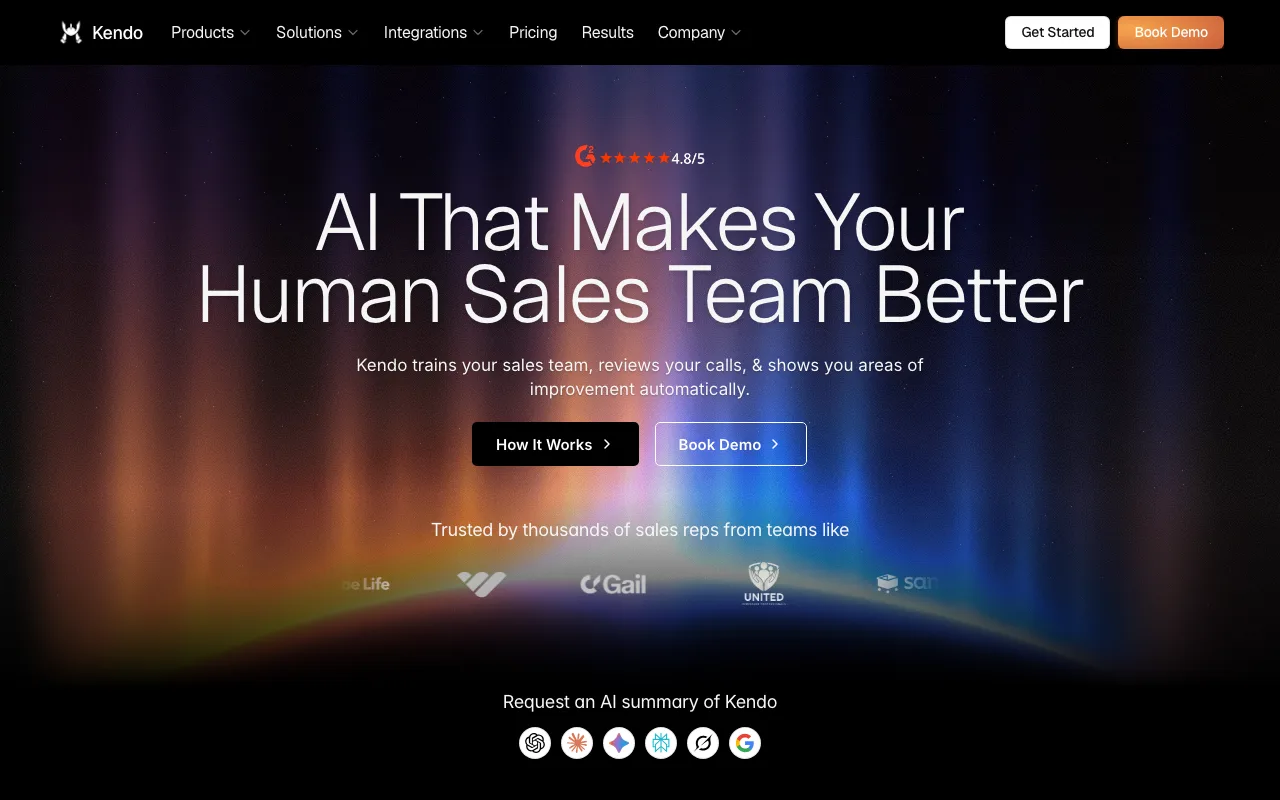
Fair warning, you are on our site, so we are biased. But the reason we built Kendo is the exact gap this article is about. Most roleplay tools drop you into preset scenarios and hand back a score. Kendo lets you build the buyer first, then practice live against a voice that pushes back, stalls, and changes its mind like a real prospect.
Where PitchMonster stops at practice, Kendo runs both loops. Reps rehearse against custom AI buyers, then Kendo also reviews their real recorded calls with custom scorecards. You practice before the call and learn from the actual one, in the same tool, instead of buying a roleplay app and a separate conversation intelligence platform.
This is what practicing on Kendo looks like. The AI buyer pushes hard on SOC 2, ISO 27001, and proof the tool cuts compliance work, and the rep has to handle it on the spot, before any of it lands on a live deal.
Kendo vs. PitchMonster: Key Differences
For the side-by-side, see the dedicated Kendo vs PitchMonster comparison.
| Dimension | Kendo AI | PitchMonster |
|---|---|---|
| What it does | AI roleplay + real call review | AI roleplay practice only |
| Buyer customization | Build any prospect by ICP, role, personality | 48 templates + custom scenarios |
| Languages | 40+ languages | Not stated |
| Pricing model | $55/mo per seat, published | From $1,200/quarter, demo-gated |
| Minimum commitment | Single seat, monthly | Team-size gate, 12-month standard |
| Trial access | 10 minutes free practice | Free trial on request via demo |
The thing reps notice first is that the buyer feels real. We pair state-of-the-art voice AI with prospects that express genuine buying hesitation, so practice does not feel like talking to a chatbot. Setup takes seconds, not a planning meeting.
"A week after we got Kendo set up our sales doubled. Can't recommend them enough."
 Brian Moran · Founder, SamCart
Key Features
- Custom Prospect Builder. Create AI buyers that match your exact ICP by role, industry, and personality, with professional or casual styles. Borrow from 20+ pre-built roleplay scenarios to start fast, then make them yours.
- Live, low-latency voice roleplay so reps make their mistakes here, not on real deals, with a buyer that interrupts and objects like a person.
- Automated call review on real calls. Upload recorded calls and get objective scoring on discovery depth, talk ratio, and objection handling, the loop PitchMonster does not run. See how AI call reviews work.
- 40+ languages for distributed and global teams.
- A full enablement system, not just practice: screen new hires with a shared roleplay link before you interview them, track rep development, and standardize what "good" looks like.
Try Kendo with 10 Minutes of Free Roleplay, Plans Start at $55/mo
Kendo's per-seat plans include monthly AI training minutes with transparent overages. Teams typically report a 5 to 15% lift in close rates, which usually pays for the platform within the first month. See full per-seat pricing.
| Pro $55/mo per seat | Max $100/mo per seat | Enterprise Custom |
|---|---|---|
| AI roleplay, AI call reviews, advanced analytics, AI sales manager + coach, 180 roleplay minutes/seat per month | Everything in Pro, 480 roleplay minutes/seat per month, for teams that want maximum usage | Teams of 10+, custom AI models, custom scoring, DFY setup, dedicated account manager |

United Insurance Pros cut new-rep ramp from 45 days to 14
After rolling out Kendo roleplay, United Insurance Pros got brand-new agents to baseline performance in 14 days instead of 45, while saving thousands per agent every month on training time.
"Typically we would see about a 45-day period where people would dip their foot in the water and slowly improve and then level off. Now that's 14 days."
Waylon Artrip, Founder at United Insurance ProsHyperbound: Roleplay and Call Scoring in One Platform
Bridges AI roleplay and real-call scoring, trained on 2M+ hours of B2B sales calls.
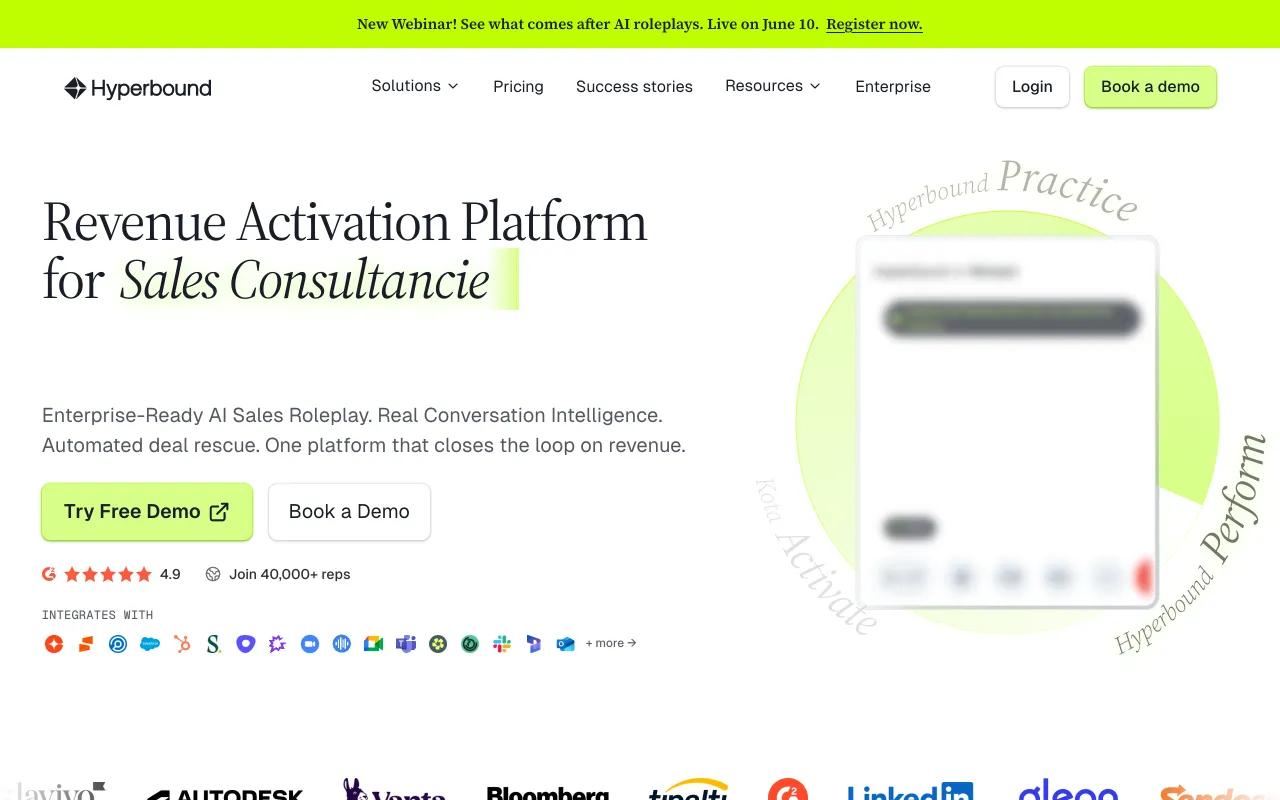
Hyperbound is the alternative closest to Kendo in scope: like us, it runs roleplay and call analysis together, now positioned as a "revenue activation platform." For a PitchMonster shopper who wants more than practice, that combination is the main reason to look here.
It leans enterprise. The realism is strong and the reach is global (used by reps in 40+ countries), but multilingual support sits in the top "Custom" tier, and the breadth that makes it powerful also gives it a steeper learning curve than a focused roleplay app.
Key Features
- AI roleplays for cold calls, discovery, demos, and renewals against lifelike buyers, with a simulated autodialer for high-volume SDR practice.
- Real call scoring on recorded or imported calls, integrating with Salesforce and Gong, the loop PitchMonster lacks.
- Gamified leaderboards for participation, similar in spirit to PitchMonster's competitive angle.
- Multilingual practice for global teams on the enterprise plan.
Heads up · Based on user reviews
- Pricing is not public. Paid plans require a demo; the free tier includes 9 roleplay bots for cold, warm, and discovery calls. Third-party reports put enterprise around $15,000+ per year. A contrast with Kendo's published $55/month starter. [Sources: Hyperbound pricing page; third-party]
- Breadth can mean complexity. Reviewers note the wide feature set creates a learning curve. [Source: G2]
Want both loops without the enterprise quote? See our best Hyperbound alternatives.
Second Nature: Avatar-Based Roleplay Across 20+ Languages
AI-powered training through interactive conversations with visual AI avatars.
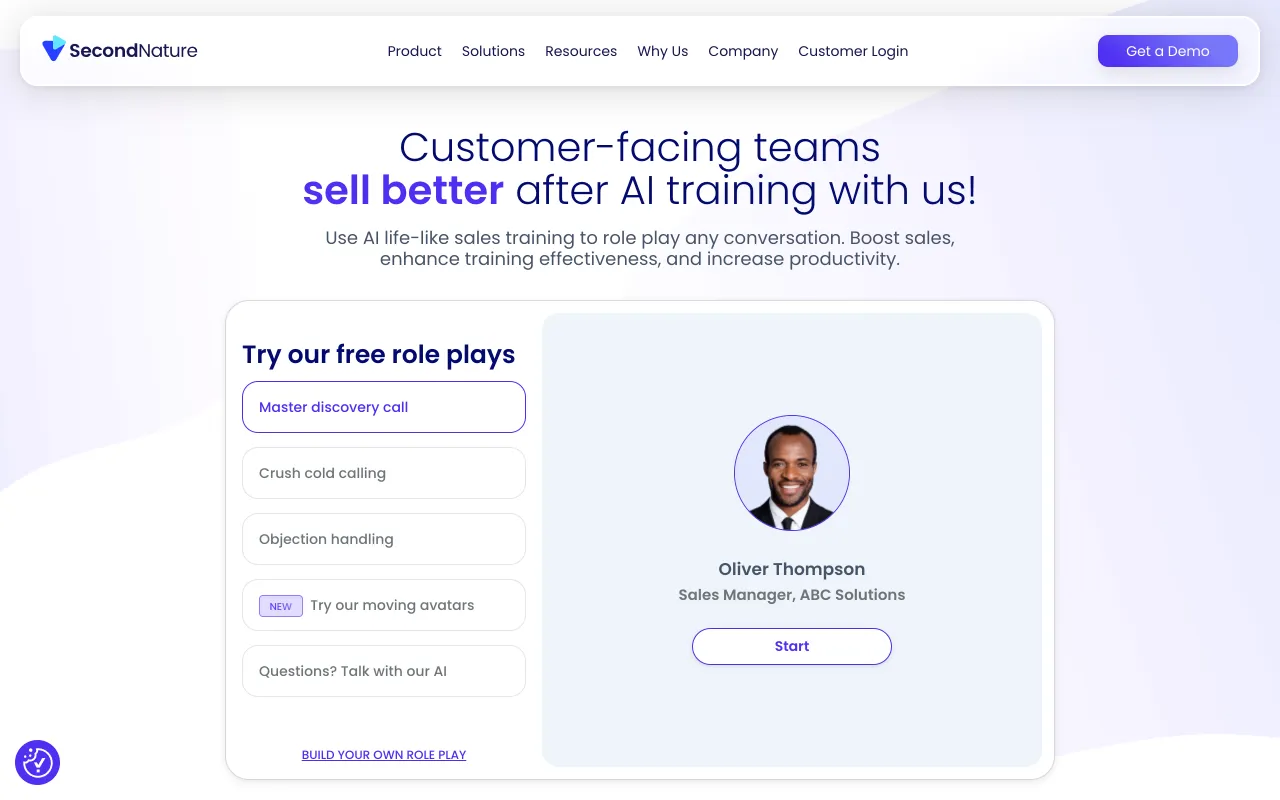
Second Nature is the pick for teams who want to see a face during practice. Its differentiator versus PitchMonster's voice-and-text approach is visual avatars, plus structured programs across 20+ languages, which makes it a real option for multilingual onboarding.
The tradeoff is that the avatar layer is where the value lives, and the experience can be uneven. For phone-heavy teams, a voice-first tool usually feels more natural than talking at an animated character.
Key Features
- AI avatar interactions for a visual, structured practice experience.
- Custom roleplays from your materials (decks, recorded calls, playbooks), similar to Kendo's scenario customization.
- 20+ languages for global onboarding programs.
- Multi-industry templates for diverse training needs.
Heads up · Based on user reviews
- Voice recognition can misfire. The top-mentioned con is voice-recognition issues that disrupt the roleplay, alongside a learning curve. [Sources: G2, Capterra]
- No public pricing. Teams commit to a demo process to evaluate whether the avatar approach justifies the spend. [Source: Second Nature site]
Weighing the avatar approach? See 14 Second Nature alternatives.
Mindtickle: AI Roleplay Inside a Full Enablement Suite
AI roleplay bundled into a broad revenue-readiness platform.
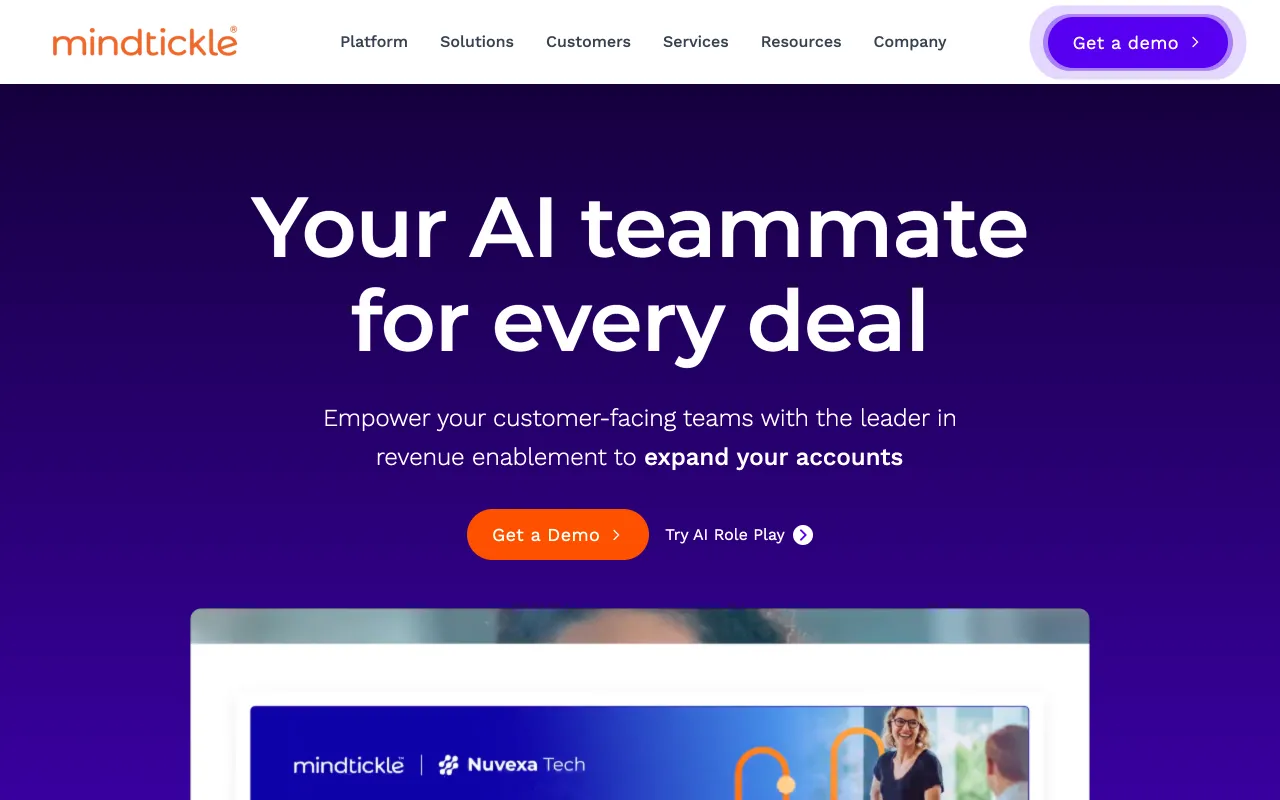
Mindtickle is a different kind of buy. Where PitchMonster does one job, Mindtickle bundles content management, learning paths, digital sales rooms, and conversation intelligence into one readiness platform. Roleplay is a single module inside a much larger suite.
That makes sense if you are standardizing enablement across a large org and want everything in one contract. If you mainly want reps practicing, it is a lot of platform (and a lot of procurement) to buy for one feature.
Key Features
- AI Copilot and roleplay as part of a broader readiness workflow.
- Digital Sales Rooms that customers credit with materially higher win rates. [Source: Mindtickle, 2025 State of Revenue Enablement Report, "26% higher win rate"]
- Comprehensive analytics across training engagement and sales effectiveness.
- Enterprise onboarding with dedicated support.
Heads up · Based on user reviews
- Heavy and complex. Reviewers report slow loading with large content libraries and a steep learning curve, with "missing features" and navigation among the top cons. [Sources: G2, Capterra]
- No public pricing. Expect multi-year contracts; interactive two-way roleplay is often a separate add-on. [Source: Vendr, third-party]
Buying a whole suite for one feature? See 12 Mindtickle alternatives built for roleplay.
Across Kendo customers: 5-15% higher close rates, 70% faster ramp, and $3,000+ saved per rep.
See the results →
Allego: Enablement and Video Coaching at Scale
A market-leading revenue enablement platform that folds AI roleplay into learning, content, and coaching.
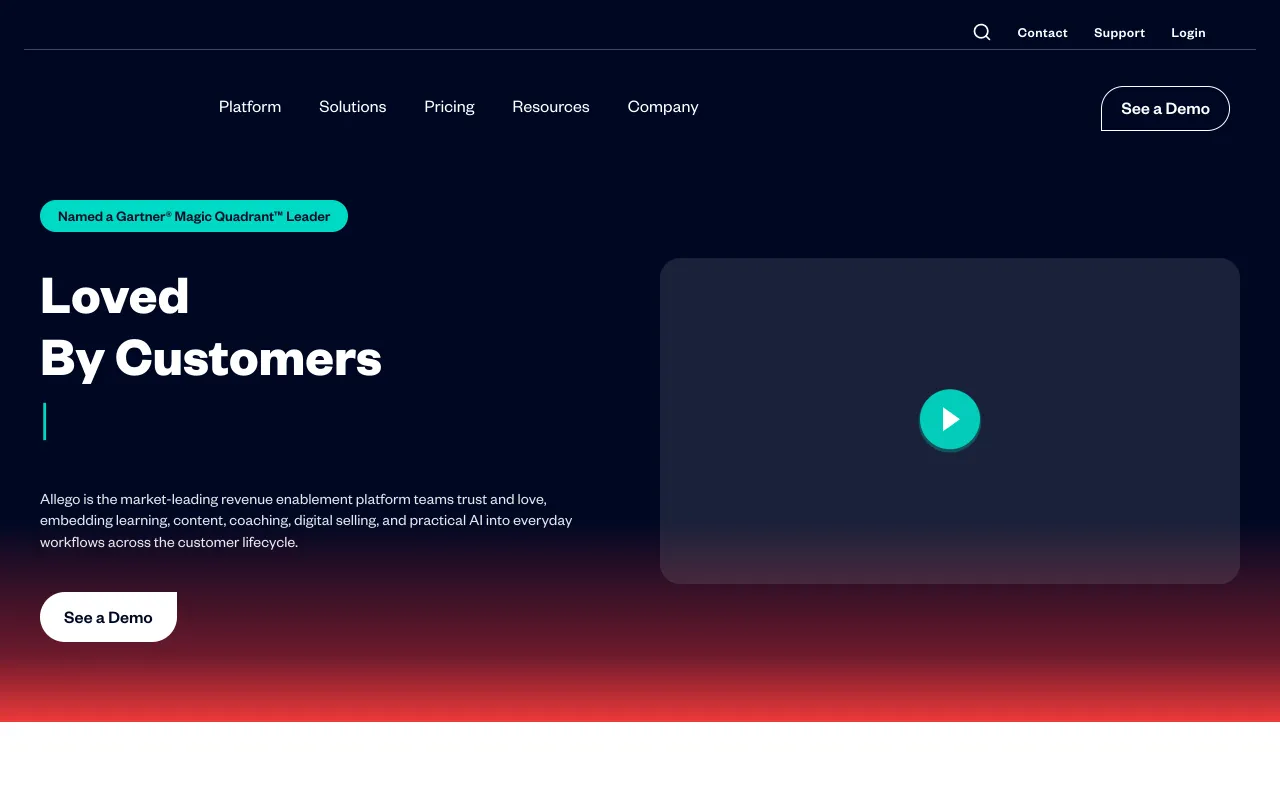
Allego sells the whole enablement stack: learning, content, digital selling, and coaching, with a strong video-practice heritage and a Gartner Magic Quadrant Leader badge on its homepage. For PitchMonster shoppers, the draw is video coaching plus AI roleplay inside one enablement system rather than a standalone drill tool.
Like Mindtickle, the breadth is the point and the catch. It is built for enablement teams running a full program, so it is more than most teams need if the goal is simply more rep practice.
Key Features
- AI roleplay and video coaching so managers can review recorded reps at scale, not just live sessions.
- Content and learning management embedded into everyday seller workflows.
- Conversation and deal intelligence across the customer lifecycle.
- Enterprise-grade with broad integrations and analytics.
Heads up · Based on user reviews
- Suite complexity. Reviewers point to a learning curve and an interface that can feel heavy when you only need part of the platform. [Sources: G2, Capterra]
- No public pricing. Allego routes pricing through a demo and custom quote. [Source: Allego site]
Quantified: Enterprise AI Roleplay for Regulated Industries
Best for realismLife-like simulations and detailed analytics for large, often regulated, sales organizations.
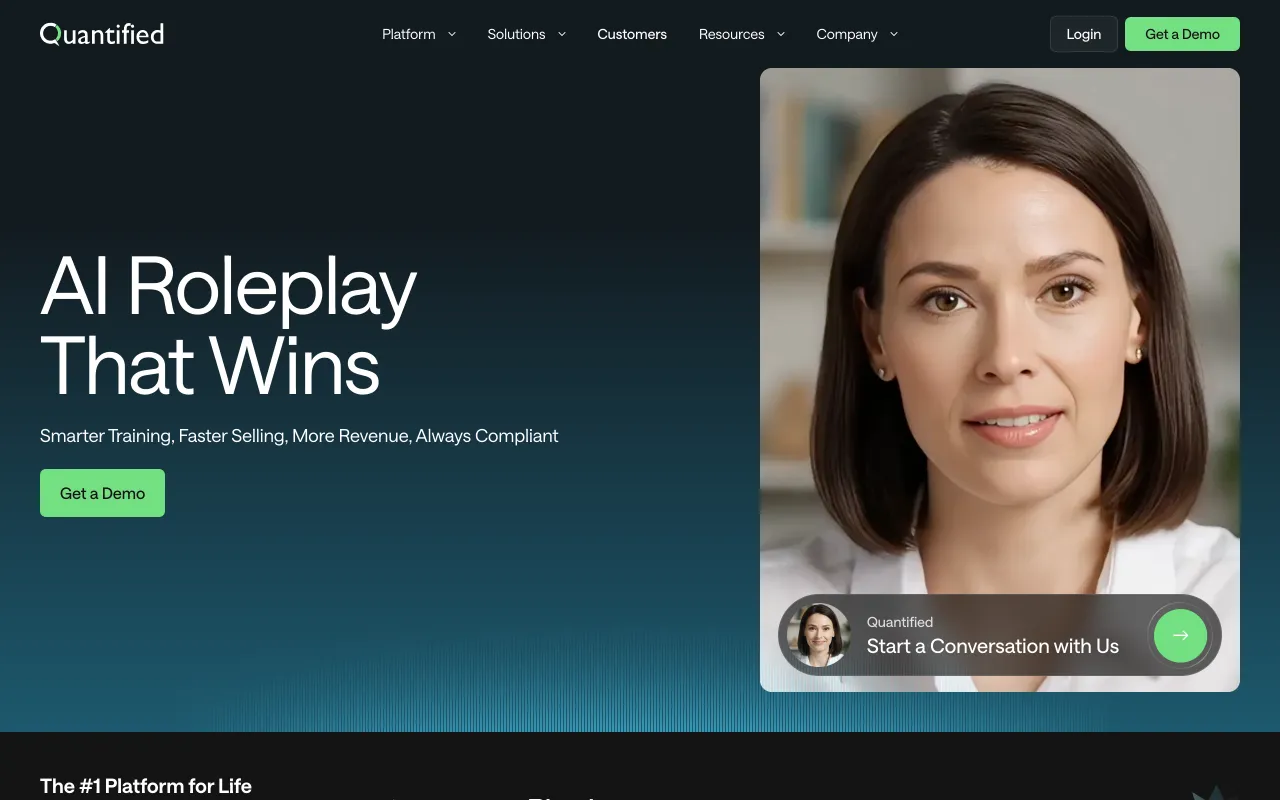
Quantified is where to look if realism and compliance are the whole game. It carries a 92% realism rating from users and ships industry-specific roleplays for Life Sciences, Financial Services, Insurance, and Medical Devices, the kind of scripted-but-monitored practice regulated teams need.
It is also enterprise-only, so it sits at the opposite end of the spectrum from PitchMonster on accessibility. Smaller teams will not get in the door.
Key Features
- 92% realism rating for authentic practice, comparable to Kendo's human-like simulations.
- Industry-specific roleplays for regulated verticals.
- Scale metrics like 6x more practice frequency and 4x more coaching (vendor figures).
- Measurable ramp impact, with a cited 42% faster ramp time (vendor figure).
Heads up · Based on user reviews
- Adaptability has limits. The most-cited con is that the AI avatar's adaptability can make conversations feel less dynamic than a real buyer. [Source: G2]
- Enterprise-only custom pricing, typically five or six figures a year, which rules it out for small and mid-market teams. [Source: Quantified site]
FullyRamped: Drill AI Twins of Your Real Calls
Onboarding-focused roleplay that turns your hardest recorded calls into practice reps.
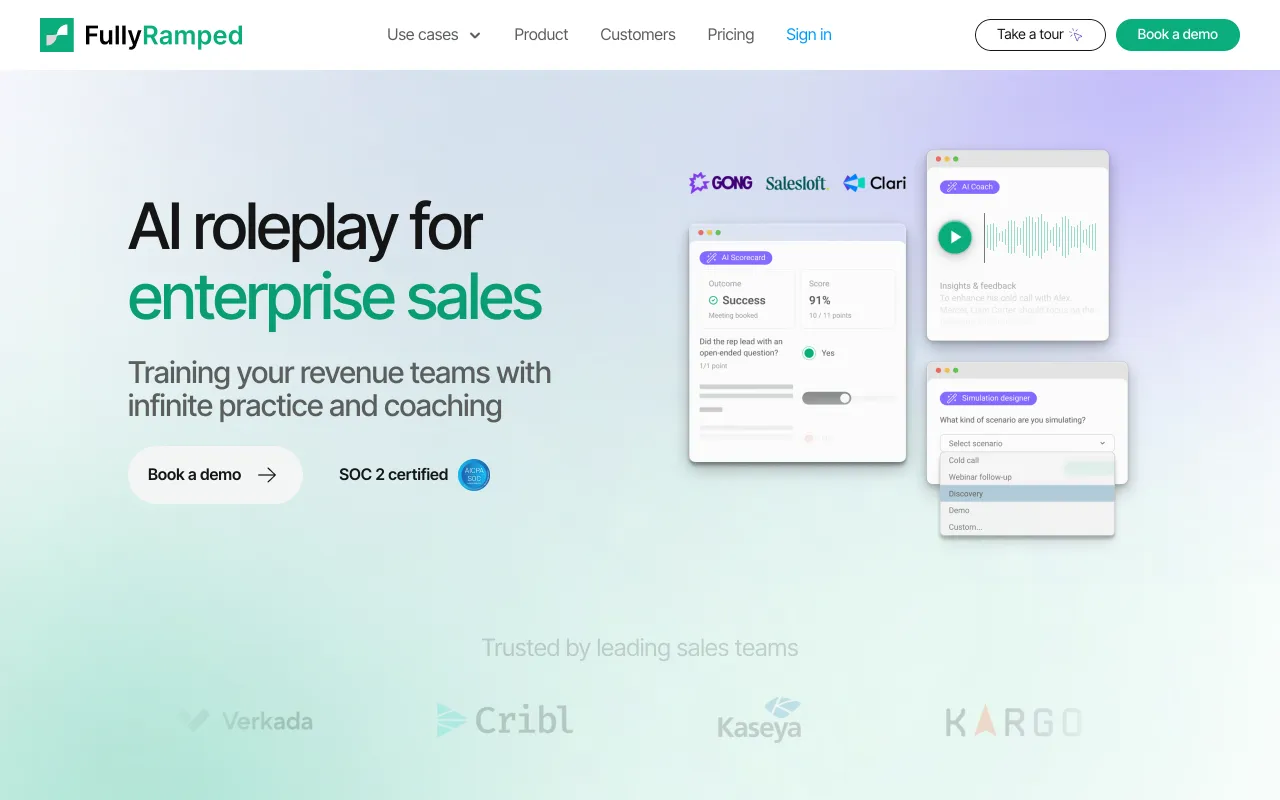
FullyRamped's angle is grounding practice in reality. It pulls real calls in through Gong and spins up AI "twins" of your toughest conversations, so reps drill the exact calls that go sideways in the field, not generic scenarios. That is a meaningful edge over template-first tools like PitchMonster.
It targets SMB and mid-market onboarding, with white-glove setup. The catch is the 10-seat minimum and a desktop-only experience.
Key Features
- Gong integration that pulls real calls in for coaching based on actual field performance.
- AI twins that recreate your hardest calls to practice repeatedly.
- Custom scorecards and certifications for unbiased rep assessment.
- White-glove onboarding with hands-on support.
Heads up · Based on user reviews
- No mobile app. A reviewer notes reps cannot practice or view history and analytics on a phone; everything runs on desktop. [Source: G2]
- No public pricing and a 10-seat minimum on the Business tier point to mid-market targeting. [Source: FullyRamped pricing page]
Want self-serve flexibility? See 14 FullyRamped alternatives.
Rehearsal: On-Camera Roleplay for Enterprise L&D
Reps record themselves on camera handling high-stakes conversations, then get AI feedback.
Where PitchMonster is voice-and-text, Rehearsal adds the on-camera dimension: practicing body language and presence, with managers reviewing recorded reps at scale. It also carries blue-chip social proof and, notably, one of the few public price tags in this category.
That makes it a fit if you train delivery and presence, not just call scripts. It is heavier and more L&D-oriented than a quick-start rep tool, so it suits structured programs more than a solo seller wanting daily practice.
Key Features
- AI roleplay partners for judgment-free practice with simulated prospects.
- AI feedback on delivery, including talk-to-listen ratio, sentiment, and pace.
- The Hot Seat for high-pressure, one-take scenario practice.
- Transcript-first scoring across 50+ languages to reduce accent and tone bias.
Heads up · Based on user reviews
- Limited independent validation. Rehearsal's dedicated Capterra listing currently shows no reviews, so there is little public peer feedback to assess fit. [Source: Capterra]
- Higher entry price and an L&D orientation ($439/mo standalone, $879/mo for the full Studio bundle) make it heavier than a quick-start rep tool. [Source: ELB Learning pricing page]
Luster: Predictive Enablement That Forecasts Skill Gaps
"Predictive enablement" that diagnoses skill gaps and forecasts readiness risk before customer conversations.
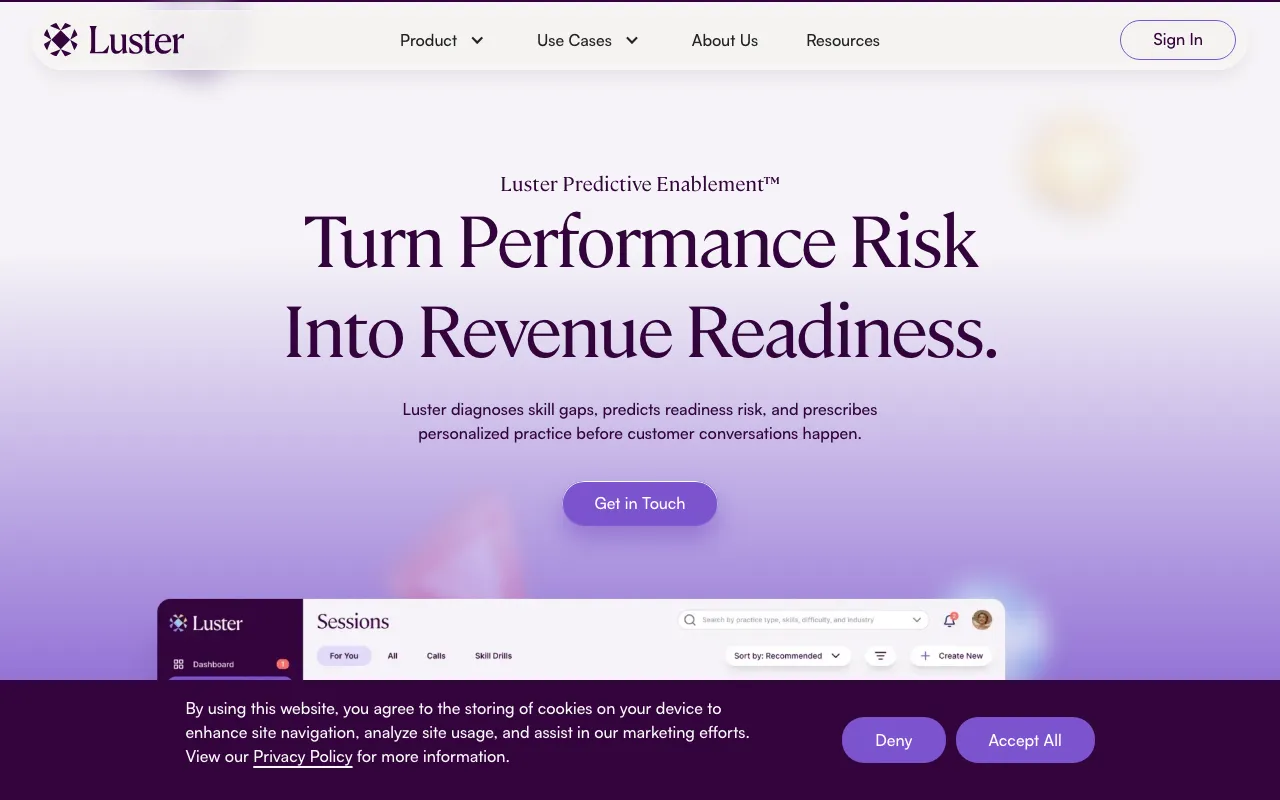
Most tools score a rep after a practice session. Luster's differentiator is the predictive layer: it connects roleplay performance and live-call signals to forecast where a rep will struggle in real deals, then prescribes targeted practice. For data-driven enablement leaders, that is a sharper angle than PitchMonster's leaderboard.
It is newer and demo-gated, so independent feedback is thinner and the standout outcome figures are vendor-reported.
Key Features
- Proactive Practice, AI roleplay scenarios with realistic buyers.
- Predictive Insights that forecast readiness risk and skill gaps before live calls.
- EchoIQ, live-call assessment that detects where skills are not being applied.
- AI coaching with personalized, data-driven practice prescriptions.
Heads up · Based on user reviews
- Responses can feel predictable. A reviewer notes objections could become predictable and wants a wider persona and scenario library. [Source: G2]
- No public pricing (demo only), and outcome figures such as a 50% ramp reduction are vendor claims. [Source: Luster site]
UneeQ: Face-to-Face Digital Human Roleplay
Practice against emotionally expressive, lifelike digital humans you speak with face-to-face in a browser.
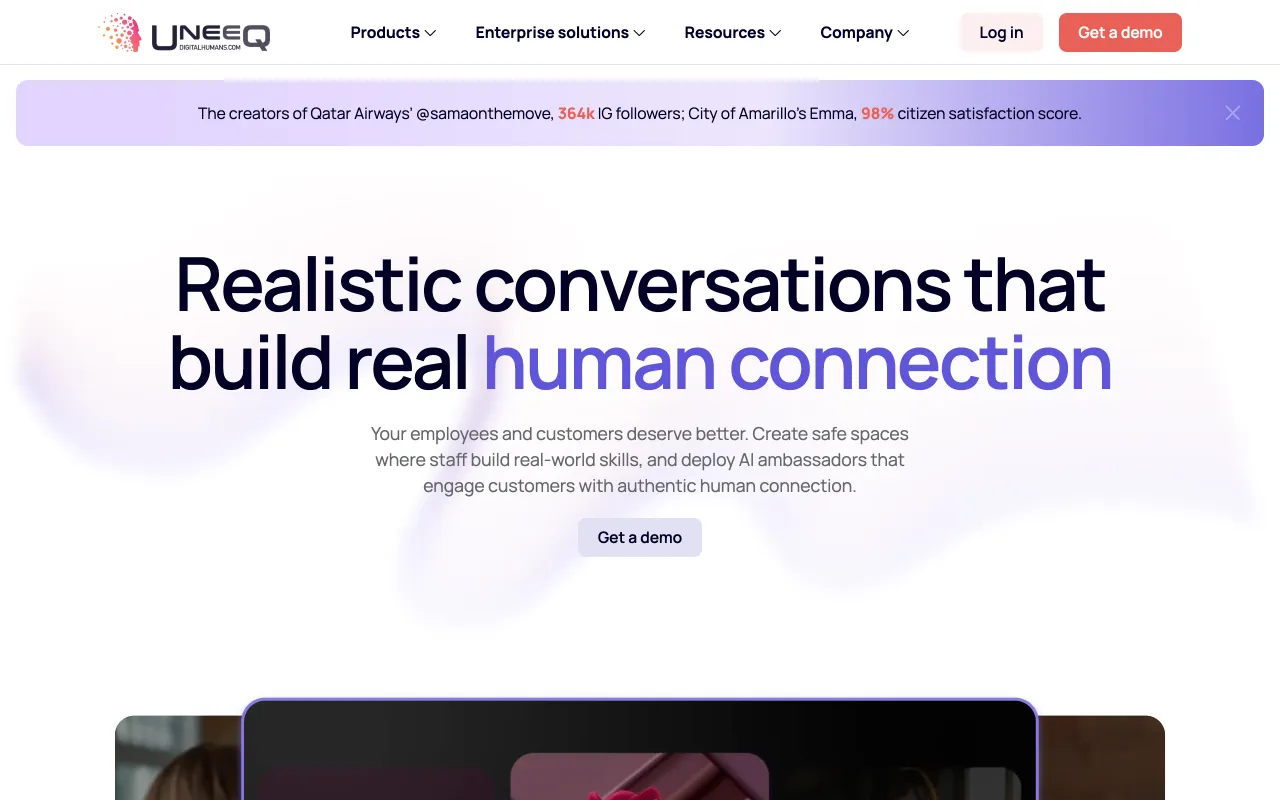
UneeQ's Immersive Training Platform adds the one angle the rest of this list does not: a visual, animated counterpart for practicing face-to-face selling and reading the room, no VR headset required. If your team sells in person or on camera, that face-to-face realism is the reason to look here over a voice-only tool.
It is very new and demo-gated, so independent reviews are limited and vendor outcome claims should be treated as such.
Key Features
- Face-to-face real-time conversation with digital humans that respond, react, and adapt, not pre-recorded.
- Soft-skills scoring with instant personalized coaching after each session.
- Browser-based, with scenario setup in minutes and LLM-agnostic integrations.
- SOC 2 Type II and GDPR compliance.
Heads up · Based on user reviews
- Cost and polish. A reviewer of the digital-human platform notes cost can be a barrier for smaller projects and wants a wider range of expressions and better lip-sync. [Source: G2]
- Very new and no public pricing, so independent validation is limited. [Source: UneeQ site]
Yoodli: The Cheapest Entry Point
A "train like an athlete" approach to communication coaching for sales, interviews, and public speaking.
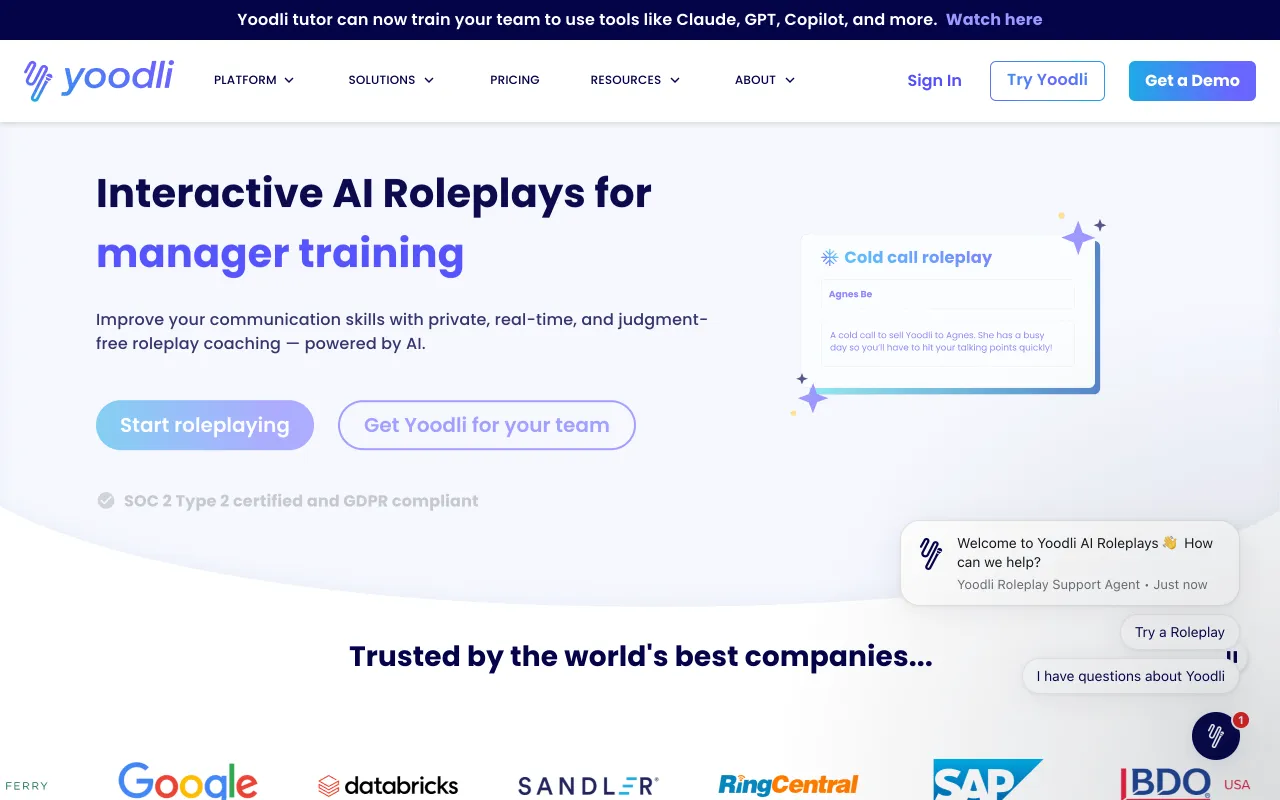
Yoodli is the obvious pick if price is the only thing standing between you and PitchMonster. It has the most accessible pricing in this list, with a free tier and paid plans from $11 per month. The catch is the focus: it leans toward general communication coaching more than sales-specific practice.
For an individual rep sharpening delivery, it is hard to beat on value. For a team that needs realistic objection handling and deal-specific scenarios, it is thinner than the dedicated sales tools above.
Key Features
- Multi-persona roleplays that simulate group and panel scenarios.
- Real-time AI feedback on delivery, clarity, and pacing.
- Enterprise integration for automated assignments and progress tracking.
- SOC 2 Type II and GDPR compliance.
Heads up · Based on user reviews
- Limited languages and shallow reporting. Reviewers flag limited language and accent options and want more quantitative depth to benchmark progress. [Source: G2]
- General, not sales-first. The free Starter is capped at 5 lifetime sessions; Pro is $11/mo and Advanced $28/mo, but the focus skews to broad communication over deal-specific practice. [Source: Yoodli pricing page]
Need more sales-specific depth? Compare 14 Yoodli alternatives.
Gong: Call Intelligence, but No Roleplay
The conversation intelligence leader, for teams whose real gap is analyzing calls, not practicing them.
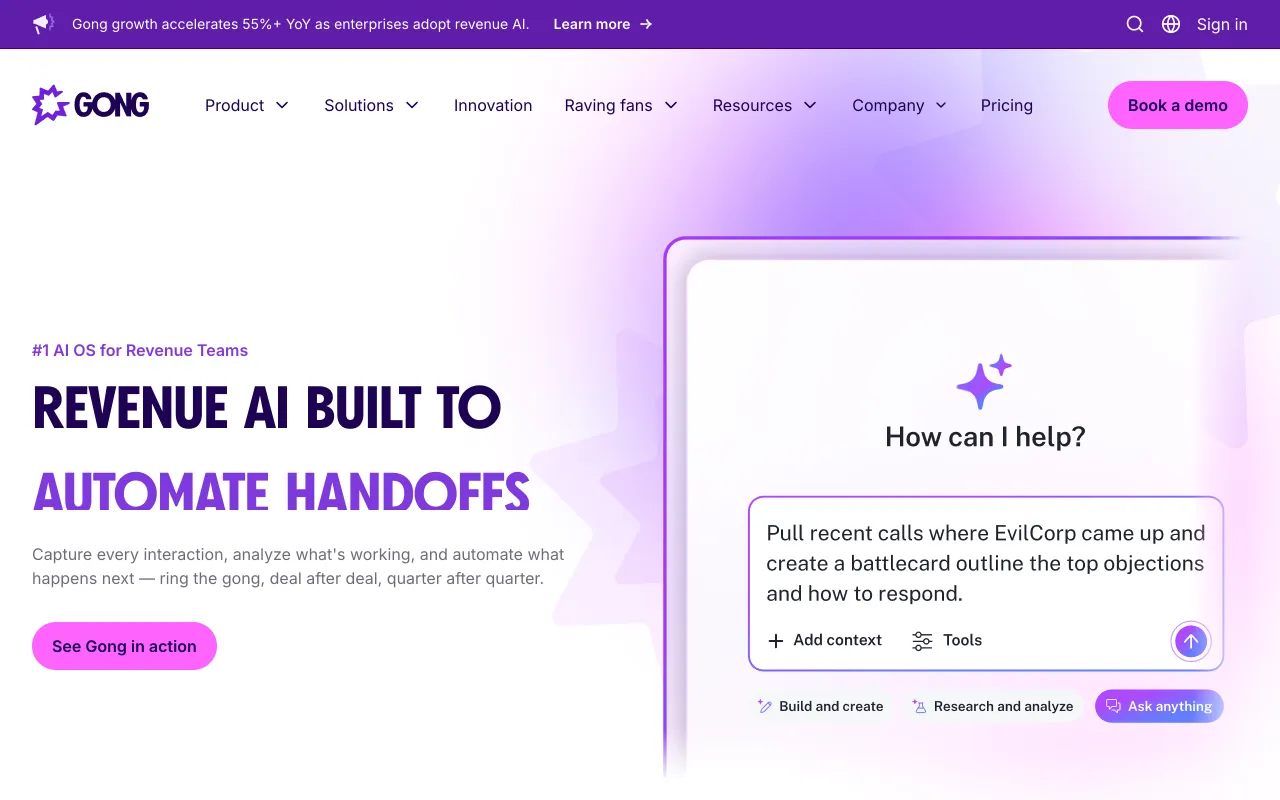
Gong is the odd one out here on purpose. It is the conversation intelligence leader, and it is excellent at recording, transcribing, and analyzing calls at scale. But it does the opposite job from PitchMonster: Gong tells you what happened on past calls, while PitchMonster (and most of this list) helps reps practice before the next one.
We include it because some teams searching for a PitchMonster alternative actually discover their real gap is analysis, not practice. If that is you, Gong is the heavyweight, though it is priced and scoped for that job; our Kendo vs Gong comparison breaks down where each one fits. If you want both loops, Kendo and Hyperbound pair roleplay with call review.
Key Features
- Call recording and transcription at scale across the team.
- Conversation and deal intelligence on talk ratios, topics, and risk.
- Forecasting and revenue intelligence on top of call data.
- Deep CRM integration for enterprise revenue teams.
Heads up · Based on user reviews
- It reviews, it does not train. Gong has no AI roleplay, so reps get no place to practice objections before a live deal. [Source: Gong product positioning]
- Cost and contracts. Gong does not publish pricing (per-seat licenses plus a platform fee); third-party reports put a 15-rep deployment at $30,000+ per year with no public free trial. [Sources: Gong pricing page; G2, Capterra]
Want training, not just call surveillance? See 14 Gong alternatives.

Globe Life nearly doubled close rates for brand-new agents
By giving new hires unlimited reps against realistic objections before they ever touched a live lead, Globe Life lifted new-agent close rates from about 33% to over 60%, pure repetition, rebuttals, and practice.
"Our closing rate for brand new agents has been almost close to double with the use of Kendo, just because they're getting that repetition, the rebuttals, and the practice."
Jess Chang, Partner at Globe LifeHow to Choose the Right PitchMonster Alternative
Match the tool to why you are leaving and how you sell, not to the loudest brand. A quick way to narrow it down:
| Your Situation | What to Prioritize | Strong Options |
|---|---|---|
| You want realistic practice plus call review, with public pricing | Both loops, custom buyers, transparent cost | Kendo AI, Hyperbound |
| You are an individual or tiny team on a budget | Lowest entry price, self-serve | Yoodli, Kendo |
| You sell face-to-face or train on camera | Avatars, video, non-verbals | UneeQ, Rehearsal, Second Nature |
| You are standardizing enablement across a big org | Full suite, content, SSO | Mindtickle, Allego |
| You are in a regulated, enterprise vertical | Compliance, realism, scale | Quantified |
| Your real gap is analyzing live calls | Conversation intelligence | Gong (add roleplay separately) |
One pattern holds across the whole category: the tools that move the needle are the ones reps actually use every day. A platform that scores you 72% and stops there gets ignored. A buyer that pushes back, plus coaching that names the moment you lost the deal, is what builds the habit.
If global onboarding is your driver, weigh language coverage first: Kendo supports 40+ languages, Second Nature 20+, and Hyperbound's multilingual support sits in its top tier. To ramp new reps faster, our playbook on how to reduce sales ramp time goes deeper, our roundup of the best SaaS sales training programs covers structured onboarding, and for high-stakes phone practice see the AI cold calling training guide.
The Verdict: Which PitchMonster Alternative Should You Choose?
PitchMonster is a solid tool. But if the demo-gated pricing, quarterly minimum, or practice-only scope is what sent you looking, here is where each kind of team should land:
- Best overall: Kendo AI. Fully custom AI buyers, real call review, 40+ languages, and published pricing from $55 per seat per month, with a free 10-minute roleplay so you can judge realism before you pay.
- Best for both loops at enterprise scale: Hyperbound. Roleplay and call scoring in one, with global reach, if you can live with a demo-gated quote.
- Best for face-to-face and on-camera teams: UneeQ and Rehearsal. Visual, presence-focused practice the voice-first tools cannot match.
- Cheapest entry point: Yoodli. Free to start and $11 per month, best for individuals sharpening delivery rather than teams drilling deals.
The best roleplay tool is the one your reps run before every hard call. If you want them drilling realistic objections, then reviewing the real call in the same place, start a free Kendo roleplay or book a demo.
Frequently Asked Questions
What are the best alternatives to PitchMonster?
The best PitchMonster alternative for most teams is Kendo AI, which pairs unlimited AI roleplay against fully custom buyers with automated call review and transparent $55 per seat per month pricing. Hyperbound is the strongest pick for enterprises that want call scoring and roleplay in one tool, Second Nature suits teams that prefer visual avatars across 20+ languages, and Yoodli is the cheapest entry point for individuals.
How much does PitchMonster cost?
PitchMonster does not publish per-seat pricing. Its pricing page says pricing starts at $1,200 per quarter on a per-seat model, with a standard 12-month contract (3 or 6 months for qualifying teams) and a team-size minimum that screens out smaller teams. You have to book a demo to get an exact quote. By comparison, Kendo publishes pricing at $55 per seat per month with a free 10-minute roleplay to start.
Is there a free PitchMonster alternative?
Yes. Yoodli has a free Starter tier and paid plans from $11 per month, though it focuses on general communication rather than sales-specific practice. Hyperbound offers a free demo with 9 roleplay bots. Kendo lets you run a 10-minute roleplay free before its $55 per seat per month plan, and it is built specifically for sales rather than general speaking practice.
Which PitchMonster alternative is best for onboarding large or global teams?
For global teams, language coverage matters most. Kendo supports 40+ languages, Second Nature covers 20+, and Hyperbound's multilingual support sits in its enterprise plan. For onboarding speed specifically, Kendo and customers like United Insurance Pros have cut new-rep ramp from 45 days to 14 by giving reps unlimited reps against realistic AI buyers before they touch a live lead.
What does PitchMonster do well?
PitchMonster is a capable, well-reviewed AI roleplay tool (4.9 stars on G2 from a smaller review base). It is strong on gamification, with leaderboards and competition that drive participation, 48 ready-to-use scenarios, and "sales Grammarly" style speech coaching on pacing, filler words, and methodology adherence. The most common reasons teams look elsewhere are its demo-gated pricing, quarterly minimum, team-size gate, and the fact that it is roleplay-only with no live call review.
What should I look for in a PitchMonster alternative?
Judge AI roleplay tools on the things that actually decide a deal: how realistic the AI buyer feels and whether it pushes back, voice versus text versus avatar, the depth of call scoring and coaching, how easily you can customize scenarios to your real ICP and objections, language coverage for global teams, how fast reps can start, and whether pricing is transparent. A tool that scores you 72% means nothing without coaching on why.
Does PitchMonster review live sales calls?
No. PitchMonster is a practice-only platform: reps roleplay against AI buyers and get feedback on those practice sessions. It does not analyze your real, recorded sales calls. If you want both loops, practice before the call and review of the actual call, Kendo and Hyperbound combine AI roleplay with automated call review in one tool, while Gong handles call analysis but offers no roleplay.

Luke Alexander is the founder of Kendo AI, where he's helped train more than 5,000 sales reps. He started in sales as a frontline closer, scaled a high-ticket sales-training company, and founded Closer Cartel and co-founded Closify before building Kendo to fix the tools he wished he'd had: realistic AI roleplay and automated call review for fast-moving sales teams. He writes about sales training, ramp speed, objection handling, and applying AI across the revenue org.