
Most sales enablement strategies stall because they treat learning like a one-time event instead of a continuous loop. Playbooks and onboarding videos lay the foundation, but real mastery happens during the actual sale, when a rep is on a live call and the prospect goes off-script.
That gap is expensive. According to Salesforce's State of Sales research, reps now spend less than a third of their week actually selling, and 78% of sellers missed quota in 2025, up from 69% the year before. The strategy on the slide deck is not the problem. The execution in the field is.
Leading teams have traded static training for high-velocity execution: AI roleplay for pre-call prep, automated reviews to close performance gaps in real time. This guide gives you the framework to bridge the distance between a strategy that reads well and one that actually changes what reps do.
A sales enablement strategy is the cross-functional operating system that equips every seller, from new hires to senior AEs, with the training, content, tools, and coaching to win deals. Done right, it aligns sales, marketing, and RevOps around one goal and turns knowledge into consistent field behavior, instead of a content library reps ignore.
The Modern Sales Enablement Definition: Moving From Content to Execution
A sales enablement strategy is the cross-functional operating system that equips every seller, from new hires to senior AEs, with the training, content, tools, and coaching required to win deals. It aligns sales, marketing, and RevOps around a single goal: getting more reps to quota with less manual remediation.
The payoff is real when the strategy is written down and run with intent. Organizations with a documented enablement strategy see 27.1% higher win rates and 18.1% higher quota attainment than teams running it ad hoc (CSO Insights' Sales Enablement Study). Simply forcing your enablement and marketing teams to document a defined plan surfaces the gaps and redundancies you were paying for blind.
But a documented strategy only earns that lift if it changes rep behavior in the field. A binder nobody opens does nothing. The rest of this guide is about making the strategy execute.
The Execution Gap: Where Strategies Break Down
Most sales enablement plans look brilliant in a slide deck and fall apart the moment a rep enters a live Zoom room. That distance between knowing what to do and actually doing it under pressure is the execution gap, and it is where almost every strategy leaks revenue.
Before you build anything new, find out where your current plan is already failing. Run this honest self-assessment.
The Sales Enablement Execution Gap Audit
Answer each question for your team as it operates today, not as you wish it did. Every "yes" is a leak, and the right-hand column is where to start plugging it.
| The Leak | Ask Yourself (Honest Yes/No) | The Fix |
|---|---|---|
| Practicing on live leads | Do reps get their first real reps on actual prospects because there is no safe place to practice? | Give every rep a daily simulation environment so the practice happens before the call, not on your most expensive leads. |
| The retention cliff | Has it been more than a week since reps were reinforced on a core skill or talk track? | Replace one-time onboarding with short, repeated practice so skills survive the forgetting curve. |
| The coaching bottleneck | Can your managers realistically review only a small fraction of team calls? | Automate call review and scoring so every conversation gets feedback, not just the handful a manager has time for. |
| Content without adoption | Do reps have to leave the dialer to hunt for a battlecard mid-call? | Embed the right asset in the workflow so it surfaces in seconds, or it effectively does not exist. |
| No leading indicators | Do you only track revenue results, with no view of the daily habits that produce them? | Measure practice volume and call scores, not just closed deals, so you can fix problems before they hit the number. |
| No named owner | If a pillar of your strategy failed next month, is it unclear whose job it was? | Assign one accountable owner per pillar so the system does not quietly drift. |
Two of those leaks deserve a closer look, because they are the ones that quietly calcify into bad habits.
The retention cliff. Without reinforcement, people forget up to 90% of what they learn within a week (this is the well-documented forgetting curve). For sales reps specifically, most of a training session is gone within 90 days. With no daily feedback loop, reps eventually invent their own pitches, and those are usually worse than the one you taught.
The coaching bottleneck. Managers can only manually review a small slice of their team's calls, which leaves the bulk of conversations uncoached and lets bad habits set. If you cannot see what the middle 60% of your team is actually saying on calls, you are not managing them. You are guessing.
When enablement stops at content, the business pays for it three ways:
- Burn rate on new hires. Average B2B ramp time has crept up to nearly six months, and a slow sales onboarding process means every extra ramp day is salary spent with no revenue back.
- Manager burnout. Reviewing calls by hand pushes managers into admin and away from strategy.
- Leaking pipeline. Reps learning on live leads lose deals that should have closed.
The audit in one move: compare your A-players against your B-players. Same CRM, same content, different results? Then the gap is execution, and the unlock is a way to clone what your top performers do through repeatable practice.
The 4 Pillars of a Modern Sales Enablement Strategy
Before you build the plan, get clear on the four architectural pillars that separate a high-growth strategy from a static one. Modern enablement has shifted from content-first (what reps read) to execution-first (how reps perform). When you choose the technology layer, use a platform comparison built around those same pillars rather than a generic feature checklist.
Pillar 1Execution Reinforcement (The Performance Layer)
This is the shift away from one-time onboarding toward continuous, AI-driven practice and automated call reviews that make skills stick. Traditional coaching does not scale because it depends on managers finding time to review calls. Automating this pillar with AI roleplay and automated reviews turns the biggest bottleneck into a competitive advantage.
Pillar 2Content Deployment (The Asset Layer)
The right case studies, battlecards, and decks have to be personalized and findable inside the rep's workflow, in seconds. A perfect battlecard the rep cannot find during a call is worth nothing.
Pillar 3Workflow Integration (The Habit Layer)
Enablement tools have to live where reps already work, inside the CRM, the dialer, and the email client. If it requires a new tab, adoption dies.
Pillar 4Shared Outcomes (The Alignment Layer)
Sales, marketing, and customer success have to march to one message and a shared set of revenue metrics like win rate and ramp speed. Misaligned teams produce mixed messages that buyers feel immediately.
"Kendo matches or beats a human practice partner. The objections are the exact same as real calls." Kody's team saw 5-20% production increases across the board, with one top performer doubling monthly revenue collected within 30 days.
Kody Skvarla, Founder, Skvarla Insurance
The Execution Framework: How to Build Your Strategy
With the pillars defined, use this five-step framework to turn them into a working revenue engine. Each step ties a daily habit to a revenue outcome, so the strategy is measurable, not aspirational.
The Five-Step Execution Engine
Each step turns one daily habit into one revenue outcome, and the last step feeds back into the first. That loop is what makes the strategy self-correct instead of decay.
Benchmark Performance Data
Compare your top 10% against the rest and find the exact stage where B-players drop off.
Find the gap a top-seller profile to coach towardDefine SMART Goals and Metrics
Pair a leading habit you can coach this week with the lagging revenue number it moves.
Practice volume and call scores win rate and ramp speedArchitect Your "Active" Stack
Push insight to the rep inside the CRM and dialer instead of making them hunt for it.
A GPS, not a map tools reps actually useEstablish the Operating Cadence
Make it a rhythm: a daily warm-up, automated feedback on every call, and data-driven weekly 1:1s.
Daily and weekly habits skills that survive the forgetting curveAssign Ownership and the Flywheel Review
Give every pillar a named owner and run a 30-day review that feeds new objections back into step 1.
Monthly review a loop that restarts at step 1-
1.
Benchmark Performance Data
To fix the gap, you first have to measure it. This step is about trading gut feel for actual numbers. Before you roll out new training, pull a snapshot of where your middle-of-the-pack reps lose steam.
- CRM StagesAnalyze CRM stage conversions. Compare your top 10% against the rest of the team and find the specific drop-off point. Are B-players stalling after discovery, or losing deals at the contract stage?
- Talk TracksIdentify talk-track gaps. Use call recordings to find the missing links. If your top earners mention ROI or implementation four times more often than everyone else, you have found your first training priority. Build your first AI roleplay scenario around that exact difference.
- Ramp BaselineSet a ramp baseline. Calculate the average number of days it takes a new hire to lead their first discovery call and to close their first $10k in revenue.
- The GoalA clear profile of what a top seller actually does, so you are coaching the team to replicate your best reps instead of training for the sake of it.
-
2.
Define SMART Goals and Metrics
Quantify the impact of Pillar 1. Most teams track only lagging results like revenue, but a modern strategy also tracks the leading habits that produce them. For a deeper look at which KPIs matter, see the guide to sales performance metrics.
Metric Category Leading Indicator (The Pillar 1 Habit) Lagging Outcome (The Revenue Result) Ramp speed Days to first AI-simulated discovery call Days to first $10k in closed ARR Win rates % of calls scored above 80% on custom rubrics Overall win rate by segment The point is where you apply pressure. You cannot coach a closed-won number after the quarter ends, but you can coach practice volume and call scores this week, and those move the number.
-
3.
Architect Your "Active" Stack
Most sales stacks are graveyards of unused tools. If a rep has to dig through five tabs for a battlecard while a prospect waits, they will not use it. Your tech should push information to the rep, not make them go hunting.
- Replace LMSReplace passive LMS systems. Most traditional SaaS sales training programs are built for compliance, not performance. Move toward the best AI sales training software that automates content delivery and scoring based on live call data.
- One-Tab RuleThe one-tab rule. Enablement has to live inside the CRM, dialer, or email client. If it is not in the daily workflow, it is overhead, not an asset.
- Perf. LayerThe performance layer. Your CRM is a system of record (the past). The missing piece is a system of performance (the future) that turns CRM data into personalized roleplay and instant feedback. See how Kendo connects to your existing tools on the integrations page.
- The GoalA stack that works like a GPS, not a map. Reps should not stop to look for directions. The right insight should surface exactly when they need to make a move.
-
4.
Establish the Operating Cadence
A strategy only works once it becomes a daily habit. This step turns Pillar 1 (reinforcement) and Pillar 3 (workflow integration) into a recurring rhythm, moving the team from monthly workshops to daily micro-adjustments.
- DailyThe 10-minute warm-up. Before the first live call of the day, reps run a targeted simulation. It builds muscle memory in a safe environment so they never have to practice on live leads.
- Post-CallAutomated feedback on every call. Each conversation is scored against your specific sales framework (MEDDIC or whatever you run) while the details are fresh, eliminating the weeks-long delay of manual manager reviews.
- WeeklyData-driven 1:1s. Managers use performance insights to coach documented skill gaps. This turns the 1:1 from a subjective status update into a tactical session grounded in real call data.
Pro TipManual call review is the bottleneck that stops you from scaling. Teams that automate the loop move from reviewing a small fraction of calls to full coverage, with instant feedback for every rep. For a deeper look at structuring ongoing improvement, see how to reduce sales ramp time by 70%. -
5.
Assign Ownership and the "Flywheel" Review
Every pillar needs a named owner, or the strategy drifts and Pillar 4 (shared outcomes) quietly breaks. Accountability is what keeps the system running after the kickoff energy fades.
The owners:
- Enablement lead. Owns the high-level revenue metrics (win rate and ramp speed).
- Frontline managers. Own coaching execution and individual rep development.
- Marketing and product. Own the accuracy and freshness of content assets.
The monthly flywheel. Run a flywheel review every 30 days. Use your call data to spot emerging market trends, and if a new competitor objection surges, update your roleplay scenarios and battlecards immediately to match.
Pro TipUse the insights in Kendo's analytics suite to catch these shifts in real time. Spotting an objection early in your AI-scored data lets you pivot the whole team's messaging in hours instead of months.
The End State
Done right, this builds a self-correcting loop. Bake a practice-and-review engine into the daily workflow and you have performance infrastructure that scales as the team grows, instead of a plan that decays the week after launch. When you are ready to compare tools, the roundups of the best sales coaching software and the best AI sales tools are the right next read.
"Kendo saves us $3,000 per rep and has cut our ramp time from 45 days to 14." United Insurance Pros moved reps to baseline performance in 14 days instead of 45, with first productivity landing around the 7-day mark.
Waylon Artrip, Founder, United Insurance Pros
Where Kendo Fits in Your Sales Enablement Strategy
Most enablement platforms cover only a slice of the sales cycle. Kendo is built specifically for the highest-leverage pillar: execution reinforcement.
While legacy tools focus on storage or basic tracking, Kendo handles three functions at scale to close the gap between strategy and behavior.
- Hyper-realistic AI roleplay. Reps practice discovery, objection handling, and closing against customizable AI prospects that push back like real buyers. With support for 15+ voice models and 40+ languages, new hires can complete dozens of simulated calls in their first week and be field-ready before they touch a real lead. For the playbook, see the sales roleplay best practices guide.
- Automated review of every call. Instead of a manager spot-checking a few conversations, Kendo applies custom scorecards to every recorded call. Reps get instant, structured summaries and targeted feedback, moving call-review coverage from single digits to full coverage.
- A continuous improvement flywheel. Kendo flags performance gaps in live calls and automatically assigns the relevant practice, creating a data-driven coaching loop that replaces opinion-based feedback with measurable skill development.
If you are weighing where to run that practice, the breakdown of the best AI sales roleplay tools is the right next read before you commit to a platform.
What Teams Actually See
The shift from static training to continuous reinforcement shows up in the numbers. United Insurance Pros cut ramp to baseline performance from 45 days to 14, saving more than $3,000 per rep in wasted lead spend. Globe Life nearly doubled new-hire close rates, moving brand-new agents from 33% to over 60%, while freeing leaders from hours of daily roleplay sessions.
After Kendo: new-agent close rate nearly doubled
Brand-new agents went from a 33% close rate to over 60% once daily AI roleplay replaced learning on live calls, while leaders got back hours of daily one-on-one roleplay time.
Result: brand-new agents closing at over 60% versus 33% before, almost double, with leaders freed from hours of daily roleplay.
"Our closing rate for brand new agents has been almost close to double with the use of Kendo."Jess Chang, Partner, Globe Life
Kendo connects to your CRM or conversation intelligence tools through a native API and acts as the practice-and-coaching engine on top. It is the layer that turns an enablement strategy into consistent, revenue-generating behavior.
Sales Enablement Strategy FAQ
It is the cross-functional operating system that gives every seller the training, content, tools, and coaching they need to win deals, and keeps sales, marketing, and RevOps aligned around the same goals and metrics. The strategies that work do not stop at content. They build in practice and feedback so knowledge turns into consistent behavior on live calls.
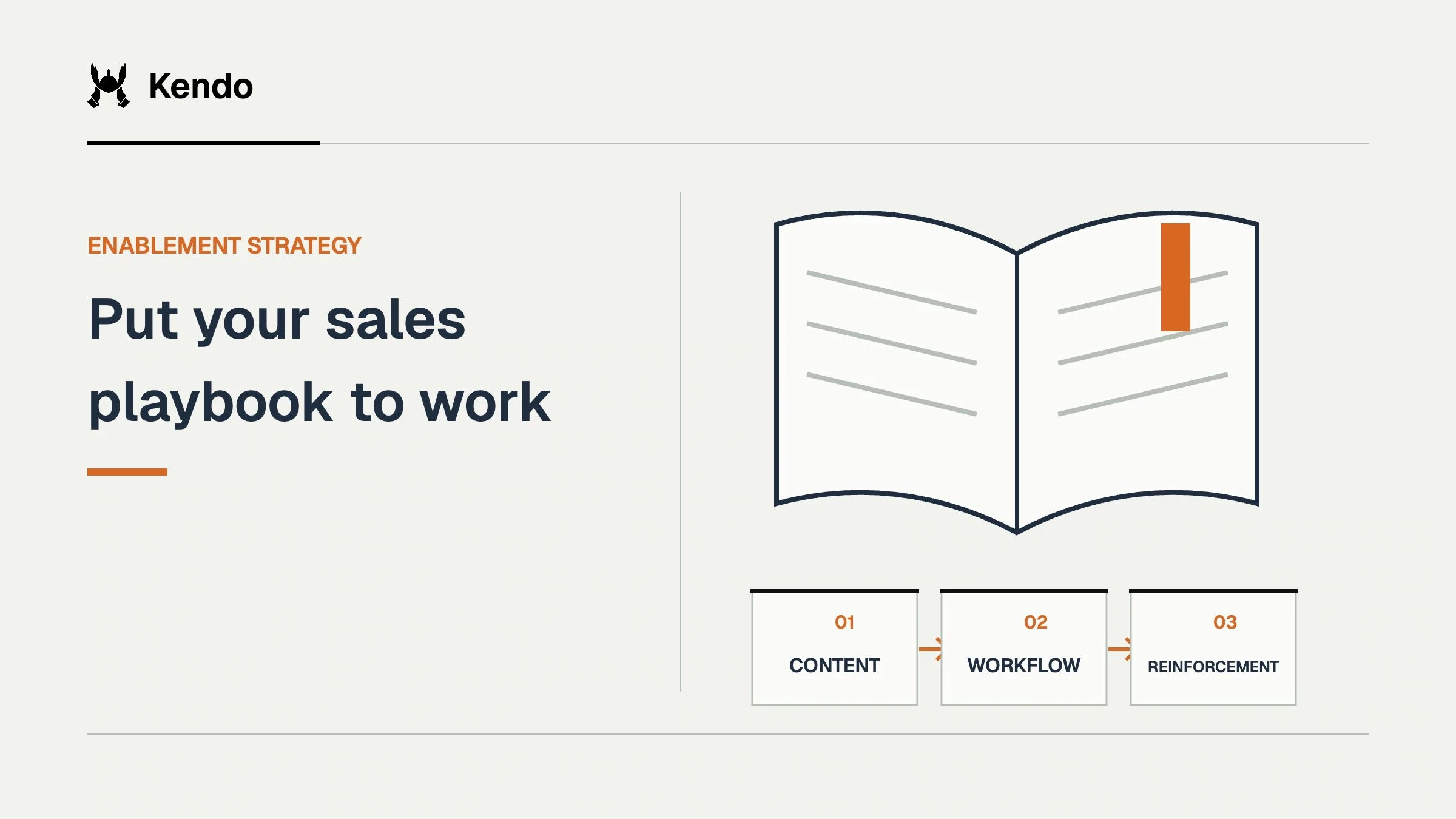
Four: execution reinforcement (continuous practice and scoring), content deployment (the right asset findable in seconds), workflow integration (everything lives in the CRM and dialer), and shared outcomes (sales, marketing, and CS aligned on one message and shared metrics). Most teams over-invest in content and under-invest in execution reinforcement, which is the pillar that actually changes rep behavior.
Benchmark your performance data to find where reps drop off, set SMART goals that pair a leading habit with a lagging revenue outcome, build an active tech stack that pushes insight into the workflow, establish a daily-and-weekly coaching cadence, and assign a named owner to each pillar with a monthly review. The thread through all five steps is reinforcement: a strategy without a practice loop is just a suggestion.
Track leading indicators and lagging outcomes together. Leading: practice volume, days to first simulated discovery call, and the share of calls scoring above your rubric threshold. Lagging: win rate by segment, quota attainment, and ramp speed. The leading metrics are the ones you can coach this week, before they show up in the number.
They fail in execution, not on paper. Reps forget most of a training session within weeks, managers can only review a fraction of calls by hand, and great content goes unused because it is not in the workflow. Without a practice-and-review loop to reinforce the strategy daily, the plan decays and old habits return.
Conclusion: From Playbooks to Performance Infrastructure
A modern sales enablement strategy is not a training event, a wiki, or a quarterly kickoff. It is a continuous operating system that combines four pillars, execution reinforcement, content deployment, workflow integration, and cross-functional alignment, and runs on a weekly rhythm of practice, review, and targeted improvement.
Stop treating enablement as a support function and start treating it as performance infrastructure. A strategy without a practice loop is just a suggestion.
The teams that win are the ones where every rep practices daily against realistic AI prospects, every call is reviewed automatically against a consistent rubric, every coaching conversation is grounded in real performance data, and every metric maps back to revenue.
- For the game plan: use the 4 pillars and the 5-step framework to turn a static strategy into a daily operating rhythm.
- For the execution: use Kendo AI to embed AI roleplay and automated scorecards into the workflow, so the strategy actually changes what reps do.
Kendo is the engine for that shift. By embedding AI roleplay and automated scorecards into the daily workflow, it helps teams collapse ramp times and lift win rates instead of hoping the slide deck sticks.
Stop letting execution be your bottleneck. Ready to turn your strategy into a high-performance loop? See how Kendo works →

Luke Alexander is the founder of Kendo AI, where he's helped train more than 5,000 sales reps. He started in sales as a frontline closer, scaled a high-ticket sales-training company, and founded Closer Cartel and AI Insiders before building Kendo to fix the tools he wished he'd had: realistic AI roleplay and automated call review for fast-moving sales teams. He writes about sales enablement, ramp speed, objection handling, and applying AI across the revenue org.