
You just finished a great demo. Then the prospect says, "I need to think about it." Most reps deflate and let the lead go cold. Top sellers hear something different: an opening to keep talking.
To win there, you need a clear plan and the right practice. This guide gives you both: how to stay calm, answer the real concern, and use AI sales roleplay to make the moves automatic.
Here is what we cover:
- Why prospects push back and what it actually means
- A simple 5-step plan to handle any tough objection
- Real scripts and video breakdowns for price, timing, and trust
- How practicing with AI turns those scripts into reflex
Sales objection handling is the process of addressing a prospect's concerns, hesitations, or pushback so the conversation can move toward a confident yes. The key idea is that an objection is not a rejection. It tells you exactly which barrier to remove. Clari even found that when a prospect raises an objection, the win rate tends to go up, not down.
What Is Sales Objection Handling?
Sales objection handling is the process of addressing a prospect's concerns, hesitations, or pushback during a sales conversation. It is not about arguing or memorizing slick comebacks. It is about understanding what is really behind the "no" and guiding the prospect toward a confident buying decision.
Objections surface at every stage, from the first cold call to final contract terms. A prospect might hesitate over price, timing, internal politics, a bad experience with a past vendor, or simply because they do not trust you enough yet.
Here is the distinction that changes everything: an objection is not a rejection. A flat "no" ends the conversation. An objection opens one. When a prospect says "I'm not sure the timing is right," they are handing you the exact barrier you need to remove.
Why Objection Handling Matters
- It keeps deals alive. Without skilled objection handling, every hesitation becomes a dead end. Reps who work through pushback keep conversations moving instead of watching deals stall.
- It builds trust. Responding with empathy and genuine curiosity, rather than defensiveness, signals that you care about solving the prospect's actual problem.
- It uncovers hidden needs. The stated objection is rarely the real one. "We don't have budget" often means "I'm not convinced this will work." Good objection handling peels back the layers.
- It increases revenue. Only 41% of reps feel prepared to respond to objections, according to Topaz Sales Consulting. Mastering the skill gives you a real edge in every competitive deal.
- It shortens sales cycles. Unaddressed objections linger, slow internal decisions, and seed doubt at every stage. Handling them cleanly in the moment prevents weeks of deal drag.
And the payoff is counterintuitive. After analyzing 224,000+ sales calls in 2020, Clari found that when a prospect raised an objection, the win rate went up by almost 30%. The objection is not the problem. Ducking it is.
The 5-Step Framework for Handling Any Sales Objection
Before the specific objections, here is the universal process that works on all of them.
-
1
Listen and Validate
Let them finish completely. Then acknowledge the concern: "I appreciate you raising that." It lowers the temperature and shifts the conversation from adversarial to collaborative.
Most reps start building a response before the prospect stops talking, which is a mistake. When Gong analyzed 67,149 sales calls, the top performers actually paused longer after an objection and used fewer words than average reps. The details a prospect shares at the very end are often the most revealing, so do not talk over them to get there.
-
2
Clarify With Open-Ended Questions
Dig deeper. The first objection is almost never the real one, and strong discovery skills are what surface it.
- "When you say the timing isn't right, what specifically would need to change?"
- "Is it the total cost, or more about how the budget is structured?"
- "What would you need to see to feel confident moving forward?"
Gong's data backs this up: star reps ask clarifying questions instead of assuming they already understand the concern.
-
3
Isolate the Objection
Ask: "If we solved this, is there anything else holding us back from moving forward?" This prevents whack-a-mole, where you resolve one concern only for three more to surface.
-
4
Respond With a Tailored Solution
Now give your response. Use case studies, data, or references that mirror the prospect's exact situation. The more targeted the response, the more credible it feels.
-
5
Confirm and Advance
Check in: "Does that address your concern?" Get explicit confirmation, then immediately move to the next step, whether that is scheduling a follow-up, looping in a stakeholder, or talking terms.
5 Common Sales Objections and How to Handle Them
Knowing which category an objection falls into lets you choose the right response instead of guessing. Four of these five map onto the classic BANT qualification framework (budget, authority, need, timing), so tight discovery upstream defuses most of them before they ever surface. For each one below, you get:
- What it really means, the unspoken signal under the surface
- Actionable tips for what to do before you open your mouth
- 2-3 response options with a breakdown of why each works
- A real-world clip of someone handling that objection well
- A Kendo drill you can run today to make the skill stick
A quick note on "I need to think about it." It is the most common objection in sales, and it is almost never the real one. It is usually price, trust, or authority in disguise. When you hear it, figure out which category below you are actually in and respond to that.
The 5 Objections Decision Map
When pushback lands, the win is knowing which of the five types you are in before you open your mouth. Read each row left to right: what the objection really means, the first move that works, and the trap that quietly loses the deal.
The 5 Objections Decision Map
Match what you just heard to a type, then run the move and dodge the trap. The detailed scripts for each are further down.
Price Objections
What to do before you respond:
- Don't flinch. A pause is fine. A defensive tone tells the prospect they hit a nerve and hands them leverage.
- Never discount first. The moment you cut price unprompted, you have confirmed your sticker price was always negotiable.
- Have your ROI math memorized. If you have to "get back to them" with numbers, the momentum is gone. Know your top three ROI levers before the call.
"It's too expensive."
| Strategy | Recommended script | Why it works |
|---|---|---|
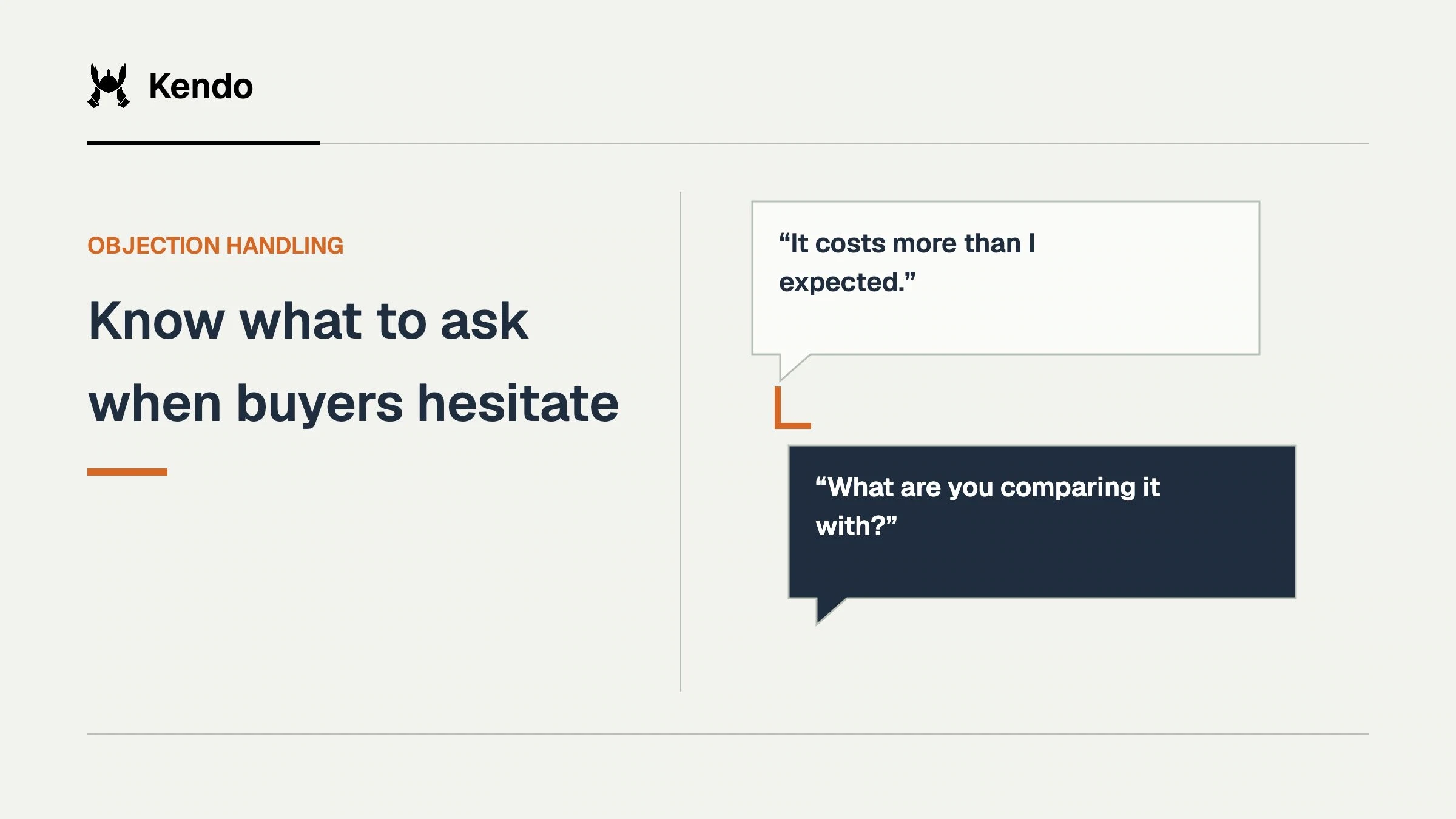
| Response AAnchor to ROI | Can you help me understand what you're comparing it to? Teams often find that once they factor in [cost of the problem], the ROI is significant within a few months. | Questions the benchmark instead of defending the price. It often reveals the prospect is comparing apples to oranges. |
| Response BReframe inaction | Totally fair to flag. Can I ask, what's the cost of not solving this for another 12 months? When teams run that math, the conversation usually shifts. | Leverages loss aversion. Prospects are more motivated by what they are losing today than by what they might gain later. |
| Response CIsolate the concern | Got it. If we set price aside for a second, and assuming we found a structure that worked, is everything else a fit? | Tests whether price is the real hurdle or a smokescreen for doubts about fit, timing, or trust. |
Here is how Sabri Suby handles "it's too expensive."
What Sabri Suby does here: he never defends his price. He makes the prospect do the math out loud about theirs. Three beats: get the numbers ($4,800 now vs. a $10,000 goal), subtract ($5,200 a month gap), multiply by time already spent ($62,000 over 12 months).
By the end, the prospect is not being asked to spend money. He is being shown he already spent $62,000 by not buying. The social-proof line, "Do you think there are other people out there doing $10,000 a month in your space?", turns the gap from a market reality into a personal failure to act.
Takeaway: a live demo of Anchor to ROI and Reframe inaction fused together. When someone says "too expensive," put a number on their situation, not yours.
"We don't have budget."
| Strategy | Recommended script | Why it works |
|---|---|---|
| Response ANormalize, then offer ammo | Most teams we work with didn't have pre-allocated budget either. It became a priority after they saw the business case. Would an ROI projection based on your numbers help you bring something concrete to finance? | Normalizes the situation to lower tension, then offers to help build the internal case for finance. |
| Response BTest the budget reality | When you say no budget, is that no budget for anything this quarter, or no budget specifically allocated for this category? Because those are very different conversations. | Forces a real answer and reveals whether there is discretionary or reallocatable spend. |
Watch how a top rep flips a "we don't have budget" stall.
What this rep does well:
- Flips the pressure. "Yeah, that could be a problem for you guys for sure." Instead of panicking, he agrees, and puts the weight of the budget gap on the prospect. It instantly raises his status from needy rep to in-demand expert.
- Makes the prospect sell themselves. "If you did have the funding, is this something that would work for you?" The prospect says yes and starts listing reasons why. Now they are not objecting, they are building their own case to buy.
Takeaway: this is Response A, Normalize then offer ammo, with a status flip. When someone says they can't afford it, don't justify your price. Make them articulate why they want it anyway.
Watch how Tristan Tate justifies a premium price instead of cutting it.
What Tristan Tate does well selling a cigar:
- Diagnoses before pitching. He asks about cigar experience first and surfaces the coughing problem.
- Reframes the bad experience as a budget problem. "That's your problem, you've been buying the lower-quality cigars."
- Justifies price with craft, not features. He tells the story of aging, compares it to fine whiskey. By the time "$350" lands, it sounds reasonable.
- Reframes the spend pattern. Fewer cigars, better cigars, same monthly cost, dramatically better experience.
- Is willing to walk. "If you can't afford it, that's perfectly fine, because I have customers who can."
Takeaway: this lives out the never discount first tip and the willing-to-walk-away trust signal in one clip. When a prospect says they can't afford it, don't make it cheaper. Make staying the way they are sound more expensive.
"Your competitor is cheaper."
| Strategy | Recommended script | Why it works |
|---|---|---|
| Response ATotal cost of ownership | Thanks for sharing that. Does their proposal include [key differentiator]? Total cost of ownership often looks different once you factor in what's included versus what's extra. | Encourages an apples-to-apples comparison. It feels collaborative rather than defensive and surfaces hidden costs like fees or support tiers. |
| Response BThe honest pivot | You're right, they're cheaper. The question I'd want answered in your shoes is: cheaper at what? If [specific outcome] is the goal, here's where the gap shows up. | Builds credibility by acknowledging the price difference, then redirects to the outcome, which is the metric that actually matters. |
Watch how a top closer handles "your competitor is cheaper."
The whole move is one question: "When you bought from them, how did you find the service?"
It is a trap. If the competitor really were cheaper and similar, the prospect would have bought already. When they admit they haven't, the follow-up, "why wouldn't you buy from them if they're so cheap?", exposes the bluff. Now the prospect has to either backpedal on the competitor or commit to going elsewhere, which they already didn't. He never defends his pricing, lists differentiators, or bashes the competitor. He just makes the prospect's own behavior the evidence.
Takeaway: a sharper version of Response A, Total cost of ownership. When someone uses a competitor's price as leverage, take them at their word and watch them backpedal.
Timing Objections
What to do before you respond:
- Pin "later" to a date. "Next quarter" is fog. "April 15" is a commitment. No date means the deal is effectively dead.
- Bring a cost-of-delay number. "Every month of delay costs teams like yours $X" turns timing from abstract into arithmetic.
- Check for the real signal. Timing stalls after a strong demo usually mean the prospect can't get internal alignment, not that they're genuinely busy. This is where reducing ramp time on objection skills pays off.
"Now isn't a good time."
| Strategy | Recommended script | Why it works |
|---|---|---|
| Response AMirror and explore | Totally understand. What would the right time look like? I ask because teams in similar spots told us they wished they'd started sooner, given [specific cost of delay]. | Validates the prospect to lower pressure while using social proof and the cost of delay to create urgency. |
| Response BPre-empt the silent kill | Fair. Most 'not now' conversations either become 'never' or 'next quarter.' Which one is this honestly closer to? I'd rather know now than chase you for six months. | Builds trust through radical honesty. It forces a real answer and saves time by revealing whether the deal is dead or just delayed. |
Watch how a rep neutralizes "now isn't a good time" by matching it.
Prospect says, "I've only got 10 minutes." The rep mirrors it: "Oh geez, I've only got a few minutes before my next appointment anyway." That does two things. It removes the pressure, since the time constraint is no longer a power move when both sides have one, and it raises his status, because he is not a rep grateful for scraps of time. Then he just moves forward: "So what I wanted to ask..." No negotiation, no acknowledgment that it is a problem.
Takeaway: the flip side of Response A, Mirror and explore. That version validates then probes. This version neutralizes the objection by matching it. Better for throwaway timing stalls than genuine scheduling conflicts.
"Let's revisit next quarter."
| Strategy | Recommended script | Why it works |
|---|---|---|
| Response AQuantify the wait | Happy to. One thing to flag: if [problem] continues at its current rate, that's roughly [quantified impact] in lost productivity. Would a pilot now make sense, so you're ready when timing opens up? | Avoids resistance by agreeing with their timeline while highlighting the cost of waiting. A pilot is a low-friction way to keep progress alive. |
| Response BLock the calendar | Sounds good. To make sure this doesn't slip, can we put a 30-minute call on the calendar for [specific date in Q+1]? I'll bring an updated business case based on whatever changes between now and then. | Stops a vague "next quarter" from becoming a dead deal. Booking the meeting immediately keeps momentum alive for a future date. |
"We're locked into a contract with another vendor."
| Strategy | Recommended script | Why it works |
|---|---|---|
| StrategyPlant the seed for renewal | Understood. When does that come up for renewal? In the meantime, would it be valuable to run a side-by-side comparison so you have data ready when that decision arrives? | Avoids aggressive requests to break a contract. It positions you as the prepared alternative for when the renewal window opens. |
Watch how a rep gets in when the prospect is locked in with another vendor.
When the prospect says they are already working with someone, the rep doesn't pitch against them. He asks one question: "If you were to give them a one out of ten, what would that look like?" The prospect says "seven going down to six." Now he has a gap. So he asks the follow-up: "What would need to happen for them to be a ten?" The prospect tells him exactly what the current vendor can't do. He just let the prospect build the pitch for him. Then the close is easy: "Are you interested in learning how we might help you expand beyond what they're doing?" The prospect says yes, because they already articulated the problem themselves.
Takeaway: Plant the seed for renewal in action. He doesn't ask anyone to break a contract. He surfaces the gap in the current vendor's service and positions himself as the answer for when that gap becomes a dealbreaker.
Authority Objections
What to do before you respond:
- Map the buying committee on call one. If you're hearing "I need to check with someone" for the first time at the close, your discovery failed three steps ago.
- Show up with materials ready. Champions have day jobs. The rep with a pre-built one-pager beats the rep who says "let me know what they think."
- Multi-thread while energy is high. Asking for intros after the deal stalls looks desperate. Ask while things are moving.
"I need to run this by my boss" or "I need to ask my spouse."
| Strategy | Recommended script | Why it works |
|---|---|---|
| Response AVolunteer to build the case | Of course. What would be most helpful for that conversation? I can put together a one-page business case or join a quick call to answer questions directly. | Makes the champion's job easier and ensures your value proposition is told accurately, not watered down through a third party. |
| Response BSurface objections in advance | Smart. Quick question, what are the top two things you think they'll ask? If we pre-empt those now, you'll walk in with answers instead of needing a round two. | Treats your contact as an ally and uncovers the real hurdles, like price or fit, that they may have been too polite to raise. |
Watch how a rep handles "I need to run this by my spouse."
The rep accepts the stall, then asks, "What if your wife says no, what are you going to do?" That forces the prospect to game-plan the rejection scenario now instead of disappearing for two days. Then he finds the real number: "What's the max you can spend without a two-day conversation?" Whatever they say, he fits the deal under that limit.
Takeaway: Responses A and B work with the decision maker. This one works around them by finding the prospect's own authority ceiling. Best when the "decision maker" is more comfort blanket than real gatekeeper.
"I'm not the decision maker."
| Strategy | Recommended script | Why it works |
|---|---|---|
| Response AAsk for the warm intro | I appreciate the honesty. Would you be comfortable making an introduction? I can draft a quick intro email you can forward. | "Comfortable" respects their social standing. Providing the draft removes the friction that usually kills follow-through. |
| Response BKeep them as champion | Got it, really helpful to know. Two questions: what does [decision maker] usually care about most, and what's their typical process for greenlighting a tool like ours? | Leverages their internal knowledge. Even if they can't sign the check, they can tell you exactly how to win over the person who can. |
| Response CFind their authority limit | No problem. Out of curiosity, what's the max you could comfortably approve without looping anyone else in? | Surfaces the threshold for solo approval. If you can structure a pilot or payment plan under that limit, you can close now. |
Watch how a rep maps the buying committee when a contact says "I'm not the decision maker."
Instead of asking "who else is involved in this decision?" (which feels like going over their head), the rep reframes it: "Can you walk me through your company's decision-making process when it comes to solving problems like this?" Same information, completely different tone. You get the org chart without making your contact feel bypassed. And by tying it to "solving problems like this," he anchors the process question to the pain they already named.
Takeaway: this sets up Response A (warm intro) and Response B (champion coaching) by giving you the map before you ask for either. You can't navigate the buying committee if you don't know how it works.
Need / Fit Objections
What to do before you respond:
- Question the status quo, don't argue it. Telling them their solution is bad makes them defensive. Asking what they'd change makes them critique it for you. The Sandler methodology calls this the "negative reverse."
- Respond with a question, not a feature list. When they say "we already have a solution," weak reps compare features. Strong reps ask questions, the core habit of consultative selling.
- Reference their pain, not generic pain. "Companies like yours struggle with X" is a script. "You mentioned your team spends four hours a week on Y" is a sale.
"We already have a solution" or "I don't see how this applies."
| Strategy | Recommended script | Why it works |
|---|---|---|
| Response ASurface the gap | That tells me you see the value of solving this problem. If you could change one thing about your current solution, what would it be? | Every tool has tradeoffs. This opens the door to existing gripes without you badmouthing the competitor, giving you a wedge. |
| Response BCompliment, then differentiate | That's great, [competitor] is solid for [strength]. Most teams that switch to us do it when they hit a wall on [specific use case]. Have you run into that yet? | Acknowledging a competitor's strength builds credibility, then lets you honestly map where your tool wins on specific outcomes. |
| Response CLong-game patience | Makes sense. I won't try to convince you to switch. Mind if I check back in [3-6 months]? In the meantime, here's a resource on [pain point] you might find useful. | Concedes the immediate sale to stay in their orbit, so you're on the list for the next renewal cycle. |
| Response DDiagnose, don't pitch | Fair. I may not have connected the dots well enough. Can I ask a few questions about your current process so I can show you the right angle? | Taking the blame lowers their guard and lets you redirect to discovery, the only way to fix a generic pitch that missed. |
Watch how a rep turns "we're okay" into an opening.
Prospect says "we're okay." The rep doesn't accept it. "Does that mean you have the best callers in the country?" The prospect softens. "Does that mean it couldn't be done better?" The prospect admits, "I'm sure everything could be done better." Three questions turned "we're fine" into a gap. He never pitched and never bashed anyone. He just asked until the prospect poked holes in their own status quo. And when the prospect shut it down, he accepted cleanly. Knowing when to stop is part of the skill.
Takeaway: Response A, Surface the gap, in live fire. The prospect opened with a wall. The rep didn't climb over it, he asked questions until the prospect opened a door themselves.
Trust / Credibility Objections
What to do before you respond:
- Match the case study to their situation. A logo from the wrong industry or company size doesn't reduce risk. It can increase it. See how real teams measure results from AI-powered training.
- Offer the smallest possible "yes." Pilots, trials, single-team rollouts. The right move is usually a smaller commitment, not a bigger discount.
- Be willing to walk. Reps who would turn down a bad-fit deal are more trusted than reps who try to close everything.
"I've never heard of your company."
| Strategy | Recommended script | Why it works |
|---|---|---|
| Response AReframe the unknown | We focus on building a great product over big marketing budgets. Here's what customers say: [case study]. Would it help to connect with someone in your industry who uses us? | Reframes low brand recognition as a deliberate choice to prioritize product quality, then uses customer-to-customer intros as the ultimate proof. |
| Response BAcknowledge and qualify | Totally fair. We're not the household name yet. The teams who find us have usually outgrown [competitor] or hit a wall around [pain point]. Does that sound like you? | Owns your size instead of fighting it, and acts as a qualifier so prospects who move forward have already identified your specific value. |
One effective move here is to deflate the objection with humor: "We're pretty well known at this point. Should I forgive you for saying that?" The prospect laughs, the concern disappears, and it rarely comes back up. It works even at senior levels, because joking about your own brand size signals confidence. Insecure reps don't make that joke.
Takeaway: a different path than Responses A and B, which handle this with logic. This one handles it with tone. Sometimes the fastest way past an objection is to make it feel too small to take seriously.
"We tried something similar and it failed."
| Strategy | Recommended script | Why it works |
|---|---|---|
| StrategyDiagnose the past failure | Important context. Can you tell me what went wrong? I want to show you exactly how our approach differs, or be honest if it doesn't. | Offering to be honest about a lack of fit signals you are not a desperate vendor. That builds real credibility with prospects who have been burned. |
Watch how a rep defuses "we tried something similar and it failed" before it is even raised.
His move is prevention, not reaction. During discovery, before the objection ever comes up, he asks what they've tried before, what they liked, and what they didn't. Then when he presents, he maps it directly: "You liked these things, we have those. You didn't like these things, here's how we're different." The objection never gets raised, because he already addressed it.
Takeaway: the recommended response handles this objection head-on. This clip shows how to stop it from happening at all. The best approach is to do both: diagnose during discovery, and if it still comes up later, you already have the ammo.
"How do I know this will actually work?"
| Strategy | Recommended script | Why it works |
|---|---|---|
| Response AHand over the keys | You shouldn't take my word for it. I'd suggest a [trial/pilot] so you can see results in your own environment. That way the data speaks for itself. | De-risks the decision by removing the need for blind trust. The prospect relies on their own data, not a sales pitch. |
| Response BStack the proof | Best way I can answer that is to show you. I'll send three things: a case study, a 15-minute reference call, and specific month-one metrics. Which is most useful? | Offers a variety of evidence and lets the prospect choose, which forces active engagement instead of a passive brush-off. |
The #1 AI Roleplay Tool for Objection Handling Training: Kendo AI
Traditional roleplay fails because it lacks real tension. Peers are too nice, feedback is slow, and you don't get enough reps to build muscle memory. Objection handling is a performance skill. It is about what you can execute when a deal is on the line, not what you can recite from a slide deck.
If you want your team to move past memorizing frameworks and start performing under pressure, Kendo AI is built for live simulation practice. It turns objection handling from theory into instinct, the way an athlete drills a single move until it is automatic. Here is why it works for this skill specifically.
- Realistic AI prospects that adapt. Build custom personas, from skeptical CFOs to stall-heavy mid-market buyers. These AI prospects respond to your tone, energy, and strategy in real time, closer to real-time sales coaching than a static script. Sound shaky and they push harder. Reframe well and they move forward.
- Drill the exact objections your team faces. Pull the top five objections from your last 50 lost deals and turn each into a dedicated practice scenario. Practice the specific phrasing, industry context, and decision criteria your real buyers bring, for hours if that is what it takes to master a single objection like price.
- Instant feedback loops. AI call scoring gives reps immediate feedback on tone, pacing, and response quality, so they self-correct without waiting on a manager's calendar.
- Risk-free reps. The bolder moves (the status flip, the negative reverse, the willing-to-walk-away play) only become reliable after dozens of attempts. Kendo is where you get those attempts without burning live deals.
If you are still deciding where your team should drill, the breakdown of the best AI sales roleplay tools is the right next read before you commit to a platform.
Proven Results
Skvarla Insurance: team production improved 20-25% by practicing against AI objections identical to their real calls. As the team put it, Kendo "matches or beats a human practice partner, and the objections are the exact same as real calls."
United Insurance Pros: took reps from 45 days to 14 days to reach baseline performance, with new hires productive inside their first week.
The bottom line: knowledge alone doesn't win deals. Kendo closes the gap between knowing a framework and executing it on a live call.
Related: Sales Roleplay Best Practices (AI Guide).
Building an Objection Handling Playbook
- Audit and organize. Pull your top 10 to 15 objections from call recordings. Map them to deal stages (cold call vs. demo vs. close). You'll likely find 80% of lost deals involve the same five or six concerns.
- Document flexible responses. For each objection, write two or three frameworks reps can adapt to their style. Not rigid scripts. The responses in this guide are a starting point.
- Practice and track. Build roleplay scenarios targeting each objection. Use call scoring to measure improvement over time. If this needs to run across a phone-heavy team, compare call-center training platforms that combine scenarios, scoring, and manager coaching. Are objection-heavy calls converting better? Are specific objections still causing losses? Update the playbook quarterly as markets and competitors change.
Related: Best Sales Call Analysis Software.
Objection Handling Dos and Don'ts
| Do | Don't |
|---|---|
| Listen completely before you respond. | Interrupt the prospect mid-objection. |
| Ask clarifying questions to uncover the root concern. | Assume the first objection they raise is the real one. |
| Validate the objection to show empathy before solving it. | Get defensive or treat the objection as an argument. |
| Use specific data and case studies instead of generic claims. | Ignore the emotional component or the prospect's underlying anxiety. |
| Isolate objections so you aren't playing whack-a-mole. | Offer discounts as your first response to price concerns. |
| Practice regularly through realistic AI simulations. | Move to close before confirming the concern is fully resolved. |
Sales Objection Handling FAQ
Treat it as a clue, not an answer. It is usually price, trust, or authority in disguise. Ask a gentle isolating question to find the real category: "Totally fair. When you think it over, what's the main thing you'll be weighing?" Their answer tells you which section of this guide to run. The worst move is to accept it at face value and wait, because a vague "I'll think about it" with no next step is how most deals quietly die.
They cluster into five types: price ("it's too expensive," "no budget," "your competitor is cheaper"), timing ("now isn't a good time," "next quarter"), authority ("I need to ask my boss," "I'm not the decision maker"), need or fit ("we already have a solution"), and trust or credibility ("never heard of you," "how do I know this will work"). Budget and price tend to come up most often, but the stated objection is rarely the whole story.
A simple five-step loop works on almost any objection: listen and validate, clarify with open-ended questions, isolate the objection, respond with a tailored solution, then confirm and advance. The order matters. Most reps skip straight to responding, which is why they end up answering the wrong concern.
Usually the opposite. Objections mean the prospect is engaged enough to surface their real hesitations. Clari found that when a prospect raised an objection across 224,000+ calls in 2020, the win rate actually rose by nearly 30%. Silence is the worrying signal. A prospect who pushes back is telling you what they need to hear to say yes.
Reading scripts is not enough, because objection handling is a performance skill that breaks down under pressure. The reps who improve fastest practice deliberately against realistic resistance, the same way you'd rehearse anything you want to do well live. Tools like Kendo let you drill a specific objection, like price, against an adaptive AI prospect for as long as it takes, then score the reps so you can see exactly where you revert to old habits.
Stop Practicing on Your Customers: Try AI Sales Roleplay Now
Mastering the 5-step framework is real sales craft. But in 2026, knowing the steps isn't the advantage. Executing them flawlessly when a deal is on the line is.
Knowledge without deliberate practice stays theoretical. Relying on static playbooks or predictable peer roleplays leaves an execution gap that quietly stalls deals and loses revenue. Kendo AI bridges that gap, turning these objection-handling strategies from a PDF on a drive into sharp, intuitive instincts.
- For the playbook: use the frameworks in this guide to define your team's best-practice responses.
- For the execution: use Kendo to give reps the flight hours they need to handle price, timing, and trust objections before the stakes are real. You can see how teams are already measuring their ROI from AI sales training.
Turn Hesitations Into Revenue
Don't let your next high-stakes negotiation be the first time a rep attempts a difficult isolation loop or a real reframe. Give your team the unfair advantage of AI-built muscle memory, so the response is already automatic when it counts.
Ready to turn objection-handling theory into reflex? See how Kendo AI works →

Luke Alexander is the founder of Kendo AI, where he's helped train more than 5,000 sales reps. He started in sales as a frontline closer, scaled a high-ticket sales-training company, and founded Closer Cartel and AI Insiders before building Kendo to fix the tools he wished he'd had: realistic AI roleplay and automated call review for fast-moving sales teams. He writes about sales training, ramp speed, objection handling, and applying AI across the revenue org.