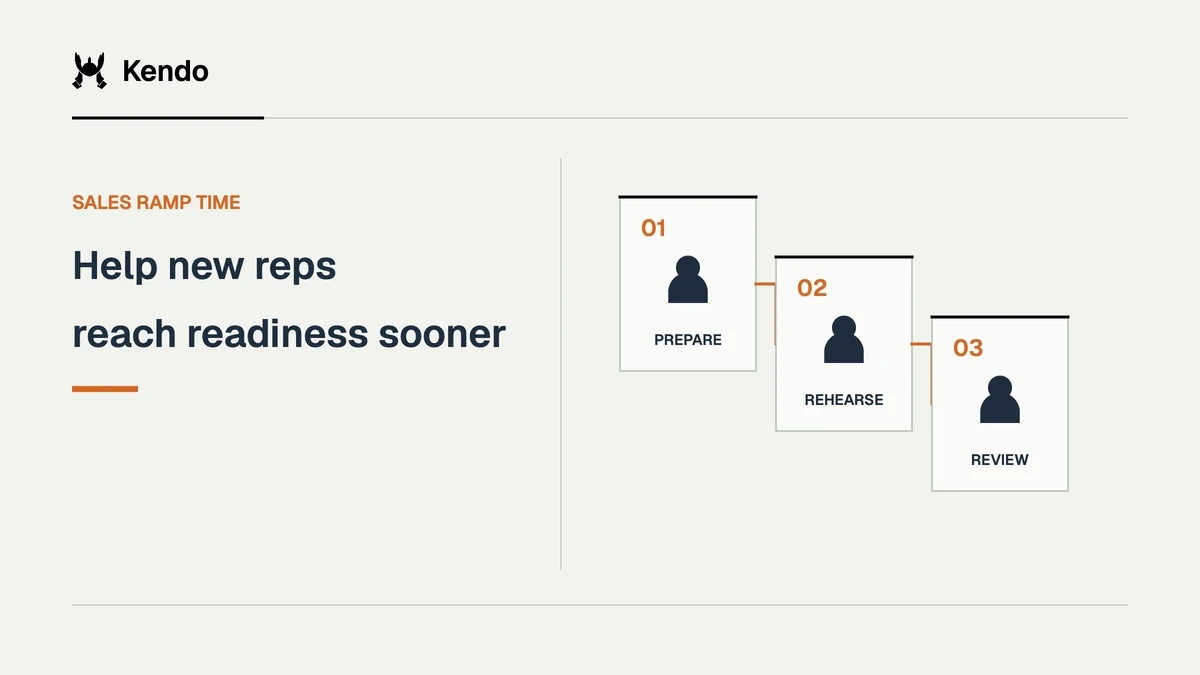

The average new sales hire takes 11.2 months to reach full productivity, according to the Sales Management Association. The Bridge Group puts the average ramp for a B2B SaaS account executive around 5.7 months, up from 4.3 in 2020. Either way, you are paying full salary, burning leads, and bleeding manager time for the better part of a year before that rep contributes a dollar to pipeline.
Slow ramp isn't inevitable. It is a symptom of unstructured onboarding. This guide is your 2026 playbook for building a real program, from pre-boarding to day 90, that produces revenue in weeks instead of months.
Here is what actually moves ramp time:
- The 5 pillars every high-performing onboarding program is built on
- A 30-60-90 day execution framework with milestones, not vibes
- A readiness scorecard so you stop clearing reps for live leads on a hunch
- Why AI-powered roleplay is becoming the fastest way to build muscle memory without torching live leads
Sales onboarding is the structured process of taking a new hire from signed offer to full productivity, covering your product, your buyers, your sales process, your tools, and the conversations that close deals. Done well it runs 30 to 90 days and shrinks ramp time. Done poorly it burns leads and the new reps you just paid to recruit.
What Is Sales Onboarding?
Sales onboarding is the structured process of taking a new sales hire from signed offer to full productivity. It goes far beyond HR orientation and first-day paperwork. A real onboarding program teaches reps everything they need to sell with confidence: your product, your buyers, your sales process, your tools, and most importantly, how to handle the conversations that actually close deals.
Put it this way: HR onboarding gets someone set up as an employee. Sales onboarding gets someone set up as a revenue producer.
A strong program typically spans 30 to 90 days and blends product education, methodology training, tool proficiency, roleplay practice, call shadowing, and coaching. The goal isn't to drown new reps in information. It is to sequence learning so they build competence and confidence in the right order.
If shrinking ramp is the real objective, the deeper playbook on how to reduce sales ramp time by 70% is the natural next read.
Why Sales Onboarding Matters More Than You Think
Bad onboarding is one of the most expensive problems in sales, and one of the least discussed. Here is what is actually at stake.
The Cost of Getting It Wrong
The fully loaded cost to ramp a new rep, once you add up recruiting, training, manager time, and lost revenue, is commonly benchmarked at roughly three times their base salary. For a rep earning $60,000, that is around $180,000 before they contribute a dollar to pipeline. Treat that 3x as a planning rule of thumb, not a precise law, but the order of magnitude is real.
And if that rep churns during ramp, the whole investment resets to zero. Studies have pegged the cost to replace a single sales rep at roughly $115,000 (DePaul University), and that figure is on the conservative side today. The math only gets worse at scale: a team hiring ten reps a quarter on a six-month ramp is carrying a productivity gap that compounds every cycle.
The Upside of Getting It Right
Structured onboarding pays back in hard numbers, not feelings. Effective onboarding improves quota attainment by 16.2% (CSO Insights), and reps in the strongest programs reach productivity 3.4 months sooner than those in weak ones (G2). Retention moves too: a standard, structured onboarding process is associated with roughly 50% greater new-hire retention (UrbanBound).
The difference is obvious once you watch it happen. A rep who shows up on day one with no plan spends weeks figuring out where things are, who to ask, and what "good" even looks like. A rep who walks into a structured program hits the ground running because every day has a purpose.
Kendo founder Luke Alexander shared a customer result where ramp time dropped dramatically, with reps ready to be placed after 14 days instead of 45. As he put it, 50% faster ramp means fewer burnt leads, less time spent by sales leaders, the ability to hire twice as many reps with the same team, and reps hitting KPI faster.
See more customer results →Sales Onboarding vs. Sales Enablement: What's the Difference?
These terms get used interchangeably, but they do different jobs.
| Dimension | Sales Onboarding | Sales Enablement |
|---|---|---|
| Primary goal | Turn a new hire into a productive rep | Drive consistent performance across the whole team |
| Timeline | Fixed and finite (usually 30, 60, or 90 days) | Continuous and evergreen |
| Audience | New hires and recent additions | Everyone: new reps, veterans, and managers |
| Focus areas | Foundational tools, product basics, "the way we sell" | Advanced strategy, new releases, market shifts |
| Success metric | Time-to-first-deal, or ramp time | Overall quota attainment and win rates |
The best onboarding programs are built inside your enablement system, not bolted on beside it. When your onboarding curriculum runs on the same playbooks, scorecards, and coaching tools the team uses every day, the handoff from "new hire" to "full contributor" is clean instead of jarring.
The 5 Pillars of an Effective Sales Onboarding Program
Every high-performing sales onboarding program stands on five pillars. Miss one and the whole structure wobbles.
-
1
Product and Market Knowledge
Reps need to understand what they are selling, who they are selling to, and why it matters. This runs deeper than feature memorization. Strong product training covers core use cases, customer pain points, your value proposition, competitive differentiation, and the actual language your buyers use.
Pair it with market context, industry trends, common objections by vertical, and buyer personas, so reps can speak with authority from their very first conversation.
-
2
Sales Process and Methodology
Every company has a sales process. Not every company makes it clear to new hires. Your program should map every stage: prospecting, discovery, qualification, demo, proposal, negotiation, close. Define exit criteria for each so reps know exactly when a deal should advance, and when it shouldn't.
If your team runs a specific methodology like MEDDIC, Sandler, or Challenger, onboarding is where you embed it. Don't just teach the framework. Show reps how it maps to your sales cycle with real examples and roleplay scenarios.
-
3
Tool and CRM Proficiency
A rep who can't navigate your CRM, sequencer, or call recording platform is a rep who can't do the job. This matters more than it sounds: Salesforce's State of Sales research finds reps already spend less than 30% of the week actually selling and juggle around 10 tools to close deals. Pile that onto an untrained new hire and you get a rep who is busy but not selling.
So tool training should be hands-on, not theoretical. Have reps build pipeline entries, log call notes, set up sequences, and run reports in their first week, not just watch a demo. The goal is muscle memory. By the time a rep takes a live call, CRM hygiene should be automatic, not a thing they are still puzzling out.
-
4
Practice and Simulation
This is where most onboarding programs fall apart. They teach reps about selling and never let them practice selling before putting them in front of real prospects.
The best programs build scored practice into the entire timeline: call shadowing in week one, guided roleplays in weeks two and three, and increasingly independent reps as the new hire approaches live conversations.
AI roleplay platforms changed the economics here. Instead of leaning on busy managers or peer partners, reps run unlimited simulations against realistic AI prospects, complete with objections, pushback, and industry-specific scenarios. Kendo lets you design custom AI prospects in seconds, so a new rep can practice the exact objections they'll face in your sales cycle before they ever touch a live lead.
This is exactly what cut United Insurance Pros ramp time from 45 days to 14, with $3,000+ per agent per month in saved lead cost and 180 to 200% month-over-month ROI, because new agents get their reps in on AI prospects instead of on the company's real leads. The full before-and-after is the case study just below the roadmap.
-
5
Coaching and Feedback
Onboarding without coaching is just self-study. Managers have to be in it: reviewing calls, debriefing practice sessions, and giving real-time feedback that helps reps course-correct before bad habits set.
The most effective onboarding coaching is event-triggered, not calendar-driven. Don't wait for the weekly one-on-one. Debrief a rep's first discovery call within 48 hours. Review their first demo right after. Break down their first lost deal the same day.
AI call scoring accelerates that loop hard. Instead of managers manually reviewing every recording, Kendo scores each call against custom scorecards and surfaces the specific coaching moments, so managers spend their time on high-impact conversations instead of listening to hours of audio.
The 30-60-90 Day Sales Onboarding Roadmap
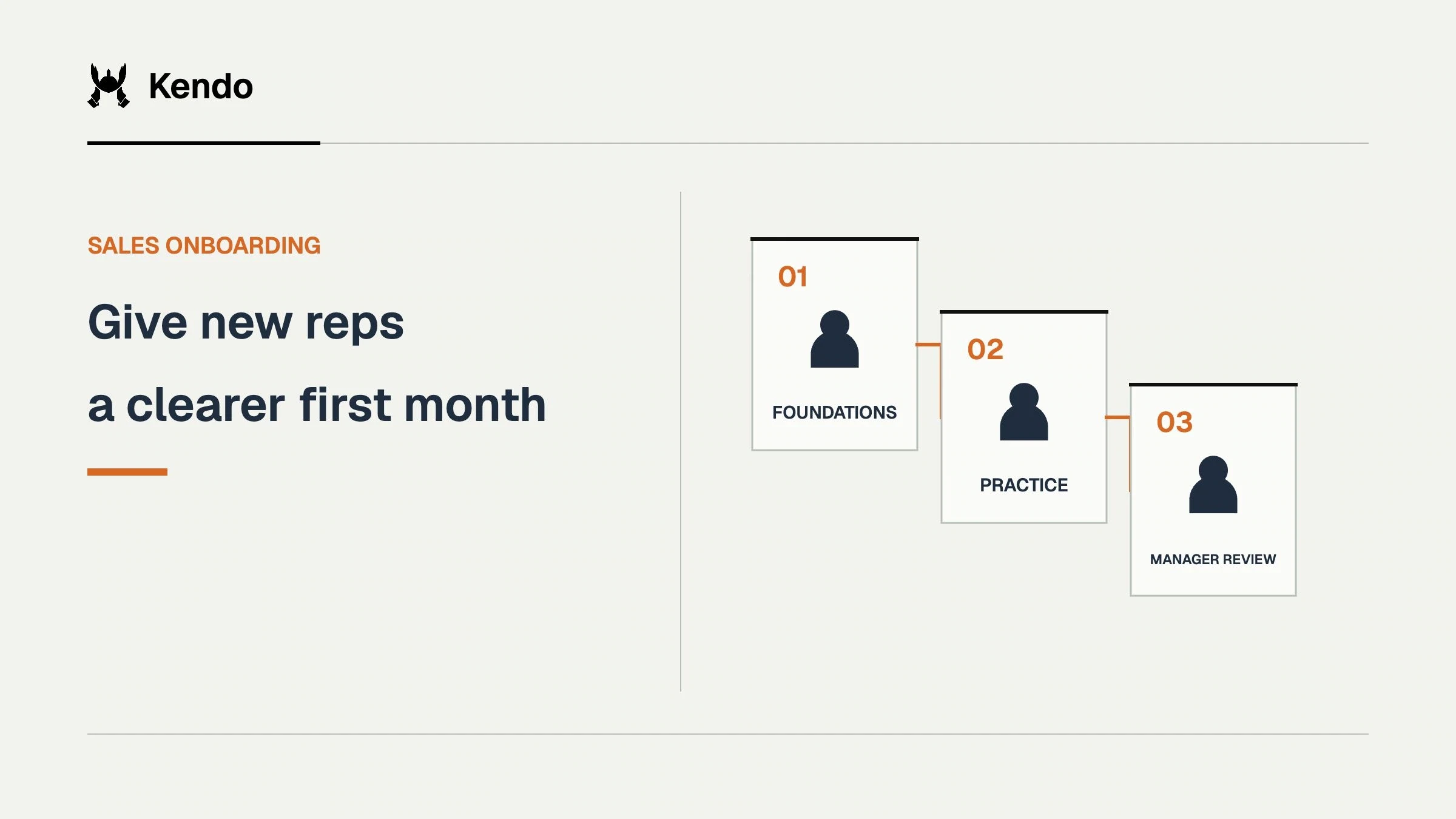
A structured ramp period is the difference between a rep who thrives and one who churns. This framework merges high-level goals with tactical milestones to move a new hire from day zero to full quota.
Pre-Boarding (The Launchpad)
Goal: cut friction and build momentum before day one- Ops checklist: Ship hardware, set up CRM and email accounts, confirm system access.
- Cultural buy-in: Send a welcome email with a week-one schedule and assign an onboarding buddy.
- Head start: Provide foundational reading (ICP, product one-pagers) and access to your training platform.
Days 1-30: Build the Foundation
Focus: learning over earningBuild the knowledge base required to sell with confidence.
| Learning Pillars | Tactical Milestones |
|---|---|
| Product & market: capabilities, ICP, competitive landscape | Pass a product and ICP knowledge assessment |
| Process: sales stages, CRM hygiene, pricing | Complete 5+ call-shadowing sessions with debriefs |
| Skillset: discovery flow, active listening, openings | Score 3+ roleplays above the competency threshold |
Manager tip
Reward learning velocity and habit formation. Don't over-index on revenue in month one.
Days 31-60: Execute With Guardrails
Focus: quality outputMove from learning mode to active pipeline generation.
- Core activity: High-volume outreach and live calling on a structured weekly plan.
- Coaching cadence: Weekly pipeline reviews focused on qualification quality and objection handling.
- Observation shift: From shadowing others to taking the lead with manager backup.
Key milestones
- Hit target weekly qualified-conversation counts.
- Book a first set of meetings at a baseline conversion rate.
- Demonstrate clean CRM discipline and data hygiene.
Days 61-90: Own the Pipeline
Focus: autonomy and scaleReps operate independently and start hitting ramp quotas.
- Advanced training: Multi-threading, negotiation tactics, closing frameworks.
- Autonomy: Manage a full pipeline from lead to close with standard oversight.
- Collaboration: Join team strategy sessions and cross-functional feedback loops.
The final step
- Close first deals or show clear, defensible progression.
- Pass the final certification assessment (methodology, product, positioning).
- Transition to the standard coaching and enablement rhythm.
Post-Onboarding: The Handover
Focus: continuityOnce the 90-day mark hits, the formal checklist ends but growth doesn't. Run a performance review to set longer-term goals, then move the rep into your continuous sales enablement strategy.
A roadmap only matters if it actually compresses the curve. Here is what that looks like when a real team puts practice at the front of it.
With Kendo, new hires get productive 75% faster
Onboarding went from 45 days to 14 days. New agents hit baseline in 14 days instead of 45+ by logging 3 to 5 hours of AI practice before their first live call.
Result: 7-day ramp-up + 7 days to baseline performance = 14 days total vs 45+ days before.
"Typically we would see about a 45-day period where people would dip their foot in the water and slowly improve and then level off at their performance level. Now that's 14 days. So it's the 7-day ramp-up and then 7 days to be where they're going to be at their baseline."Waylon Artrip, Founder, United Insurance Pros
Sales Onboarding Best Practices
1Ditch the Information Dump
The classic week-long bootcamp, cramming everything into five days of back-to-back slides, doesn't work. Reps retain a fraction of it. In fact, B2B sales reps forget about 70% of what they learn within a week and roughly 87% within a month (the Ebbinghaus forgetting curve). Front-load everything and your new hire spends month two re-learning month one.
Instead, break training into daily micro-learning modules (10 to 15 minutes each) with clear competency gates between stages. Require reps to pass an assessment before advancing. It protects your leads and builds real confidence.
2Make Practice Non-Negotiable
Product knowledge alone doesn't make a seller. Practice does. Every program should include structured, scored practice sessions, not optional "if you have time" roleplays.
Knowing the pitch
Recites features, the methodology, and the objection list. Passive recall.
Doing the call
Handles real pushback live without freezing. Scored practice builds the reflex.
The teams seeing the best onboarding results require a minimum number of practice hours before a rep touches live leads. Hailie Miller at Airbnb Takeoff requires one hour of daily AI roleplay from every new rep, no exceptions, and reports a 100% increase in team performance.
3Assign an Onboarding Buddy
Pair every new hire with a tenured rep who can field the informal questions formal training never covers. "How does this CRM field actually get used?" "Which discovery questions land in our vertical?" "Who do I loop in when a deal stalls?"
Buddies give new hires social integration, institutional knowledge, and a safety net that cuts the isolation reps feel, especially on remote or hybrid teams.
4Use a Blended Learning Model
Mix modalities to hold engagement and meet different learning styles. The most effective programs blend live instructor-led sessions, self-paced modules, recorded call libraries, shadowing, interactive AI simulations, and hands-on practice.
No single format does everything. Use live sessions for methodology and process. Use self-paced modules for product knowledge. Use AI roleplay for conversation skills. Use shadowing for real-world context.
5Measure What Matters, Early
Don't wait until day 90 to find out whether onboarding is working. Track leading indicators from week one:
- Time to first qualified conversation
- Roleplay scores and improvement trajectory
- Product knowledge assessment scores
- CRM hygiene compliance rate
- Time to first booked meeting
- Time to first closed deal
- Call quality scores across early conversations
- Manager coaching hours per rep
These surface struggling reps while there is still time to intervene, and they expose systemic gaps that are quietly hurting everyone.
6Build Coaching Into the Structure
Coaching shouldn't happen "if the manager has time." Put it on the onboarding calendar with non-negotiable touchpoints: daily check-ins in week one, call debriefs after every live interaction in month one, weekly strategy sessions in months two and three.
The best sales managers treat the ramp period as their highest-ROI coaching investment. An hour spent coaching a new rep in week two pays off for years.
7Create a Clear Certification Path
Reps should earn the right to sell solo, not get tossed in the deep end after an arbitrary number of days. Design a certification path that requires demonstrated competence, not attendance, before a rep is cleared for full quota. The Sales Onboarding Readiness Scorecard below turns that idea into something you can actually score.
8Don't Stop at Day 90
Onboarding ends. Development shouldn't. The transition from onboarding to ongoing AI-driven enablement is where a lot of programs fail: reps graduate, then lose the support, feedback, and accountability that made them good.
Build a bridge. Keep call scoring and reviews running, hold a coaching cadence, and give reps continued access to training resources and practice tools. Habits formed during onboarding only stick if you reinforce them.
After switching to AI roleplay, the team practices before live calls instead of learning on $30 to $50 leads.
- 5 to 20% production increase; one rep doubled output in 30 days
- $10 AI warm-up versus $30 to $50 per wasted live lead
- 10+ hours of daily manager time reclaimed
"Kendo matches or beats a human practice partner. The objections are the exact same as real calls."Kody Skvarla, Skvarla InsuranceRead the full case study →
How AI and Kendo Transform Sales Onboarding
The biggest shift in sales onboarding over the past two years is AI-powered training software. Platforms like Kendo AI attack the two bottlenecks that break traditional programs: limited manager bandwidth, and the high cost of practicing on live prospects.
Risk-free practice that mirrors reality. Old-school training made reps practice on real leads, which torched pipeline. AI roleplay gives reps a sandbox to build muscle memory with nothing on the line. With Kendo, you create custom AI prospects that behave like your real buyers, so reps log their flight hours on real pushback and your specific scenarios before the first live call.
A virtual coach on every call. Waiting days for a manager to review a recording is useless because the learning moment is gone. Kendo scores every interaction against custom scorecards and tells the rep exactly what they missed, so they can fix it on the next dial. That instant feedback loop is what helped Globe Life move brand-new agents from around 33% to 60%+ close rates.
Data-driven readiness over guesswork. Most managers decide a rep is "ready for the floor" on gut feel. Kendo's analytics replace the guess with objective data, tracking discovery questions asked and objections handled, with custom scorecards for cold calls, discovery, and demos. You stop guessing and start coaching exactly where it counts. If you want the financial case, the breakdown of AI sales training ROI is the deeper read.
The Sales Onboarding Readiness Scorecard
Here is the question every competitor skips: how do you actually know a rep is ready for live leads, not just that they sat through training? Most managers answer it with "it's been 30 days, go hit the phones," which is exactly how leads get burned and confidence gets wrecked.
This scorecard turns "ready for the floor" into six observable signals. Run it before you clear any new hire for live leads. If a rep misses a row, that is your coaching assignment, not a reason to throw them on the phones anyway.
The Sales Onboarding Readiness Scorecard
Six observable signals that tell you a rep is ready for live leads. Score each before you clear a new hire, and coach to any row they miss.
| Readiness Dimension | Cleared for Live Leads When... | Not Yet (Send Back to Practice) |
|---|---|---|
| Product & ICP command | Passes the knowledge assessment and can explain fit to a buyer without notes | Still reciting features; can't tie product to a buyer's problem |
| Process discipline | Logs calls, updates stages, and keeps CRM clean unprompted | Forgets to log activity; pipeline data is messy or stale |
| Discovery quality | Runs a layered discovery and surfaces the real pain, not just surface symptoms | Jumps to pitching; questions are closed or generic |
| Objection handling | Handles your top 5 to 10 objections in roleplay without freezing | Goes blank or defensive when a prospect pushes back |
| Scored practice reps | Hits the minimum roleplay hours and scores above your competency threshold | Below the practice minimum or below the score bar |
| Live-call readiness | First monitored calls score within range on your scorecard | Early call scores fall short on structure or talk-to-listen |
Common Sales Onboarding Mistakes (and How to Avoid Them)
Even well-meaning programs fail when they hit these traps.
Mistake 1: Treating Onboarding as an HR Function
Sales onboarding is a revenue function, not an administrative one. When HR owns it with minimal sales-leadership involvement, it becomes a compliance exercise: policy reviews and benefits enrollment, none of the skills training that drives performance.
Fix: Sales leadership owns the program; HR handles only the administrative parts. The sales manager is the primary coach and accountability partner through the whole ramp.
Mistake 2: No Defined Milestones
Without clear milestones, neither rep nor manager knows whether onboarding is working. Reps drift, and managers lack the data to intervene before someone falls behind for good.
Fix: Define specific, measurable milestones for days 30, 60, and 90, tied to competency assessments, not just activity counts. Use a performance metrics framework to track progress objectively.
Mistake 3: Skipping Practice
The most dangerous mistake is jumping from training straight to live selling with no structured practice in between. That is how you burn expensive leads and crush new-rep confidence at the same time.
Fix: Build mandatory practice blocks into the calendar. Use AI roleplay simulations for scalable, consistent practice that doesn't depend on manager availability, and require minimum competency scores before clearing reps for live conversations.
Mistake 4: One-Size-Fits-All Programming
An experienced enterprise AE and a first-time SDR have very different needs. Running both through the same generic program wastes the veteran's time and overwhelms the newcomer.
Fix: Build role-specific tracks that share core fundamentals (product, ICP, tools) but diverge on skills training, practice intensity, and timeline.
Mistake 5: Abandoning Reps After Day 90
Graduating from onboarding shouldn't mean graduating from support. Reps who lose structured coaching after ramp often regress, especially when they hit their first real slump. Remember, structured onboarding is tied to roughly 50% higher new-hire retention (UrbanBound); throwing that away at day 91 is self-inflicted churn.
Fix: Transition reps into an ongoing coaching and enablement rhythm with regular call reviews, continued practice, and quarterly skill assessments.
How to Measure Sales Onboarding Success
You can't improve what you don't measure. Track these to evaluate and continuously sharpen your program.
| Metric | What It Tells You |
|---|---|
| Time to first qualified meeting | How fast reps can execute the top of funnel |
| Time to first closed deal | Overall ramp speed |
| Ramp quota attainment | Whether reps are hitting progressive targets |
| Call quality scores (weeks 1-12) | Skill development trajectory |
| Roleplay assessment scores | Practice effectiveness and readiness |
| CRM compliance rate | Tool adoption and data discipline |
| New-hire retention (6 and 12 month) | Whether onboarding supports long-term engagement |
| Manager coaching hours per rep | Investment in development during ramp |
| Training completion rate | Program engagement and pacing |
| Ramp Velocity Score | Efficiency of the whole onboarding system |
A useful composite to track is what we call a Ramp Velocity Score: not just how fast a rep reaches productivity, but how efficiently the org gets them there, factoring in manager time invested, training resources consumed, and leads used during ramp. Define it once for your team and watch the trend, not the single number.
After turning on AI call tracking and daily roleplay, the team stopped guessing whether reps were improving.
- 100% team performance increase
- 1 hour of mandatory daily AI roleplay, no exceptions
- ~30 minutes a day on tracking versus hours reviewing raw recordings
"What doesn't get tracked doesn't get improved. As soon as you turn on proper tracking, you can't lie to AI because it reviews every call, people realize 'Oh, I didn't realize how bad we were at this.'"Hailie Miller, Airbnb TakeoffRead the full case study →
Sales Onboarding FAQ
Plan for a structured program of 30 to 90 days, with full productivity often arriving later. Benchmarks vary by role and complexity: the Sales Management Association puts average time to full productivity at 11.2 months, The Bridge Group reports around 5.7 months for B2B SaaS account executives, and HubSpot has cited about 3.2 months. The takeaway isn't the exact number; it is that unstructured onboarding pushes you toward the slow end of that range, and a real program pulls you toward the fast end.
Onboarding is finite and aimed at new hires: it takes someone from signed offer to productive rep in a fixed window, usually 30 to 90 days. Enablement is continuous and aimed at everyone: it keeps the whole team sharp on strategy, new releases, and market shifts over time. The best onboarding programs run inside the enablement system, on the same playbooks and scorecards, so the handoff is seamless.
Days 1-30 focus on learning: product, ICP, sales process, CRM, and scored practice, with knowledge assessments as the gate. Days 31-60 shift to guided execution: live calling on a structured plan, weekly pipeline reviews, and an engineered early win. Days 61-90 build autonomy: full pipeline ownership, advanced skills like negotiation and multi-threading, and a final certification before the rep moves to standard quota.
Don't gate it on the calendar; gate it on demonstrated competence. Use a readiness scorecard that checks product and ICP command, CRM and process discipline, discovery quality, objection handling, scored practice reps above a threshold, and in-range scores on first monitored calls. If a rep misses a dimension, that is a coaching assignment, not a reason to put them on real leads. The Readiness Scorecard above lays out what "cleared" looks like for each; teams that need to operationalize that gate can compare systems that verify skills before a rep reaches live pipeline.
For Kendo customers, yes, and the proof is in named outcomes, not theory. United Insurance Pros cut ramp time from 45 days to 14 by requiring 3 to 5 hours of AI practice before live calls. Globe Life nearly doubled new-agent close rates. Skvarla Insurance saw 5 to 20% production gains. The mechanism is simple: reps build the reflexes on AI prospects instead of burning your real leads to learn.
Stop Burning Leads on Day One: Scale Your Onboarding With AI
Mastering the onboarding playbook is real sales engineering, but in 2026 the bottleneck usually isn't the plan. It is the execution. Most managers don't have the hours to roleplay with every new hire, and most new hires aren't ready for live calls as fast as you need them to be.
Knowledge without reps is just theory. If your onboarding leans on passive reading or "shadowing" without active simulation, you are building an execution gap, and that gap is where leads die. Kendo AI closes it, turning new hires from students into confident revenue producers before they ever touch a live lead.
- For the roadmap: use this guide to audit your 30-60-90 day milestones and cut the information dump.
- For the velocity: use Kendo AI to give new reps the flight hours to master your pitch, handle your top 10 objections, and hit the phones with real confidence.
If you are still deciding which platform to run that practice on, the breakdown of the best sales onboarding software is the right next read before you commit.
Turn Ramp Time Into Revenue
Don't let your next hire's first real sales conversation be with your most valuable prospect. Give your team the unfair advantage of AI-built muscle memory.
Ready to slash ramp time and stop burning leads on day one? See how Kendo AI works →

Luke Alexander is the founder of Kendo AI, where he's helped train more than 5,000 sales reps. He started in sales as a frontline closer, scaled a high-ticket sales-training company, and founded Closer Cartel and AI Insiders before building Kendo to fix the tools he wished he'd had: realistic AI roleplay and automated call review for fast-moving sales teams. He writes about sales training, ramp speed, objection handling, and applying AI across the revenue org.