
BANT has anchored sales qualification since IBM built it in the 1950s to sort serious mainframe buyers from browsers. Seventy years later it is still the fastest way most reps have to separate a real opportunity from a tire-kicker.
Here is the uncomfortable part: most reps who "know" BANT still run it badly. They treat the four letters like a checklist, fire off robotic questions, kill rapport in the first five minutes, then wonder why the deal stalls. The distance between memorizing an acronym and running a smooth, trust-building qualification call is enormous.
Closing that distance takes practice. Specifically, the kind of high-repetition, realistic practice most teams never get enough of.
This guide breaks down the parts that actually move deals:
- Each BANT criterion translated for modern, committee-driven selling
- The questions that actually surface the truth on a call
- A simple way to score qualification objectively, with a worked example
- Why AI roleplay is the fastest way to turn the framework into instinct
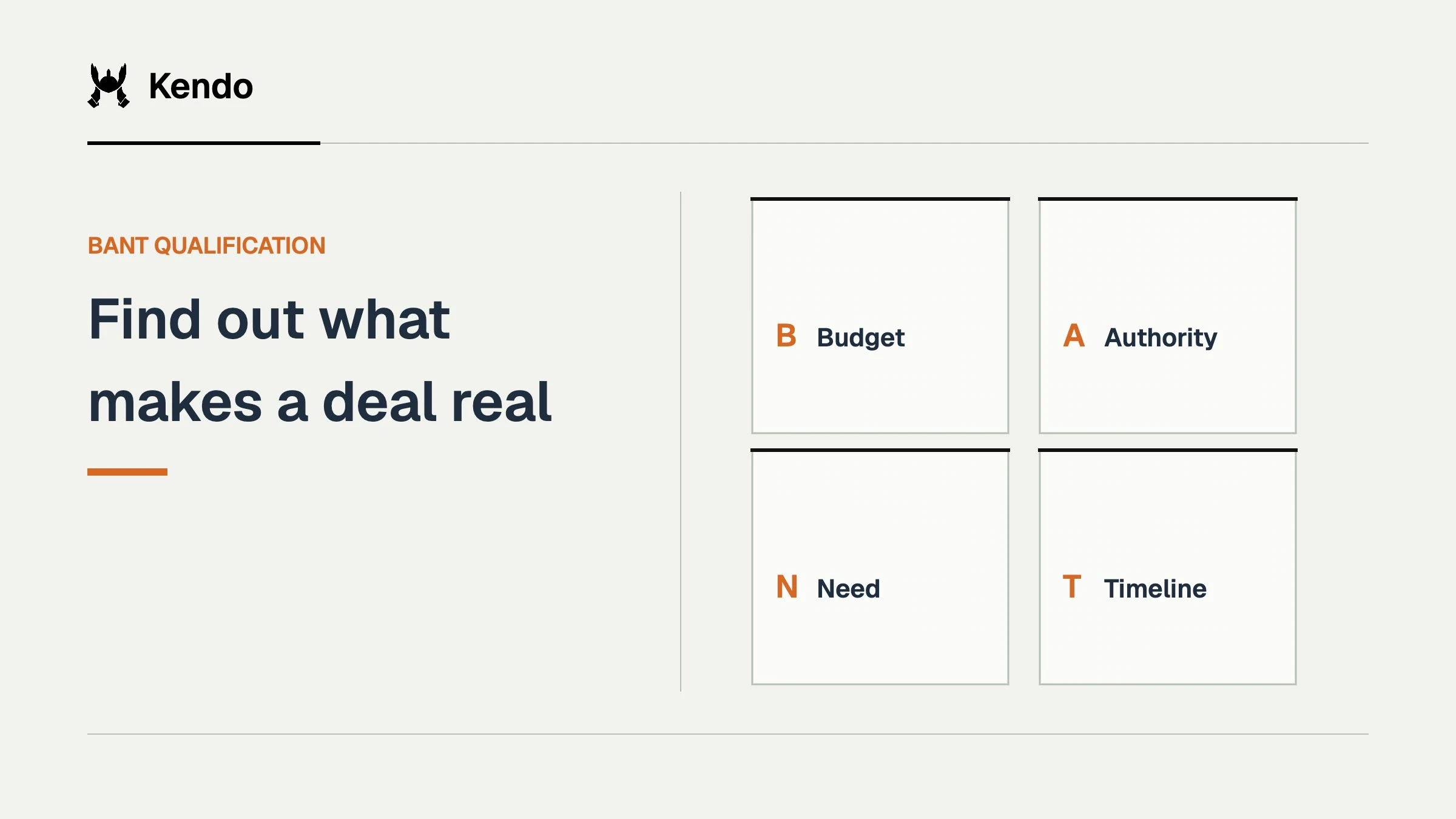
BANT is a sales qualification framework that scores a prospect on four factors: Budget, Authority, Need, and Timeline. Developed by IBM in the 1950s, it helps reps decide fast which opportunities are worth pursuing. In 2026 it works best as a conversational qualification lens applied need-first, not a rigid checklist.
Why BANT Still Matters in 2026
BANT (Budget, Authority, Need, Timeline) endures because its core logic is timeless. Every deal, in every era, has to answer those four questions before it can close.
What has changed is the world around them. The 1950s version assumed one IT director with one fixed annual budget. Today a single purchase runs through a committee. Gartner finds that a typical B2B buying group for a complex solution involves six to 10 decision-makers, each showing up with four or five pieces of research they gathered on their own. Add to that the fact that 61% of B2B buyers now say they would rather buy with no sales rep involved at all (Gartner, 2025), and the job of qualification looks very different than it did when BANT was born.
The framework still works. The mechanical way most people run it does not.
The Modern Adaptation: From Script to Strategy
The main reason BANT fails is execution. Reps treat it as a rigid survey, and a survey kills rapport. In modern B2B, BANT works as a qualification lens applied conversationally, not a verbatim checklist you read off a screen.
That shift comes down to a few habits:
- Prioritize need first. Establish the business case and the problem before you ever raise money.
- Map authority across the committee. Decision-making is distributed now, so find every stakeholder instead of hunting for one signature.
- Gather evidence progressively. Collect BANT data across several touchpoints instead of forcing a single-call interrogation.
- Keep it conversational. Weave the criteria into natural dialogue so you build trust and keep momentum.
The Four Pillars of the BANT Framework
Read in its classic order the acronym puts budget first, which is exactly backwards for modern selling. Run it need-first instead. Here is the framework reordered the way it should actually flow on a call:
Flip the Acronym: Run BANT Need-First
The classic order leads with money, which puts buyers on the defensive. Reorder it so you establish the problem first and only talk budget once value is clear.
Classic order (1950s)
Need-first order (2026)
NNeed
This is the most important pillar. Without a genuine problem, budget and timeline mean nothing.
- What is the core problem you are trying to solve right now?
- What happens if you do not solve this in the next six months?
- What have you already tried, and how did it go?
AAuthority
Modern enterprise deals involve a crowd. Authority qualification means mapping the entire buying committee, not finding a single name.
- Walk me through how a decision like this usually gets approved here.
- Who else needs to weigh in before this moves forward?
- Has anyone vetoed a similar initiative in the past?
The hard part is conversational finesse, especially with a gatekeeper who claims more power than they have. That is a reflex you build by doing, not by reading.
TTimeline
Timeline tells you whether you have an active opportunity or someone window-shopping.
- What is driving the timing on this decision?
- Are there milestones coming up that this needs to be in place for?
- What would have to happen for you to make a decision by [date]?
Tracking how your team handles these urgency patterns across calls (the kind of view sales performance metrics give you) shows you which reps create urgency and which let it drift.
BBudget
Budget comes last on purpose. It is not just "can they afford it," it is about financial capacity, spend patterns, and how the purchase gets justified internally.
- How have you funded similar initiatives before?
- Does an investment in the range of $X to $Y fit how you are planning?
- Is this a new line item, or is it coming out of an existing budget?
Money talk is where reps freeze most. The fix is repetition: practicing against prospects who give realistic, evasive answers until surfacing financial detail feels natural instead of awkward.
Bridging the Gap
Under pressure, reps default to leading with budget because it feels efficient. It is the fastest way to make a buyer defensive. Thriving in modern sales takes the discipline to hold a need-first flow even when the clock is ticking.
Moving from "checklist" to "discovery" is a skill, and skills are built through deliberate practice. Realistic roleplay is what turns the framework into a filter for high-value deals instead of a barrier that scares good prospects off.
How to Score BANT Qualification
The most practical way to use BANT consistently is to score it. Rate each pillar on a 0 to 3 scale based on the quality of the evidence you actually gathered, not how the call felt.
- 0 (no information): you never explored this pillar.
- 1 (weak evidence): vague, noncommittal answers. "We might have budget." "I think I can decide."
- 2 (moderate confidence): specific information shared. A named range, identified stakeholders, a documented problem, or a stated deadline.
- 3 (strong verification): multiple data points confirmed. Budget approved by finance, the committee mapped, pain quantified with metrics, timeline tied to an external trigger.
The BANT Qualification Scorecard
Here is the rubric in one place, so a rep can score a call in under a minute and a manager can use the same standard in pipeline review:
The BANT Qualification Scorecard
Score each pillar 0 to 3 on the evidence you gathered. One shared standard for reps on a call and managers in pipeline review.
| BANT Pillar | 0-1: Weak (disqualify or dig deeper) | 2: Moderate (keep going) | 3: Verified (high confidence) |
|---|---|---|---|
| Need | Generic interest, no quantified pain | A documented problem with clear impact | Pain quantified in revenue, time, or risk |
| Authority | Talking to one contact, role unclear | Key stakeholders named | Full committee and approval path mapped |
| Timeline | "Sometime this year" or vaguer | A stated target date | Date tied to an external, hard trigger |
| Budget | "We'll find money if it's good" | A range or funding path identified | Budget confirmed or approved by finance |
A Worked Example
A mid-market SaaS team books a demo. Discovery shows a documented pipeline-visibility problem costing them forecast accuracy, a named VP plus two stakeholders but no confirmed approver yet, a stated goal of "before our next board meeting in Q3," and a "we'll fund it if the ROI is there" answer with no line item.
Scoring also fixes pipeline reviews. Instead of "How do you feel about this deal?" you ask "What's the BANT score, and where are the gaps?" Data replaces gut feel, which is exactly why automated sales call tracking matters once you are running BANT across a whole team.
When BANT Works Best (and Where It Falls Short)
BANT shines in specific environments and needs backup in others. Knowing the line keeps your team from forcing it onto deals it was never built for.
- Sales move fast and on volume. The quickest way to triage a flood of inbound leads, built for SDR teams working dozens a week.
- Deals are SMB or mid-market. For smaller deals (under roughly $25K) with few stakeholders and short cycles, it gives enough rigor without the overhead.
- You need a first-pass filter. Many enterprise teams use BANT to confirm commercial viability before layering on a deeper method.
- Sales and marketing need a shared language. Marketing passes BANT-scored leads, sales gives objective feedback on the same criteria, and the finger-pointing drops.
- The deal involves 10 or more stakeholders
- Procurement runs on multi-year cycles
- Contract values are seven figures
- The four criteria are necessary but nowhere near sufficient on their own
Plenty of enterprise teams still use BANT as the opening screen, then graduate the deal to a deeper method like MEDDIC for the long close. The smarter play is to qualify fast with BANT, then switch frameworks as complexity grows. More on that next.
BANT Alternatives Worth Knowing
If your cycle or deal complexity calls for a different lens, these are the alternatives worth having in your back pocket, alongside newer frameworks like the SPICED sales methodology:
CHAMP Challenges · Authority · Money · Prioritization
Leads with the prospect's challenge, mirroring the need-first approach. It assumes budget can flex when the solution is right.
ANUM Authority · Need · Urgency · Money
Puts authority first. Strong for outbound, where reaching the actual decision-maker is the main hurdle.
FAINT Funds · Authority · Interest · Need · Timing
Built for prospects who have not set a budget yet but clearly have the funds to invest. Good for demand generation.
MEDDIC Enterprise standard
The standard for high-value deals. It goes far deeper than BANT on metrics, economic buyers, and decision criteria.
Pro tip: the strongest teams do not pick one and ban the rest. They use BANT as the initial filter and graduate promising deals to MEDDIC as complexity grows. If you want to roll an approach like this out across reps, the best sales training programs show how teams operationalize it.
Common BANT Mistakes to Avoid
Even a good framework fails when it is run badly. These five pitfalls are the usual suspects.
| Mistake | Why It Kills the Deal | The Fix |
|---|---|---|
| 1. Treating BANT as a Checklist | Reps fire off questions just to tick boxes, and the buyer feels processed, not understood. | Run it as a conversation guide, not a survey. Weave the criteria into natural dialogue. |
| 2. Leading With Budget | Asking about money in the first five minutes creates instant friction. | Lead with need to establish value. The budget conversation opens up once the prospect sees what a fix is worth. |
| 3. Assuming a Single Decision-Maker | The "qualified" deal dies the moment a hidden stakeholder shows up late with objections. | Map the whole committee: buyers, influencers, and blockers, not one name. |
| 4. The "One-and-Done" Qualification | Budgets get cut, timelines slip, priorities shift. BANT data is fluid. | Treat qualification as ongoing, revisited through the whole cycle, not a one-time gate. |
| 5. Ignoring Disqualification | Chasing prospects who fail the key criteria with no path to change wastes the pipeline. | Use BANT to say "no" as often as "yes." When a prospect fails with no path, walk away. |
Protecting your time is a discipline, and it is best built through AI-powered cold calling training before a real pipeline is on the line.
Why AI Sales Roleplay Is the Missing Piece in BANT Training
Most BANT training fails for one reason: there is no bridge between the classroom and the live call. Reps learn the four letters in a session, then crumble the first time a real prospect dodges a question.
Traditional manager-led roleplay helps, but it runs into three walls:
- Scalability. Managers do not have time for consistent one-on-one reps with everyone.
- Predictability. A manager who knows the product tends to go easy, so the practice is too clean.
- The real-call gap. A rep can ace a friendly internal drill and still freeze when a prospect gets evasive.
Software has stepped into that gap, and the best AI sales training software is built to give reps that volume of realistic practice on demand. This is where Kendo's AI roleplay changes the math. You build custom AI prospects from a simple prompt and aim them at the exact BANT moment your reps fumble:
- Realistic resistance. Spin up a prospect who insists they have no budget or claims to be the sole decision-maker. Reps learn to handle real objections and read a gatekeeper in a genuine discovery setting, not a scripted one. The AI persona library covers the scenarios reps actually face.
- Need-first reps. Reps practice uncovering layered pain and building a business case before budget ever comes up, until the sequence is automatic.
- Zero stakes. A rep can pause, pivot, and blow a call with nothing on the line. A $10 AI warm-up beats burning a $30-50 lead figuring it out live.
Then you measure it. Kendo's AI call scoring reviews every call imported from Zoom or Fathom and applies the same BANT scorecard from earlier, automatically, across the whole team instead of the handful of calls a manager can listen to. Build weighted scorecards (heavier on need, lighter on budget) so reps cannot pass by box-ticking, and reps get specific feedback minutes after a call instead of a week later.
From there, Kendo Agent turns coaching from guesswork into evidence. Instead of scrubbing through hours of recordings, you ask plain questions like "Which reps lead with budget instead of need?" or "Where are we losing deals on authority mapping?" and get answers pulled from every call. Coaching sessions stop being "I feel like" conversations and start being "here are the three calls where you skipped discovery."
Proven Results
This is not theory. High-repetition AI practice shows up in the numbers:
| Company | Result |
|---|---|
| United Insurance Pros | Cut ramp-to-baseline from 45 days to 14, with new reps productive in about 7. |
| Globe Life | Nearly doubled new-hire close rates, from around 33% to 60%+. |
Globe Life is the clearest example of what high-repetition qualification practice does to the only number that matters in the end: close rate.
After Kendo: new-agent close rates nearly doubled
Brand-new agents went from roughly 33% to 60%+ close rates after building their qualification reps on AI prospects, applying the same need-first discovery and scorecard before they ever touched a live lead.
Why it moves: the lift comes from reps who qualify need-first on instinct, so they pursue the right deals hard and stop burning the rest. The practice happens on AI prospects, not on Globe Life's real leads.
The pattern is consistent. Reps who practice qualification hard before going live qualify faster and waste fewer leads. The ones who do not default to checklist mode, kill rapport, and stall deals. If you are weighing where to run that practice, the breakdown of the best AI sales roleplay tools is the right next read before you commit to a platform. You can also see how to reduce sales ramp time for the wider playbook.
BANT Sales Methodology FAQ
BANT stands for Budget, Authority, Need, and Timeline. It is a sales qualification framework, originally built by IBM in the 1950s, that scores a prospect on those four factors to decide whether an opportunity is worth pursuing.
Yes, for the right deals. BANT is still the fastest way to triage high-volume, shorter-cycle deals and run a first-pass filter. The catch is that buyers now decide in committees of six to 10 people (Gartner) and do most of their research before they ever talk to a rep, so the rigid, checkbox version of BANT no longer fits. Run it conversationally and need-first and it still earns its place.
BANT is a fast, top-of-funnel filter that answers one question: should I pursue this opportunity past the first meeting? MEDDIC (Metrics, Economic Buyer, Decision Criteria, Decision Process, Identify Pain, Champion) goes much deeper and is built for complex, high-value enterprise deals. Many teams use both: BANT to qualify quickly, then MEDDIC as the deal gets serious.
If you score each pillar 0 to 3, a total of 8 or higher out of 12 generally signals a well-qualified deal worth pursuing hard. A score below 6 means you either need more discovery or the lead belongs in nurture rather than your forecast. The point is to base the call on evidence, not a gut feeling.
Lead with Need, not Budget. Establish a real, quantified problem first, then map authority across the buying committee, then pin down the timeline, and only then talk budget once the prospect already sees the value. Asking about money first is the quickest way to make a buyer defensive.
Stop Guessing, Start Qualifying
BANT has lasted seven decades because the four questions it asks are the four questions every deal has to answer. Budget, authority, need, and timeline are not going anywhere. The framework's simplicity is its strength, but only when reps can apply it conversationally instead of mechanically.
That skill comes from practice. Kendo AI gives your team unlimited, realistic reps against AI prospects who push back, dodge, and resist, so everyone walks into a real call with the instinct to qualify naturally and the scorecard to prove it worked.
Ready to make BANT a team habit instead of a team checklist? See how Kendo AI works →

Luke Alexander is the founder of Kendo AI, where he's helped train more than 5,000 sales reps. He started in sales as a frontline closer, scaled a high-ticket sales-training company, and founded Closer Cartel and AI Insiders before building Kendo to fix the tools he wished he'd had: realistic AI roleplay and automated call review for fast-moving sales teams. He writes about sales training, ramp speed, objection handling, and applying AI across the revenue org.