
Modern B2B buyers do most of their homework before they ever pick up the phone. By the time a rep gets on a call, the buyer has read the reviews, compared the options, and built an opinion. Gartner found that 61% of B2B buyers would rather buy with no sales rep involved at all (Gartner, 2025), and that across a full purchase, buyers spend as little as 5-6% of their time with any single seller.
So the old playbook of pitching features doesn't land. Nobody books a meeting to hear a walking brochure. They want an advisor.
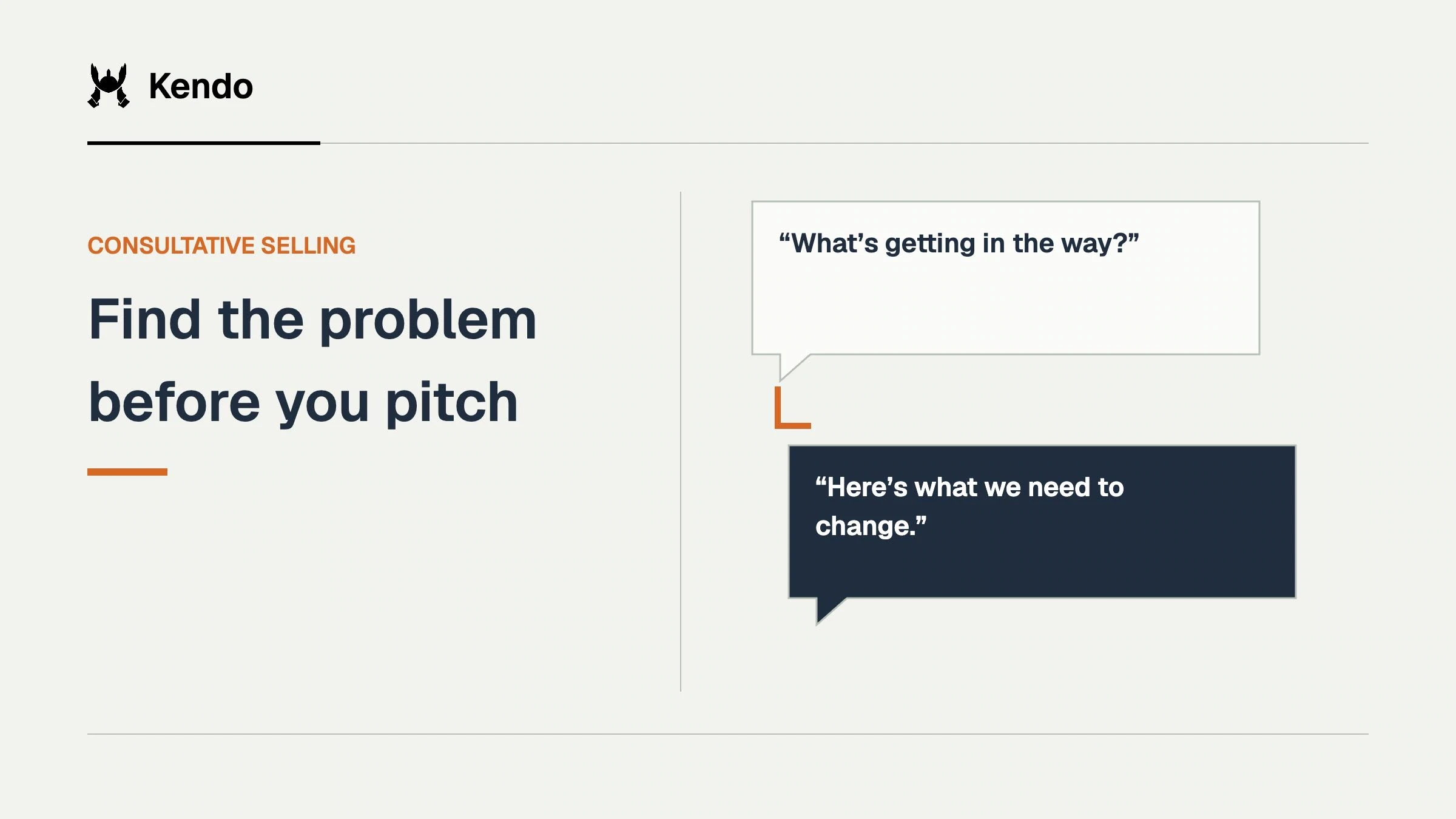
That is the core of consultative selling. It is an approach where reps work to understand a buyer's specific situation before they ever suggest a solution. You lead with curiosity instead of a pitch, and you diagnose the problem instead of listing features.
Here is the catch: deciding to be an advisor is easy. Holding that role when a deal is on the line and the buyer goes quiet is where most teams fall apart.
This guide covers the parts that actually move deals:
- The principles that separate advisors from pitchers
- A 6-step framework your team can run on real calls
- The 5 skills every consultative seller has to sharpen
- How to use AI-powered roleplay to turn the theory into live-call reflex
Consultative selling is a sales approach where the rep acts as a trusted advisor, diagnosing the buyer's problem through questions before recommending a solution, instead of leading with a product pitch. It wins in complex, multi-stakeholder B2B deals where trust and fit decide the sale, not feature lists.
What Is Consultative Selling?
Consultative selling (sometimes called needs-based selling) is an approach where the rep acts more like a trusted advisor than a traditional salesperson. The goal isn't to push a product. It is to deeply understand the buyer's situation and arrive, together, at a solution that genuinely fits.
Think of it like the difference between a doctor and a street vendor. A street vendor shouts about the product to anyone walking by. A doctor asks questions, listens, runs diagnostics, and only then prescribes. Consultative selling follows the doctor's model.
The reason it works comes down to trust. In LinkedIn's State of Sales research, 35% of decision-makers said trust was the single most important factor in closing a deal, ahead of both ROI and price. And the deals where it matters most are exactly the messy ones: Forrester's State of Business Buying 2024 found that 86% of B2B purchases stall and the average buying decision now involves 13 people. When that many stakeholders are in the room, the rep who understands the whole situation wins. The one reciting a feature list gets ghosted.
Traditional vs. Consultative vs. Solution Selling
The clearest way to see the advisor mindset is next to its two closest relatives. Solution selling and traditional selling both start from the product. Consultative selling starts from the buyer.
Here is how the three approaches compare across the stages of a deal:
| Dimension | Traditional (Transactional) | Solution Selling | Consultative (Advisor) |
|---|---|---|---|
| Primary Focus | Product features and benefits | Mapping problems to features | Buyer's goals and business context |
| The Rep's Role | The Pitcher: leads with scripts | The Solver: plugs holes with product "pegs" | The Diagnostician: leads with curiosity |
| Airtime | Rep talks 70%+ of the time | Rep talks to present solutions | Rep listens 70-80% of the time |
| Discovery | Surface-level qualification | Finding a match for the product | Deep diagnostic questioning |
| The Goal | A transactional sale | A product-to-need fit | The truth of the situation |
| The Close | A technique-driven push | Agreement on the solution | The organic outcome of a solved problem |
Tactical systems like SPIN questioning, the Sandler methodology, and qualification frameworks like BANT are not competitors to this approach. They live inside it. They give you structured ways to run the discovery and qualification that consultative selling depends on.
The "Speed" Paradox
A common objection is that the consultative process takes longer. In practice, the opposite is usually true. Investing time in a real diagnosis up front closes deals faster, because you avoid the friction cycles later: the objections, the stalls, the "let me think about it" that come from pitching a solution the buyer never actually needed.
Shallow discovery feels fast. Then you spend three follow-up calls untangling a misaligned proposal. Deep discovery feels slow. Then the deal just closes.
The Difference in Practice: Handling Challenges
Modern buyers are sensitive to "pivoting," the moment a rep steers the conversation toward a predetermined conclusion.
- The scenario: A buyer says, "Our reps are struggling with cold calls."
- The solution seller: Immediately demos a cold-call training module. They found a hole and plugged it with their product.
- The consultative seller: Probes deeper. Is it a messaging problem, a targeting problem, or a data problem? If the real issue is bad lead data, selling training won't fix the root cause.
The takeaway: by resisting the urge to pitch early, you build a level of trust that "solution mapping" never reaches. Your recommendation gets weight because it accounts for the buyer's full reality, not just the first symptom they named.
When Consultative Selling Works Best (and When It Doesn't)
Consultative selling is not a universal setting you leave switched on. It is most effective in specific environments, and knowing where it fits keeps your team from over-engineering simple deals.
- The sale involves complex, high-value solutions with multiple stakeholders
- Buyers have nuanced problems that need tailored solutions
- Long-term relationships and account expansion matter
- The market is crowded and the buying experience is the main differentiator
- The buyer's problem isn't fully defined and they need help articulating it
- The product is a commodity with one obvious use case
- The buyer already knows exactly what they need and just wants a price
- The sales cycle is extremely short and transactional
- A single buyer decides, with no organizational complexity
Even in transactional deals, the basics of consultative selling, asking good questions and actually listening, still improve outcomes. But the full approach pays off most in complex B2B environments where trust, expertise, and a tailored recommendation are the real buying criteria. That is also where the dysfunction lives: when 89% of purchases involve two or more departments (Forrester, 2024), somebody has to make sense of the whole picture for the buying group. That somebody is your advisor.
The Consultative Selling Framework: Principles in Action
Consultative selling moves the rep from vendor to trusted advisor. That takes a real shift in mindset, where the job is to solve a problem, not push a product.
Built into a repeatable process, these six steps let your team earn trust and close more complex deals.
The 6-Step Consultative Loop
Diagnose before you prescribe. The first four steps stay in the buyer's world before you ever position a solution, and the same loop repeats deal after deal.
Research and Prepare
Use pre-call research to ask informed questions, not to recite facts. Lead with curiosity.
DiagnoseSet the Agenda
Guide with purpose. Open with an insight, and say plainly that your first goal is to understand their needs.
DiagnoseDeep Discovery
The heart of the method. Spend most of the call listening and asking layered questions.
DiagnoseValidate and Reframe
Play back what you heard to prove you listened, then bring a point of view they didn't have.
DiagnoseTailored Recommendation
Only now do you present. Connect every feature to a specific, buyer-defined outcome.
PrescribeCollaborative Next Steps
Frame the next step as a joint evaluation. The close happens organically, not as a technique.
Prescribe-
1
Research and Prepare (Lead With Curiosity)
Every deal starts with a blank slate. Even if you've sold to 100 similar companies, this buyer's internal politics, goals, and bottlenecks are their own. Curiosity is the engine here. Resist the urge to assume you know their problem from their headcount or their industry.
- The ActionUse pre-call research to ask informed questions, not to recite facts. Look at growth trajectory, industry trends, competitor positioning, and the buyer's recent LinkedIn activity.
- The GoalMove from stranger to someone who clearly "gets it."
- Sample"I saw your company recently expanded into the EMEA market. Usually that creates some friction with localized reporting. How has your team been handling that?"
Kendo InsightUse AI roleplay to practice the informed opening. Pull a dummy LinkedIn profile and work it into the first two minutes until it sounds natural instead of researched. -
2
Set the Agenda (Guide With Purpose)
Consultative selling is not passive. You are the expert guiding the buyer through a complex decision, which means you lead the conversation with a clear, buyer-first structure.
- The ActionKeep control by setting an agenda. Open with a relevant insight, not small talk, and say plainly that your first goal is to understand their needs.
- Sample"I'd like to spend our time today understanding your current process. If there's a fit, I'll show you how similar teams solved these challenges. Does that work?"
-
3
Deep Discovery (Diagnose Before You Prescribe)
Think like a doctor. You wouldn't trust a surgeon who scheduled the operation before reading the X-ray. This is the heart of the methodology. Spend most of this stage listening, because this is where the real expert work happens.
- The ActionStay in discovery longer than feels comfortable. Use layered questions: Layer 1 (Situational): "How do you currently handle X?" Layer 2 (Problem): "Where does that process break down?" Layer 3 (Impact): "What does it cost you in revenue or time when this fails?"
- Sample"Before we look at the software, walk me through what happens to a lead today if it isn't touched within 24 hours. Who gets notified? What's the fallback?"
-
4
Validate and Reframe (Build Trust Through Honesty)
Earning trust is worth more than winning one deal. Before you suggest anything, play back what you heard to prove you were listening. Summarize their points, including the emotional subtext, and let them correct you.
There is a useful nuance here that most "just ask more questions" advice misses. RAIN Group studied 731 major B2B purchases and found that simply deepening a buyer's understanding of their own needs ranked near the bottom of what set winners apart. What actually wins is demonstrating that you understand and bringing a point of view they didn't already have. Diagnosis is the table stakes. Insight is the differentiator.
- The ActionSummarize the root cause, not just the symptoms. Be honest about your product's limits, even when a competitor might serve them better.
- Sample"It sounds like the real frustration isn't just the software's speed, it's that the lag makes your team look unreliable to the board. Honestly, if you mainly need a high-volume cold-calling tool, we might be overkill. Is that fair?"
-
5
Tailored Recommendation (Sell Outcomes, Not Features)
Only after a real diagnosis do you present the solution. Buyers don't buy analytics dashboards. They buy Friday nights back with their families, or hitting their quarterly number.
- The ActionConnect every feature to a specific, buyer-defined result. Use evidence like case studies to show the recommendation is the logical conclusion of your discovery.
- Sample"Since you said manual data entry eats four hours a week, this integration gives you most of a full day back every month to spend on strategy instead."
-
6
Collaborative Next Steps (The Outcome-Driven Close)
In consultative selling, the close happens organically. You aren't running a technique. You are collaborating on a solution, which lowers the adversarial friction and reinforces your role as an advisor.
- The ActionFrame the next step (demo, trial, stakeholder meeting) as a joint evaluation. Respect the buyer's autonomy.
- Sample"Based on our conversation, a technical deep-dive with your operations lead sounds like the logical next step. Does that fit your timeline?"
The Execution Gap
Most reps understand these six steps intellectually. But the moment a prospect throws a curveball objection or goes guarded, the "doctor" mindset disappears and the "pitcher" comes back.
5 Essential Skills for Consultative Sellers
Consultative selling needs a specific skill set, one that goes beyond what most traditional sales training covers. These are the five capabilities your reps have to develop.
1Active Listening
This is the baseline for trust. It means processing the emotional drivers and the subtext behind a buyer's words, not just waiting for your turn to talk.
- Tactical focus: Read verbal cues like pacing and pauses to catch what the buyer is avoiding.
- The goal: Make every follow-up question come from genuine understanding.
2Strategic Questioning
The depth of your discovery is capped by the quality of your questions. Strategic questioning moves you from surface-level qualification to real business diagnosis.
- Tactical focus: Use layered questions to surface the cost of inaction.
- Example: Instead of "Do you have issues with training?" ask, "What's the biggest gap between your team's current performance and your year-end target?"
3Business Acumen
Advisors speak the language of the C-suite. That means moving past product features to talk about ROI, operational efficiency, and risk.
- Tactical focus: Connect your solution to the buyer's broader goals and bottom line, not just their day-to-day pain.
4Emotional Intelligence (EQ)
Buying is emotional. Whether it's fear of a wrong choice or pressure to deliver, reps have to recognize those dynamics to steer the deal.
- Tactical focus: Sense when to push for a decision and when to pull back and address a buyer's anxiety or internal constraints.
5Adaptability
Consultative calls rarely follow a straight line. Reps have to pivot in real time, shifting from data-heavy analysis to vision-driven storytelling as the buyer needs.
- Tactical focus: Drop the rigid script and stay responsive to where the conversation actually goes.
Consultative Selling Examples: What It Looks Like in Practice
Principles are useful, but concrete examples are the difference between understanding consultative selling and being able to do it. Here are three scenarios that show the approach in action, each one shifting the focus from product features to business outcomes.
SaaS (Enterprise CRM)
The shift: from "managing data" to "forecasting confidence."
- The Context
- A mid-market company moving off spreadsheets onto a CRM.
- The Discovery
- The rep digs into how leadership reviews pipeline and what inaccurate data costs them.
- The Insight
- The real pain is a lack of revenue predictability, which creates friction with the board.
- The Solution
- The recommendation centers on forecasting and reporting. The CRM gets framed as the infrastructure that solves leadership's visibility problem, not as a place to store contacts.
Insurance (Agent Onboarding)
If insurance is the core use case, compare the best insurance sales training programs before choosing a generic curriculum.
The shift: from "training curriculum" to "protecting lead investment."
- The Context
- An agency leader wants to reduce the time it takes new agents to become productive.
- The Discovery
- The rep examines the current "live fire" training method and the failure rate of early calls.
- The Insight
- The true cost is burned lead equity. Every untrained agent wastes $30-50 per qualified lead.
- The Solution
- A practice-first simulation program, framed as a cost-saving measure that makes agents "lead-ready" before they ever touch a live prospect.
Financial Services (Advisor Training)
The shift: from "objection handling" to "emotional discovery."
- The Context
- A wealth management firm wants better initial client discovery meetings.
- The Discovery
- The rep reviews actual call recordings to find gaps in advisor-client rapport.
- The Insight
- Advisors are stuck on surface technicalities like risk tolerance while ignoring emotional drivers like retirement anxiety or legacy concerns.
- The Solution
- Targeted training on nuanced discovery skills, built around high-emotion client moments rather than standard sales rebuttals.
Common Consultative Selling Mistakes (and How to Avoid Them)
Even reps who understand the approach stumble on execution. Here are the most common pitfalls and the fix for each.
| Mistake | Why It Kills the Deal | The Fix (Advisor Action) |
|---|---|---|
| Discovery as a Checkbox | Reps wait for a pause to start pitching. Buyers feel interrogated, not understood. | The 3-point test: don't recommend anything until you can state the buyer's top 3 challenges, their business impact, and what they've already tried. |
| Diagnosing Without Confirming | Assuming the root cause leads to misaligned proposals and stalled deals. | The validation pause: use a summary bridge, "Let me make sure I have this right," and let the buyer correct or expand before you pivot. |
| Feature-Dumping Under Pressure | When challenged, reps retreat to safe feature lists. It feels adversarial and kills the dynamic. | The curiosity pivot: when tension rises, ask another question. "It sounds like you have some concerns there. What's behind that?" |
| Discovery Fatigue (Interrogation) | Endless questions with no value make the buyer feel mined for data. | The insight mix: weave in brief observations. "That's common at your stage. Teams usually hit a wall with X once they pass growth phase Y." |
| Generic Follow-ups | A standard deck erodes the trust and differentiation you built in the conversation. | Personalized recaps: reference specific talk tracks, restate the challenges they named, and map your proof points directly to their reality. |
How to Train Your Team on Consultative Selling
Understanding consultative selling is one thing. Getting an entire team to execute it consistently on live calls is a different problem.
That is why a one-off workshop never sticks. The framework evaporates and old habits return the moment a call gets tense.
Source: Gartner, forgetting curveThe gap between knowing and doing is where most sales organizations get stuck. Reps sit through a session, nod along to the concepts, then revert to old habits the second a real call gets uncomfortable. Closing that gap takes more than a workshop. It takes practice, feedback, and reinforcement on a schedule.
The Problem With Traditional Consultative Sales Training
Most programs follow the same pattern: a one- or two-day workshop, a binder of frameworks, a few role-plays with colleagues, then "go apply it." The problem is that traditional role-play is limited.
Standard training suffers from:
- Lack of realism. Peer role-play rarely mimics the complexity or the curveball objections of a real prospect.
- Inconsistency. Managers don't have time to run individual sessions for every rep at scale.
- No baseline data. Traditional methods give you no objective way to tell whether discovery or listening skills are actually improving.
The result is predictable. Consultative selling becomes something the team talks about in meetings and forgets on calls.
How Kendo AI Solves the Training Bottleneck
Sales coaching is usually the first thing to slip when a team gets busy. Kendo AI removes the logistical drag of manual coaching so you can turn consultative theory into a reflex across the whole org, not just the reps a manager happens to have time for.
Four things make that work:
- Unlimited realistic practice. Kendo's AI personas simulate specific buyer behaviors, industry objections, and emotional drivers, with the teeth that peer role-play never has. A rep can log "flight hours" by running ten discovery simulations before lunch, a volume that would take weeks to coordinate with human partners.
- Objective, data-driven feedback. Coaching consultative skills is usually subjective. Kendo's AI call scoring measures the advisor behaviors that matter: talk-to-listen ratio, the depth of open-ended questions, and how well a rep mapped a feature to a problem the buyer actually named.
- Scalable coaching at speed. Instead of hunting through hours of recordings for one coachable moment, Kendo's analytics in Kendo Agent flag exactly where each rep is struggling, so leaders can coach the specific gap without adding admin load.
- A safe place to fail. A high-stakes enterprise deal is the wrong place for a rep to find their consultative voice. In simulation, reps can try radical honesty or high-level strategic questioning with nothing on the line, so they're call-ready before the stakes are real.
The Consultative Training Cadence
To move from theory to live-call execution, run an 8-week roadmap like this:
| Timeline | Phase | Focus and AI Integration |
|---|---|---|
| Weeks 1-2 | Foundation | Study the framework and analyze recordings of high-performing discovery calls. |
| Weeks 3-4 | Guided Practice | Use AI roleplay to isolate single skills, like open-ended questioning or reframing. |
| Weeks 5-8 | Applied Practice | Run full simulations from opening to recommendation. Use AI scoring to flag where reps revert to pitching. |
| Ongoing | Reinforcement | Build 15-minute AI practice sessions into the weekly routine for every rep. |
The Advisor Scorecard
You can't improve what you can't see. The problem with "coach them to be more consultative" is that it's invisible on a call recording until you define what you're looking for. This scorecard turns the philosophy into five behaviors you can actually score, one deal at a time.
The Advisor Scorecard
Five behaviors that separate a real diagnosis from a disguised pitch. Score each one on a call, then coach to the gap.
| Consultative Behavior | What Good Looks Like | Red Flag (Reverting to Pitching) |
|---|---|---|
| Discovery depth | Rep surfaces the root cause and its business impact | Rep stays at surface symptoms and moves to demo |
| Talk-to-listen ratio | Buyer talks the majority of the discovery call | Rep talks 70%+ of the time |
| Question quality | Questions are open-ended, layered, and tied to outcomes | Questions are closed yes/no or feature-fishing |
| Tailoring | Recommendation references the exact challenges the buyer named | Generic pitch that would fit any account |
| Buyer engagement | Buyer participates, expands, asks questions back | Short, guarded, one-word answers |
Real-World Impact
This practice-first approach is already producing measurable results.
After Kendo: new-hire close rates nearly doubled
By building consistent AI practice into onboarding, Globe Life moved brand-new agents from a 33% close rate to 60%+, so reps learn the reflexes on AI prospects instead of on live leads.
Result: brand-new agents closing at roughly 33% to 60%+, nearly doubling output by making AI practice a consistent part of onboarding.
"Kendo matches or beats a human practice partner, and the objections are the exact same as real calls."Kody Skvarla, Skvarla Insurance
Globe Life nearly doubled new-hire close rates, moving brand-new agents from around 33% to 60%+ by building consistent AI practice into onboarding.
Kody Skvarla's insurance team saw 5-20% production increases across the board, with top performers doubling their output after adding daily AI-powered simulations. As Kody's team put it, the AI "matches or beats a human practice partner, and the objections are the exact same as real calls."
If you're weighing where to run that practice, the breakdown of the best AI sales roleplay tools is the right next read before you commit to a platform. More success stories live here.
The bottom line: consultative selling isn't a one-time workshop. It's a reflex built through flight hours, and AI gives you the environment to log those hours before the stakes are real.
Getting Started: Your Consultative Selling Action Plan
If you're ready to move your team toward a consultative approach, here's a practical plan to start this week.
- Audit your current conversations. Record and review recent calls. Measure talk-to-listen ratios, count the open-ended questions asked, and check whether recommendations were tailored or generic. This is your baseline.
- Build a question library. Develop a shared library of high-impact discovery questions organized by stage (situational, problem, impact) and by industry vertical. Keep it living, and let reps add questions that work.
- Implement structured practice. Make consultative role-play a weekly habit, not a quarterly event. Use AI sales training software to give every rep on-demand practice with realistic buyer personas.
- Create consultative scorecards. Define the behaviors you want on calls, discovery depth, listening quality, tailored recommendations, and score every call against them.
- Coach from real data. Use recordings and scoring to find each rep's specific strengths and gaps. Coach to the gap, not to a generic curriculum.
- Celebrate the right behaviors. Publicly recognize reps who show excellent consultative skills, not just the ones who close the most. It signals that how you sell matters as much as what you close.
Consultative Selling FAQ
It matters more, not less. When 61% of B2B buyers prefer a rep-free experience (Gartner, 2025) and most of the journey happens before a call, the rep who does get in front of the buyer has to add something the internet couldn't. A pitch fails that test. A genuine diagnosis and an outside point of view pass it.
Solution selling starts with the product and looks for a problem it fits. Consultative selling starts with the buyer's situation and follows the diagnosis wherever it leads, even when the honest answer is that you're not the right fit. Solution selling maps problems to features. Consultative selling earns trust first and lets the recommendation follow.
Research and prepare, set the agenda, run deep discovery, validate and reframe, make a tailored recommendation, and agree on collaborative next steps. The thread through all six is listening more than you talk and diagnosing before you prescribe.
Because it teaches knowledge, not reflex. Reps forget roughly 70% of what they learn within a week and nearly 90% within a month (the Ebbinghaus forgetting curve). Without ongoing practice and feedback, the framework evaporates and old habits return the moment a call gets tense. Reinforcement, not a better binder, is what fixes it.
Score the behaviors, not the vibe. Track discovery depth, talk-to-listen ratio, question quality, how tailored the recommendation is, and how engaged the buyer stays. The Advisor Scorecard above lays out what good looks like for each, and AI call scoring can apply those checks across every call instead of a manager spot-checking a few.
Stop "Wingin' It" on Discovery Calls: Build Advisor Instincts
Mastering the consultative approach is real sales craft, but in 2026 the theory is just the baseline. The reps who win are the ones who can run a high-level diagnostic discovery with total confidence when a deal is on the line. For a broader look at how elite sellers built repeatable instincts, study the greatest salespeople of all time.
Knowledge without practice is just a good idea. If your team is relying on passive videos and the occasional role-play with a teammate, you're leaving an execution gap that quietly kills deals.
Kendo AI closes that gap, turning consultative frameworks from a static slide deck into a sharp, intuitive reflex. You can see how teams are already measuring their training ROI.
- For the game plan: use this guide to redefine how your team thinks about the buyer relationship.
- For the mastery: use Kendo AI to give reps the flight hours they need to master deep discovery before the stakes are real.
Turn Curiosity Into Revenue
Don't let your next big enterprise sales call be the first time a rep tries a complex diagnostic approach for real. Give your team the unfair advantage of AI-built muscle memory.
Ready to train your team on consultative selling with AI-powered roleplay and call scoring? See how Kendo AI works →

Luke Alexander is the founder of Kendo AI, where he's helped train more than 5,000 sales reps. He started in sales as a frontline closer, scaled a high-ticket sales-training company, and founded Closer Cartel and AI Insiders before building Kendo to fix the tools he wished he'd had: realistic AI roleplay and automated call review for fast-moving sales teams. He writes about sales training, ramp speed, objection handling, and applying AI across the revenue org.