
Most sales methodologies obsess over the close. SPICED is built for the recurring-revenue era, where the close is just the start. Developed by Winning by Design, the framework treats selling like medicine: you diagnose the root cause before you prescribe a solution.
That matters more than it used to. Industry benchmarks consistently show that mature SaaS companies generate 70 to 80% of their annual recurring revenue from existing customers, through renewals and expansions. A deal that closes but never delivers the outcome the customer wanted does not just churn. It loses money.
So SPICED creates a shared language for sales and customer success. The hard part is not memorizing the acronym. It is holding the diagnostic mindset under pressure and turning theory into conversational muscle memory.
Here is what this guide gets into:
- The 5 elements of SPICED: what each one does in a real B2B conversation.
- The diagnostic mindset: why root-cause analysis beats transactional selling.
- Tactical execution: sample questions and clean handoffs that survive the deal.
- Making it stick: how AI-powered roleplay drills SPICED until your team runs it on instinct.
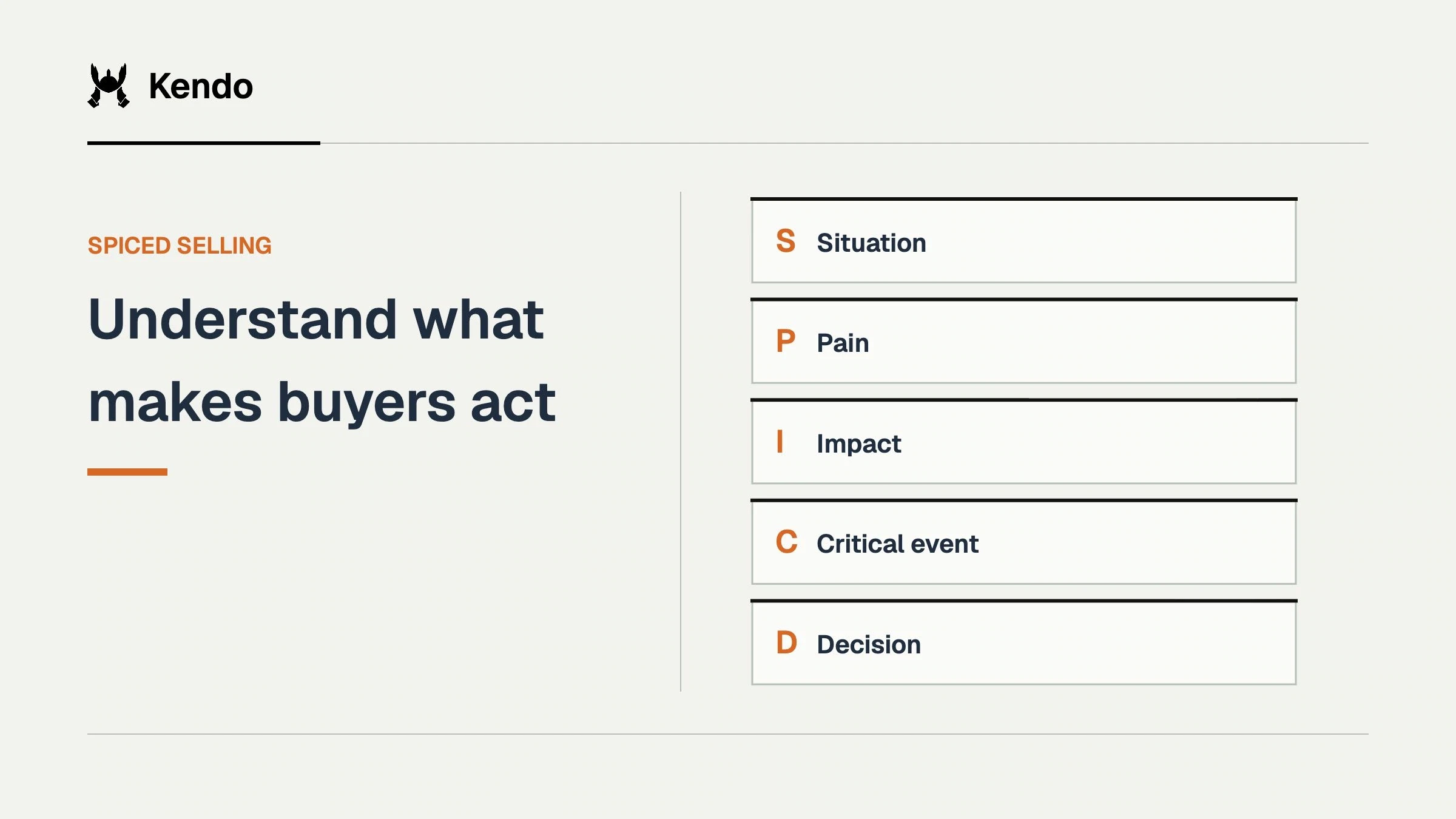
SPICED is a diagnostic sales methodology from Winning by Design that stands for Situation, Pain, Impact, Critical Event, and Decision. Reps work through the five elements to uncover the customer's real problem and desired outcome before recommending a solution, instead of leading with a pitch. It is built for complex, recurring-revenue B2B deals where keeping the customer matters as much as winning them.
Why SPICED Has Taken Over Modern B2B Sales
B2B has shifted from one-time licenses to recurring revenue, where the first sale is often the smallest revenue event of the relationship.
In that world, most of the money lives after the contract is signed. Research across SaaS consistently puts 70 to 80% of ARR with existing customers, won through renewals and expansions. Transactional frameworks were never built for that. A deal that closes but fails to deliver a real outcome ultimately costs you more than it brought in.
The Operating System for Revenue Teams
SPICED aligns the whole organization, Sales, Marketing, and Customer Success, around the customer's desired outcome rather than a seller's quota.
Because every department speaks the same diagnostic language, the context captured on the first discovery call carries through onboarding and renewal for years. The notes a rep takes in week one become the metrics CS defends at renewal.
That cross-functional pull is why the framework keeps spreading inside subscription businesses. A customer success leader at Asana has said publicly that she runs SPICED on her calls because it lets her understand clients "without sounding salesy." When CS adopts the same model as Sales, the handoff stops being a reset and starts being a continuation.
What Is the SPICED Sales Methodology?
SPICED is a diagnostic framework that treats the salesperson like a doctor.
Developed by Winning by Design for recurring-revenue teams, it stands for Situation, Pain, Impact, Critical Event, and Decision. Just as a physician does not prescribe based on a surface complaint, a SPICED-trained rep uses a structured process to find the root cause before recommending any treatment.
The Diagnostic Approach: Symptoms, Causes, Treatment
Unlike a traditional call that jumps straight to a demo, SPICED runs a real three-step diagnosis.
Symptoms First
Understand the customer's current state and observable problems before you assume you know the cause.
Root-Cause Analysis
Separate the presenting symptom from the underlying issue. A complaint about slow reporting might really be a data-integration problem.
Targeted Prescription
Only after the diagnosis is complete do you recommend a solution, anchored to the specific impact the customer wants.
Is SPICED Right for Your Team?
SPICED is a specialized tool for specific, high-complexity environments. It earns its keep when the deal is genuinely complex. It is most effective for:
- You sell SaaS and subscription models, where long-term outcomes decide profitability
- Deals are complex B2B or enterprise, with multiple stakeholders and long cycles
- Cross-functional teams need one shared language across the customer lifecycle
- The motion is consultative: diagnose and recommend, not pitch features
- You sell a simple, transactional product to a single buyer
- The buyer already knows exactly what they want
- There is no organizational complexity to map
If you sell a simple, transactional product to a single buyer who already knows what they want, a full SPICED diagnosis is overkill. Use the parts that help (Pain and Impact) and skip the ceremony.
The 5 Elements of the SPICED Framework
The power of SPICED is in the structured diagnosis. Treat the five elements as threads to weave into a natural discovery conversation, not a linear checklist you read off a script.
The SPICED Diagnostic Flow
Each stage narrows the conversation from raw context toward a committed decision. Run them in order and every answer sharpens the next.
Situation
Facts and context → a clear map of the "as-is" state
Pain
Root cause → a confirmed diagnosis of the actual problem
Impact
Business value → a quantified success metric the CFO will recognize
Critical Event
Deadlines → a compelling reason to act now
Decision
Stakeholders → a roadmap of the internal approval process
-
S
SituationThe Context
Before you diagnose anything, you need a clear picture of how the prospect operates today.
Sample Questions- Walk me through how your team currently handles [relevant process].
- What does your tech stack look like in this area today?
- How is your team structured around this function?
- What are you working on this quarter that intersects with this area?
Training TipDo not rush this. Skipping Situation makes every later stage shallower and leads straight to a one-size-fits-all pitch. Practicing against AI prospects in zero-stakes roleplay scenarios is the most reliable way to build the patience this stage demands. -
P
PainThe Diagnosis
Now move from gathering facts to naming specific problems.
Sample Questions- What is the biggest challenge you are facing in this area right now?
- Walk me through what happens when [specific scenario] occurs today.
- Where does your current process break down?
- If you ranked your top three frustrations with how this works today, what would they be?
Training TipAvoid pattern matching. Do not start pitching the moment you hear a familiar keyword. Keep digging until you hit the root cause. Drilling against AI prospects who only describe symptoms until the rep keeps digging is how that habit gets built. -
I
ImpactThe Desired Future State
This is where you quantify the business value, and it becomes the north star for Customer Success after the deal closes.
Sample Questions- If we solved this completely, what would that be worth to the business?
- What metrics would tell you this is working six months from now?
- How would your team's day-to-day change if this were resolved?
- What does success look like to your CFO or your board?
53%more sold by reps who uncovered ImpactAgainst the same volume of opportunities as reps who stopped at Pain. Quantifying the outcome is what turns a "nice to have" into a deal the CFO will sign off on.
Source: Winning by Design researchTraining TipIf the Impact is not quantified, the CFO can veto the deal later, and often will. This is not a soft step. Winning by Design's own research found that reps who uncovered Impact sold 53% more against the same volume of opportunities as reps who stopped at Pain. If you want to see what your best reps do differently in these moments, AI sales coaching can surface the patterns. -
CE
Critical EventThe Urgency
A Critical Event is the deadline or trigger forcing action. Without one, deals sit in pipeline limbo.
Sample Questions- What is driving the timeline for solving this?
- Are there deadlines, events, or business milestones that depend on this?
- What happens if you do not have a solution in place by [end of quarter, fiscal year]?
- Why now, and why not in six months?
Training TipIf no Critical Event exists, you either help the prospect create one or move the deal to a nurture cadence. Forcing a forecast onto a deal with no urgency is how pipelines fill up with ghosts. -
D
DecisionThe Process
Map the B2B buying journey so late-stage surprises do not kill the deal.
Sample Questions- Walk me through how decisions like this usually get approved here.
- Who else needs to weigh in, and what are their priorities likely to be?
- What criteria will you use to evaluate the options you are considering?
- What has caused similar initiatives to stall in the past?
Training TipMap the committee, not just your contact. Gartner puts the typical complex B2B buying group at 6 to 10 decision-makers. Tracking decision criteria over time also reveals patterns, and sales performance metrics can show you which decision-process gaps are quietly killing deals across the whole team.
Bridging the Execution Gap
The five elements are easy to memorize and deceptively hard to run conversationally.
Reps treat SPICED like a survey. Real mastery takes the patience to stay in discovery mode even when the prospect is pushing for a demo.
Using AI-powered roleplay to simulate those high-pressure moments is what turns diagnostic discipline into a reflex instead of a workshop memory.
How SPICED Compares to Other Sales Methodologies
SPICED does not necessarily replace your existing playbook. It usually acts as the engine that powers it, sitting comfortably alongside your other modern B2B sales techniques. Depending on your sales motion and deal complexity, you might run it alongside another framework to bridge the gap between discovery and deal management.
| Methodology | Best For | How It Compares to SPICED |
|---|---|---|
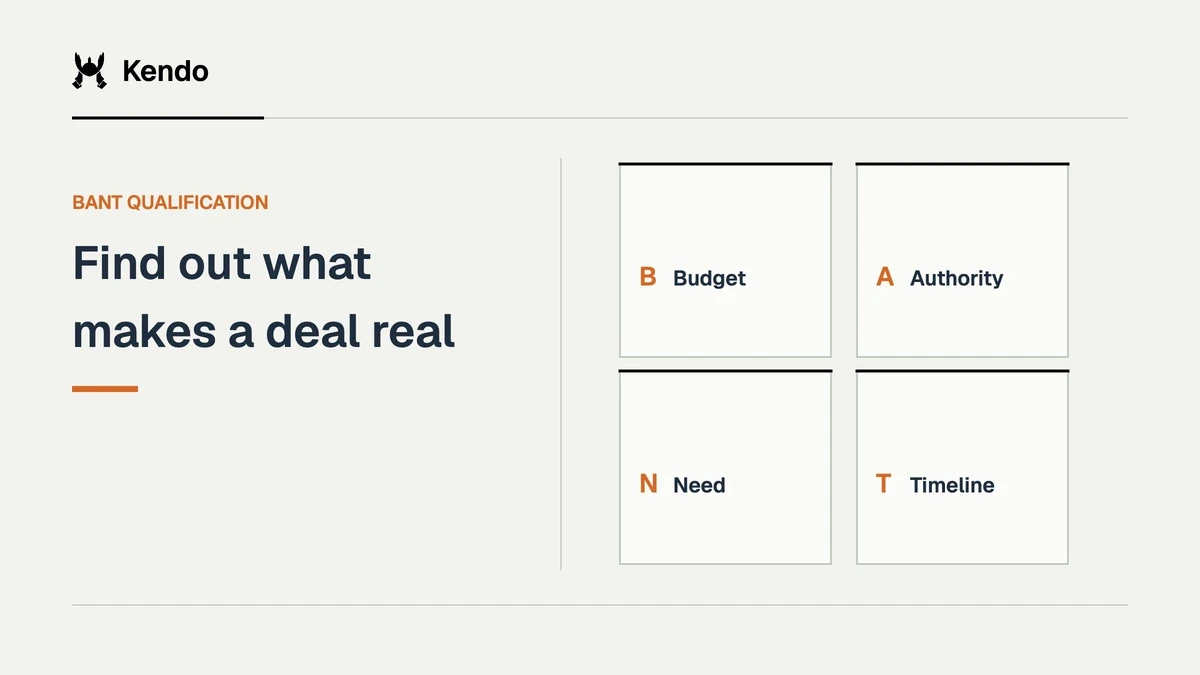
| BANT | Rapid top-of-funnel screening | BANT is a quick yes/no filter; SPICED is a deep diagnostic for long-term value and post-sale alignment |
| MEDDIC | Rigorous internal deal management | MEDDIC focuses on the mechanics of closing (metrics, economic buyer); SPICED focuses on the customer's outcome and cross-functional handoffs |
| SPIN Selling | High-logic diagnostic discovery | The closest relative. SPICED takes SPIN's core logic and adds Critical Event and Decision mapping for a fuller picture |
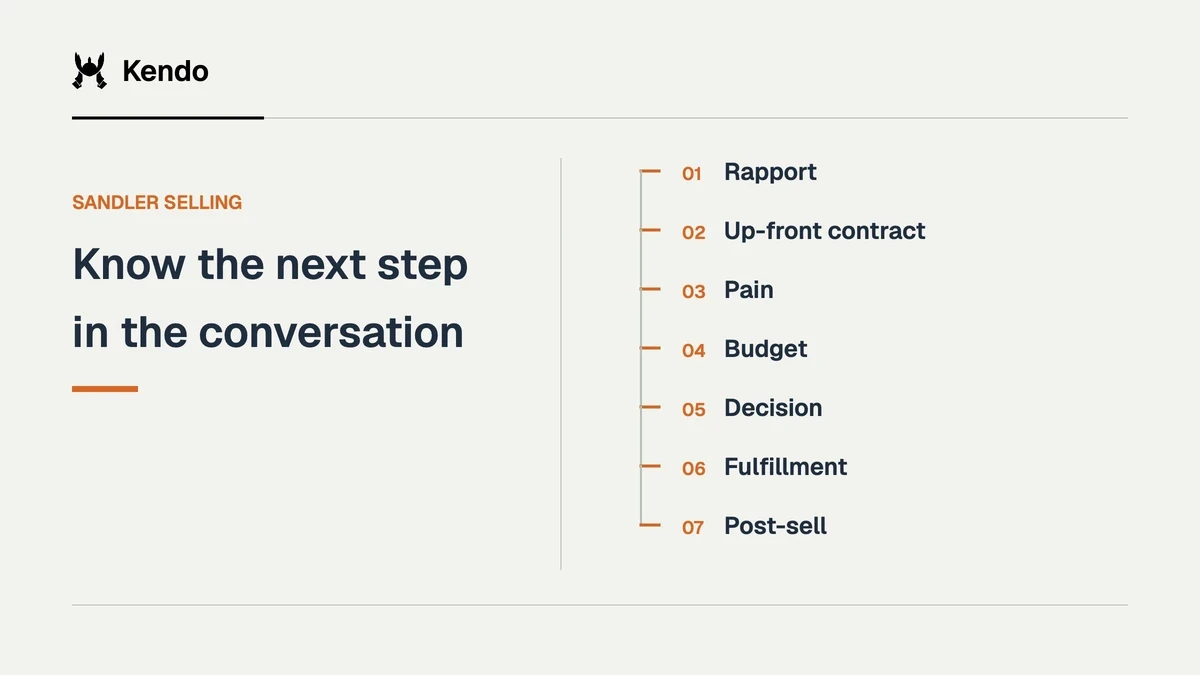
| Sandler | Buyer-seller psychology and rapport | Sandler manages the emotional dance; SPICED gives you the conversational scaffold to uncover hard business data |
Choosing Your Framework
The right choice comes down to your revenue model. For SaaS and recurring-revenue businesses, SPICED is built for the long game.
Something like BANT is faster for a quick pulse check. But SPICED makes sure that when a deal closes, Customer Success actually inherits the data they need to keep that customer for years, not a blank slate.
Best Practices for Implementing SPICED
Adopting SPICED is not about memorizing five letters. It is about installing a diagnostic mindset across the revenue org. Here is how to make it stick.
How to Drive Real Results
- Let the buyer guide the order. SPICED is a framework, not a script. If a prospect names a Critical Event in the first two minutes, follow that thread. Capture elements as they surface instead of forcing a rigid sequence.
- Operationalize your CRM. The framework only adds value if the data survives the call. Build a CRM field for each SPICED element so discovery does not vanish into a wall of messy notes.
- Master the handoff. Use SPICED as the bridge between Sales and CS. When a CSM knows the exact Impact the customer expected before the kickoff, churn drops and trust climbs.
- Align Marketing. When Marketing understands the Situation and Pain patterns of your best customers, they can build content that actually converts instead of guessing.
- Treat practice as permanent. SPICED is a conversational skill. Without consistent reps, like weekly AI-powered roleplays, your team reverts to old pitching habits fast. The right AI sales training software makes that cadence automatic instead of something a manager has to schedule.
Common SPICED Mistakes to Avoid
| Mistake | Why It Kills Deals | The Fix |
|---|---|---|
| The Checklist Trap | Treating discovery like a survey kills rapport and makes you sound like a telemarketer | Use a diagnostic mindset; uncover information through natural conversation |
| Premature Pitching | Jumping to the solution right after hearing Pain, before quantifying Impact | Wait. You cannot prescribe the right dose until you know the desired outcome |
| Symptom Confusion | Mistaking a surface complaint ("we're slow") for the actual root cause | Keep digging. Is it a tool problem, a people problem, or a process problem? |
| Ignoring the Critical Event | Accepting "we want to be better" as urgency, so the deal stalls forever | Disqualify early if there is no time-bound trigger forcing a decision |
| Post-Close Amnesia | Forgetting the SPICED data the moment the contract is signed | Hand the Impact metrics to Customer Success so they drive the renewal |
Why AI Sales Roleplay Is the Missing Piece in SPICED Training
Memorizing an acronym is easy. Keeping your cool when a prospect dodges every question about Impact is a different skill entirely. Most teams learn SPICED in a one-off workshop, then get thrown into live deals to figure it out.
The problem is reinforcement. Manager-led roleplay does not scale, and it is rarely as gritty as a real call. So the framework fades, and old habits come back.
How Kendo AI Drills SPICED Mastery
- Kills surface-level Pain. Reps practice against AI prospects that stick to vague symptoms, which forces them to keep digging until they reach the root cause, the whole point of the framework.
- Fixes soft Impact answers. When a rep accepts "we just want to save time," the AI pushes back. That trains them to stay in the conversation until they get a quantified, boardroom-ready metric.
- Navigates the hidden boss. Decision-mapping drills let reps practice uncovering the 6 to 10 stakeholders in a modern deal, so they spot gatekeepers before assuming they have authority.
- Runs the "why now" filter. Critical Event drills put reps in front of prospects who have pain but no deadline, which builds the discipline to disqualify window-shoppers early.
The SPICED Discovery Scorecard
Most teams cannot tell the difference between a rep who ran SPICED and a rep who collected five answers. The framework is invisible on a recording until you define what good looks like for each element.
This scorecard turns SPICED into five gradeable behaviors. Use it on call reviews to separate real diagnosis from box-checking, one deal at a time.
The SPICED Discovery Scorecard
Five gradeable behaviors that separate real diagnosis from box-checking. Score each element on a call, then coach to the gap.
| SPICED Element | Strong Signal (Real Diagnosis) | Red Flag (Box-Checking) |
|---|---|---|
| Situation | Rep maps processes, stack, and team before probing pain | Rep skims context and jumps to a generic pitch |
| Pain | Rep separates the symptom from the root cause and confirms it | Rep grabs the first complaint and starts selling |
| Impact | Rep lands a quantified metric ("20 hours a week," "$200k") | Rep accepts a soft answer like "be more efficient" |
| Critical Event | Rep surfaces a hard, time-bound trigger forcing action | Rep logs a vague "sometime this year" as urgency |
| Decision | Rep maps the buying committee and the approval criteria | Rep assumes one contact has the authority to sign |
Beyond Roleplay: Automated Coaching and Insights
Kendo AI does not just provide practice. It gives you infrastructure for continuous improvement across the revenue function.
- AI scorecards. Score real calls against each SPICED element automatically, so you can verify reps are uncovering Impact and Critical Events with real depth, not just checking boxes.
- Diagnostic quality checks. Measure whether reps are separating symptoms from root causes. The system flags surface-level discovery for coaching.
- AI sales manager. Query your team's performance in plain language. Ask "which reps are skipping Critical Event?" or "where is our Impact quantification weakest?" and turn intuition into evidence.
- Handoff readiness. Confirm the captured data is detailed enough for a clean handoff to CS, so discovery becomes a long-term asset instead of a one-time form.
Proof in the Performance
This practice-first approach already shows up in results.
United Insurance Pros cut onboarding time from 45 days to 14 days by making AI roleplay a prerequisite for live calls. And when reps drill the diagnosis instead of winging it, the close rate follows. Here is the clearest example.
After Kendo: new-agent close rates nearly doubled
Brand-new agents climbed from around 33% to 60%+ in six months by drilling discovery and rebuttals on AI prospects before live calls, instead of learning the diagnosis on real leads.
Result: a close rate that nearly doubled for brand-new agents, driven by repetition and rebuttal practice before the first live conversation.
"Our closing rate for brand new agents has been almost close to double with the use of Kendo just because they're getting that repetition, they're getting the rebuttals, they have the practice."Jess Chang, Partner, Globe Life
The bottom line: why waste a $50 lead on an underprepared rep when you can run a high-fidelity warm-up for a fraction of the cost?
SPICED Sales Methodology FAQ
SPICED stands for Situation, Pain, Impact, Critical Event, and Decision. A rep works through all five to diagnose the customer's real problem and desired outcome before recommending a solution.
Winning by Design developed SPICED specifically for subscription and recurring-revenue businesses, where keeping and expanding customers matters as much as winning them. The framework's creators report that improving sales skills with SPICED can drive up to 78% more ARR.
BANT is a fast top-of-funnel filter (Budget, Authority, Need, Timeline) and MEDDIC is a closing-mechanics framework built around the economic buyer. SPICED is a diagnostic model focused on the customer's outcome and the post-sale handoff. It complements both rather than replacing them, you can screen with BANT and still run a SPICED diagnosis on the deals that survive.
It is built for SaaS and recurring revenue, where long-term outcomes decide profitability, but the core discipline (find the root cause, quantify the Impact, confirm a Critical Event) helps in any complex, multi-stakeholder sale. For a simple transactional deal with one buyer, a full SPICED diagnosis is overkill.
Workshops teach the acronym; they do not build the reflex. Reps forget most of what they learn within a month (the Ebbinghaus forgetting curve), so the fix is repetition and feedback, not a better binder. Build in regular practice against realistic prospects and score real calls against each SPICED element so coaching targets the specific gap, whether that is a tool like Kendo or a disciplined manual cadence.
Stop Pitching, Start Diagnosing
SPICED works because it forces teams to treat customers the way doctors treat patients: diagnose first, prescribe second, and stay engaged through recovery. In a recurring-revenue world where the first sale is just the beginning, that diagnostic discipline is what separates the teams that build durable relationships from the teams that churn them.
The framework is simple to understand and brutally hard to execute consistently. Most teams adopt SPICED in a workshop and lose the discipline within weeks because nothing reinforces it.
- The framework gives you the diagnostic structure: Situation, Pain, Impact, Critical Event, and Decision.
- Kendo AI turns it into instinct, with unlimited practice and automated scoring of every real call against your SPICED scorecard.
Ready to make SPICED a team habit instead of a workshop memory?

Luke Alexander is the founder of Kendo AI, where he's helped train more than 5,000 sales reps. He started in sales as a frontline closer, scaled a high-ticket sales-training company, and founded Closer Cartel and AI Insiders before building Kendo to fix the tools he wished he'd had: realistic AI roleplay and automated call review for fast-moving sales teams. He writes about sales training, ramp speed, objection handling, and applying AI across the revenue org.