
The B2B Sales Cycle: Stages, Length, and How to Shorten It
Your cycle isn't long because your reps are slow. It's long because the committee is large and indecision is rampant. Here are the 7 stages, real benchmarks, and the levers that compress it without discounting.
The average B2B sales cycle now runs 6.5 months, up from 4.9 months in 2019 (Ebsta, 2024). For deals over $100K in annual contract value, six to nine months is normal, and a real enterprise deal can take longer than that.
If you carry a B2B number, none of this is news. You watch deals sit in "evaluation" for a quarter. You watch a great demo go quiet because the champion couldn't sell it internally. You watch procurement show up at the eleventh hour with a redline nobody warned you about.
Here is what most "shorten your sales cycle" advice gets wrong: your cycle isn't long because your reps are slow. It's long because the committee is large, the cost of a wrong call is high, and most of the buyer's journey happens where your rep can't see it.
You don't fix that by rushing. You fix it by removing the things that make committees stall.
This guide is the operator's version of the topic, not a glossary:
- The 7 stages of a B2B sales cycle, with the committee, procurement, and security review where they actually belong
- A stage-by-stage map you can run against your three oldest open deals today
- Real length benchmarks by deal size, and the data on why cycles got longer
- Why deals actually stall (it's almost never price), and the levers that compress the cycle without discounting
The B2B sales cycle is the repeatable set of stages a seller moves a deal through, from prospecting to a closed, signed, handed-off account. It spans roughly 2 to 9+ months by deal size: under $25K ACV closes in around 90 days, while enterprise (over $100K) runs 6 to 9+ months (Norwest, 2024). It runs long because a complex purchase now involves 6 to 10 decision makers (Gartner), not because the work is slow.
What the B2B Sales Cycle Actually Is (and How It Differs From the Funnel)
The B2B sales cycle is the repeatable sequence of stages a seller takes a deal through, from first contact to a closed-won, signed, and handed-off account. It's a process you can name, measure, and coach against.
Stage by stage, it answers one question: what has to be true for this deal to advance?
People mix up three things here, so let's be precise.
The sales funnel is a volume view. It tracks how many opportunities sit at each stage and what falls out between them. It's a reporting lens for the pipeline as a whole.
The sales cycle is the path a single deal walks. Same stages, different unit of analysis: one opportunity, start to finish.
The buyer's journey is the same process from the other side of the table, and in B2B it's the one that controls your timeline. Gartner frames it as six "buying jobs" a committee has to complete: problem identification, solution exploration, requirements building, supplier selection, validation, and consensus creation (Gartner).
Notice that selection sits fifth and consensus sits last. Most of the journey is the buyer wrestling with itself, not with you.
That's why this matters. B2B buyers spend only about 17% of their total buying time meeting with all potential suppliers combined (Gartner). Split across the vendors in play, any single rep might get 5 to 6% of the buyer's attention.
Your cycle is mostly happening in rooms you're not in. The job is to arm the people who are in those rooms.
The 7 Stages of a B2B Sales Cycle
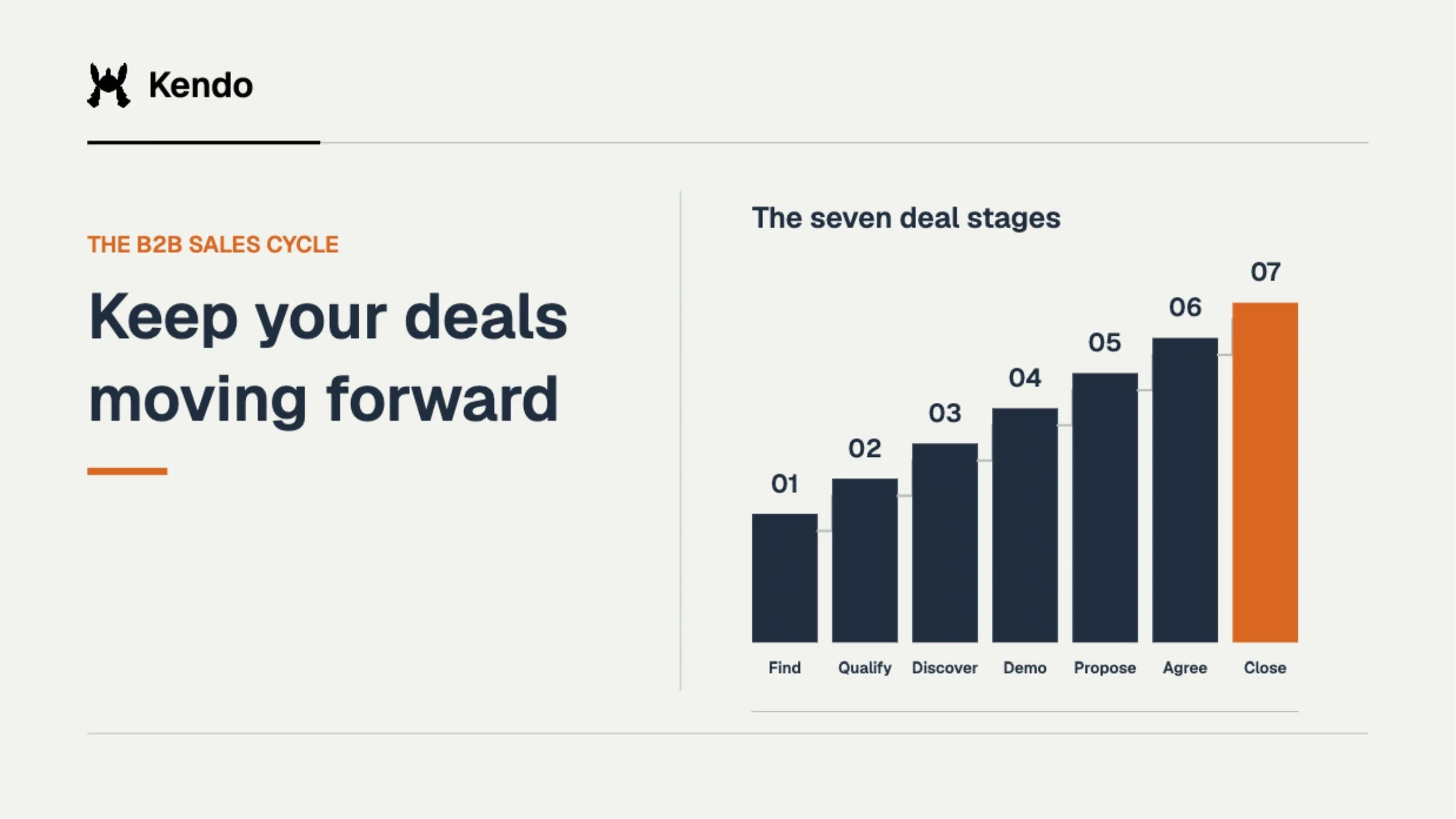
Every B2B cycle moves through the same seven stages. The names vary by org; the work doesn't. What makes it B2B is that a committee, not a person, has to clear each one.
-
1
Prospecting
You identify accounts that fit your ICP and find a way in. In B2B that means an account, not a lead: a company with the problem, the budget, and a trigger to act now. The output of good prospecting isn't a name, it's a reason a specific account should care this quarter.
-
2
Qualification
You decide whether this is a real deal worth your time. Weak qualification is where most cycles go to die slowly, because an unqualified deal doesn't lose, it lingers. This is where qualification frameworks earn their keep. A lightweight checklist like the BANT framework confirms budget, authority, need, and timing, while a deeper method like MEDDPICC forces you to confirm the economic buyer, decision process, and paper process before you pour months into a dead deal.
-
3
Discovery
You map the problem and the people. Done right, discovery surfaces the committee. You're not just diagnosing pain, you're learning who else touches this decision and what each of them needs to say yes. A consultative, pain-led discovery that only talks to one friendly contact is how you get blindsided in month four. Ask who else has a vote.
-
4
Demo and Solution
You show how you solve the specific problem you uncovered, for the people who have to buy in. A generic product tour is a wasted stage. The demo that moves a B2B deal connects your capability to the metrics the economic buyer cares about and the day the end users live in. Different members watch for different things; speak to each.
-
5
Proposal and Business Case
You put numbers on the table and hand your champion something they can defend. This is the stage B2B reps under-build. Your champion has to walk into a room you're not in and make the case to Finance, IT, and their boss.
If the business case can't survive that room without you, the deal stalls there. Give them the ROI math, the rollout plan, and the answer to "why now."
-
6
Negotiation and Procurement
Procurement and legal arrive with the fine print, often at the eleventh hour. Surface them in discovery so the redline is no surprise.GIF via Giphy The committee's machinery kicks in: security review, legal redlines, vendor risk assessment, and procurement's mandate to win a better price. None of this means the deal is in trouble; it means the deal is real. But it adds time, and people who weren't in your discovery.
Reps who've practiced these conversations hold price and pace. The redline pushback and the late discount ask are textbook sales objections to handle, not signals to fold. Reps who haven't rehearsed them give away margin to make the discomfort stop.
-
7
Close and Handoff
Signatures, then a clean handoff to onboarding or customer success. In B2B the close isn't the finish line, it's the start of the expansion cycle. A sloppy handoff after a six-month deal torches the trust you spent two quarters building. Treat the first 30 days post-signature as part of the cycle, because renewal starts there.

The B2B Sales Cycle Map
Here's the reference version of everything above. The stages are easy to recite. What separates reps who close from reps who sandbag the pipeline is knowing when a stage is actually done, where it tends to stall, and what to do about it.
Run your three oldest open deals against this. If a deal is sitting "in" a stage but can't pass that stage's exit criteria, that's the earliest stall signal you'll ever get. Act on it before it shows up in next quarter's forecast.
The B2B Sales Cycle Map
The 7 stages as one connected flow. Each node carries the exit criteria (when it's truly done), where deals stall, and the move that de-risks it. Run your oldest open deals down it.
-
1
Prospecting Done: a named account fits ICP with a real trigger
StallsSpraying low-fit accounts with no compelling reason to actDe-riskTighten ICP; lead with a trigger, not a feature -
2
Qualification Done: budget, authority, pain, and a buying process confirmed
Stalls"Interested" deals with no real budget or timelineDe-riskQualify the decision process and economic buyer early -
3
Discovery Done: you know the full committee and what each needs
StallsSingle-threaded on one friendly contactDe-riskAsk who else votes; map the committee -
4
Demo & Solution Done: each key stakeholder has seen their specific value
StallsA generic tour that lands with no oneDe-riskTailor to the economic buyer's metrics and the users' day -
5
Proposal & Business Case Done: your champion can defend the ROI without you
StallsA champion who can't carry the case internallyDe-riskBuild the business case and the "why now" for the champion -
6
Negotiation & Procurement Done: security, legal, and pricing cleared with the committee
StallsA surprise security review or last-minute procurementDe-riskSurface procurement and security in discovery, not at the end -
7
Close & Handoff Done: signed, with a clean handoff to onboarding or CS
StallsA verbal yes that drifts; a messy post-sale handoffDe-riskRun a mutual action plan through signature and the first 30 days
How Long Is a B2B Sales Cycle? (Benchmarks by Deal Size)
There's no single honest "average," because cycle length tracks deal size almost linearly. The number that matters is the one for your ACV tier.
| Deal size (ACV) | Typical cycle length | What's driving it |
|---|---|---|
| SMB (under $15K) | 14 to 30 days | One or two decision makers, low risk |
| Mid-market ($15K to $100K) | 30 to 90 days | A small committee, some review |
| Enterprise (over $100K) | 90 to 180+ days | A full committee, security, legal, procurement |
So why did cycles get longer? They expanded from 4.9 months in 2019 to 6.5 months on average (Ebsta, 2024), and the cause isn't laziness. It's the buying committee.
A typical complex B2B purchase now involves 6 to 10 decision makers (Gartner), and big enterprise deals can climb past 15 once you count legal, compliance, finance, and multiple business units. Every person you add is another calendar, another set of objections, and another way the deal can stall. More buyers means more time, full stop.
To keep your pipeline math honest as cycles stretch, get disciplined about the pipeline metrics that actually matter instead of just deal count.
Why B2B Deals Stall (It's Not Price)
Ask a rep why a deal slipped and you'll usually hear "budget" or "they went with a competitor." The data says otherwise, and this is the single most important thing to understand about the B2B cycle.
The biggest threat to your pipeline isn't your competition. It's the buyer deciding to do nothing.
A landmark Harvard Business Review study of more than 2.5 million recorded sales conversations found that 40% to 60% of B2B deals end in "no decision" (The JOLT Effect, Dixon and McKenna, 2022). Not lost to a rival. Lost to indecision.
The same research found customer indecision costs roughly twice as much lost revenue as losses to the competition. And buyers don't love the status quo: of the deals lost to inaction, about 56% actually wanted to move forward but couldn't commit.
It gets worse when the committee turns on itself. Gartner found that 74% of B2B buying teams demonstrate "unhealthy conflict" during the decision process (Gartner, 2025). Disagreement among your buyers is the norm, not the exception, and it freezes deals.
Three failure modes drive most of it:
- Buyer indecision. The deal is qualified, the champion is real, but the committee can't get to a confident yes. 86% of B2B buyers report a purchase stalled in the past year (Forrester State of Business Buying 2024). The fear isn't "will this work," it's "will I look bad if it doesn't."
- Single-threading. Roughly 70% of opportunities have just one point of contact (UserGems data science). One champion, one thread. When that person goes quiet, gets reassigned, or leaves, the deal dies with them, and you never saw it coming.
- A champion who can't carry the case. Someone inside wanted it. They just couldn't sell it to Finance and their boss without you in the room. The business case didn't travel.
None of those are price problems. They're decision-risk and execution problems, which is good news, because those are the things you can actually fix.
How to Shorten and De-Risk the B2B Sales Cycle
You don't shorten a B2B cycle by adding urgency or cutting price. You shorten it by making the buyer's decision feel safe and by running the cycle well enough that deals stop stalling. Here are the five levers that work, roughly in the order they pay off.
1Qualify Harder, and Earlier
The fastest way to shorten your average cycle is to stop spending months on deals that were never going to close. Ruthless qualification at the front isn't pessimism, it's how you protect time for the deals that can win.
Confirm the real decision process, the economic buyer, and the paper process before a deal earns a slot in your forecast. A structured method like the MEDDIC framework forces those questions early, so a dead deal exits in week two instead of aging in "evaluation" for a quarter.
2Multi-Thread the Committee
If 70% of deals ride on one contact and one contact is the most common point of failure, the move is obvious: build more relationships inside the account. Multi-threading is the single highest-leverage habit for de-risking a B2B deal.
The data backs it hard. Engaging multiple stakeholders instead of one can lift win rates several times over and grow deal size by 57% (UserGems data science). More threads means the deal survives a champion leaving, and it means you hear procurement's concerns in month two instead of month five. For producers selling to businesses, the commercial insurance sales playbook connects discovery to operations, exposures and the people involved in the buying decision.
The catch is that multi-threading is a skill. Getting a champion to introduce you to their skeptical CFO, then holding your own in that room, is exactly the high-stakes call reps avoid because they're not ready for it.
This is where deliberate practice pays off. Spin up that skeptical CFO as an AI prospect and rehearse the exec-level ask on realistic AI sales roleplay tools, instead of spending a real stakeholder relationship learning on the fly.
3Run a Mutual Action Plan
A mutual action plan is a shared, written timeline that you and the buyer build together, listing every step from here to signature and beyond: who does what, by when, including the buyer's internal milestones like security review and legal.
It sounds like project-management overhead. It's actually a forecasting and momentum tool. Deals that run on a mutual action plan close at roughly a 60% win rate versus a 29% baseline, and reps who use one see about a 26% higher win rate (Trumpet and Outreach analyses).
The plan does two jobs: it gets the buyer to commit to their own steps out loud, and it gives you an early warning the moment a date slips.
4De-Risk the Decision
Since indecision kills more deals than any competitor, your job in the back half of the cycle is to make saying yes feel safe. The JOLT research is blunt about this: beating the status quo is about showing the upside, but overcoming indecision is about proving the buyer won't fail by choosing you.
In practice that means shrinking the perceived risk: a tighter rollout plan, a pilot or proof of value, clear success criteria, references from buyers who looked just like them.
It also means handling the late-stage objections that are really fear in disguise. The reps who close complex deals are the ones who can work the late-stage objection-handling scenarios that stall committees without getting defensive or caving on terms, and that, too, is a rehearsable skill.
5Ramp Reps Faster So They Run the Cycle Well
Here's the lever leaders underrate. Every stage above is gated by how well your reps execute the conversation: the discovery that surfaces the committee, the demo that lands with the economic buyer, the multi-threading ask, the business case the champion can carry.
A rep who's still finding their footing runs every one of those worse, and the cycle stretches across the whole team. So a faster, better ramp isn't just an onboarding metric. It's a cycle-length lever.
This is the gap the best AI sales training software closes: it lets reps drill the exact calls a B2B deal hinges on long before a real committee is on the line.
This is the bottleneck Kendo was built to attack. Reps practice your exact committee, objections, and call types against AI prospects. Managers get every live call scored automatically instead of spot-checking a few, so a stalled deal shows up as a low score, not a surprise.
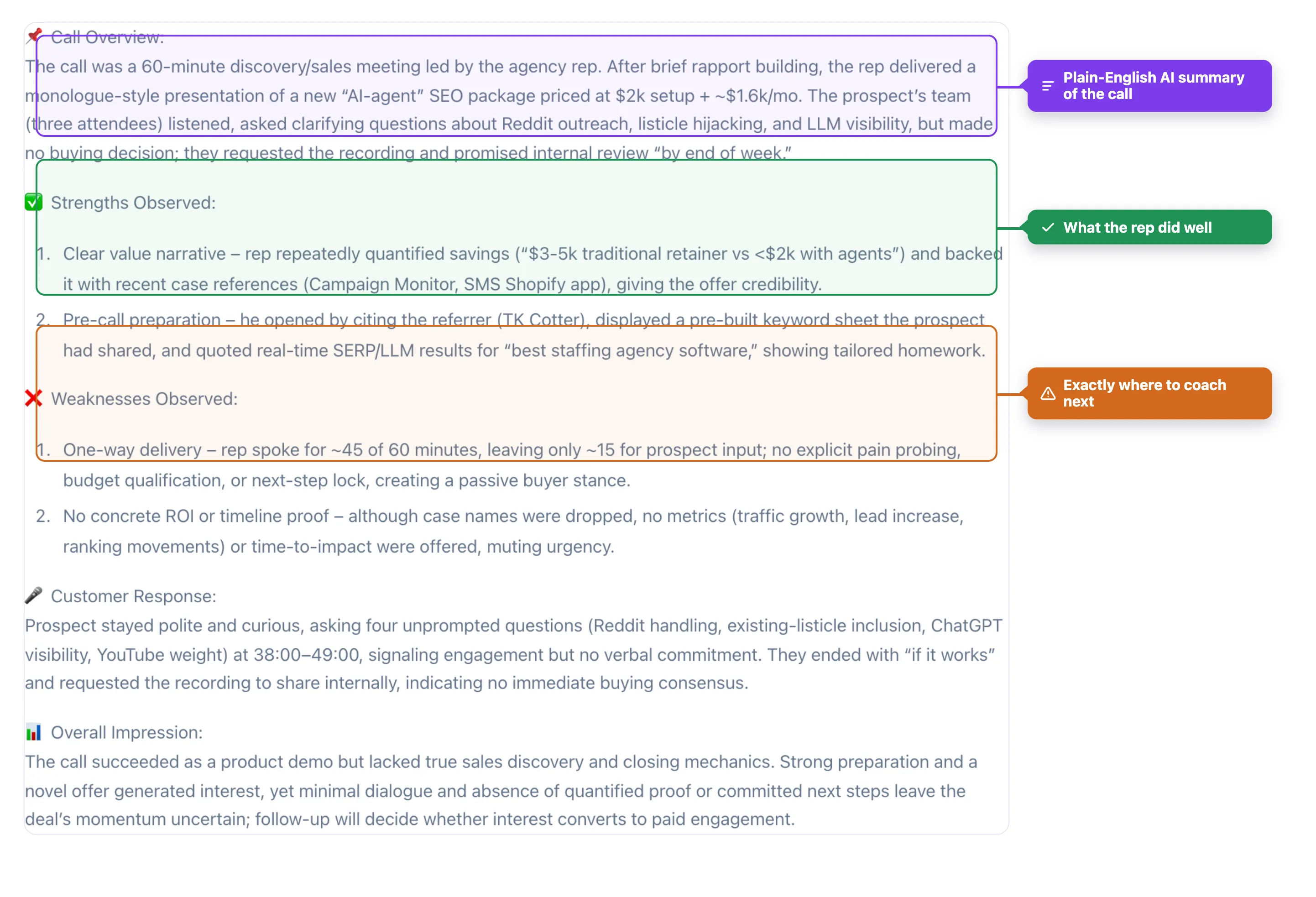
Every Live Call Gets Scored and Read for Coaching
Kendo auto-reviews each recorded call and writes a plain-English summary of what the rep did well and exactly where to coach, then scores it against a custom scorecard by call type. A stalled deal surfaces as a low score with the reason attached, not a surprise at the forecast review.
Reps Get Specific, Next-Call Feedback in Seconds
After any analyzed call, a rep can ask Kendo's AI Coach how to run the next stage better and get back prioritized, concrete fixes, not a vague score. This kind of real-time AI sales coaching points to the exact habits stalling the deal and the language to use instead, so the next committee call moves the deal forward.
You only have one contact on this deal. Ask for a working session with the economic buyer before the next step, so it survives your champion going quiet.
Your champion can't defend the ROI without you. Hand them the numbers, the rollout plan, and the answer to "why now" so they can carry it into the room you're not in.
Replace "let me know" with a dated mutual action plan: name the security review and legal steps now, so procurement doesn't surface a redline at the buzzer.
A real example of Kendo AI Coach feedback on a scored call. Reps act on the specifics, not a number.
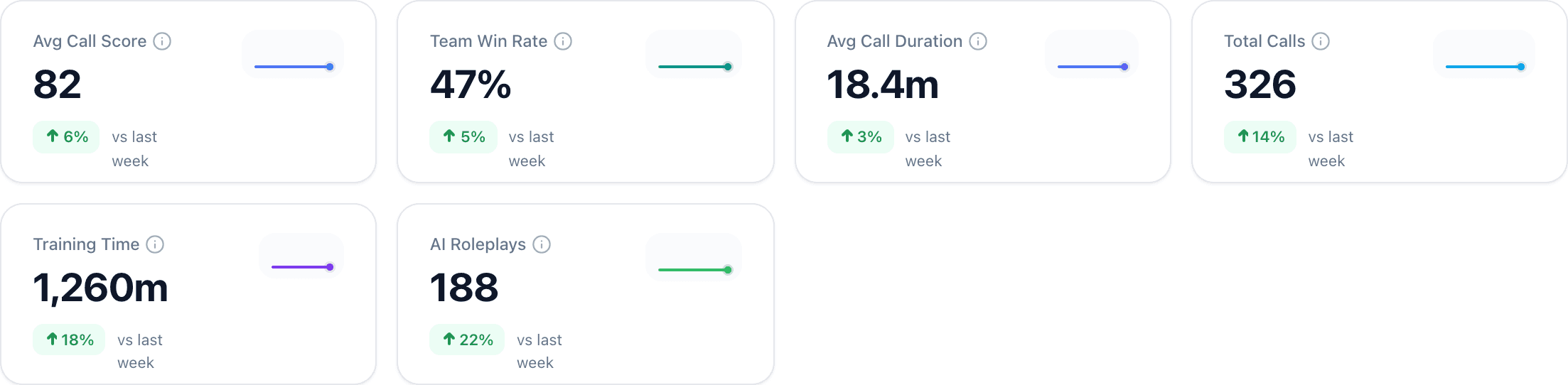
Leaders See Which Stages Are Dragging, Team-Wide
The same scored data rolls up to a team view, so leaders can spot which reps and which cycle stages are stalling deals instead of guessing from a few spot-checked calls.
The deeper playbook on how to reduce sales ramp time lays out the full approach.
New reps ramp 75% faster, so deals stop stalling on execution
United Insurance Pros required new agents to log practice on AI prospects before touching a live deal. New reps got productive 75% faster, ramping in 7 days instead of 30, with onboarding down from 45 days to 14 days and time to baseline from 45 days to 14, saving $3,000+ per agent every month in wasted lead spend.
Result: 7-day ramp-up + 7 days to baseline performance = 14 days total vs 45+ days before. Reps who hit baseline faster run every stage of the cycle better, so fewer deals stall on a rep who wasn't ready.
"Typically we would see about a 45-day period where people would dip their foot in the water and slowly improve and then level off at their performance level. Now that's 14 days. So it's the 7-day ramp-up and then 7 days to be where they're going to be at their baseline."Waylon Artrip, Founder, United Insurance Pros
The same pattern shows up at Globe Life, where brand-new agents went from around 33% to 60%+ close rates in six months once they got real repetition before live calls. Practice doesn't just ramp reps. It changes how the whole cycle runs.
A Real Deal That Moved Through the Cycle 6x Faster
None of this is abstract. TIBCO Software closed an 8-figure, 6-year deal in 90 days instead of its usual 9 months (Gong case study). Same enterprise committee, same procurement, a fraction of the calendar.
What changed was execution, not pressure. Group VP of Sales Pedro Diaz had reps run the deal on MEDDIC qualification and a shared deal board, so the whole team could see exactly where the committee stood and coach the rep mid-cycle.
The team-wide effect was the bigger tell: TIBCO went from booking 90% of quarterly revenue in month three to 60% in month one. Tighter qualification and faster, better rep execution pulled the entire cycle forward, instead of letting deals pile up at the buzzer.

B2B Sales Cycle FAQ
The average B2B sales cycle runs about 6.5 months, up from 4.9 months in 2019 (Ebsta, 2024), but the only number that matters is the one for your deal size. Small deals under $25K ACV close in roughly 90 days, while enterprise deals over $100K routinely take 6 to 9+ months (Norwest, 2024). Length tracks deal size and committee size, not effort.
Most B2B cycles move through seven stages: prospecting, qualification, discovery, demo/solution, proposal and business case, negotiation and procurement, and close and handoff. What makes them B2B is that a buying committee of 6 to 10 people (Gartner), not a single buyer, has to clear each stage, with security review, legal, and procurement entering in the back half.
The sales cycle is the path one deal walks from first contact to closed-won, a process you coach and measure. The sales funnel is a volume view of the whole pipeline, showing how many opportunities sit at each stage and where they fall out. The cycle tracks a single deal; the funnel tracks the aggregate.
Almost never price. A Harvard Business Review study of 2.5 million sales conversations found 40% to 60% of B2B deals end in "no decision" (The JOLT Effect, 2022), driven by buyer indecision, single-threading (about 70% of deals ride on one contact), and a champion who can't carry the business case internally. Indecision costs roughly twice the lost revenue that competitors do.
Not by rushing. Qualify harder up front so you stop aging dead deals, multi-thread the committee so the deal survives a champion leaving, run a mutual action plan to keep momentum, de-risk the buyer's decision so indecision doesn't freeze them, and ramp reps faster so they execute every stage well. The cycle compresses when execution improves, not when you add pressure.
Stop Losing Deals to a Slow, Stalled Cycle
The B2B sales cycle is long for real reasons: big committees, high stakes, and a buyer that spends most of the journey deciding without you. You can't change that the buyer has to build consensus.
You can change how well your reps run every stage with sharper B2B sales techniques, and that's where cycle length actually lives.
Start this week with the cheap, high-leverage moves:
- Run your three oldest open deals against the B2B Sales Cycle Map. Any deal that can't pass the exit criteria of the stage it's "in" is your earliest stall signal. Multi-thread it or qualify it out.
- Instrument execution, not just activity. The discovery, the demo, the multi-threading ask, the business case: those are the conversations that decide your cycle length, and they're trainable.
Knowing the stages is the easy part. Running them well, deal after deal, rep after rep, is the whole game.
Kendo AI lets your team practice your exact committee and objections against realistic AI prospects, and scores every live call automatically, so reps run the cycle like veterans sooner and fewer deals die in "no decision."

Luke Alexander is the founder of Kendo AI, where he's helped train more than 5,000 sales reps. He started in sales as a frontline closer, scaled a high-ticket sales-training company, and founded Closer Cartel and AI Insiders before building Kendo to fix the tools he wished he'd had: realistic AI roleplay and automated call review for fast-moving sales teams. He writes about sales training, ramp speed, objection handling, and applying AI across the revenue org.