

Kendo is the strongest fit for final-expense teams that need repeatable practice, recorded-call review and manager follow-through. InsuranceSales101 and Life Insurance Academy teach the product in depth; carrier and agency resources cover other needs. Choose the mix that fills your team's actual gap, not the longest library of sales presentations.
For an agency leader, the buying question is simple: can an agent talk through needs, budget and product facts clearly, then answer a concern without pressure? Training should build that skill and show the manager proof it is improving. It should not turn a conversation about a funeral into reading a script.
Published by Kendo AI; this comparison includes its platform.
Compare six training options
| Option | Main training job | Delivery | Ask before buying |
|---|---|---|---|
| 1. KendoRecommended | Practice and review | Software with manager oversight | Usage and scenario setup |
| 2. InsuranceSales101 | Specialist final-expense course | Final Expense 101 plus advertised support | Exact package and human-help terms |
| 3. Security National Life | Carrier product learning | Final-expense training resources | Appointment and access rules |
| 4. DIG | Free self-directed learning | Guides and videos | Free material versus agency services |
| 5. Premier Producers Group | Agency-based telesales training | Training platform and mentorship | Agency relationship and costs |
| 6. Life Insurance Academy | Courses plus optional coaching | Membership courses and coaching | Individual versus team access |
These are different things to buy. A carrier's free training is not a software subscription, and a free guide is not a coach.
What does the team actually need?
Start with the last conversation a manager had to repair. Was the agent missing product facts? Did they talk over a budget worry? Did they explain something correctly but never check that the customer understood? Fix that problem first. That is the training assignment.
Cost is the number one reason. The first skill to train is hearing the budget worry, not talking past it.
For final-expense agent training, split the job into four parts:
- Product education: use current, approved information for the specific policy and carrier.
- Conversation skills: listen, ask relevant questions and explain without adding promises. Life insurance sales scripts for needs analysis show what that sounds like.
- Follow-through: write down the next step and follow the agency's process.
- Manager review: look at the call, fix the mistake and pick the next thing to practice.
General life insurance advice, not final-expense specific, but every habit shows up on a recorded call.

- 0:04Take the pressure off first. Tell the customer you are there to inform them, and either decision is fine.
- 0:27Let the customer do most of the talking. That is the listening skill in item 2.
- 0:44Skip the speech about your company and prices. “People don't buy price, people don't buy product.”
- 0:50Focus on the customer's problem, not the product. That is the needs and budget part of the call.
Agents say the same thing in public forums: they want help, not more content. In the r/InsuranceAgent forum, a licensed agent asking for final-expense coaching wanted structure and accountability, not more scripts and lead offers.
Another experienced agent, weighing a move to a new IMO, said training was not the priority; carrier access and contracting were. Together, they make one point: find the gap before you buy a fix for it.
Memory research says the same about training that is all content and no rehearsal.
Share of a passage remembered one week later. A lab study of reading, not insurance calls, but practice beat re-reading by 21 points.
Source: Washington University in St. Louis, on Roediger and Karpicke (2006)
The six options
1. Kendo: best for consistent rehearsal and manager follow-through
Kendo fits teams that already have a sales process and need more practice on it, plus a clear way to check the results.
- AI roleplay lets a manager set up the prospect and the scenario, so an agent can practice a budget worry or a weak opening question.
- Recorded-call review gives summaries and feedback after the call ends. It does not prompt agents during live calls.
- Sales management ties each call review to the next practice assignment (see the sales coaching software comparison). The agency still owns its product content and its managers still coach.

The scenario a manager sets up in Kendo: a discovery call, a final expense whole life product and a customer who wants straight answers about what she is paying.
Insurance case study: a final-expense team's top performer roughly doubled his baseline
Kody Skvarla leads a final-expense team that practices with Kendo. The wider team reports a 5 to 20% improvement.
“Kendo matches or beats a human practice partner. The objections are the exact same as real calls.”
Pricing
| Detail | Kendo (for reference) |
|---|---|
| Pro | $55 per seat/month. 180 roleplay minutes and 25 hours of real-call scoring per seat. Usage is pooled across the team. |
| Max | $100 per seat/month. 480 roleplay minutes and 100 hours of real-call scoring per seat. Usage is pooled across the team. |
| Enterprise | Custom quote, from 10 seats. Setup and support are set in the contract. |
| Kendo is a monthly software subscription, not a course fee. | |
Plan allowances: Kendo pricing and subscription plans.
What to weigh: You are buying practice and review. Licensing, carrier training and product advice are not what Kendo does.
2. InsuranceSales101: best for a dedicated final-expense course
InsuranceSales101 is the pick when an agent needs to learn final expense from the ground up before practicing it.
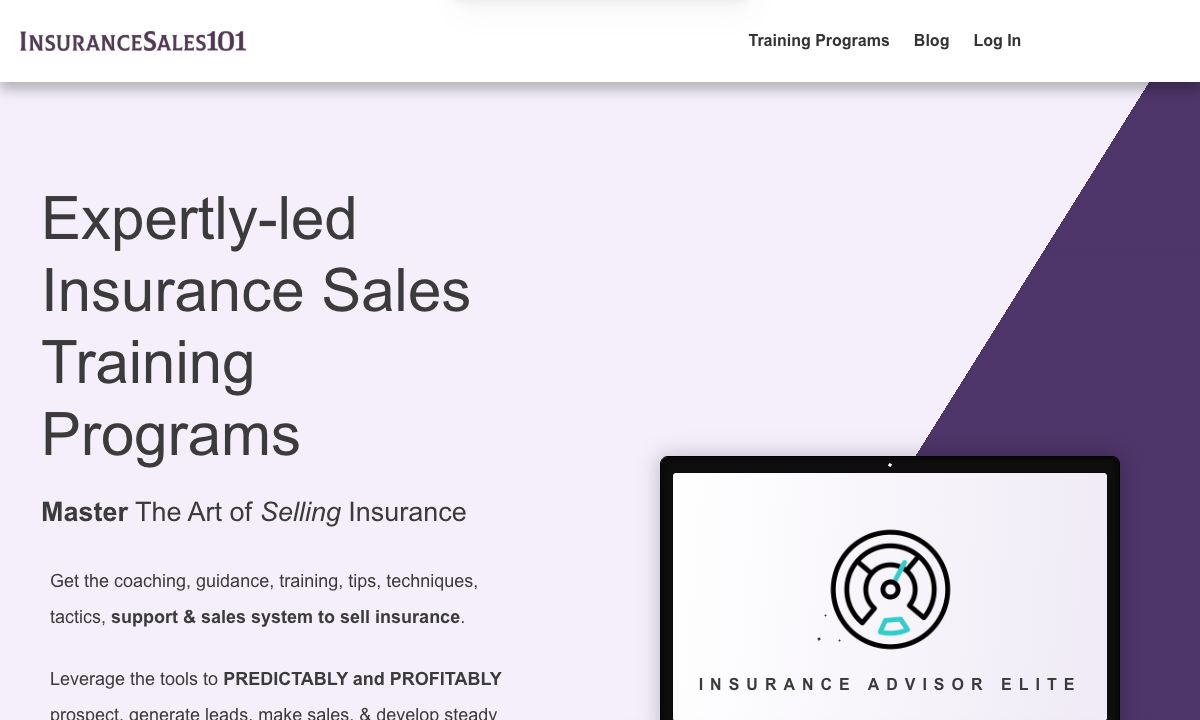
- Final Expense 101 is a dedicated course, not a generic sales-skills module.
- The provider advertises human guidance and support, so it is not a video-only course.
- The course page describes one-to-one help by phone, chat, email or booked sessions, and access does not depend on an upline contract.
Check the course against how your team sells. Ask them to show how an agent goes from watching a lesson to getting corrected on a real call.
Pricing
| Offering | Price / billing | Access and limits | Kendo (for reference) |
|---|---|---|---|
| Final Expense Insurance 101 | Advertised $14.99/month | Confirm the amount due and renewal terms at checkout. | Pro: $55/seat/month; Max: $100/seat/month; Enterprise: quote. |
Price from the provider's public offer page. Kendo pricing: kendo.ai/pricing.
Cons
What the offer does not cover.
- No leads included: The course FAQ separates vendor discounts from a lead program. Buying leads is still a separate cost.
- Final expense only: Final Expense 101 covers final-expense selling, not personal or commercial lines. It does include advertised one-to-one support.
3. Security National Life: best for carrier-specific learning
Security National Life's training makes sense when your agents sell that carrier's products.
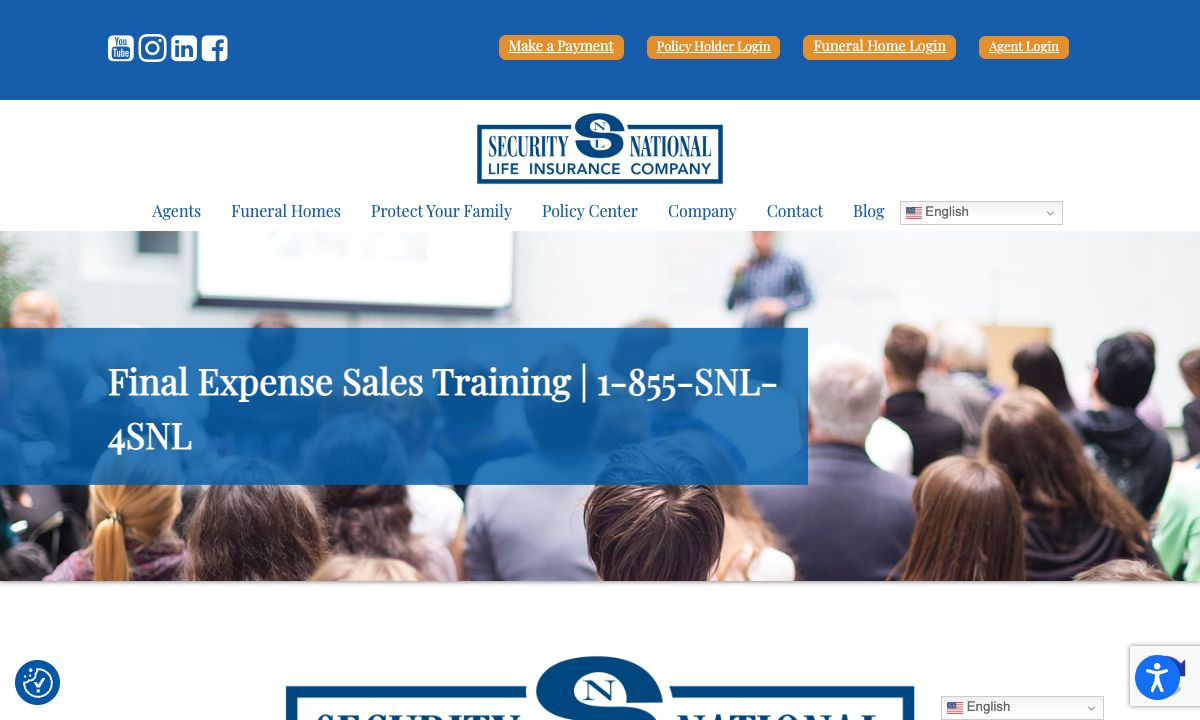
- Self-paced video courses cover products, policy submission, the agent portal and sales techniques.
- The public page includes agent-portal tutorials and past marketing webinars.
- Its download library covers product, underwriting and telesales material. Check each document's date before using it.
Use carrier training to get the product facts right. If your team sells for several carriers, label each carrier's material so agents do not mix up products on a call.
Pricing
| Offering | Price / billing | Access and limits | Kendo (for reference) |
|---|---|---|---|
| Public resources and webinar recordings | No listed course fee | Registered agent courses may have access rules. Not every service is free. | Pro: $55/seat/month; Max: $100/seat/month; Enterprise: quote. |
Public resources are listed on the carrier's training page. Kendo pricing: kendo.ai/pricing.
Cons
What the offer does not cover.
- Other carriers are not covered: Product, portal and submission lessons follow Security National Life's own process. A team that sells for several carriers needs each carrier's material.
- Public and registered access differ: Webinar recordings are public, while the self-paced courses need registration. Confirm course access before planning around it.
Insurance case study: United Insurance Pros cut time to baseline from 45+ days to 14
Carrier courses teach the product. United Insurance Pros, a 500+ agent organization, uses Kendo's AI roleplay for the conversation.
“If you've got more than five agents, it's a no-brainer.”
4. DIG: best for exploring free final-expense learning material
DIG's free guide is an easy way to look at final-expense training before paying for anything.
- The guide links to free videos and written material.
- It sits inside a wider agency and recruiting offer, so judge the free education and the agency support separately.
Give self-directed agents a specific assignment: “Which part of this presentation helps clarify the customer's concern, and how would it fit our process?”
“Present the plan, then ask for the application.”
Customer: “I just worry about another monthly payment.”
Practice the second panel before the live call.
Check the age of each resource before reusing product or process details. A good selling idea can stay useful while a carrier procedure or product detail changes.
Pricing
| Offering | Price / billing | Access and limits | Kendo (for reference) |
|---|---|---|---|
| Public final-expense articles and videos | Free | Agency affiliation, contracting and other training are separate decisions. | Pro: $55/seat/month; Max: $100/seat/month; Enterprise: quote. |
Free material is listed on DIG's public guide. Kendo pricing: kendo.ai/pricing.
Cons
What the offer does not cover.
- Some material is older: The resource index is dated February 2023. Check product and carrier details before copying an example.
- Free learning and joining the agency are separate: The index links to recruiting next to the free articles and videos. Reading the library is not the same as joining.
5. Premier Producers Group: best for agency-based telesales training
Premier Producers Group fits if you are looking at joining an agency that trains you, not buying a course.
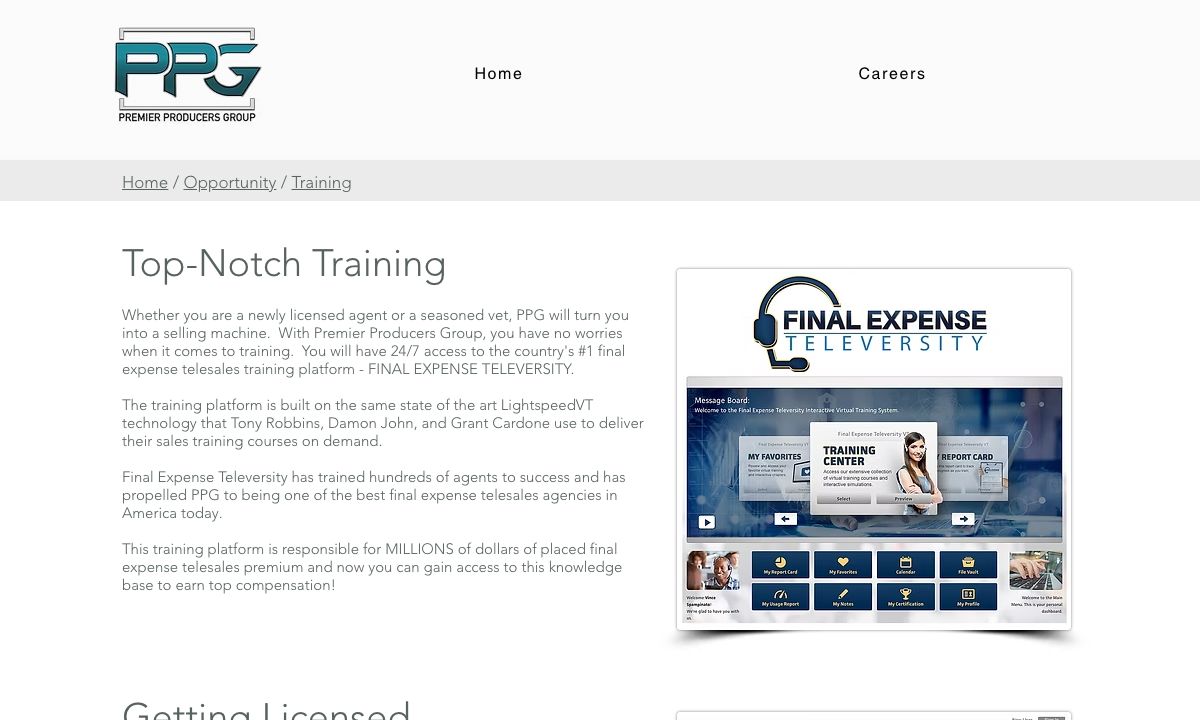
- Its training page presents Final Expense Televersity as an on-demand telesales training platform.
- The training is tied to the group's own final-expense sales operation and support.
For a principal comparing training partners, ask who can use the platform, how mentorship works, whether training requires joining and what happens if an agent leaves.
Also check the channel. Telesales training covers phone delivery and call control, while a field agent needs help with in-person presentations and follow-up.
Pricing
| Offering | Price / billing | Access and limits | Kendo (for reference) |
|---|---|---|---|
| Agency-associated Televersity access | Ask for written terms | Confirm affiliation rules, mentorship access and any fees. | Pro: $55/seat/month; Max: $100/seat/month; Enterprise: quote. |
Terms are not published; ask PPG in writing. Kendo pricing: kendo.ai/pricing.
Cons
What the offer does not cover.
- Built for telesales: Televersity and its mentorship focus on selling final expense by phone. Field agents need examples for in-person work.
- Training comes with an agency relationship: The page describes support with PPG and sends buyers to a conversation. Get standalone-access and affiliation terms in writing.
6. Life Insurance Academy: best for choosing between course access and coaching
Life Insurance Academy splits its memberships into courses only, or courses plus coaching.

- Starter includes the course library and sales resources, including final-expense and telesales material.
- Premium adds live group coaching and one private coaching session, according to the current membership page.
That raises a useful question: do your agents need lessons they can work through alone, or a person who helps them apply them? Confirm how group sessions fit your schedule and whether one private session is enough.
Pricing
| Offering | Price / billing | Access and limits | Kendo (for reference) |
|---|---|---|---|
| Starter Membership | $297/year | Individual course library. Confirm team access; purchases are nonrefundable. | Pro: $55/seat/month; Max: $100/seat/month; Enterprise: quote. |
| Premium Membership | $697/year | Adds weekly group coaching and one private session. Purchases are nonrefundable. | Pro: $55/seat/month; Max: $100/seat/month; Enterprise: quote. |
Prices from the Academy's public membership page. Kendo pricing: kendo.ai/pricing.
Cons
What the offer does not cover.
- Live coaching needs the higher tier: Premium lists weekly group sessions and one private session, not unlimited one-to-one coaching.
- No refunds: Its policy makes purchases final, including services and events. Check the package and schedule before you pay.
Insurance case study: Globe Life lifted new-agent close rates from about 33% to 60%+ in about six months
Coaching by the session runs out. With Kendo, agents practice on their own and leaders coach from the scores.
“Kendo buys back time for my leaders”
Choose by the conversation that is breaking down
For new agents, pair accurate product education with supervised practice. An insurance agent onboarding checklist keeps the two in order. A smooth pitch can hide an agent who does not understand the product.
For experienced telesales agents, check whether the problem is the conversation or something training cannot fix, such as lead routing, follow-up ownership or carrier access. A drop in sales alone does not call for a beginner course.
- 53%
- prefer to talk to a person (in person, phone or video) when ready to buy
- 45%
- work with a financial professional
- About 75%
- overestimate what life insurance costs
Most buyers still want a person, and most guess the price wrong. Listening before quoting is the skill that pays.
If a manager spends every day running the same roleplay, a practice tool can take that load. If an agent has a product question, the carrier or a qualified specialist is the right source.
For teams selling several lines, the broader insurance training comparison covers producer development and enterprise options. Keep this decision focused on final-expense conversations.
Practice final-expense conversations with Kendo
Use the monthly-payment worry your agents hear on real calls. Build a fictional customer in Kendo, rehearse the question and review the completed session. Coach understanding before a closing attempt, then change the budget answer for practice.
Buyer Profile
Define who the buyer is and the context they make decisions in.
Scenario & Resistance
Set what is being sold, the conversation stage, and how this buyer should resist.
Final Expense: Needs and BudgetACTIVE



I want to help my children, but another monthly payment worries me.
What worries you most about keeping up with it?
My income changes. I don't want to start something I can't keep.
Let's pause the application. We can review your existing arrangements and questions before discussing any commitment.
A coach plays the agent so the agent hears a better first question. Worth clipping for your next team practice.

- 0:03Swap roles. The coach plays the agent and asks the agent to say exactly what customers say on calls.
- 0:13The real objection: money is tight right now, so call back in a month or two.
- 0:35Ask before answering: “When you say it's a little out of budget, what exactly do you mean?”
- 0:52Where a manager would pause the tape. The coach moves to a smaller plan at 0:52. Score whether the agent first confirmed what the customer can keep paying.
Use a made-up customer and approved product material. Keep real health histories, bank details and policy records out of the scenario. Have a qualified reviewer approve the setup before agents use it.
- Customer
- The monthly cost may be hard to keep up with.
- You
- It sounds like keeping the payment manageable matters most. What would you like to clear up before we talk about a next step?
- Manager
- Did the agent listen and ask about the worry, or push straight to an application?
A fictional rehearsal line. Swap in your agency's approved wording.
The manager checks whether the agent paused, asked about the worry and respected the customer's answer. Moving smoothly to the close does not prove the budget worry was handled.
Use a simple review sheet:
| Skill | What the manager should hear | Fix if it is missing |
|---|---|---|
| Listening | Repeats the stated worry before answering | Replay the worry and ask for a summary |
| Needs and budget | Asks relevant, approved questions without pressure | Rehearse one open question and its follow-up |
| Product explanation | Stays within verified material | Go back to the source and fix the explanation |
| Handling uncertainty | Says what needs checking | Practice the approved escalation route |
| Next step | Confirms an action both sides understand | Name an owner and a realistic follow-up |
“Be more empathetic.”
“At 02:10 she mentioned the budget. Ask what monthly amount feels comfortable.”
Specific beats vague. Every time.
Two managers should score the same first attempt on their own. If one rewards persistence and the other rewards careful questions, settle that before agents get mixed feedback.
Keep business outcomes in their proper systems
Track practice scores next to business results, not instead of them. Submitted applications, placed policies and later persistency need definitions and records from the carrier, CRM or agency system. The agency KPIs worth tracking guide defines each one.
An application submitted today is not the same as a placed policy, and neither one proves the policy will stay in force.
Three numbers that are not the same number
- 01
Application submitted
Recorded in the carrier system or CRM
- 02
Policy placed
Recorded by the carrier
- 03
Policy still in force (persistency)
Recorded by the carrier, months later
Practice scores and training completion live in Kendo. Keep them next to these three numbers, not inside them.
Do not blend these into one “sales improved” number.
If the group's results change, note what else changed: lead source, agent experience, manager attention and product mix. A training pilot can guide a purchase without proving that training caused every change in sales.
For the practice layer, compare scenario control and feedback in the AI sales roleplay tools comparison, separately from final-expense courses and carrier support.
Common buying questions
Are free resources enough?
They can be enough for a knowledgeable, self-directed agent filling one specific gap. They fall short as a team program when nobody picks the material, checks that it is current or reviews how agents use it. The missing piece may be management, not another paid course.
Does final-expense sales training replace licensing or carrier preparation?
No. Check the licensing and carrier requirements for each agent's role separately. A polished presentation or a high practice score does not make an agent eligible to sell a product.
Should telesales and field agents use the same training?
They can share basics such as listening and clear explanations. The scenarios should still match the channel, the customer and the agency's process. Ask a provider to show the right format before buying access for both groups.
What should a manager request in the first meeting?
Bring one training problem with personal details removed and ask the provider to show the lesson, the feedback and the follow-up. Then get access and pricing terms in writing. That gives the agency something concrete to compare beyond testimonials.