
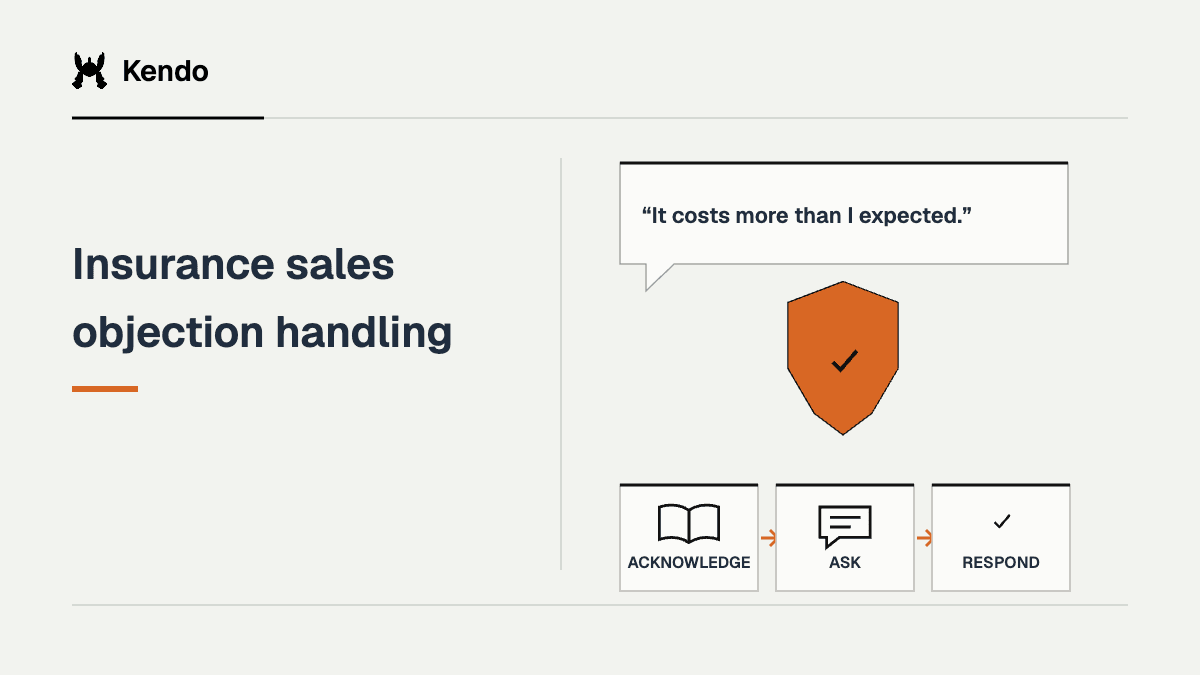

Handle an insurance objection by finding out what the customer means before you answer it. Repeat back what they said, ask one question if they are still open to talking, then explain, check, pass them on or stop.
“Too expensive” might mean a payment they cannot afford or a cheaper quote from someone else. Those are different problems, and neither calls for an automatic comeback.
For sales leaders, the goal is a customer who makes a good decision, not an agent who wins every argument. Some customers already have enough cover, some need more information, and some should not buy what the agency sells. Good coaching leaves room for all three.
Diagnose the statement without pretending to read minds
An objection is how the customer describes a worry. It does not tell you what they are thinking. Even agents who argue about this online cannot agree that every objection fits into three neat boxes, so treat any neat system as a useful argument, not research.
Ask a question only when it helps the customer. Do not turn it into a string of questions that makes saying no feel awkward.
The table below is a coaching aid. The middle column lists what the words might mean, not what they do mean. The example lines in this guide are practice dialogue, not real calls or policy advice.
| What was said | Possible concern | One useful question | Response direction |
|---|---|---|---|
| “Too expensive” | Affordability or comparison | “Is the payment beyond your budget, or are you comparing another quote?” | Respect the budget or check equivalent terms |
| “Already covered” | No identified need | “Is there anything you wanted a review to establish?” | Review only if useful |
| “Shopping around” | Choice and confidence | “What are you comparing besides the premium?” | Make differences understandable |
| “Need to think” | Unresolved information or time | “Is there a question still open, or would you prefer time without follow-up?” | Answer or give space |
| “Speak to my spouse” | A shared decision | “Would a joint review help?” | Support the decision process |
| “Email me” | Information or preferred channel | “Which question should the information address?” | Send relevant approved material |
| “Don't trust this” | Identity, product or experience | “What would you like to verify?” | Provide a checkable route |
| “Not interested” | A decision to stop | No question required | End respectfully |
Eight objections and the branch worth practicing
1. “The premium is too expensive”
Agent: “Is the payment outside what you can comfortably keep up, or is another quote coming in lower?”
If the problem is the budget, accept the limit. If there is a cheaper option that still fits, a licensed agent can walk through it and what it gives up. Do not quietly strip out protection to hit the price.
If nothing suitable exists, say so. Budget pushback is common: the US average cost of auto insurance was $1,281 per insured vehicle in 2023, up 19.24% from 2019.
If the problem is another quote, compare the actual terms before you argue value. The NAIC's auto insurance page explains the main coverages and has a shopping tool that makes a fair comparison easier.
Prices climbed 57% in six years, then eased.
| Year | Change |
|---|---|
| 2019 | 0% |
| 2020 | -1.5% |
| 2021 | -0.5% |
| 2022 | 8.2% |
| 2023 | 28.9% |
| 2024 | 50.1% |
| 2025 | 57.1% |
| 2026 | 49.1% |
Price change for motor vehicle insurance in the US consumer price index, August of each year, calculated from the BLS index. A customer who says “too expensive” in 2026 may be reacting to the 2022 to 2025 jump, or to a newer, lower quote.
Source: U.S. Bureau of Labor Statistics, CPI, motor vehicle insurance (CUUR0000SETE)
- Useful branch: “Let's check the limits, deductibles and other real differences before we call these two quotes equal.”
- Avoid: “You can't afford not to have it.” That ignores the stated budget and whether this option even fits.
- Coach from evidence: Did the agent work out which problem they were answering? A confident speech about value, given to someone who cannot afford the payment, is a weak answer.
“Rebuttal loaded. Let me show you the value.”
“Is the payment too high, or is another quote lower?”
Ask which problem you are solving before you solve it. Original coded panel, fictional lines.
2. “I already have insurance”
Agent: “Understood. Is there anything about your current cover you wanted to review?”
If the customer says the cover does what they need and they do not want a review, stop. Having insurance already is not a gap to find, and it is not an invitation to run down another agent.
If they do raise a concern, ask for the facts you need to look at it. A life customer who is unsure what their work policy covers needs the facts checked, not a stock line that work cover is never enough.
- Useful branch: “Let's confirm what your current policy covers before we talk about anything else.”
- Avoid: “Most people are underinsured,” said without any evidence about this customer.
- Coach from evidence: Did the agent tie the review to something the customer asked, or invent a reason to replace the policy? For the rest of a life conversation, use the life insurance sales scripts.
3. “I'm getting other quotes”
Agent: “That makes sense. What matters most to you in the comparison?”
The customer may care most about payment, deductible, coverage terms or service. Ask which differences are still unclear and explain your option accurately. Do not claim the other quotes leave out cover until you have the documents to prove it.
- Useful branch: “If you send me the other quote, we can line the two up side by side.”
- Avoid: A made-up deadline to stop them shopping. Only say how long a quote is good for when you know for sure.
- Coach from evidence: Did the agent make the comparison easier, even when the other quote stayed the better deal? See the guide to auto insurance quote conversations for the full call.
Share of US auto policies in force that were shopped at least once in the prior 12 months. Q4 2025 is the highest reading since the series began; the two earlier bars are calculated from the published year-on-year changes. “I'm getting other quotes” is routine, not a signal to push harder.
Source: LexisNexis Risk Solutions, U.S. Insurance Demand Meter, Q4 2025
4. “I need to think about it”
Agent: “Is there something you still want explained, or would you rather have time to think without another call?”
If a question is still open, answer it. If the customer wants time, offer a follow-up only if they want one. “I need time” does not become a lie just because the agent has heard it before.
- Useful branch: “What would you want settled before you decide?” Use it while the customer is still talking, not after they have clearly ended the conversation.
- Avoid: Asking again and again what the “real objection” is after the person has already answered.
- Coach from evidence: Did the agent accept the answer and log an accurate next step? “Follow up” in the CRM is not enough if the customer did not agree to another call.
Insurance case study: a final-expense team reports a 5 to 20% improvement
Kody Skvarla leads the team. On top of the team-wide gain, one top performer roughly doubled his own baseline.
“Kendo matches or beats a human practice partner. The objections are the exact same as real calls.”
5. “I need to speak with my spouse”
Agent: “Of course. Would a review together be useful, or would you rather talk it over privately first?”
If a joint conversation helps, agree on the questions it should answer. If the customer would rather talk privately, send the information they ask for and agree whether they want any follow-up.
- Useful branch: “Is there a specific point you think they'll want explained?” The goal is useful information, not turning the customer into the salesperson at home.
- Avoid: Questioning the customer's independence or hinting that a caring spouse would agree right away.
- Coach from evidence: Did the agent help the couple decide together without going around either of them? Wanting to talk to a spouse is not a sign of weak rapport or a hidden objection.

- 0:05The spouse line usually hides one of two things: the price feels uncomfortable, or the person wants someone else to approve.
- 0:21His question: are you the person who pays for this? For Medicare: are you the one who has to use it? A clean way to find out whose decision it really is.
- 0:36The toothbrush line: a grown child would not pick your toothbrush, so your own coverage is your call. Easy for an agent to remember.
- 0:56He closes on “it's their decision”. This guide goes one step further: offer the shared review and never question the customer's independence.
Rehearse the question at 0:21, not the opening quip about the spouse.
6. “Just email me the information”
Agent: “Which part would you like to look at: the option itself, the cost, or a question we haven't answered?”
If the customer answers, send material that covers that need through your agency's usual channel. Point to the section that matters and flag anything that still needs checking.
If they just want the call to end, end it. Do not demand an appointment as the price of getting the details in writing.
- Useful branch: “Would you like any follow-up after you read it?” Log “no follow-up” as a valid choice.
- Avoid: A broad sales packet sent as the full answer to a narrow policy question.
- Coach from evidence: Did the information sent match the request, and did the next contact match what the customer wanted? Review the follow-through, not just the friendly tone of the call.
7. “How do I know this is legitimate?”
Agent: “You should be able to check who you're dealing with. What would you like to check before we go on?”
Give them the agency's published phone number and the state licensing lookup so they can check you themselves. Let them use a source they trust instead of a link from a call they did not expect.
- Useful branch: “You can stop here and call the agency on its published number.”
- Avoid: Asking for sensitive information as the price of proving who you are. More pressure is not an answer to distrust.
- Coach from evidence: Did the agent make it easy to check? If the distrust comes from an old service problem, send that problem to whoever owns it. A complaint is not just another objection to get past.
- $3.5 billion
- reported lost to imposter scams in 2025
- nearly 1 in 3
- fraud reports in 2025 named an imposter
- about 3x
- the 2020 level of reported imposter losses
Reports to the FTC. Business impersonators alone cost people nearly $1 billion in 2025, and the FTC cites enforcement against sellers who impersonated large insurance carriers. A customer who checks you out is being careful, not difficult.
Source: Federal Trade Commission, Consumer Sentinel data release, June 2026
8. “I'm not interested”
Agent: “Understood. Thank you for letting me know.”
That can be the whole answer. If they ask not to be contacted again, add them to the do-not-call list the way your agency requires. Do not add a last discount, a guilt line or a “Tuesday or Thursday?” question.
About 258.5 million numbers sit on the national Do Not Call registry, so plenty of people want fewer sales calls. A clean stop and a logged request is a normal outcome, not a failure. For openings that make it easy to say no in the first place, see these insurance cold calling scripts.
- Useful branch: There may be no sales branch. Log the outcome accurately and finish.
- Avoid: Teaching agents that every no hides a yes waiting for the right phrase.
- Coach from evidence: Did the call end promptly, and did the request reach the right system? A manager who rewards more pitching after a clear stop request trains the wrong habit, even if the agent sometimes gets an appointment.
You: “Before you go, let me see what I can knock off the price.”
You: “Understood. Thank you for letting me know.”
Call ended, request logged. A clean stop can be the best score on the sheet. Original coded panel, fictional lines.
Remove tactics that make the customer work to decline
Ask ten agents how to beat a price objection and you get ten answers, and a few will admit that a price that is too high sometimes just stays too high. Do not turn the most aggressive reply into the team standard.
Cut these from the team's playbook:
- False urgency.
- Claims about a competitor you cannot back up.
- Fear-based family language.
- Talking over a budget answer, or treating every delay as avoidance.
- Implying the customer has already agreed to buy.
The line is between explaining consequences and using fear. A licensed agent can explain a real gap in coverage accurately. That does not justify inventing a disaster or suggesting that saying no to this policy makes someone irresponsible.
New business, renewal worries and complaints need different handling. If the problem starts with an existing policy or an open service request, use the insurance retention workflow instead of treating the call like a new-business close.

- 0:04Take the pressure off first: say it is fine whether or not they do business with you.
- 0:27Let the prospect do the talking. Same move as “ask one question, then listen”.
- 0:36Make the person comfortable instead of reciting product features.
- 0:52Talk about the problem the person has, not about your product.
General prospecting advice, not a script for one objection. The values match this guide: no pressure, listen first.
Score the decision process, not the comeback
Score what managers can hear on the call. The levels below are coaching descriptions, not benchmarks or compliance grades.
What good objection handling sounds like
- Needs work
Defends the premium before checking what the customer means by expensive.
- Developing
Asks about the concern, then carries on with a stock reply that ignores the answer.
- Effective
Finds out what the concern is, explains what has been checked, and agrees a useful next step or a respectful stop.
A slick comeback should score low if it answers a concern the customer never confirmed. One good question followed by a respectful stop can score well even when no sale follows.
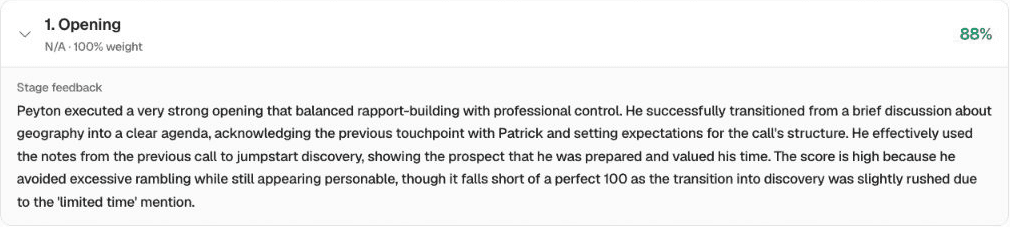
Scores and feedback appear after the session. Managers see the reasoning, not just the number.
Before using the scorecard across the whole team, have every manager score the same handful of calls on their own. Compare the evidence they used, then tighten any criterion they read differently.
“Built value” is hard to check. “Explained the verified deductible difference and asked what the customer preferred” is concrete. Teams that want scoring and manager review in one place can compare the best sales coaching software.
Insurance case study: Globe Life lifts new-agent close rates from about 33% to 60%+
Scoring practice calls takes leader time. Partner Jess Chang saw the jump over about six months.
“Kendo buys back time for my leaders”
Practice insurance objections with Kendo
Choose one objection your agents keep answering too quickly. Build that buyer in Kendo, practice the exchange and inspect the feedback after the call. The next attempt should change one behavior, not add a longer rebuttal.
Buyer Profile
Define who the buyer is and the context they make decisions in.
Scenario & Resistance
Set what is being sold, the conversation stage, and how this buyer should resist.
Insurance Objections: Caller VerificationACTIVE



How do I know you're really with this agency?
You can find the agency's published contact details independently and call to verify me before sharing information.
I'd rather do that than use a number you give me.
That makes sense. We can stop here while you check. You don't need to share anything now.
The manager still checks the call and the feedback. Kendo is for practice and post-call coaching. It does not quote, coach during a live call or sign off on compliance.
Insurance case study: United Insurance Pros cut time to baseline from 45+ days to 14
United Insurance Pros is a 500+ agent organization that tracks how fast new agents reach a defined baseline.
“If you've got more than five agents, it's a no-brainer.”
Questions managers ask
Is every objection a buying signal?
No. It may signal confusion, a real limit or a decision not to go ahead. Judge the reply in context instead of rewarding persistence by default.
What if the other quote really is cheaper?
Explain the verified differences and let the customer weigh them. If the terms are comparable and your agency cannot offer a better fit, say so. Do not invent a flaw in the other offer.
What should the next coaching session cover?
Pick one repeated habit that the call evidence supports. Rehearse the question or explanation the agent missed, then check for it in the next relevant call. Repeating the whole sales pitch rarely fixes the problem.