
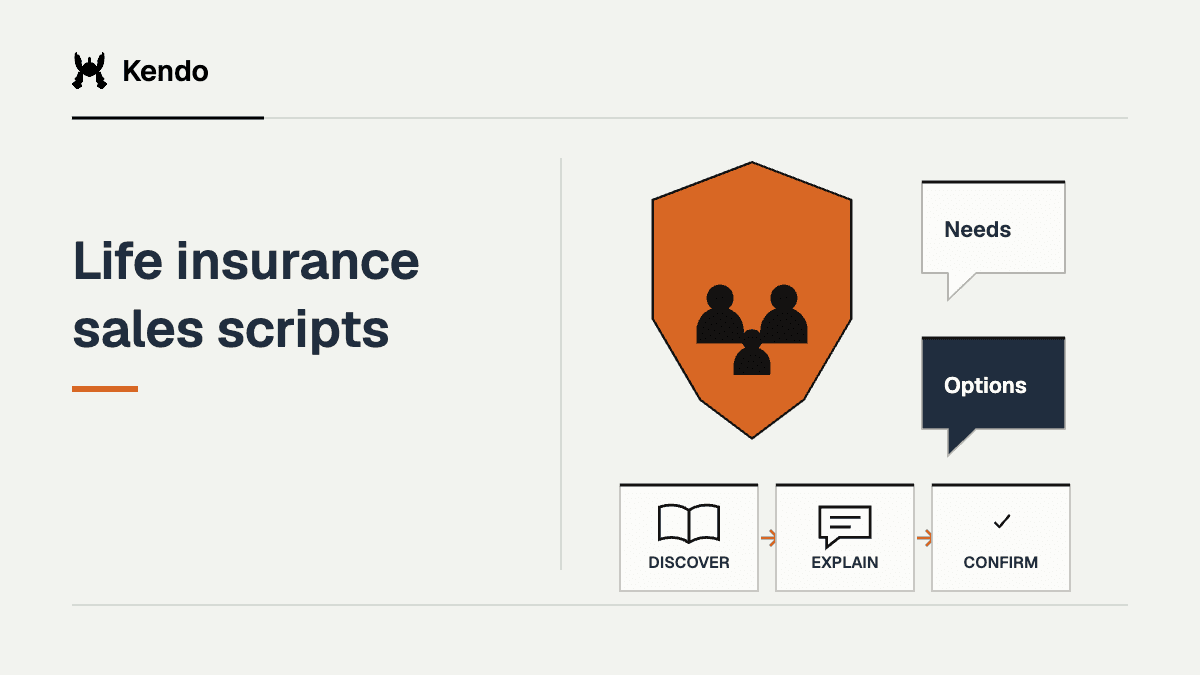

A good life insurance script ties what the client must protect, what cover they already have and what they can afford to one clear next step. Start after first contact: find out why the person wants a review, learn what cover is in place, explain the options accurately and agree on the follow-up. Do not jump from an inquiry to a product pitch.
For agency leaders, the goal is every agent asking the same core questions without sounding like a robot. An agent should know which questions need answers and when to stop talking. What the client says, not the next line on the page, decides what the agent does next.
| Point | Need gap |
|---|---|
| Pre-pandemic | 45% |
| 2024 | 42% |
| 2025 | 40% |
Share of US adults who say they need life insurance or need more of it. That is about 100 million adults in 2025.
Source: Life Happens and LIMRA, 2025 Insurance Barometer Study
Use a conversation map, not a universal pitch
These examples assume a booked conversation or an inquiry that is already open. For first contact, use the separate insurance cold calling scripts. Put cold calling, needs questions and application steps in one script and you cannot coach any of them well.
The North Carolina Department of Insurance tells buyers to decide on three things: how much cover they need, what they can afford and which policy type fits. Use those three as your discovery questions, not as a formula for the amount or product.
- Reason
Why are we talking now?
- Protection
Who depends on you, and what cover is already in place?
- Affordability
What can this household keep paying?
- Explanation
What does the policy actually say, and what is still unclear?
- Follow-up
What gets decided or checked next, and by whom?
Any missing fact or open question pauses the map at that step.
The dialogue below is practice material, not real calls or approved policy wording. Have a licensed reviewer adapt it to your products, states and agency rules. Fill every [bracket] from the client's records and the carrier's materials.
A good script also says where to stop. If an agent cannot explain a policy term accurately, the next move is to check it. If the client cannot afford the proposed premium, the next move is not to argue that their family matters more than their budget.
Insurance case study: 500+ agents reach the defined baseline in 14 days, not 45+
A five-step map only helps if new agents learn it fast. United Insurance Pros is a 500+ agent organization.
“If you've got more than five agents, it's a no-brainer.”
Ask about the reason for the review before the product
Among adults who say they need cover but have not bought it, 46% blame cost and 22% say they do not know how much or what type to buy. That second group needs discovery, not a pitch.
Find the change that brought the client here
Practice script: Opening the review
- Agent
- “What prompted you to look at life insurance now?”
- Client
- “We recently had a child.”
- Agent
- “What would you most want the coverage to help your family manage?”
If the client answers differently
- Client
- “Nothing changed. I just want to understand what I have.”
- Agent
- “Then let’s start with your current coverage and your questions before we talk about anything new.”
The follow-up ties a life event to what the client cares about. It does not assume every new parent has the same income, debts, dependents or cover.
Coaching check: did the agent stick to what the client asked for? If a “help me understand my policy” call turns into a replacement pitch, the agent has drifted. The same rule holds when reviewing coverage with existing clients: start from their question, not the next product.
Client: “We just had a baby. I'm ready to talk coverage amounts.”
Client: “Honestly, my coworker told me to call.”
Good scripts have a branch for that. Practice the second panel.
Separate known coverage from assumptions
Practice script: Checking the cover already in place
- Agent
- “What coverage do you already have, and which details have you been able to confirm?”
- Client
- “There’s a policy through work, but I don’t know the amount.”
- Agent
- “Can you get the plan details? Then we can talk about what it really provides instead of guessing.”
If the client answers differently
- Client
- “I have a personal policy and brought the documents.”
- Agent
- “What was that policy meant to cover, and does that still match what matters to you now?”
Do not wave off workplace cover as worthless or assume a personal policy is too small. Keep three lists: confirmed, what the client remembers, and still to check. Any replacement talk follows the agency's approved review process.
Understand responsibilities without turning discovery into an interrogation
Practice script: Who depends on the client
- Agent
- “Who depends on your income or the work you do at home, and which costs would be hardest for them to cover?”
- Client
- “My spouse earns an income too. The mortgage is the main worry.”
- Agent
- “How would you want the mortgage handled, and what money would still be there?”
If the client answers differently
- Client
- “My children are grown. I’m mostly thinking about final expenses.”
- Agent
- “Which costs are you planning for, and what have you already set aside or arranged?”
Follow the agency's fact-finding form, but tell the client why you are asking each personal question. Do not collect a detail just because the form has a box for it. If the client would rather not answer, say what that leaves unclear and ask how they want to go on.
A 47-second Short from an insurance sales creator. Worth clipping for any agent who opens with “what death benefit do you need?”

- 0:00A life insurance lead does not mean life insurance is the answer. Go in with an open mind.
- 0:16His opener: he does not know yet if he can help, so the call is to find out. Same purpose-first start as the scripts above.
- 0:28What failed early on: asking what kind of policy or death benefit they wanted. The usual answer was “I don't know.”
- 0:34The fix was to make the call about teaching first, then match a product to what he learned.
Discuss affordability before asking for a commitment
Ask about budget before the agent treats the proposal as done. Affordable means the household can keep paying it, not the biggest payment the agent can talk someone into today.
General prospecting advice, not a life insurance script, so treat it as the mindset behind the budget questions.

- 0:05Remove the pressure first: say you are there to inform, and buying or not buying is both fine.
- 0:28Let the prospect do most of the talking. Ask, then listen.
- 0:47People do not buy the price or the product. They buy the person asking.
- 0:53Focus on the client's problem, not your product. A budget that works is part of that problem.
Here is what it sounds like when the budget question comes first.
Practice script: Budget first
- Agent
- “What monthly payment would you be comfortable keeping up alongside your other bills?”
- Client
- “It needs to stay within the amount we set aside.”
- Agent
- “Let’s treat that as a limit. If an option doesn’t fit both your needs and that budget, we’ll talk through the tradeoffs instead of assuming you can stretch.”
If the client answers differently
- Client
- “I don’t know what this should cost.”
- Agent
- “We can look at real options once the details are confirmed. What would make a payment hard to keep up?”
- 3 in 4
- adults overestimate the cost of life insurance
- 10 to 12x
- how far adults 18 to 30 overestimate a $250,000, 20-year term policy
- 1 in 4
- say the household would feel the loss of the main earner within a month
A real quote often lands well below the client's guess.
Source: Life Happens and LIMRA, 2025 Insurance Barometer Study; press release (10 to 12x)
Do not make up a sample premium to keep the conversation moving. Quote from the real system and explain what the price depends on, including anything underwriting still has to decide.
Managers should listen for budget talk in disguise. “It's only the cost of a coffee” does not answer a real budget limit. It swaps the client's priorities for the agent's favorite comparison.
When it is unclear what the concern is, the insurance objections playbook shows how to tell “cannot afford it” apart from “not sure it is worth it” or “looking at another option”.
Explain the option, then check what the client understood
Use the real policy and the approved presentation. Smooth delivery does not make up for wrong terms. A friendly explanation that skips an important limit still leaves the client with the wrong picture.
A term-life discussion
Practice script: Explaining a term policy
- Agent
- “You said the priority is protection during [client’s stated period]. This option has [verified term], [verified premium terms] and [verified benefit]. Let’s go through what happens during that period and what the contract says happens after it.”
- Client
- “So I can keep it on exactly the same terms after that?”
- Agent
- “Let’s check the renewal and conversion rules in this policy. Those details should come from the contract, not a guess.”
If the client answers differently
- Client
- “That period seems shorter than what we discussed.”
- Agent
- “Then we need to look at the fit again before going ahead. Which responsibility lasts longer than that?”
The agent's answer is “let's check” on purpose. Renewal, conversion and future prices differ by policy, so never promise them from memory.
A final-expense discussion
Practice script: Explaining a final-expense policy
- Agent
- “You said your main concern is [stated expense]. Before you decide, let’s go through the premium, the benefit, who qualifies and when this policy pays out.”
- Client
- “Is the full benefit available right away?”
- Agent
- “That depends on this policy’s terms and the underwriting result. Let’s check the benefit schedule and any limits before I answer.”
If the client answers differently
- Client
- “I already have something arranged for that cost.”
- Agent
- “Then let’s understand that arrangement before talking about whether you need anything more.”
Final expense policies do not all pay out the same way. Never coach agents to give one blanket line about waiting periods or who gets accepted. For training on this product line, see the final expense sales training guide.
Insurance case study: a final-expense team reports 5 to 20% improvement
Kody Skvarla leads a final-expense team, the product in the script above. One top performer roughly doubled his own baseline.
“Kendo matches or beats a human practice partner. The objections are the exact same as real calls.”
Make teach-back feel like service, not a test
Practice script: Teach-back
- Agent
- “To check I explained it clearly, how would you describe what this option covers and the main limit we talked about?”
If the answer shows confusion, explain the point again in different words. Do not ask “Does that make sense?” over and over and count a string of yeses as understanding.
Teach-back is a coaching technique here, not a legal requirement. The point is to find a misunderstanding while there is still time to fix it.
Follow up on the unresolved decision
After the sale, many clients rarely hear from the agent who sold them the policy. A follow-up with a clear owner and purpose stands out.
- 43%
- have had no contact with the agent who sold the policy for more than 3 years
- 15%
- get some contact, but without the basics of a good relationship
- 19%
- call the relationship trusted, with regular contact
Separate shares of life insurance customers, so they do not add up to 100%. 5,065 customers surveyed, August 2024 to July 2025.
Source: J.D. Power 2025 U.S. Individual Life Insurance Study
When a spouse or family member is involved
Practice script: A spouse joins the decision
- Client
- “I need to talk with my spouse.”
- Agent
- “Of course. Would it help to go over the options together, or would you rather talk it through privately first?”
If a shared review is welcome, ask what each person needs to know and agree on a next step. If the client wants privacy or no follow-up, respect that.
Do not treat the spouse as an obstacle to remove. No single phrase reliably tells you what a buyer is thinking. A family discussion may be exactly what it sounds like.
When the client asks for written information
Practice script: A request for something in writing
- Agent
- “Which question should the information help you answer?”
If the question is about premium changes or when benefits pay, send the approved material that covers that point. Name the open items instead of burying them in a general brochure.
Ask whether the client wants a follow-up and what it is for. Saying yes to a brochure is not saying yes to six chase calls. A follow-up with a clear purpose is also the start of keeping clients after the sale.
When the agent owes an answer
Practice script: An answer the agent owes
- Agent
- “The question about [policy term] is still open. I’ll confirm it with [right source or specialist] and send the answer through [approved channel]. When would be a useful time?”
Write down who owns the answer. If checking takes longer than expected, tell the client about the delay instead of filling the gap with guesses.
Never push the application faster than the client understands the policy.
Practice life insurance discovery and follow-up with Kendo
Give agents a household that wants to review existing cover with a partner. Build the scenario in Kendo and rehearse the missing question. Score discovery and follow-through, not a practice purchase, then change the documents for the retry.
Buyer Profile
Define who the buyer is and the context they make decisions in.
Scenario & Resistance
Set what is being sold, the conversation stage, and how this buyer should resist.
Life Discovery: Existing Cover and Follow-UpACTIVE



I need to discuss this with my spouse.
Of course. What would you both want clarified before another conversation?
Whether my cover through work already takes care of what we need.
Let's start with those documents and the responsibilities you want covered. If you both want a review, we can arrange one around those questions.
A manager can check discovery with five questions anyone can hear on the recording. Pair them with the agency KPIs the team already tracks.
- Purpose
The client said why the review matters now.
- Existing protection
The agent kept confirmed facts apart from missing ones.
- Affordability
The budget came up early, without pressure.
- Explanation
The client had a chance to ask about the important terms.
- Follow-through
The next step matched the decision that was still open.
Score what the agent did, not whether the practice customer bought. An agent who pauses to check a term should not lose points because a more confident peer guessed and pushed on.
Scorecards: the team decides what counts
Kendo AI Follow-Up Call
Define categories, criteria, and weights
Weight distribution 100/100
Category weights are percentages and must total 100. Criterion points are relative within each category.
- Prior Context7 pts
- Creates Continuity6 pts
- Professional Reopen5 pts
- Relevant AgendaRequired7 pts
- Recap and ConfirmRequired7 pts
- Change Discovery6 pts
- Focused Questions6 pts
- Business Case6 pts
Review the original call before assigning practice. A missing budget question may mean a skill gap, a client who chose not to answer or a service call that should never have become a pitch. If the gap is product knowledge rather than questioning, compare insurance sales training programs for an outside course.
On a bigger team, have managers score the same call and compare notes. Agree on what “enough discovery” means before you compare agents. Otherwise the score says more about who reviewed the call than about what happened on it.
Insurance case study: new-agent close rates from about 33% to 60%+
Managers scoring calls is where leader time goes. Jess Chang saw new-agent close rates climb over about six months.
“Kendo buys back time for my leaders”
Questions managers ask
Should every life agent use the same script?
Use one shared discovery standard and approved product wording, with branches for the client's reason and situation. An income protection talk and a final-expense review should not run through the same questions.
How long should needs analysis take?
Long enough to get the facts that matter and answer the important questions, without stretching the call to hit a time target. Ask whether the client wants detail now or in a separate review. Stop collecting information that has no clear use.
How can a manager tell whether the explanation worked?
Look for the client's own description, real questions and corrections to misunderstandings. Silence and nodding along are weak evidence. Pick one unclear explanation from a reviewed call and rehearse it again with the real approved material.