10 Best Sales Readiness Software Platforms for 2026
Sales readiness is the layer that proves a rep can actually run the call before it counts. We scored 10 platforms on practice realism, coaching, and whether practice and live calls share one scorecard, then named the best fit for your team.
Your new reps don't fail because they lack information. They fail because the first time they say the pitch out loud, it's to a real buyer.
That's the gap sales readiness software is supposed to close. Not another content library, not a one-time bootcamp, but a system that makes sure every rep can actually run the call before the call counts.
If you lead enablement or manage a sales team of 10 to a few hundred reps, you already know the tax: new hires taking too long to become productive, inconsistent messaging, and coaching that lives or dies on how many hours you personally have this week. You've probably also been burned by "training" that looked great in a completion dashboard and changed nothing on live calls.
So we did the work. We evaluated 10 sales readiness platforms against 7 criteria built around one question: does this actually change what happens on the phone? Below you'll find the ranked list, an at-a-glance comparison, honest trade-offs, and a plain "choose this if" guide so you can build a shortlist in an afternoon.
For most SMB and mid-market teams, Kendo is the best sales readiness platform because it closes the loop: reps rehearse against realistic AI buyers, and live calls and practice calls get scored on the same rubric, with pricing you can see up front. If you need deep content governance and digital sales rooms across a large org, Seismic or Highspot go deeper there. For an enterprise readiness suite with a formal Readiness Index, Mindtickle is built for that weight.
What Sales Readiness Actually Means
Sales readiness is the discipline of making sure every rep can run the conversation before they're in front of a buyer. Analysts like Forrester frame it as equipping sellers with the knowledge, skills, and confidence to have effective conversations across the buyer journey.
It gets confused with two neighbors, so let's separate them.
Playbooks, battlecards, decks, and digital sales rooms. The content and systems reps use to sell.
A methodology or technique, usually delivered as an event at a single point in time.
The ongoing, measured layer that verifies execution, then keeps reps sharp with practice, coaching, and certification tied to real outcomes.
The distinction matters because a lot of "readiness" tools are really content systems with a quiz bolted on. Readiness that works looks less like a course catalog and more like a flight simulator with a scoreboard.
The Loop That Turns Training Into Readiness
A content library with a quiz stops after the first box. Readiness runs the whole loop, and grades practice on the exact same standard as the real call.
Rehearse
Reps drill against a realistic AI buyer that actually pushes back.
Score
Practice graded on your rubric, not a completion checkmark.
Certify
Reps clear the bar before a live call ever counts.
Sell Live
Real calls graded on the exact same rubric as practice.
Coach the Gap
The delta between practice and live routes back into targeted reps.
How We Scored the 10 Platforms
We built a scoring model we call the Readiness-in-the-Flow Scorecard (RIFS). It weights the operator levers most roundups ignore and downweights the surface features that photograph well in a demo. Every platform below is scored 1 to 5 on each dimension, then rolled up to a weighted total out of 5.
Two dimensions carry the most weight. Practice realism is where reps actually rehearse; compare how each practice engine handles buyer pushback before scoring that dimension. Live-call review tie-in is the dimension most content-first suites miss; see what call analysis should surface for a coach before scoring the review side.
The RIFS Scorecard
Seven weighted dimensions built around one question: does this change what happens on the phone? Score each tool 1 to 5, multiply by the weight, total out of 5. Run it on your own shortlist before a single demo.
| Dimension | Weight | What "Good" Looks Like |
|---|---|---|
| Practice Realism | 20% Heaviest |
AI voice roleplay with custom prospects, real objections, and full-call practice, not a scripted branching video |
| Coaching Loop | 20% Heaviest |
Specific, prioritized feedback from both AI and the manager on one scorecard everyone trusts, not vibes |
| Outcome Analytics | 15% |
Leading indicators (practice volume, scores) sitting next to lagging ones (ramp, win rate), with cohort trends |
| Live-Call Review Tie-In | 15% |
Practice calls and real calls graded on the same standard, the dimension most content-first suites miss |
| Content System Depth | 15% |
Playbooks, versioning, and digital sales rooms, where the big enablement clouds are strongest |
| Integrations and API | 10% |
CRM (Salesforce, HubSpot), meeting tools, note-takers, and an open API so calls flow in from anywhere |
| Pricing and Time-to-Value | 5% |
You can see the price and get live inside 30 to 60 days, not a quote and a quarter |
One framing helps before you shop: most tools lean practice-first, content-first, or CI-first. Practice-first suites drill the rep and score the reps. Content-first suites govern the library and the sales room. CI-first tools mine live calls but rarely make reps rehearse. The best readiness stack covers all three, and the ranking below rewards platforms that close that loop instead of owning one corner of it.
The 10 Best Sales Readiness Platforms at a Glance
Use this table to screen fast, then read the card for any platform that fits your profile. RIFS is our weighted editorial score out of 5. This is the table to screenshot before your next tooling conversation.
| # | Platform | Best For | Practice + Coaching | Live-Call Tie-In | Pricing | RIFS |
|---|---|---|---|---|---|---|
| 1 | Kendo TOP PICK | Closed-loop readiness | AI voice roleplay, AI + manager on one rubric | Same scorecard on live calls | Public: $55-$100/seat | 4.6 |
| 2 | Mindtickle | Enterprise readiness suite | AI roleplays + Readiness Index | Via CI modules | Custom | 3.9 |
| 3 | Seismic Learning | Content-heavy orgs | Practice module + AI coaching | Limited | Custom | 3.8 |
| 4 | Highspot | GTM enablement | Roleplay add-on + AI coaching | Limited native | Custom | 3.7 |
| 5 | Allego | Agile learning + CI | AI roleplay + coaching | Built-in CI | Custom | 3.6 |
| 6 | Showpad | Pitch scoring + manager visibility | AI pitch scoring + Manager Hub | Limited | Custom | 3.4 |
| 7 | Bigtincan (Brainshark) | Video coaching | Video practice + coaching | Limited | Custom | 3.2 |
| 8 | SalesHood | Mid-market programs | Practice + templates + coaching | Limited | Custom | 3.1 |
| 9 | Qstream | Reinforcement | Scenario reps + light coaching | None | Custom | 2.7 |
| 10 | SmartWinnr | Gamified reinforcement | Roleplay + quizzes + nudges | None | Custom | 2.5 |
Notes reflect each vendor's positioning and public pricing as of July 22, 2026. "Custom" means the vendor does not publish a price.
If you read that table and realize you're actually shopping for the broader content-and-tools layer, not the practice-and-certification layer, compare platforms built around content, guidance, and seller workflow instead. Readiness and enablement solve related but different problems.
The 10 Best Sales Readiness Software Platforms for 2026
The ranking follows the RIFS weights: the two heaviest dimensions are practice realism and the coaching loop, so a platform that closes the loop between practice and live calls sits above one that governs a library. Content-first and reinforcement tools still earn a place for the teams whose real fire lives there.
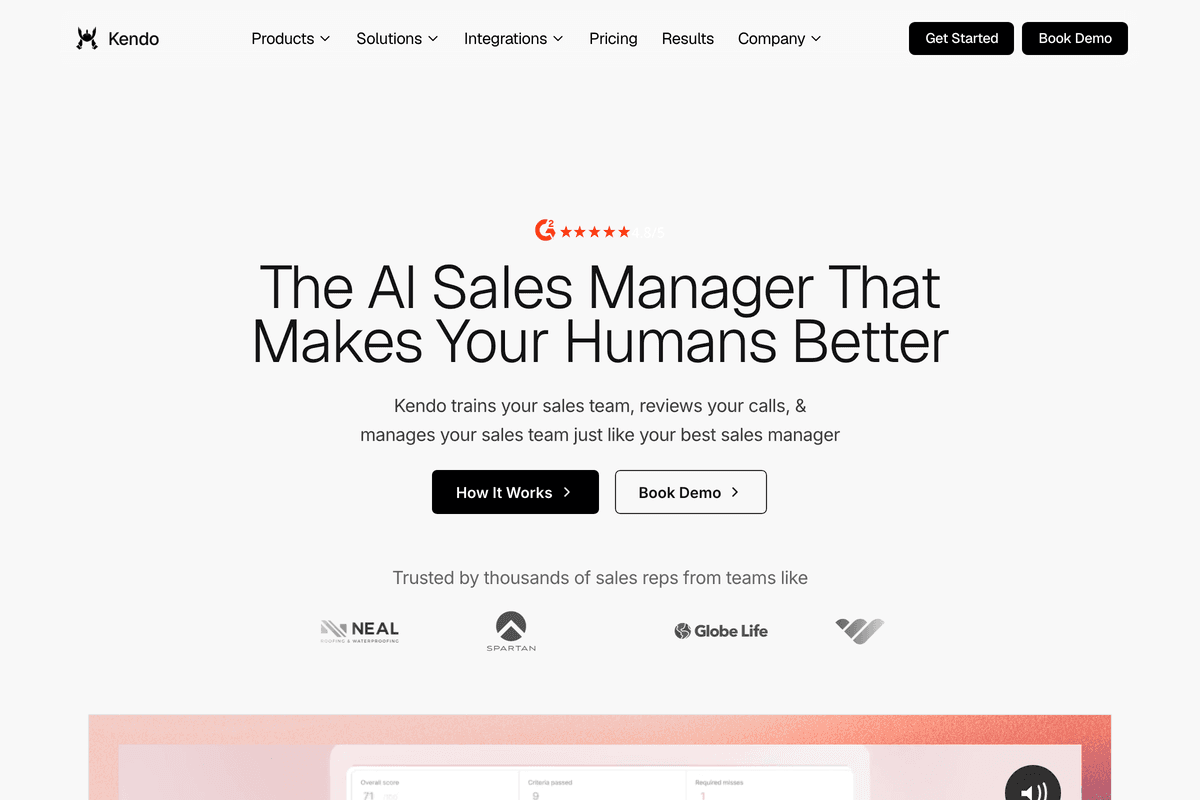
Kendo
Best OverallClosed-loop readiness: reps rehearse against custom AI buyers, and live calls and practice calls get scored on the same rubric, with an AI manager assigning training to the exact gap.
Kendo is an AI sales management and training suite that reviews real calls, finds the specific weakness, assigns targeted practice, and scores that practice on the same rubric it uses on live calls. It's built as a full readiness loop rather than a single stage of it.
Kendo Builds a Readiness Path Reps Certify On Before They Sell
You build a training path in plain language, one stage per part of the call, and each stage is a scored AI roleplay against a custom buyer. A rep has to clear the bar in practice before a live call counts.
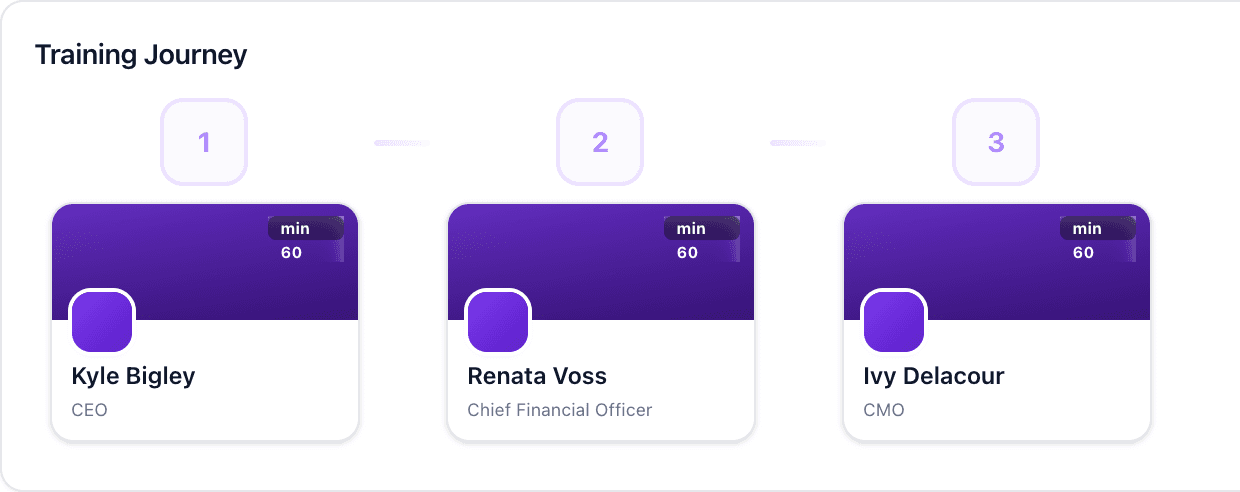 Stage 1 · rehearse the opener
Stage 2 · handle objections
Stage 3 · close, then certify
Stage 1 · rehearse the opener
Stage 2 · handle objections
Stage 3 · close, then certify
This is what practicing on Kendo looks like. The AI buyer pushes hard on SOC 2, ISO 27001, and proof the tool cuts compliance work, and the rep has to handle it on the spot, before any of it lands on a live deal.
Where It Wins
- Practice realism. Reps rehearse against fully custom AI prospects you build in plain language: industry, call type, personality, sales cycle, and ICP, across 40+ languages, with real objections and human-like voice. They can drill objections only or run the full call.
- One closed loop. Kendo scores live calls and roleplay calls with the same customizable 1-to-100 scorecard. That's the whole point of readiness: the standard a rep is graded on in practice is the standard that grades their real calls, so improvement in one shows up in the other.
- An AI manager that acts. Kendo Agent flags the reps who need attention, explains why, and assigns training to the exact gap, so managers spend their hours on high-leverage coaching. That is the repetitive review-and-assignment work an AI manager can absorb.
- Analytics you can act on. Rep skill profiles, score trends, team dashboards, and win-rate context, not just course-completion percentages.
The one honest trade-off: if your top priority is deep content governance, versioned playbooks, and digital sales rooms across a large organization, a content-first suite like Seismic or Highspot is built for that. Kendo is deliberately practice-first and lighter on content management.
Try Kendo With Public Pricing From $55/mo
Public and per seat, which is more than most of this list will tell you before a sales call, per Kendo's pricing page (as of July 22, 2026).
| Pro $55/mo per seat | Max $100/mo per seat | Enterprise Custom |
|---|---|---|
| AI call review, AI roleplay, Kendo Agent, advanced analytics, 180 roleplay minutes per seat each month | Everything in Pro, 480 roleplay minutes per seat each month, for teams that want maximum practice volume | Teams of 10+, custom AI models, custom scoring, done-for-you prospect setup, dedicated account manager |
Best for: SMB and mid-market teams that want readiness and live-call review in one system, with pricing they can see today and a setup measured in days.
RIFS highlights: Strong across all seven dimensions, and the clear leader on the two heaviest, practice realism and the coaching loop, because it's the only platform here that reviews live calls and scores assigned practice on the same standard. Lighter, by design, on content-system depth.
Structured Readiness Nearly Doubled Globe Life's New-Hire Close Rate
Globe Life was burning hours on manual roleplays while brand-new agents opened at only around 33% close rates. After putting new agents through structured practice on every part of the script, new-hire close rates roughly doubled to 60%+ inside 6 months.
Result: brand-new agents went from closing about 1 in 3 to closing more than 3 in 5, because they were getting the repetition, the rebuttals, and the practice before they touched a live lead.
"Our closing rate for brand new agents has been almost close to double with the use of Kendo just because they're getting that repetition, they're getting the rebuttals, they have the practice."Jess Chang, Partner, Globe Life
Mindtickle
Best for EnterpriseEnterprise readiness with a named Readiness Index that rolls skills, knowledge, and activity into one measure leaders can track across large orgs.
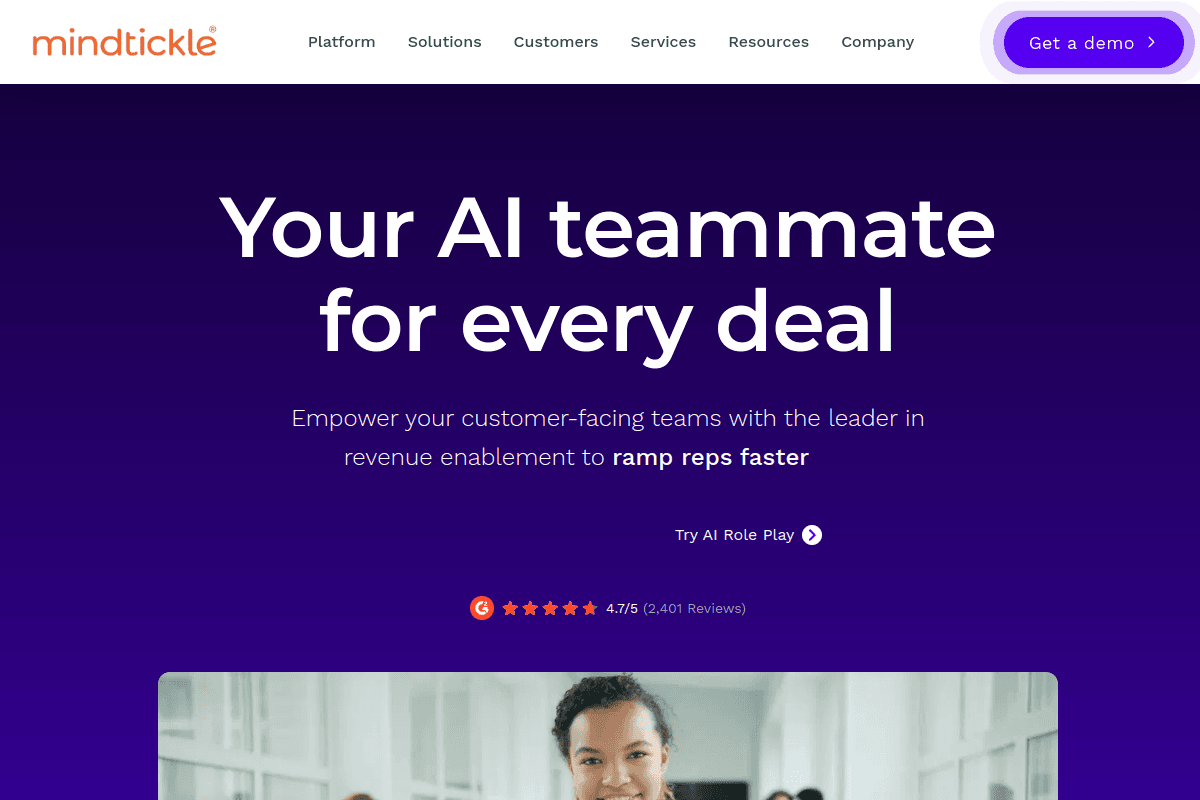
Mindtickle is an enterprise revenue-enablement and readiness platform that pairs content, training, and coaching with a named Readiness Index.
Where It Wins
- Readiness scoring at scale. The Readiness Index rolls rep skills, knowledge, and activity into a single measure leaders can track across large organizations.
- Practice and coaching. It offers AI role-plays and structured coaching workflows alongside its content and analytics.
- Breadth. Content, certification, and analytics live under one roof, which enterprise buyers often need for a coordinated rollout.
Consider before choosing
- Built and priced for the enterprise. Custom, quote-based pricing means slower procurement and a higher floor.
- Can be more platform than a lean team needs. The full suite is a lot for a team under 25 reps.
Pricing: Custom, quote-only. Mindtickle does not publish public pricing.
Best for: Enterprise sales orgs that want one readiness suite spanning content, certification, and analytics, with the budget and rollout patience to match.
RIFS highlights: Strong on readiness scoring and breadth, lighter on pricing clarity and fast time-to-value.
Seismic Learning
Best for Content DepthThe learning and coaching layer, formerly Lessonly, sitting inside the broader Seismic Enablement Cloud.
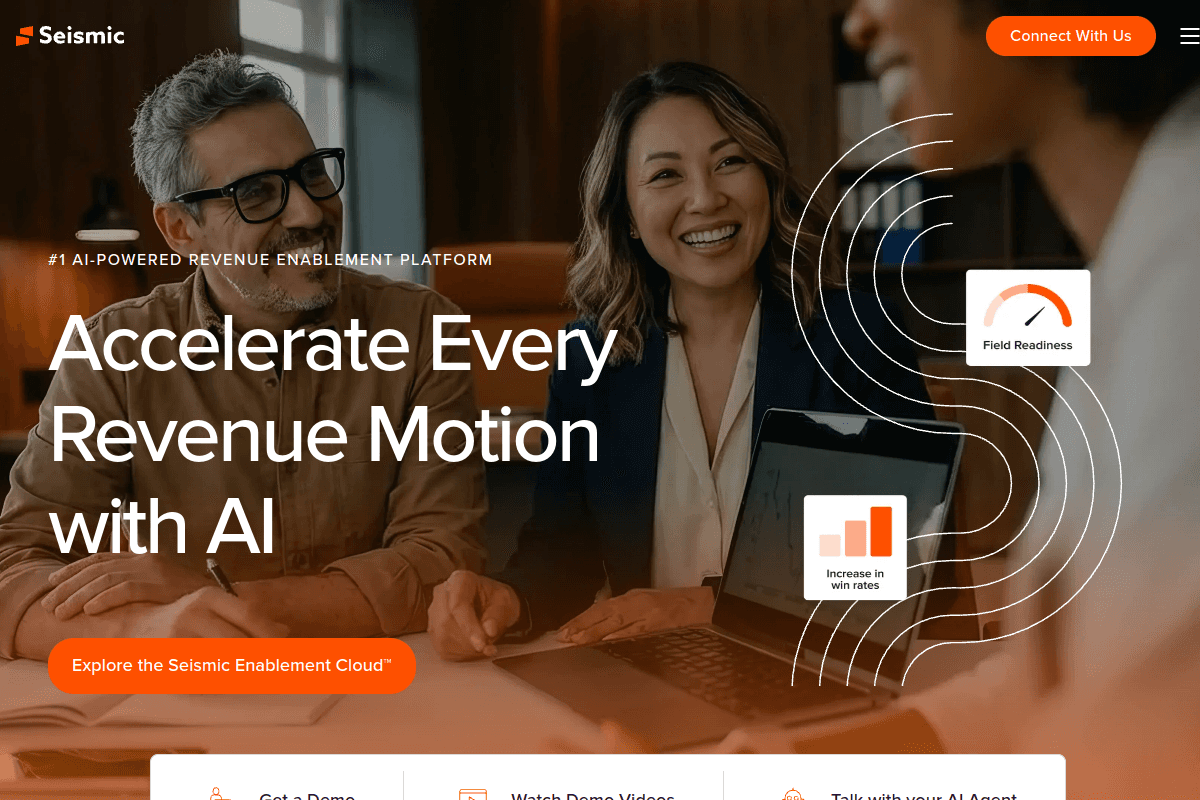
Seismic Learning is the learning and coaching layer inside the broader Seismic Enablement Cloud, built for orgs that want training in the same place as their content.
Where It Wins
- Learning tied to content. Training and coaching sit next to the content and sales-room tooling most enablement teams already run on Seismic.
- AI-assisted coaching. Seismic Learning adds AI-driven practice and feedback to its lessons and paths.
- Governance. For orgs that live and die by versioned, compliant content, the surrounding cloud is a real advantage.
Consider before choosing
- Readiness is one module in a large platform. Roleplay and live-call review depth are not the center of gravity.
- Heavier rollout and custom pricing. Expect an enterprise-scale implementation.
Pricing: Custom, quote-only.
Best for: Organizations already standardized on Seismic that want learning and coaching without adding another vendor.
RIFS highlights: Strong on content-system depth and governance, lighter on practice realism and live-call tie-in.
Highspot
Best for GTM EnablementA go-to-market enablement platform that layers training and coaching onto its content, guidance, and analytics.
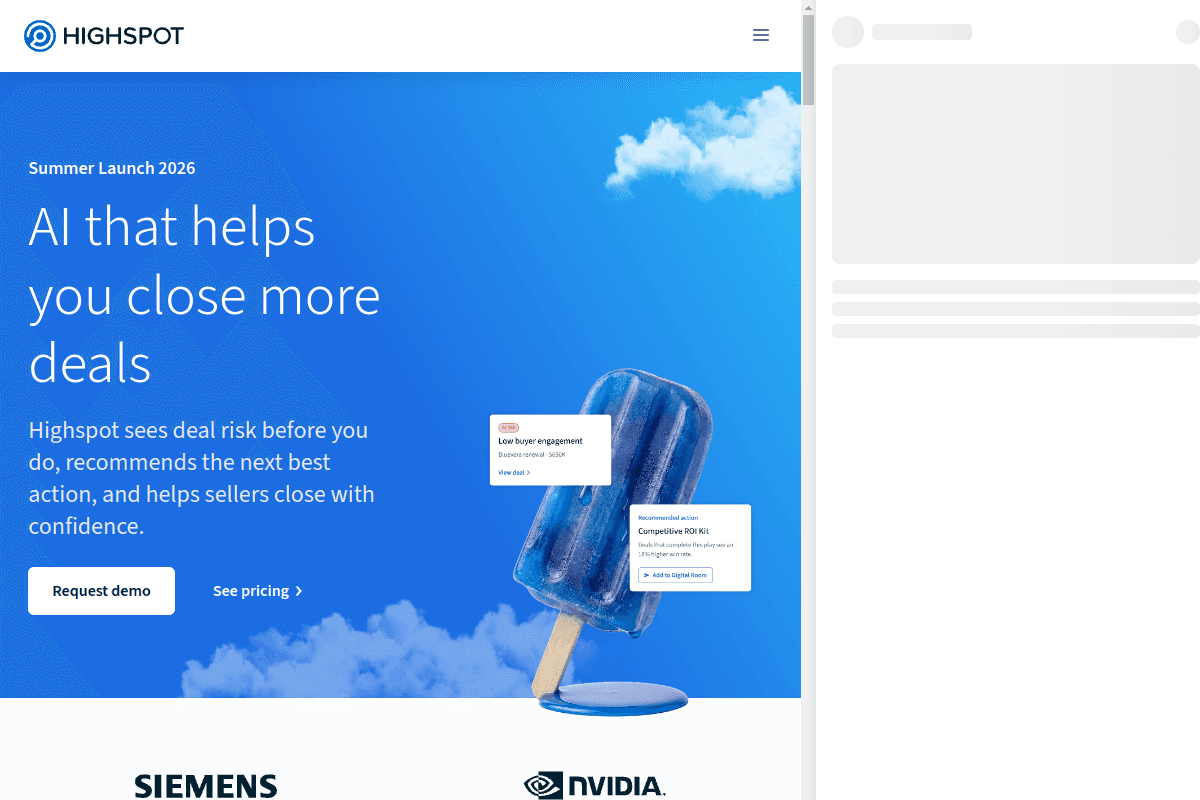
Highspot is a go-to-market enablement platform that layers training and coaching onto its content, guidance, and analytics.
Where It Wins
- Content plus context. Highspot connects playbooks and guidance to the CRM and the deal, which helps reps apply what they learn in the moment.
- AI coaching. It offers AI-assisted practice and scoring inside the same platform reps use for content.
- Measurement. Usage and scorecard analytics tie enablement activity to pipeline for leaders who report up.
Consider before choosing
- Content governance is the center of gravity. Practice and roleplay read as an add-on rather than the core.
- Custom pricing, enterprise-scale rollout. Budget for a longer implementation.
Pricing: Custom, quote-only.
Best for: Larger GTM teams that want enablement, guidance, and training under one roof and value content depth over practice depth.
RIFS highlights: Strong on content-system depth and analytics, lighter on practice realism and live-call tie-in.
Allego
Best for Learning + CIA readiness and enablement platform that unifies learning, content, AI roleplay, conversation intelligence, and digital sales rooms.
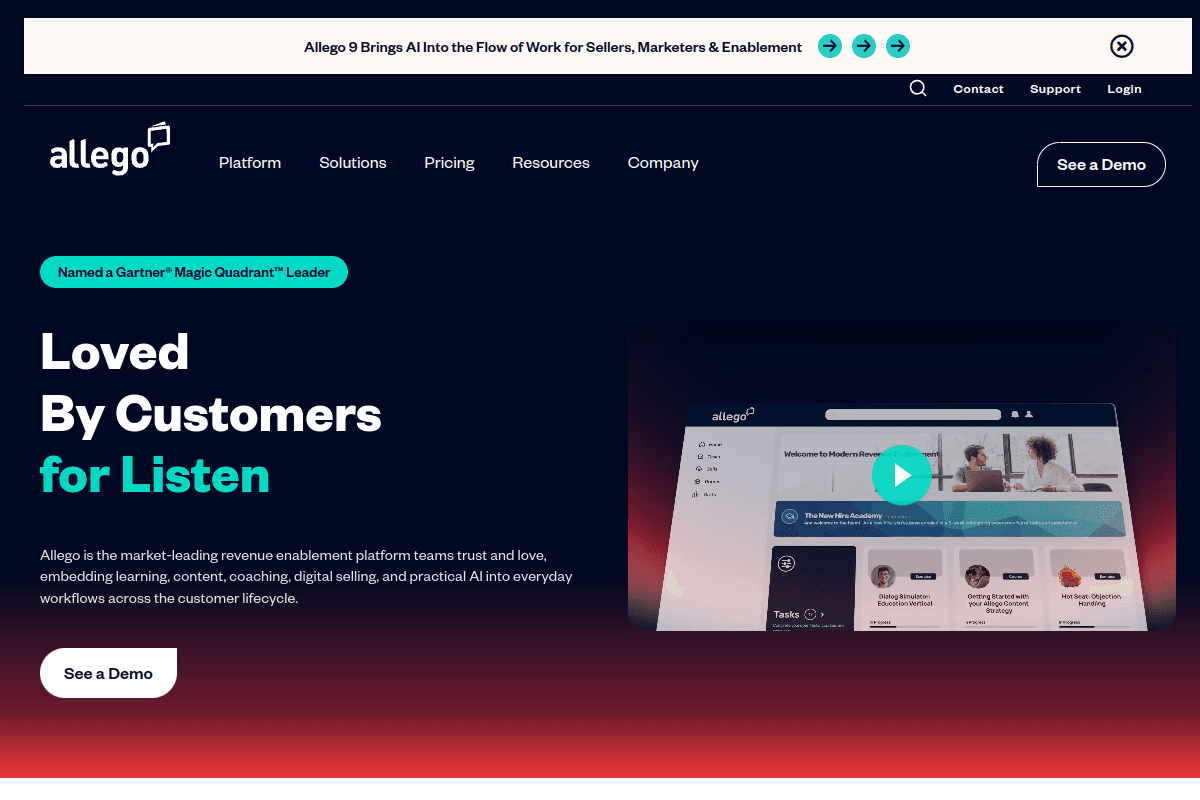
Allego is a readiness and enablement platform that unifies learning, content, AI roleplay, conversation intelligence, and digital sales rooms in one product.
Where It Wins
- Breadth done coherently. Allego frames readiness as agile learning plus agile content plus agile collaboration, and it actually ships CI and digital sales rooms in the same product.
- Practice with review. AI roleplay sits alongside call intelligence, so there's a path from rehearsal to real-call analysis.
- Video-native coaching. Its heritage in video makes peer and manager coaching feel natural.
Consider before choosing
- Wide surface area. Powerful, but more to configure and adopt before it pays off.
- Custom pricing. No public per-seat number.
Pricing: Custom, quote-only.
Best for: Teams that want learning, content, roleplay, and conversation intelligence from a single vendor and have the appetite to configure it.
RIFS highlights: Balanced across practice, coaching, and live-call tie-in through built-in CI, lighter on pricing clarity.
 Across Kendo customers: new-hire close rates from 33% to 60%+, reps ramp 75% faster, and a 5-20% production lift.
See the results →
Across Kendo customers: new-hire close rates from 33% to 60%+, reps ramp 75% faster, and a 5-20% production lift.
See the results →
Showpad
Best for Pitch ScoringA content-enablement platform with a coaching layer that scores rep pitches with AI and surfaces readiness in a manager hub.
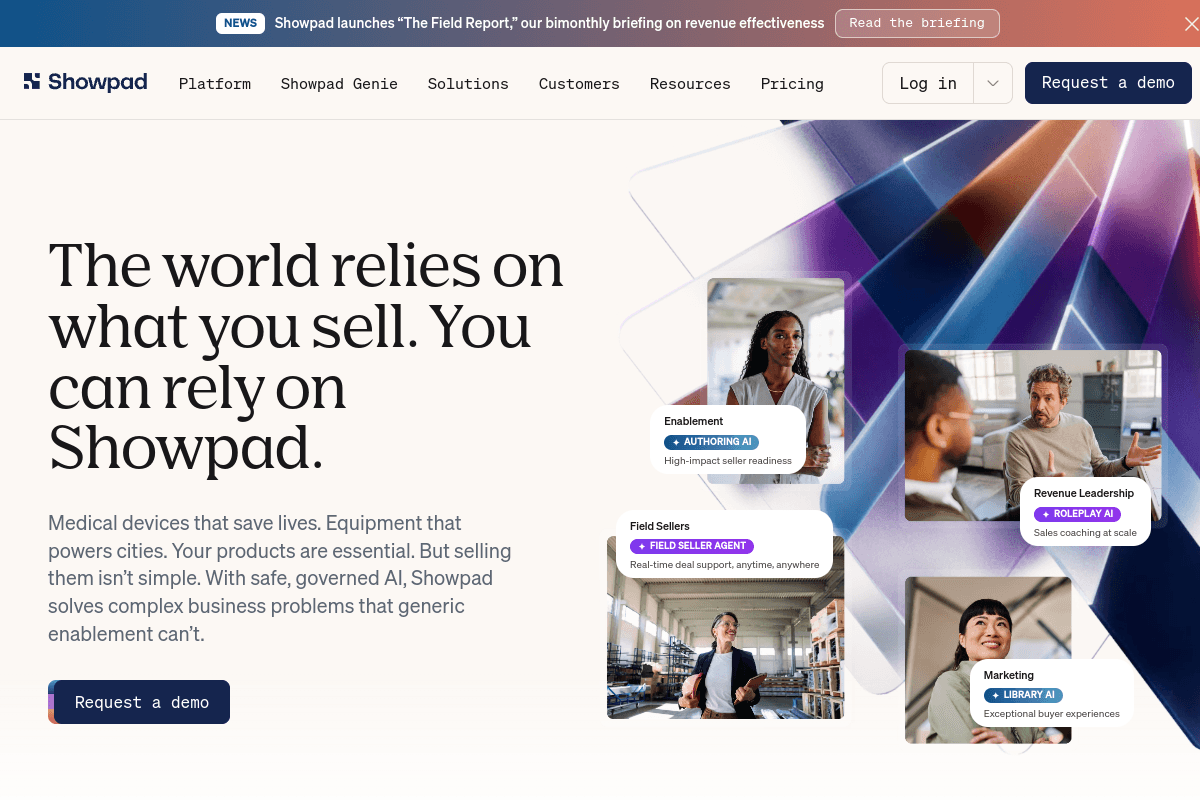
Showpad is a content-enablement platform with a coaching layer that scores rep pitches with AI and surfaces readiness in a manager hub.
Where It Wins
- AI-scored practice. Showpad's coaching scores recorded pitches so reps get feedback without waiting on a manager.
- Manager visibility. A manager hub highlights who's practicing, who's improving, and who's stuck.
- Content strength. Its enablement roots mean strong content organization for field teams.
Consider before choosing
- Readiness is one part of a wider platform. It spans content management broadly rather than a dedicated practice-and-review engine.
- Custom pricing. No public per-seat number.
Pricing: Custom, quote-only.
Best for: Field and channel teams that want AI pitch scoring and manager oversight inside a content-first platform.
RIFS highlights: Strong on pitch scoring and manager visibility, lighter on live-call tie-in and full-call practice realism.
Bigtincan Readiness (Brainshark)
Best for Video CoachingThe readiness solution built on Brainshark, now part of the Bigtincan ecosystem, with mature video coaching and authoring.

Bigtincan Readiness is the readiness solution built on Brainshark, now part of the Bigtincan ecosystem after Bigtincan acquired Brainshark.
Where It Wins
- Proven video coaching. Brainshark's video coaching and assessment tooling is mature and well understood by enablement veterans.
- Authoring depth. Strong content authoring for teams that produce a lot of their own training.
- Suite backing. Sitting inside Bigtincan adds content and enablement breadth around the readiness core.
Consider before choosing
- Buying the readiness piece can mean buying the wider suite. The live-call practice-to-review loop is not its strongest edge.
- Custom pricing. No public per-seat number.
Pricing: Custom, quote-only.
Best for: Enablement teams that value established video coaching and authoring and want it inside a broader suite.
RIFS highlights: Strong on video practice and authoring, lighter on AI-buyer roleplay realism and live-call tie-in.
SalesHood
Best for Mid-MarketA learning, coaching, content, and digital-sales-room platform aimed at mid-market teams that want to ramp readiness quickly.
SalesHood is a learning, coaching, content, and digital-sales-room platform aimed at mid-market teams that want to ramp readiness quickly.
Where It Wins
- Speed to program. Prebuilt, out-of-box programs and templates get a readiness motion live faster than a blank-canvas build.
- Coaching plus content. It combines learning paths, peer coaching, and content in a single mid-market-friendly package.
- Digital sales rooms. Buyer-facing rooms extend readiness into how reps actually run deals.
Consider before choosing
- Lighter live-call AI review. It leans more program-and-content than closed-loop scoring.
- Custom pricing. No public per-seat number.
Pricing: Custom, quote-only.
Best for: Mid-market teams that want a guided, program-led readiness rollout without heavy configuration.
RIFS highlights: Strong on out-of-box programs and speed, lighter on live-call tie-in and deep scoring.
Qstream
Best for ReinforcementA microlearning and knowledge-reinforcement platform that uses spaced scenario questions to keep skills and knowledge fresh.

Qstream is a microlearning and knowledge-reinforcement platform that uses spaced scenario questions to keep skills and knowledge fresh.
Where It Wins
- Reinforcement science. Spaced, scenario-based questions fight the forgetting curve better than one-and-done courses.
- Knowledge analytics. Qstream surfaces proficiency and knowledge gaps at the individual and team level.
- Low friction. It's a light add-on that slots next to an existing enablement or training stack.
Consider before choosing
- Reinforces knowledge, not full readiness. You'll still need a roleplay and scoring engine for true practice-and-review.
- Custom pricing. No public per-seat number.
Pricing: Custom, quote-only. If your reinforcement need is contact-center-shaped, compare tools built for high-volume contact-center reinforcement too.
Best for: Teams that already have training in place and want a reinforcement layer to make it stick.
RIFS highlights: Strong on spaced reinforcement and knowledge analytics, no live-call tie-in and light practice realism.
SmartWinnr
Best for GamificationA gamified reinforcement platform that combines quizzes, roleplay, contests, and targeted learning paths to drive engagement.
SmartWinnr is a gamified reinforcement platform that combines quizzes, roleplay, contests, and targeted learning paths to drive engagement.
Where It Wins
- Engagement. Gamification, leaderboards, and nudges keep reinforcement front of mind for distributed teams.
- Targeted paths. Learning routes to the specific gaps a rep needs, rather than one generic curriculum.
- AI coaching nudges. Automated prompts and quizzes keep practice cadence up between manager sessions.
Consider before choosing
- Complements rather than replaces. It lifts adoption on a content-heavy stack but has no live-call scoring loop.
- Custom pricing. No public per-seat number.
Pricing: Custom, quote-only.
Best for: Teams that want gamified reinforcement to lift adoption on top of an existing enablement or training system.
RIFS highlights: Strong on engagement and targeted paths, no live-call tie-in and light full-call practice realism.
Does Sales Readiness Actually Move Deals?
Fair question, and the right one to ask before you spend a budget line on it. The honest answer: readiness only moves deals when it's measured against live-call performance, not course completion.
So look for platforms that can prove the link, and hold your vendor to the same standard. Here's what that looks like in practice, using a team that ran it.
The pattern repeats across teams that run it. United Insurance Pros cut onboarding from 30 days to 24 hours, then compressed time-to-baseline from about 45 days to 14, saving north of $3,000 per rep per month in wasted leads. Skvarla Insurance used pre-call practice to lift agent close rates by 5% to 20% and roughly double monthly production for its top performer, while freeing the owner from a full day of 1-on-1 script drills.
The common thread: reps who rehearse the complete scenarios closers face and get scored on a consistent rubric ramp faster and close more. You can see the aggregate proven sales team outcomes across close rate, ramp, and savings on Kendo's results page.
- The takeaway for your evaluation: ask every vendor to show the readiness-to-outcome line, from practice volume and scorecard trends to ramp time and win rate. If a platform can only show you who finished a course, it's an enablement tool wearing a readiness label.
How to Choose the Right Sales Readiness Platform
Skip the feature checklist. Start from your actual constraint, then pick the tool that resolves it. Here's the shortlist logic for the five most common profiles.
- Choose Kendo if you want a closed loop: reps practice against realistic AI buyers, live calls and practice calls get scored on the same rubric, and an AI manager assigns training to the exact gap. It's the strongest fit for SMB and mid-market teams that want transparent, seat-plus-usage pricing and to be live in days, not a quarter.
- Choose Seismic or Highspot if your center of gravity is content: versioned playbooks, governance, digital sales rooms, and enablement across a large GTM org. You'll trade practice depth and pricing transparency for content depth and enterprise breadth.
- Choose Mindtickle if you need an enterprise readiness suite with a formal Readiness Index and a broad ecosystem, and you have the procurement runway for a custom, quote-based rollout.
- Choose Showpad or Allego if you want AI pitch scoring, agile learning, conversation intelligence, and manager visibility from a single content-first vendor, and you're comfortable configuring a wider surface area.
- Choose Qstream or SmartWinnr if you already have a training or enablement system and just need a reinforcement layer, microlearning or gamified, to keep knowledge from decaying between sessions.
One more filter for leaders who report to finance: whatever you pick should feed a performance system, not just a completion report. If you're building that scorecard-to-revenue view, see how scorecards and coaching activity connect to revenue outcomes.
Frequently Asked Questions
Sales readiness is making sure every rep can actually perform in a buyer conversation, measured and reinforced over time. Enablement defines how content, process, and seller execution fit together; training transfers a skill at a point in time. Readiness is the ongoing layer that verifies a rep can execute and keeps them sharp through practice, coaching, and certification. Analysts like Forrester frame it as equipping sellers with the knowledge and skills to have effective conversations across the buyer journey.
Track leading and lagging indicators side by side. Leading: practice volume, scorecard scores, certification pass rates, and how fast new hires clear their ramp milestones. Lagging: ramp time to first deal, close rate, and quota attainment by cohort. The point is to connect practice and scoring data to real deal outcomes, so a rising scorecard trend shows up as faster ramp and a better win rate, not just more course completions.
You need both jobs done, and ideally in one loop. Conversation intelligence tells you what happened on real calls; readiness makes sure reps can do better on the next one. When practice and live-call review share a single scorecard, feedback compounds instead of living in two disconnected tools. If you're weighing CI-first options first, compare tools built around recorded-call analysis.
Plan for four things: importing your context (scripts, playbooks, frameworks, and sample calls), designing the scorecards and rubrics that reflect how your team actually sells, connecting integrations (CRM like Salesforce or HubSpot, plus note-takers and meeting tools), and getting manager buy-in so the coaching cadence is something they can actually sustain. Practice-first tools tend to reach time-to-value in 30 to 60 days; content-heavy enterprise suites usually take longer.
The Bottom Line
The sales readiness category is splitting in two. On one side, content-first clouds are getting deeper at governance and sales rooms. On the other, practice-first tools are getting sharper at making reps rehearse and scoring them against live calls. The winners in 2026 will be the platforms that close the loop between the two.
For most SMB and mid-market teams, the fastest path to reps who can actually sell is a closed-loop system with transparent pricing you can start today.
Run Kendo on one team for 30 days, score their practice and their live calls on the same rubric, and watch whether ramp and close rate move. Start free and let the scoreboard make the call.

Luke Alexander is the founder of Kendo AI, where he's helped train more than 5,000 sales reps. He started in sales as a frontline closer, scaled a high-ticket sales-training company, and founded Closer Cartel and AI Insiders before building Kendo to fix the tools he wished he'd had: realistic AI roleplay and automated call review for fast-moving sales teams. He writes about sales readiness, ramp speed, coaching, and applying AI across the revenue org.