
If you manage a sales team of anywhere from 5 to 200 reps, you already know the math doesn't work. There are more calls every week than any human can review, more reps than you can coach one-on-one, and new hires who take 45 days to get productive while the leads keep burning. That's the exact gap an AI sales manager is built to close.
An AI sales manager is software that automates the repetitive parts of running a team. It reviews calls, scores them against your standards, spots each rep's skill gaps, assigns targeted practice, and tracks whether performance actually improves. Done right, it's a closed loop, not a fancier call recorder.
We evaluated 8 AI sales manager platforms against six criteria that map to the pains sales leaders actually feel: call-review depth, coaching realism, training workflow, manager time saved, data visibility, and pricing clarity. Below you'll find the ranked shortlist, a side-by-side comparison table, a scoring rubric you can run on your own stack, and a 30-day rollout plan. The point is simple: which one fits your team, and why.
For most teams running 5 to 200 reps, Kendo is the best AI sales manager because it runs the whole loop: it reviews live calls, assigns AI roleplay practice against the exact gap, and scores that practice on the same rubric as real calls, with pricing you can see up front. If your fire is enterprise forecast accuracy, a revenue-intelligence platform like Gong goes deeper there. If you only want a practice simulator, Second Nature is more focused.
What an AI Sales Manager Actually Does (and Doesn't)
Most tools that call themselves "AI for sales managers" stop at record and summarize. They transcribe the call, hand you a recap, and leave the coaching to you. That's useful, but it's the easy 20% of the job.
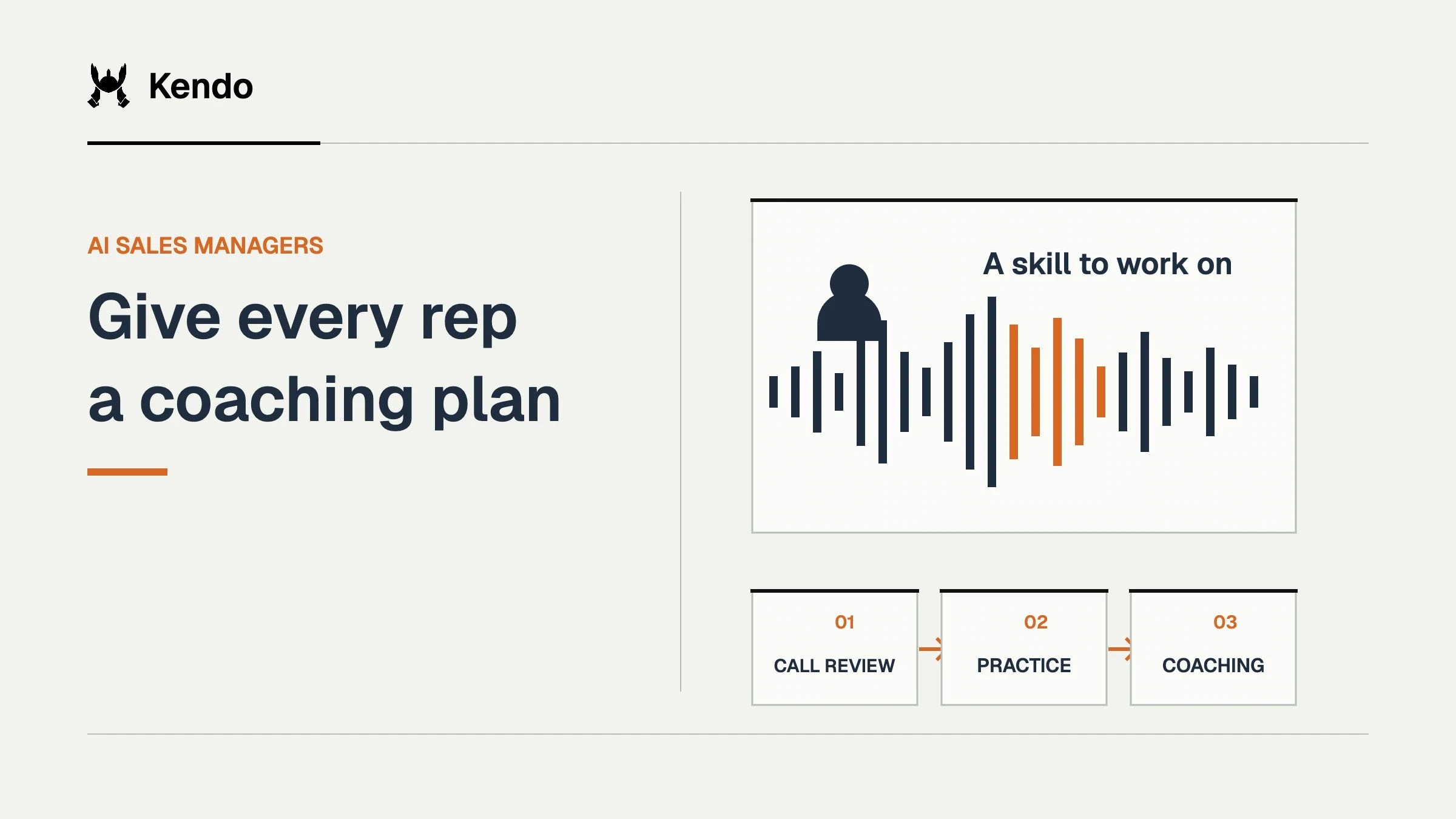
The hard 80% is the loop: review the call, diagnose the specific weakness, assign the right practice, score that practice, and confirm the rep actually changed behavior. A real AI sales manager runs that loop so you don't have to do it by hand for every rep, every week.
The Loop a Real AI Sales Manager Runs
Record-and-summarize tools stop after the first step. A full AI sales manager runs all five, on every rep, every week, without a human touching each one.
Review
Every call reviewed and scored against your scorecard.
Diagnose
Pinpoint the exact weakness, not a generic sentiment score.
Assign
Push targeted roleplay practice against the named gap.
Score
Grade the practice on the same rubric as live calls.
Confirm
Verify the behavior changed on the next live call.
Here's the one distinction worth memorizing. The analysis-first conversation intelligence layer tells you what happened on the call. AI coaching goes further: it prescribes the practice a rep needs, scores that practice against the same rubric as live calls, and tracks the behavior change over time.
| The Job | Conversation Intelligence | AI Coaching (Full Loop) |
|---|---|---|
| What it produces | A transcript, recap, and sentiment or keyword trends | A diagnosis, assigned practice, and a scored result |
| When it acts | After the call is over | After the call, then before the next one |
| Who does the coaching | Your managers, by hand | The tool assigns and scores it, managers steer |
| The question it answers | What happened on the call? | Did the rep actually get better? |
One guardrail before the list. None of these tools replace a human sales manager, and you shouldn't want them to. They automate the repetitive review and training work so you can spend your hours on the deals and the people that actually move the number.
Our Evaluation Criteria for AI Sales Managers
Every tool below is judged against the same six criteria. These are the dimensions that decide whether a platform saves you time and makes reps better, or just adds another dashboard nobody opens.
- Call-review depth and accuracy. Good means it reviews and analyzes every call, applies scorecards built for your specific call types, and returns tactical feedback, not a generic sentiment score.
- Coaching realism and feedback quality. Good means the practice feels like a real buyer, with objections that match your actual calls, and feedback specific enough for a rep to act on tomorrow.
- Training workflow (assign, goals, scorecards). Good means you can assign targeted practice against a named weakness, set a score or time goal, and see who completed it.
- Manager time saved through automation. Good means auto-review, auto-summaries, alerts on flagged reps, and the ability to ask a question about the team instead of digging through recordings.
- Data visibility across CRM, forecast, and analytics. Good means rep-level skill profiles, team trends, and clean ingestion from your call sources and CRM.
- Pricing clarity and implementation effort. Good means you can see what it costs and get value in weeks, not a quarter-long rollout gated behind a sales cycle.
Those last two matter more than vendors admit. A platform you can't price or can't launch quickly is a platform your reps won't use while procurement drags on.
The AI Sales Manager Fit Score (AIMS)
Feature lists don't help you decide. So here's a simple rubric that turns the six criteria into a number: the AI Sales Manager Fit Score, or AIMS. Score each tool 1 to 5 on each criterion, multiply by the weight, and add it up.
The AIMS Fit-Score Rubric
Score each tool 1 to 5 per criterion, multiply by the weight, total out of 5. Run it on your own shortlist before you take a single demo.
| Criterion | Weight | What a Strong Score Looks Like |
|---|---|---|
| Call-Review Depth and Accuracy | 20% Heaviest |
Reviews every call, custom scorecards by call type, tactical feedback |
| Coaching Realism and Feedback Quality | 20% Heaviest |
Human-like practice, objections that match real calls, specific fixes |
| Training Workflow (Assign, Goals, Scorecards) | 20% Heaviest |
Assign practice on a named gap, set a score or time goal, track completion |
| Manager Time Saved (Automation) | 15% |
Auto-review, auto-summaries, flagged-rep alerts, chat-based team queries |
| Data Visibility (CRM, Forecast, Analytics) | 15% |
Rep skill profiles, team trends, clean call-source and CRM ingestion |
| Pricing Clarity and Implementation Effort | 10% |
Public pricing, self-serve start, value in weeks |
Here's the method in practice. Say you run a 40-rep insurance team and your real problem is ramp, not forecasting. You keep the weights above, score each tool on your shortlist, and watch what happens: any platform that can review live calls AND assign scored practice against the same rubric clears the two biggest categories. A tool that only records and summarizes cannot, no matter how slick the dashboard.
Now flip the scenario. If you're an enterprise where forecast accuracy is the fire, you'd weight data visibility higher, and a revenue-intelligence platform climbs your board. Same rubric, different answer. Score your own shortlist before you take a single demo.
The 8 Best AI Sales Manager Tools at a Glance
Every cell below is a concrete note, not a yes/no checkmark. This is the table to screenshot before your next tooling conversation.
| # | Tool | Best For | Call Review + Scoring | Coaching + Practice Loop | Pricing |
|---|---|---|---|---|---|
| 1 | Kendo TOP PICK | Closed-loop coaching and training | Every call, custom 1-100 scorecards by call type | Native AI roleplay, auto-assigns practice, scores it on the same rubric | Public: $55 / $100 / custom |
| 2 | Gong | Enterprise revenue intelligence | Deep call analytics tied to deals and forecast | Post-call coaching, live practice not native | Quote-only |
| 3 | Salesloft | Signal-to-action in engagement | Conversation intelligence on engagement calls | Coaching layer, live practice not native | Quote-only |
| 4 | Outreach | AI agents in execution | Kaia live meeting assist | Execution guidance, practice not native | Quote (license + usage) |
| 5 | Avoma | Budget meeting AI plus coaching | Meeting AI with CI add-on | Coaching via CI add-on, practice not native | Public, self-serve |
| 6 | Highspot | Enablement-led AI | Call insights inside enablement | Agentic guidance and coaching, roleplay not core | Quote-only |
| 7 | Mindtickle | Enterprise readiness | CI plus call scoring | AI role-plays and certifications | Quote-only |
| 8 | Second Nature | Roleplay and certifications | Focused on practice, not live-call review | Strong AI roleplay and certification practice | Quote-only |
Notes reflect each vendor's positioning as of July 2026. Pricing marked "quote-only" means the vendor does not publish per-seat pricing and routes buyers through a sales conversation.
The 8 Best AI Sales Manager Tools, Ranked
The ranking follows the AIMS weights: the two heaviest categories are coaching realism and training workflow, so a tool that closes the loop sits above one that only records it. Adjacent categories, revenue intelligence and enablement, still earn a place for the teams whose real fire lives there.
Kendo
Best OverallClosed-loop coaching and training at team scale: reviews live calls, assigns AI roleplay, and scores that practice on the same rubric it uses for real calls.
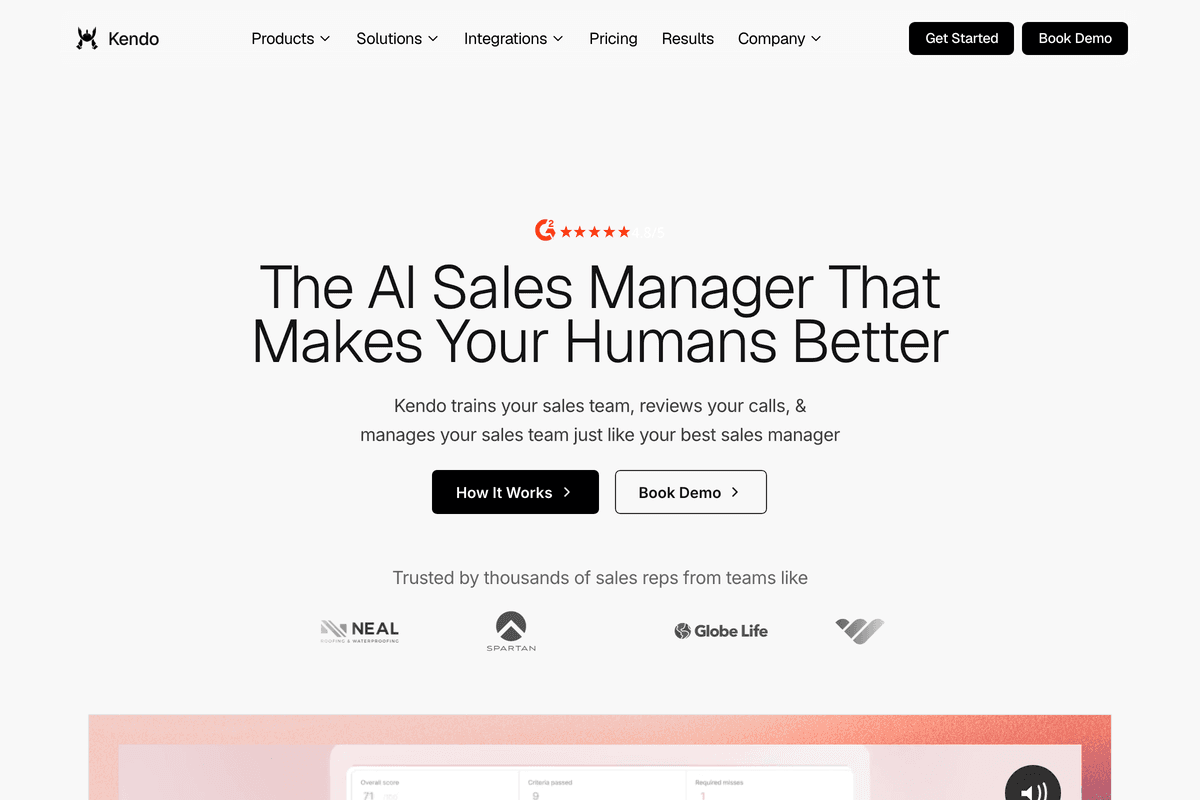
Kendo positions itself as the AI sales manager that makes your humans better.
Kendo is an AI sales management and training suite that reviews live calls, scores them, runs AI roleplay practice, and assigns training, all tied together by Kendo Agent, its AI sales manager layer. It's the only tool here built as a full loop rather than a single stage of it.
Kendo Reviews Every Call and Scores It Your Way
Kendo applies custom 1-to-100 scorecards mapped to your call types, cold calls, discovery, demos, follow-ups, and returns summaries, strengths, weaknesses, and sentiment. That's the depth criterion, handled by automated AI sales call reviews instead of you scrubbing recordings.
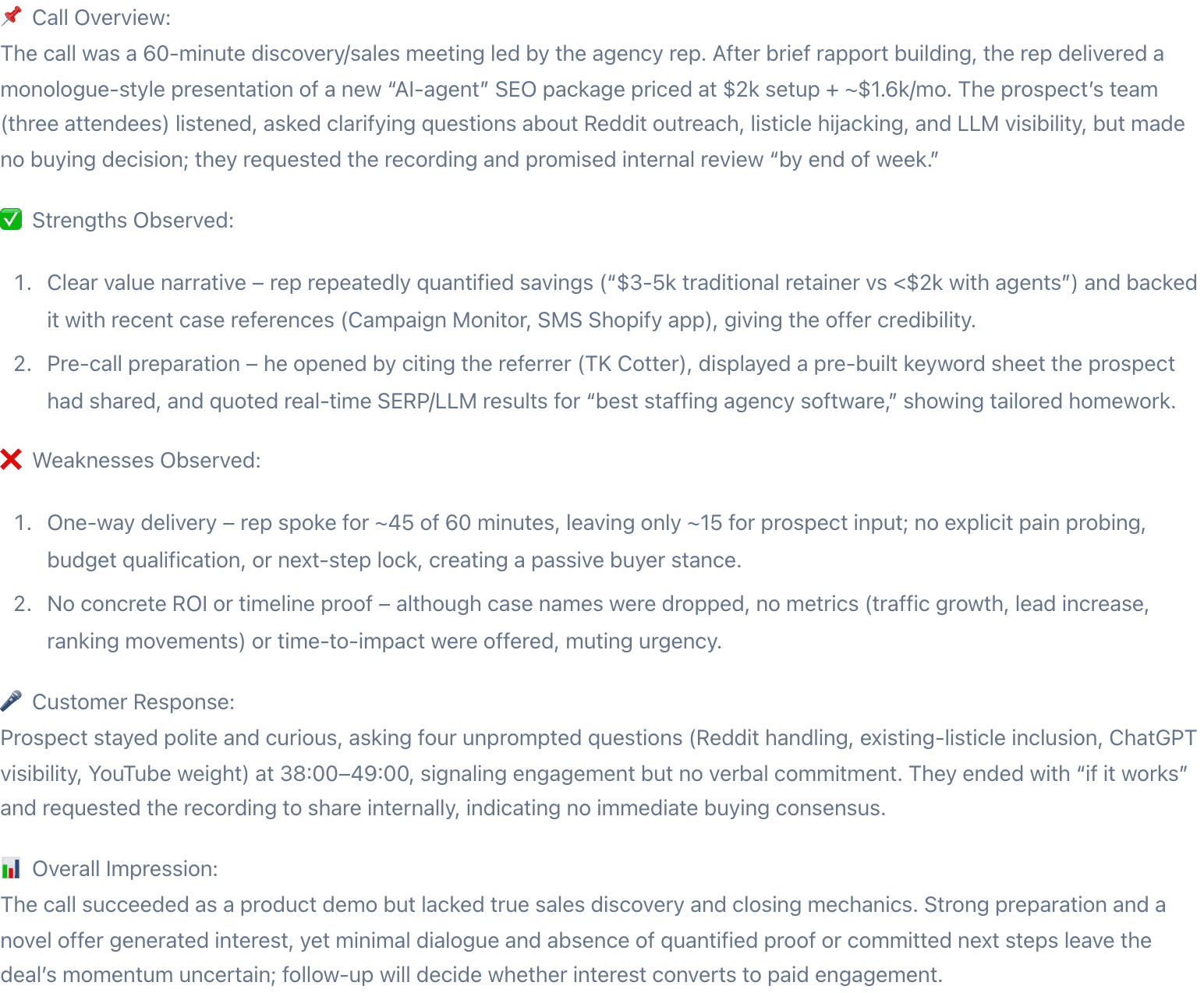 AI reviews every call
Strengths on your scorecard
Exactly where to coach
AI reviews every call
Strengths on your scorecard
Exactly where to coach
Kendo Closes the Loop Most Tools Leave Open
When Kendo spots a gap, a manager can assign AI roleplay training against a custom AI prospect, set a score or time goal, and Kendo grades that practice on the same rubric it uses for live calls. Practice quality and live execution finally speak the same language. The AI Coach turns each review into feedback a rep can use before the next conversation.
The rep spoke 45 of 60 minutes. Assign a discovery drill that forces open questions and listening.
No next-step lock. Roleplay a close that ends on a scheduled, mutual next step.
Case names dropped, no metrics. Practice quantifying ROI so the value lands.
Each fix becomes an assigned roleplay, scored on the same 1-to-100 rubric as the live call, so you can confirm the behavior actually changed.
Kendo Gives Managers the Team View Without the Busywork
Kendo Agent tracks average scores, skill trends, and individual rep profiles, flags reps who need attention, and answers plain-English questions about the team. Calls come in through native Zoom, Fathom, and Fireflies connectors, plus an open Push API for Salesloft, HubSpot, dialers, and anything custom. Insurance managers can use the insurance agency KPIs guide to define quote-to-bind, retention and readiness measures before comparing producers.
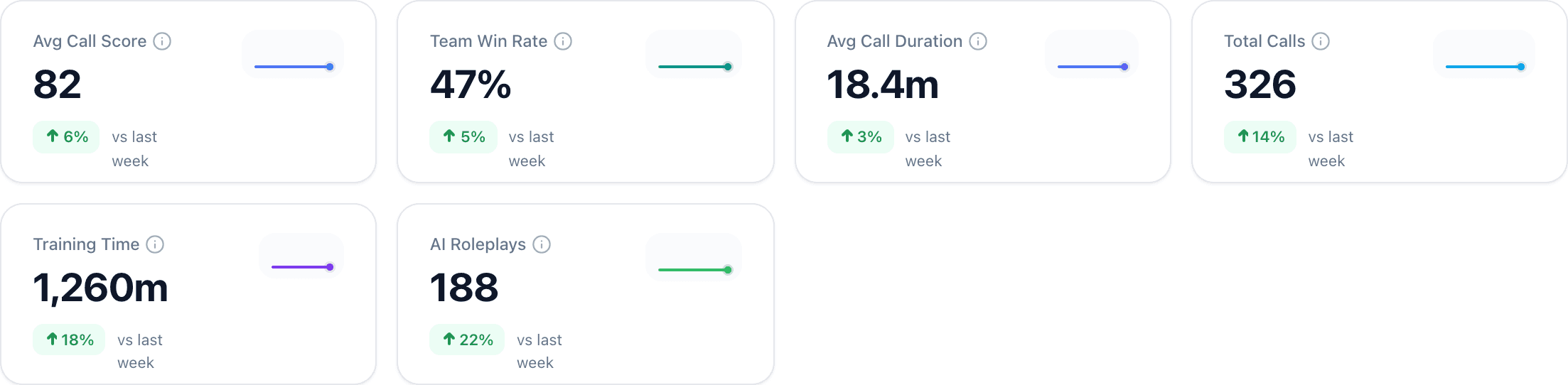 Team score, auto-tracked
Win-rate trend, week over week
Practice hours logged
Team score, auto-tracked
Win-rate trend, week over week
Practice hours logged
This is what practicing on Kendo looks like. The AI buyer pushes hard on SOC 2, ISO 27001, and proof the tool cuts compliance work, and the rep has to handle it on the spot, before any of it lands on a live deal.
The proof: New agents at Globe Life went from about 33% to 60%+ close rates with repetition on Kendo. United Insurance Pros cut onboarding from 30 days to under 24 hours, with reps hitting baseline in 14 days instead of 45-plus. Kody Skvarla's team saw a 5-20% production lift while reclaiming hours of daily training time.
Try Kendo With Public Pricing From $55/mo
Public and per seat. Pro is $55 per seat per month with 180 roleplay minutes, Max is $100 per seat per month with 480 minutes, and Enterprise is custom for teams of 10 or more that want custom models and done-for-you setup, per Kendo's pricing page (as of July 22, 2026).
| Pro $55/mo per seat | Max $100/mo per seat | Enterprise Custom |
|---|---|---|
| AI call review, AI roleplay, Kendo Agent, advanced analytics, 180 roleplay minutes per seat each month | Everything in Pro, 480 roleplay minutes per seat each month, for teams that want maximum usage | Teams of 10+, custom AI models, custom scoring, done-for-you setup, dedicated account manager |
Best for: Sales managers and enablement leads at 5-to-200-rep B2B or B2C teams who need measurable rep improvement in weeks and want to see what they're paying before they commit.
AIMS highlights: Strong across all six criteria, and the clear leader on the two heaviest, coaching realism and training workflow, because it's the only platform here that reviews live calls and scores assigned practice on the same standard.
United Insurance Pros Ran the Full Loop and Ramped Reps 75% Faster
Reviewing live calls and assigning scored roleplay against each gap turned onboarding from a slow drift into a measured curve. New agents hit baseline in 14 days instead of 45+, and setup that used to take 30 days now takes under 24 hours.
Result: 7-day ramp-up plus 7 days to baseline performance equals 14 days total vs 45+ days before, with onboarding setup down from 30 days to under 24 hours.
"Typically we would see about a 45-day period where people would dip their foot in the water and slowly improve and then level off at their performance level. Now that's 14 days. So it's the 7-day ramp-up and then 7 days to be where they're going to be at their baseline."Waylon Artrip, Founder, United Insurance Pros
Gong
Best for Enterprise RevOpsEnterprise revenue intelligence: the deepest read on what happened across deals and forecast, with post-call coaching layered on top.
Gong is a revenue intelligence platform that captures calls, emails, and deals, then layers analytics and post-call coaching on top of the data.
Where It Wins
- Deep call and deal analytics. Gong's strength is connecting what happened on a call to pipeline and forecast movement across a large team.
- Enterprise-grade breadth. For orgs standardizing a single revenue system, Gong covers a lot of surface area beyond coaching.
Consider before choosing
- Pricing is quote-only, so budgeting and procurement take longer than a self-serve tool.
- It's conversation intelligence first. Gong analyzes and surfaces, but live roleplay practice and assign-and-score training aren't its native loop, so the "diagnose then drill" half of coaching lands on your managers.
Pricing: Custom, quote-only. Gong does not publish seat pricing.
Best for: Enterprises standardizing revenue AI around deals and forecasting, with the manager bandwidth to run coaching on top.
AIMS highlights: Strong on call-review depth and data visibility, lighter on coaching realism and pricing clarity.
Salesloft
Signal-to-action across engagement and forecasting: conversation intelligence wired straight into the cadences reps already run.
Salesloft is a sales engagement platform whose Conversation Intelligence turns buyer signals into next-best actions across outreach and forecasting.
Where It Wins
- Signal-to-action in one motion. If your reps live in Salesloft cadences, its intelligence connects call signals to the next step without a context switch.
- Engagement plus forecast context. It's built to move deals forward, not just describe them after the fact.
Consider before choosing
- Pricing is quote-only, which adds procurement friction.
- Coaching is a layer, not the core. Salesloft is execution and engagement first, so scored practice and roleplay against a custom buyer aren't native to the workflow.
Pricing: Quote-only. Salesloft does not publish public plan pricing.
Best for: Teams already deep in a Salesloft engagement motion that want conversation signals wired into their next action.
AIMS highlights: Strong on data visibility and next-step signals, lighter on training workflow and coaching realism.
Outreach
Best for ExecutionAI agents and the Kaia live assistant embedded directly in the rep's daily execution workflow.
Outreach is a sales execution platform that embeds AI agents and its Kaia live meeting assistant directly into the rep's daily workflow.
Where It Wins
- AI inside execution. Kaia supports live meetings and collaboration, and Outreach's agents assist reps where the selling actually happens.
- Workflow consolidation. For teams that want execution and AI assistance in one place, it reduces tool-switching.
Consider before choosing
- Pricing is tailored, built on a license plus consumption model that requires a quote.
- It's an execution layer, not a coaching loop. Managers who want review, diagnose, assign, and score won't find that cycle native here.
Pricing: Quote-based, license plus consumption. Not publicly listed.
Best for: Teams that prioritize AI agents inside daily execution over a standalone coaching and practice system.
AIMS highlights: Strong on execution-side automation, lighter on coaching realism and the training workflow.
 Across Kendo customers: new-hire close rates from 33% to 60%+, reps ramp 75% faster, and a 5-20% production lift.
See the results →
Across Kendo customers: new-hire close rates from 33% to 60%+, reps ramp 75% faster, and a 5-20% production lift.
See the results →
Avoma
Best for Transparent PricingBudget-friendly meeting AI with public, self-serve pricing and optional conversation-intelligence coaching add-ons.
Avoma is a meeting AI tool, recording, notes, and transcription, with optional add-ons for conversation intelligence and revenue intelligence.
Where It Wins
- It's the transparency exception. Avoma is the one tool in this roundup with fully public, self-serve pricing published by tier on its own site, instead of everything gated behind a sales call. For a manager who just needs a number, that alone shortens the evaluation.
- Fast, low-friction start. Smaller teams can get meeting AI and light coaching running quickly without an enterprise rollout.
Consider before choosing
- Coaching is an add-on, not a loop. The intelligence and revenue features sit on top of meeting capture, so roleplay practice and assign-and-score training aren't native.
- Depth is lighter than dedicated coaching platforms once you get past the meeting layer.
Pricing: Public and self-serve, sold per recorder seat with paid add-ons. Avoma lists its tiers openly on its pricing page, which is rare in this category.
Best for: Budget-conscious SMB teams that want meeting AI plus light coaching, fast, without a quote cycle.
AIMS highlights: Wins on pricing clarity and implementation effort, lighter on training workflow and coaching realism.
Highspot
Best for EnablementEnablement-led AI that recommends the next best action for reps and managers at the point of work.
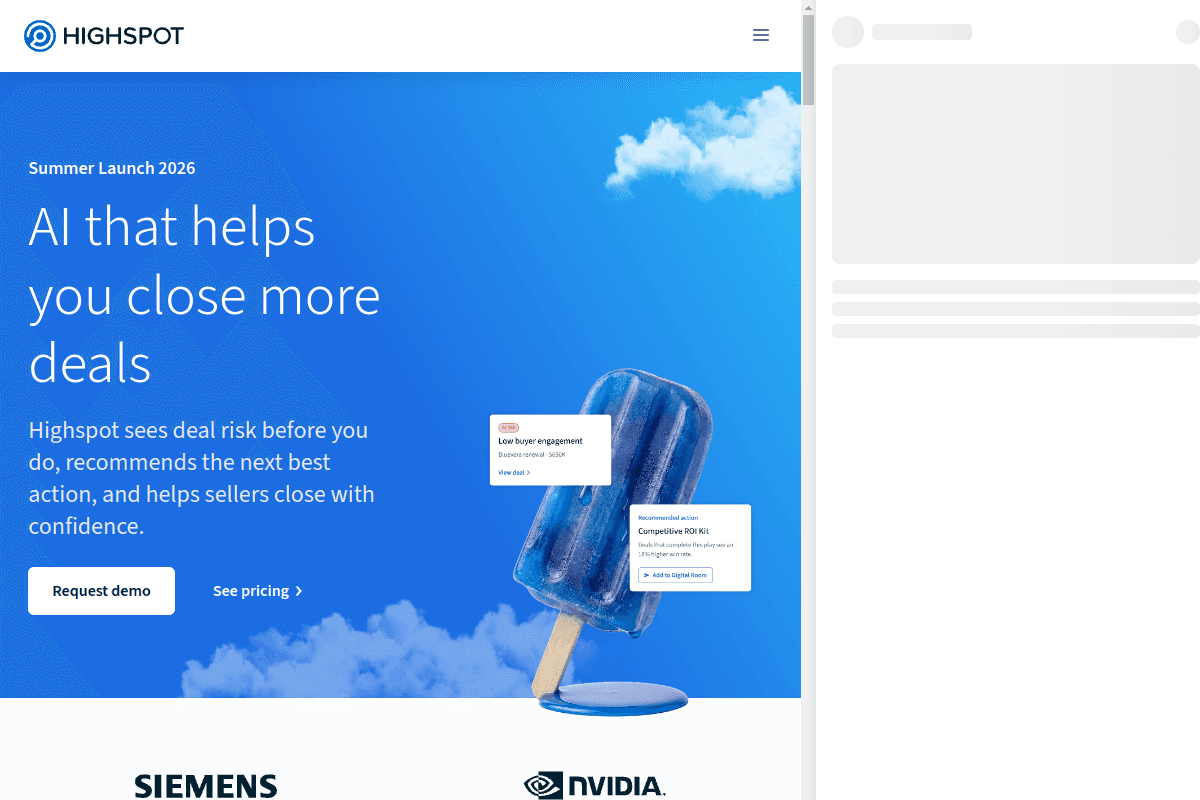
Highspot is a sales enablement platform, content, guidance, and coaching, with agentic AI that recommends the next best action for reps and managers.
Where It Wins
- Enablement and coaching in one place. If content, plays, and coaching sprawl across tools today, Highspot consolidates them.
- Guidance at the point of work. Its AI surfaces the right content and next step inside the seller's flow.
Consider before choosing
- Pricing is gated behind a "see pricing" request, so expect a sales conversation before a number.
- It's enablement and content first, which means a heavier rollout and a practice-and-score loop that isn't the core of the product.
Pricing: Quote-only. Highspot does not publish public pricing.
Best for: Teams consolidating enablement content, guidance, and coaching under one roof. If that's your priority, compare how well the leading platforms unite those three jobs.
AIMS highlights: Strong on data visibility and enablement, lighter on coaching realism and pricing clarity.
Mindtickle
Best for ReadinessEnterprise readiness with AI role-plays, conversation intelligence, and certification programs in one platform.
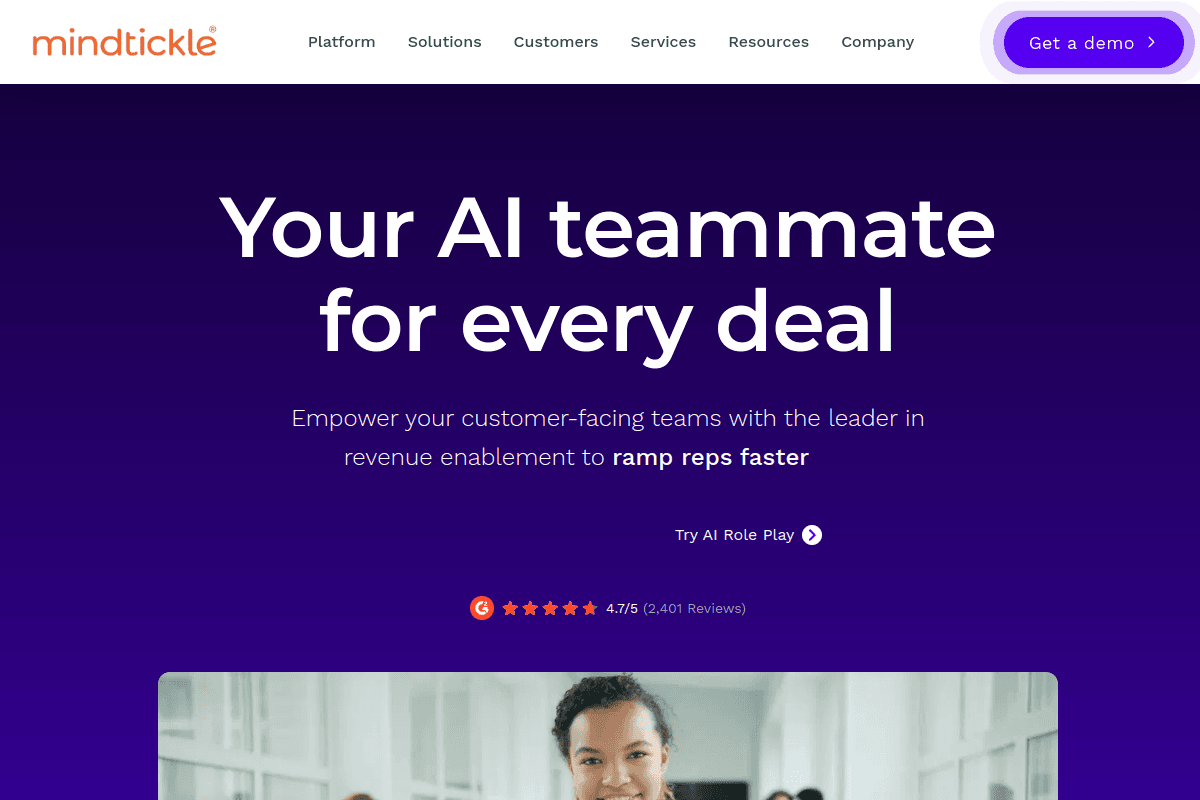
Mindtickle is a revenue enablement and readiness platform combining its Copilot, AI role-plays, conversation intelligence, and certification programs.
Where It Wins
- Readiness at enterprise scale. For global orgs formalizing certifications and structured programs, Mindtickle is built for that weight.
- Role-plays plus CI together. It pairs simulated practice with conversation intelligence inside one platform.
Consider before choosing
- Pricing is quote-only, and it's an enterprise buy.
- Implementation is heavier than a lean team needs, so time-to-value is measured in a rollout, not a week.
Pricing: Quote-only. Mindtickle does not publish public pricing.
Best for: Large, global orgs formalizing readiness, certifications, and CI at scale. If that is the priority, compare how platforms handle certification and readiness at scale.
AIMS highlights: Strong on training workflow through certifications and on data visibility, lighter on pricing clarity and fast implementation.
Second Nature
Best for Roleplay PracticeFocused AI roleplay and certification practice for drilling reps against a simulated buyer before live calls.
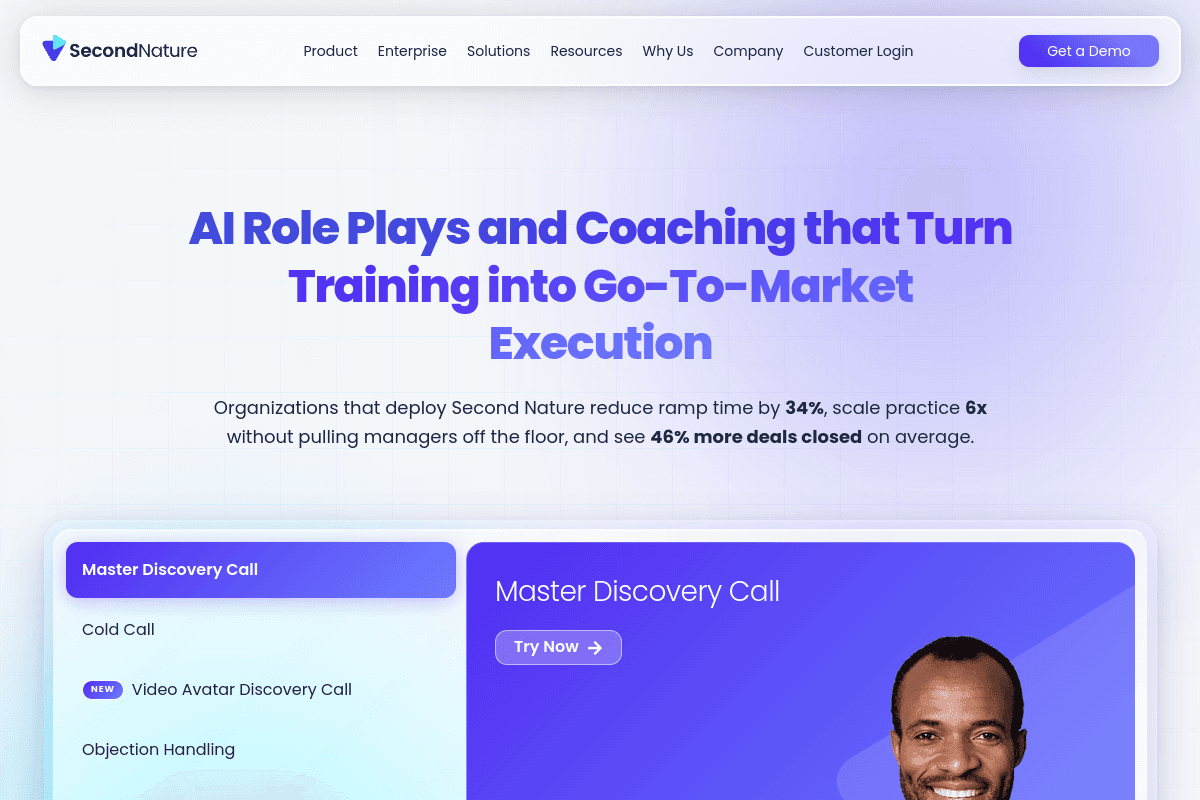
Second Nature is an AI roleplay and coaching tool focused on simulated practice and certification workflows for reps.
Where It Wins
- Practice is the whole product. Its AI roleplay and certification flows give reps structured, repeatable reps against a simulated buyer.
- Good for drilling before live calls. For teams that mainly want a practice simulator, it does that job with focus.
Consider before choosing
- Pricing is quote-only, so no self-serve start.
- It's narrower than a management suite. Second Nature centers on roleplay, so live-call review across the whole team and manager-level analytics aren't the same closed loop you get from a full AI sales manager.
Pricing: Quote-only. Second Nature does not publish public pricing.
Best for: Teams that want simulation-heavy practice and structured certifications above all else. If roleplay realism is your single most important factor, our list of the best AI sales roleplay tools breaks that category down further.
AIMS highlights: Strong on coaching realism through dedicated practice, lighter on live-call review depth, manager analytics, and pricing clarity.
Which AI Sales Manager Should You Choose?
The rubric turns fuzzy shopping into a decision. Here's how the eight tools sort by the profile you actually fit.
- Choose Kendo if your problem is ramp and rep quality, and you want the full loop, review live calls, assign scored practice, and track improvement, with pricing you can see. It's the strongest fit for 5-to-200-rep teams that need measurable gains in weeks, and the insurance and B2B proof points above are the closest match to that job.
- Choose Gong if you're an enterprise standardizing revenue AI around deals and forecast accuracy, and you have managers with the bandwidth to run coaching on top of the intelligence.
- Choose Salesloft if your reps already live in a Salesloft engagement motion and you want conversation signals wired straight into the next action.
- Choose Avoma if you're a smaller, budget-conscious team that wants meeting AI plus light coaching fast, and transparent pricing matters more than a deep training loop.
- Choose Highspot or Mindtickle if you're an enterprise consolidating enablement content, certifications, and readiness, and you can absorb a longer rollout.
Be honest about the edges. If forecast and deal intelligence across a big enterprise is your number-one fire, a revenue-intelligence specialist like Gong will go deeper there than a coaching-first platform. And if your entire need is a roleplay simulator with certifications, Second Nature is more focused than a full suite.
Where Kendo pulls ahead for most sales managers is that it does the whole loop instead of one slice. If your evaluation is really about quota attainment and comp dashboards rather than coaching, that's a different category, and our guide to the systems built around those metrics is the better next read.
Practical Use Cases: How to Roll Out an AI Sales Manager in 30 Days
Buying the tool is easy. Getting reps to use it and seeing the number move is the part teams skip. Here's a practical 30-day sequence that works.
-
Connect Your Call Sources First
Wire up native connectors for Zoom, Fathom, and Fireflies, and use a Push API for anything unsupported, Salesloft, HubSpot, Gong, dialers, or a custom system. Nothing else works until calls flow in automatically.
-
Define Scorecards by Call Type
Build a scorecard for each motion, cold call, discovery, demo, follow-up, so feedback matches the conversation.
Starter prompt: "Create a discovery-call scorecard for [industry, ICP, ACV] weighting pain discovery 25%, impact 20%, stakeholders 20%, next steps 15%, objections 20%, scored 1 to 100." -
Pilot With One Cohort and Baseline It
Pick 5 to 10 reps, review two weeks of calls, and record the baseline scores. You can't prove improvement you never measured.
-
Assign Practice Against the Weakest Criterion
Turn the gap into reps. Practice gets scored on the same rubric as live calls, so it counts.
Example trigger: "Assign two 10-minute roleplays this week to any rep scoring under 70 on objections, goal +10 points within 14 days." -
Measure Improvement Against the Same Standard
Track rep skill profiles and team trends, and confirm the behavior actually changed on live calls, not just in practice.
-
Expand and Automate the Reporting
Roll out to the full team and push call summaries, scoring, and leaderboard updates to Slack so managers get signal without logging in.
- Contact-center and B2C teams can run this same loop, and our guide to training reps in high-volume call environments covers that setting specifically.
- The same AI roleplay engine doubles as a hiring filter: send a shared prospect link to candidates and review their scored call before you spend a single interview slot.
Frequently Asked Questions
An AI sales manager is a platform that automates call review and coaching for a sales team. It reviews calls, scores them against custom scorecards, detects each rep's skill gaps, assigns targeted practice, and gives managers visibility into team performance, so managers spend less time on manual review and more on high-leverage coaching.
Conversation intelligence analyzes calls and surfaces insights, what was said, sentiment, keywords, and trends. AI coaching uses those insights to prescribe and run targeted practice, score it against the same rubric as live calls, and track whether the rep's behavior actually changes. CI tells you what happened; coaching changes what happens next.
Plan on two to four weeks to connect call sources, define scorecards, pilot with a cohort, and start assigning training. Tools with self-serve setup and transparent pricing move faster because there's no procurement cycle blocking the pilot.
Two things: a clean pipe from your call sources (Zoom, Fathom, Fireflies, and note-takers, plus an open API for CRMs and dialers like Salesforce, HubSpot, and Salesloft), and alerting into Slack so managers act on flagged calls without hunting for them.
Ask for encryption standards, data isolation, access controls, and whether your call recordings are used to train AI models. Kendo's security overview is a good template for what to request, AWS hosting, TLS 1.3 and AES-256 encryption, RBAC, and a documented compliance roadmap.
If your shortlist is really CI-first, start with a category comparison rather than a broad roundup. Our breakdown of CI-first options and their coaching tradeoffs maps that decision in detail.
The Bottom Line
The AI sales manager category is splitting in two. On one side are tools that record, transcribe, and summarize. On the other are tools that close the loop, review the call, diagnose the gap, assign scored practice, and prove the rep improved. The second group is where the number actually moves.
For most teams managing 5 to 200 reps, the fastest path to measurable improvement is the platform that runs the whole loop with pricing you can see up front. Run the AIMS rubric on your own shortlist, weight training workflow and coaching realism the way your team's real problem demands, and let the score pick.
Then take the shortest path to proof: connect a few weeks of calls, assign scored practice on the weakest criterion, and watch the baseline. Start with a live look at Kendo's AI roleplay and call reviews and see the loop run on your own calls.

Luke Alexander is the founder of Kendo AI, where he's helped train more than 5,000 sales reps. He started in sales as a frontline closer, scaled a high-ticket sales-training company, and founded Closer Cartel and AI Insiders before building Kendo to fix the tools he wished he'd had: realistic AI roleplay and automated call review for fast-moving sales teams. He writes about sales management, ramp speed, coaching, and applying AI across the revenue org.