
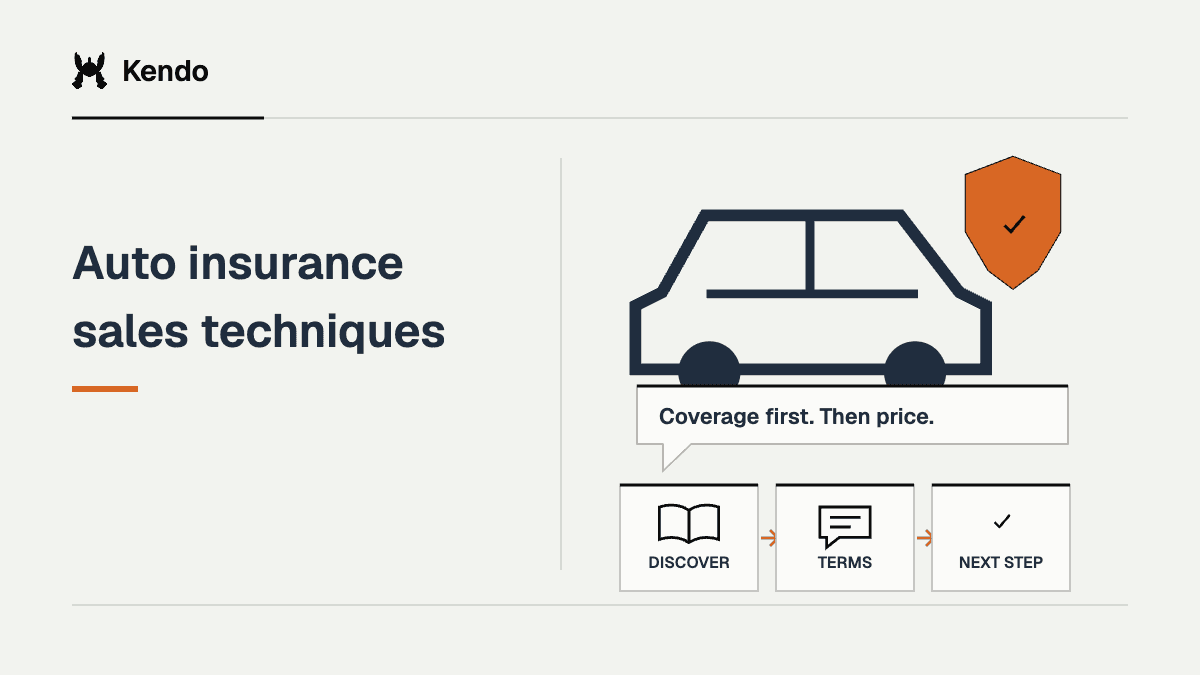

The auto insurance sales techniques that work are simple: get the facts right, compare like with like, and explain the tradeoffs in plain words. Ask why the customer is shopping, check the information behind the quote, show the differences that matter and agree on a useful next step. Do not call a cheaper quote the same until you have checked what changed.
If you manage a personal-lines team, the goal is agents who can explain a quote without hiding behind jargon. Better conversations cannot make every carrier price competitive. They help customers understand what they are buying, and they stop agents from winning on price by quietly cutting coverage.
Find out what the customer wants to change
“Shopping for auto insurance” does not tell the agent enough. The customer may want a lower payment, a clearer explanation, better service or help after a new car or a change at home.
Start with the reason, not a savings promise. Ask: “What made you want to compare options now?” Then ask what would make the review useful.
A customer whose renewal premium went up has not asked for the thinnest coverage. A customer buying a car may care more about timing and what the lender requires. Keep those conversations separate.
The average premium per insured vehicle rose from $1,048 in 2020 to $1,432 in 2024, so a renewal increase is often the reason the customer is calling at all.
The NAIC's plain-English auto insurance guide explains each coverage; share it with customers who want to read up. The customer's own requirements, policy terms and eligibility still need to be checked.
Put the quotes on the same footing
Fill in a comparison worksheet from the actual quote documents. A blank cell means not checked yet, never the same. The table below is a template, not a sample quote.
| Item to verify | Current or competing option | Proposed option | Difference to explain |
|---|---|---|---|
| Policy term and effective dates | Enter verified terms | Enter verified terms | Align the periods being compared |
| Drivers, vehicles and use | Enter verified facts | Enter verified facts | Resolve different assumptions |
| Liability limits | Enter actual limits | Enter actual limits | Identify changes clearly |
| Applicable deductibles | Enter each deductible | Enter each deductible | Explain the relevant tradeoff |
| Other coverages and material terms | Record what is included | Record what is included | Surface omissions or differences |
| Premium, payment terms and discounts | Record verified amounts and basis | Record verified amounts and basis | Distinguish confirmed from conditional |
Two monthly payments that look close are not a finished comparison. A different policy term, payment plan or assumed discount can make the headline numbers lie.
“Same coverage. Lower price.”
“Different deductible. Different limits. Different term.”
Check the fields before you compare the price.
Original illustration. The joke is on skipping the worksheet, never on the customer.
If the customer only has a screenshot of a price, say what you still do not know. Get the missing details the proper way instead of guessing them.
Five techniques to coach on quote calls
The dialogue below is made-up practice material. Licensed staff should adapt it to their own products and procedures.
1. Confirm facts before discussing the result
Agent: “Before we compare prices, let's make sure the drivers, cars and how you use them are right.”
Customer: “The other quote might still have my old car on it.”
Agent: “Then let's fix that before we treat the numbers as a fair comparison.”
The skill here is the pause. A wrong input is not a small admin detail when the customer is using the result to pick their coverage.
Run the agency's fact-find and ask what changed. If the car is now used differently, do not guess what the current policy covers. Check the policy documents or ask a licensed reviewer.
- Drivers
Everyone who drives the cars, including a new teen driver.
- Vehicles
Year, make, model and VIN on both quotes. An old car can still sit on a competing quote.
- How each car is used
Commute, business use and annual miles.
- Policy term and dates
Six months and twelve months are not the same price.
- Limits and deductibles
Written down for both quotes before anyone compares totals.
Common mistake: defending your price after finding out the two quotes describe different situations. A good explanation cannot fix a bad comparison.
2. Ask what matters besides the headline premium
Agent: “What are you hoping will be different from what you have now?”
Customer: “I want the payment lower, but I don't want a deductible I couldn't manage.”
Agent: “Then let's keep both of those in view while we look at the options.”
The script in your head
“Great, so you want the cheapest option.”
The answer you actually got
“I want the payment lower, but I don't want a deductible I couldn't manage.”
Two goals. Keep both on the table. Listen for the second half of the sentence.
That answer gives the agent something real to work with. Do not file the customer under “price shopper” and ignore the second half of the sentence.
If the customer says only price matters, confirm the terms they are comparing and explain any real differences. Respect their choice without pretending every option gives the same protection.
Common mistake: asking what matters, then giving the same value pitch whatever the answer. Managers: listen for whether the customer's stated priority shows up when the agent makes the recommendation.
3. Explain one material difference at a time
Agent: “These two options have different deductibles for this coverage. Let's look at what each one means before deciding if the price gap is worth it.”
Customer: “I thought the cheaper one was for the same thing.”
Agent: “There is a difference here. Your decision should include that change, not just the payment.”
Use the exact numbers in the quote, not a made-up example. Say which coverage and which deductible you mean; one deductible does not apply to every claim.
Then check what the customer prefers. Do not pick a higher deductible for them because it makes the quote easier to sell.
Common mistake: calling lower limits or dropped coverage “finding savings” without naming the tradeoff. The customer should be able to say what changed after the explanation.
4. Check understanding without giving a lecture
Agent: “How are you weighing that deductible difference against the price?”
Customer: “I need to think about whether I could manage that.”
Agent: “That's worth thinking about. Is there any other part of the comparison you want me to explain first?”
This is not a quiz. It is how you find out whether your explanation landed. If the customer got it wrong, explain it a different way.
Only 58% of auto customers say they fully understand their own policy and coverage, so a nod is not proof.
- 58%
- of auto customers say they fully understand their policy and coverage, down 4 points from 2025
- 30%
- reported a premium increase that came from their insurer
- 155 pts
- drop in price satisfaction (to 486 out of 1,000) among customers who got that increase
J.D. Power 2026 U.S. Auto Insurance Study, 52,216 customers, fielded April 2025 to April 2026.
Answer the question asked before you open another coverage topic. A long list of features can sound thorough and still make the decision harder.
Common mistake: taking “yes, I understand” at face value after a long explanation. Ask a question that makes the customer explain the tradeoff in their own words.
5. Finish with the next unresolved task
Agent: “The open question is [the specific issue]. Would you like [the right person] to confirm it before you decide?”
Customer: “Yes. Then I can compare them properly.”
Agent: “Let's agree how that answer will reach you, and whether a follow-up call would help.”
If the next step is to bind, follow the carrier's and the agency's process. Never suggest that a conversation, a quote or a verbal yes has already put coverage in force.
If the customer does not want another call, record that. Do not let an automatic “quote follow-up” task override what they asked for.
Common mistake: ending with “I'll check back” while the key question is still open and nobody owns the answer.
New agents take the longest to get these five moves right on a live call. United Insurance Pros measured how long its new agents took to reach its own baseline.
Insurance case study: time to baseline cut from 45+ days to 14 days
A 500+ agent organization tracked how long new agents took to reach its defined baseline, before and after Kendo.
“If you've got more than five agents, it's a no-brainer.”
Handle premium and discount questions honestly
Three price questions come up on almost every auto quote call. Here is an honest answer to each.
Can you beat this price?
“Let me check the options with the right details and matching coverage. It might come in lower or higher, and I will not promise either before I have looked.”
Do not call a rough number a final price, and do not hide the conditions behind it.
For the rest of the price pushback, the insurance sales objections guide has the responses and the coaching notes.
Both come from sales coach Josh Braun. The moves transfer to a quote call: swap “this week” for “at renewal”.

- 0:06“Too high” is often a polite way out, not the real blocker. Taking it at face value is the trap.
- 0:32Ask the what-if: if the premium matched, would you be ready to switch at renewal?
- 0:46That one question brings out the real concern: a spouse to ask, a renewal date, a different issue entirely.
- 0:58Finding out what is true matters more than winning the price argument.

Worth clipping for a team huddle. Tap a timestamp to jump to that moment.
What if we bundle home and auto?
“Let me check what you qualify for. Then we can look at the combined cost and what each policy covers before you decide.”
Do not assume the bundle is cheaper or better. Check the real offer. If the home policy needs a specialist, hand it off instead of guessing its terms.
The cross-selling insurance guide explains how to raise that review without turning a quote request into a forced bundle. Shoppers collect 3.5 quotes on average, and 45% of them already hold a homeowners policy, but only 20% got a home quote while shopping auto.
- 3.5
- quotes collected per shopper, the most in the study's history
- 53%
- of auto customers are shopping, down from 57% a year earlier
- 48%
- of new auto policies were bought digitally (36% five years ago)
- 45% vs 20%
- hold a homeowners policy vs got a home quote while shopping auto
J.D. Power 2026 U.S. Insurance Shopping Study, 12,437 shoppers, fielded January 2025 to January 2026.
Why is your quote higher?
Explain the differences you can prove, one at a time, with the quote documents in front of you. Do not knock the other carrier or invent a coverage gap to save the sale.
Sometimes the honest answer is that the coverage matches and your price is higher. Say it, then ask what the customer wants to do next.
Price pushback is easier to answer calmly after a few practice runs. Kody Skvarla leads an insurance team that rehearses objections against Kendo's AI prospect before live calls.
Insurance case study: a 5 to 20% team lift, and one rep who doubled his own baseline
Kody leads an insurance sales team. The wider team reports a 5 to 20% improvement.
“Kendo matches or beats a human practice partner. The objections are the exact same as real calls.”
Separate sales coaching from the hard-market workload
Repeated premium questions wear a team down. Rate increases, non-renewals and hard conversations hit the service desk and the sales floor at the same time. The price of auto insurance rose 19.1% in the year to August 2023 and 16.5% the year after, and only started falling in 2026.
Up 19.1% in the year to August 2023 alone. Even after the 2026 dip, prices sit about 51% above August 2020. A lost quote in that market is not automatically a skill problem.
| August | Price index |
|---|---|
| 2020 | 100 |
| 2021 | 101 |
| 2022 | 110 |
| 2023 | 131 |
| 2024 | 152 |
| 2025 | 159 |
| 2026 | 151 |
US CPI for motor vehicle insurance, not seasonally adjusted, August values rebased to August 2020 = 100. Computed from the BLS index values.
Source: BLS, CPI series CUUR0000SETE
The lesson for managers: find the actual problem before you prescribe practice.
An agent may need help explaining a deductible. A service team may need a clearer escalation route. An agency may simply have no competitive option for a particular risk.
A lost quote is not always a skill failure. Before blaming the conversation, check the lead source, the carriers you could offer, the accuracy of the inputs and the customer's own reason. For existing-client renewal work, use the insurance customer retention guide.
Practice auto quote conversations with Kendo
Give the agent a customer who calls the cheaper quote identical, but cannot find its deductible. Set that scenario in Kendo and review the response afterward. Check the missing field before comparing value, then practice the explanation again.
Buyer Profile
Define who the buyer is and the context they make decisions in.
Scenario & Resistance
Set what is being sold, the conversation stage, and how this buyer should resist.
Auto Quotes: Check Before ComparingACTIVE



The other quote is cheaper and looks the same.
Let's check the limits and deductibles on both before we call them the same.
I don't have the other quote's deductible. Does that matter?
It does. Let's get that document, then I'll show you any real difference.
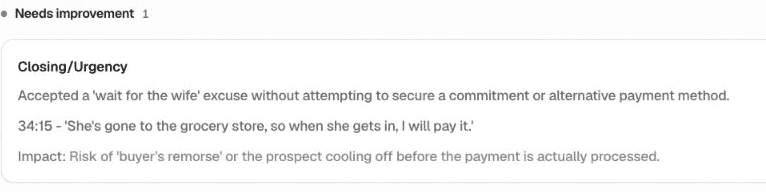
Swipe to read the whole card. Kendo's real Feedback tab: skill, quoted moment, timestamp, impact. Example from a different call type; auto-quote criteria come from your own scorecard.
Keep practice details made up and labeled as such. Do not load real driver, financial or identity details into a training scenario.
Have the manager review the evidence behind the feedback. If the rep lacked a document, coach the checking step. If the document was there but ignored, coach the comparison.
Measure quote quality alongside conversion
Quote-to-bind is one outcome number, not the whole scorecard. A rep can push it up by steering customers into terms they do not understand, or by dodging hard risks. Neither is what an agency wants. The insurance agency KPIs guide defines quote-to-bind and the numbers to read beside it.
Close rate is the number most agencies watch anyway. Globe Life tracked its new agents' close rates for about six months while they practiced daily with Kendo.
Insurance case study: new-agent close rates went from about 33% to 60%+
Globe Life's new agents practiced daily with Kendo, alongside tighter hiring and manager oversight, over about six months.
“Kendo buys back time for my leaders”
Review a small set of quality signals next to the outcome:
- Accurate inputs: Were the key facts confirmed and corrections made?
- Clear differences: Were coverage differences shown rather than hidden?
- Open-question ownership: Did each open item reach a named person?
- Follow-through: Did the customer get the agreed answer or next step?
- Customer outcome: Bound, declined, deferred or referred, with the reason recorded.
Compare like with like: similar lead sources, carriers, time periods and agent experience. A carrier rate cut can lift conversion with no change in selling. Keep CRM outcomes and practice scores as separate numbers, then look at them side by side.
Questions managers ask
How can an agent sell value when the quote costs more?
Explain only the differences that actually exist and matter to the customer. If there is no real advantage, accept that the other option may fit better. A value pitch is not a license to invent advantages.
Should an agent lead with bundling?
Not automatically. Start with what the customer asked for and their situation, then offer a separate review where it helps. Confirm terms and eligibility before making any savings claim.
What should a manager coach first?
Find the first mistake you can actually see in the quote conversation. Missing information comes before poor explanation, and poor explanation comes before a weak close. Practice that exact moment, then review the next similar call for the same behavior. For new producers, the onboarding checklist for new agents puts the fact-find before the first live quote.