Enterprise Sales Training: How to Train Reps to Win Complex Deals
An enterprise deal is a consensus sale across a 6-to-10-person committee, gated by procurement, security, and legal. Here's what enterprise training must teach, how to ramp reps, and how to make it stick.
An enterprise deal is not a bigger version of an SMB deal. It is a different animal.
You are not selling one person on one call. You are helping 6 to 10 decision-makers (Gartner) reach a consensus they can all defend, on a contract worth six or even seven figures.
Finance wants a business case. Security wants a SOC 2 review. Legal wants to redline the MSA. Your champion goes quiet for two weeks. And one wrong move sends the whole thing to "no decision."
That last outcome is the real enemy. Challenger found 38% of complex B2B purchases end in no decision, with buying groups averaging upward of 11 stakeholders (Challenger, 2020). The deal doesn't go to a competitor. It just dies in committee.
So here is the problem most teams walk into: they hire reps to close complex deals, then run them through training built for simple ones.
The rep learns to pitch, demo, and handle a price objection, then gets eaten alive the first time a 7-person committee and a procurement team show up.
This guide is for the leaders training those reps: VP Sales, enablement, enterprise managers. It covers what enterprise sales training must actually teach, how it differs from SMB and mid-market training, how to onboard and ramp enterprise reps, and how to make the training stick once the workshop ends.
Here is what's inside:
What enterprise sales training is, grounded in how complex deals actually get bought
How it differs from SMB and mid-market training, in a side-by-side table
The six things every enterprise program has to cover, plus a MEDDPICC qualification rubric
A 30-60-90 day ramp built for enterprise reps, with a readiness scorecard
Why most enterprise training doesn't stick, and how practice fixes it
In Short
Enterprise sales training prepares reps to win large, complex, six and seven-figure deals: deals decided by a buying committee of 6 to 10 people, stretched across a months-long cycle, and gated by procurement, security, and legal. It goes well beyond pitch and demo skills. It builds reps who sell to executives, multi-thread a committee, develop a champion, qualify with MEDDPICC, and navigate the paper process. Done right, it ramps reps faster and turns "no decision" losses into closed revenue.
What Enterprise Sales Training Actually Is
Enterprise sales training is the system that prepares reps to win deals where the size and complexity change the rules. Big contract value. A committee, not a buyer. A cycle measured in quarters. And a buying process with formal steps you cannot skip.
Strip away the jargon and three things define an enterprise deal:
The committee. The typical buying group for a complex B2B solution runs 6 to 10 decision-makers, each arriving with four or five pieces of information they gathered on their own (Gartner). Finance, IT, security, procurement, end users, and an executive sponsor all get a vote.
Your rep is not closing a person. They are orchestrating a group of strangers toward a decision they can all live with.
The cycle. Enterprise deals routinely run six months to a year or more, with contract value in the six or seven figures (HubSpot, Salesforce). That timeline is not dead air. It is the full B2B sales cycle stretched out: discovery, business cases, security reviews, procurement negotiation, and legal redlines, each of which can stall the deal if your rep isn't ready for it.
The scarcity of your own access. Here is the stat that should reshape how you train: a single rep gets roughly 5% of the buyer's total purchase time, and all suppliers combined get about 17% (Gartner).
The committee spends most of the journey without you in the room. Training has to build reps who make their 5% count and arm a champion to sell on their behalf when they aren't there.
6 to 10
decision-makers in a complex B2B buying group, each with 4 to 5 self-gathered info piecesSource: Gartner
~5%
of the buyer's total purchase time any single rep gets; ~17% across all suppliersSource: Gartner
6-12+ mo
typical enterprise sales cycle, on six and seven-figure contractsSource: HubSpot, Salesforce
That is the job. Enterprise sales training that ignores any of those three realities is just consultative-selling content with the word "enterprise" pasted on the cover.
Where the Buyer's Time Actually Goes
A single rep gets about 5% of an enterprise buyer's purchase time, and all suppliers combined get about 17% (Gartner). The committee spends the rest deciding without you in the room.
5%
12%
~83% the committee decides without any vendor present
Your rep: ~5% of the buyer's total purchase time. Make every minute count.
All other suppliers: ~12% more, so vendors together reach only ~17%.
The committee alone: ~83%. A champion has to sell for you when you are not there.
The training takeaway: a rep has to make a sliver of access count and arm a champion to carry the deal through the 83% they never see. Source: Gartner.
Enterprise vs. SMB and Mid-Market Training: What Actually Changes
A lot of "enterprise" programs are just the SMB curriculum with a higher price tag. That is a mistake, because almost every variable that matters moves when the deal gets bigger.
Dimension
SMB / Transactional training
Enterprise training
Deal size
Hundreds to low thousands
Six to seven figures in contract value
Who decides
One buyer, maybe two
A buying group of 6 to 10 (Gartner)
Cycle length
Days to a few weeks
Six months to a year or more
Core skill
Run a great call and close it
Orchestrate a committee through a long, gated decision
Qualification
BANT is usually enough
MEDDIC, then MEDDPICC for the paper process
What gets trained
Pitch, demo, objection handling
All of that, plus multi-threading, champions, business cases, procurement
Cost of one bad call
A lost deal
A burned six-figure opportunity and months of pipeline
Ramp time
Weeks
Often two to three quarters before full productivity
The takeaway isn't subtle. SMB training makes someone good at a conversation. Enterprise training makes someone good at orchestrating a decision. Those are different sports, and they need different programs.
This matters more than it sounds, because the failure mode is quiet. A rep trained for transactional selling doesn't blow up on an enterprise deal. They slowly lose it.
They single-thread to one friendly contact, never reach the economic buyer, get surprised by a security review in week 10, and watch the deal die in "we've decided to hold off." It looks like bad luck. It's a training gap.
What Enterprise Sales Training Must Cover
If you are building or buying an enterprise program, these are the six things it has to teach. Notice how few of them show up in a standard sales bootcamp.
1
Executive-Level Selling and the Business Case
By the time an enterprise buyer talks to you, they have done their homework. 61% of B2B buyers say they prefer a rep-free buying experience (Gartner, 2025).
They are not avoiding salespeople because they hate them. They are avoiding reps who add nothing the website already told them.
So enterprise training has to build reps who earn the executive conversation: people who understand the buyer's industry and translate your product into a financial case a CFO will sign off on. That is the heart of consultative, diagnose-first selling.
Consider how the best enterprise companies sell. Cloud-security firm Wiz skipped freemium and sold top-down to Fortune 500 CISOs from day one, landing 40% of the Fortune 100 as customers and crossing $1B in ARR before Google acquired it for $32B in 2025, the largest cybersecurity deal on record (TechCrunch, 2026).
Wiz won those deals by proving security findings within minutes and framing the value in the buyer's terms, compressing what are usually 12-to-18-month enterprise cycles. That is executive selling: a business case sharp enough that a CISO and a CFO both say yes.
The payoff for getting this right is real. Gartner found buyers who go rep-free report purchase regret 23% higher than those who work with a capable seller. A great enterprise rep is the antidote to a bad, committee-wide decision. Train them to be worth the meeting.
2
Multi-Threading the Buying Committee
Single-threading is the most common way enterprise reps lose. They find one person who likes them and run the whole deal through that contact.
Then the contact gets reorganized, goes on leave, or simply lacks the power to push a budget through. Deal over.
The data is brutal on this. Gong studied 10,332 sales deals: single-threaded deals win at about 15%, but win rates double the moment a rep brings in one more colleague, and adding a C-level exec lifts the win rate by 204% (Gong Labs).
Buyer count tracks deal size too. Gong's data runs from roughly three buyers on a $10K deal to twenty-five on a $200K one.
Multi-threading is the skill of building relationships across that whole committee, not just your one friendly contact. It is one of the core modern B2B sales techniques, it is trainable, and it is mostly a discipline problem, not a talent problem.
This is the map your reps should be able to draw for any live enterprise deal.
The Buying-Committee Map
A complex B2B deal is decided by 6 to 10 people (Gartner). Single-thread to one of them and the deal dies when that person moves. Here is who the rep has to reach, and why.
Your RepMulti-threads, not single-threads
Economic Buyer
Controls the budget and signs. If your rep hasn't met them, the deal isn't real.
Highest-priority thread
Champion
Sells internally when your rep is out of the room. Must be tested, not assumed.
Technical / Security
IT and security run the product trial and the SOC 2 review. They can veto.
Finance / Procurement
Own the business case and the paper process. Surface them early or lose weeks late.
End Users
Live with the tool daily. Their buy-in protects adoption and the renewal.
Executive Sponsor
Provides top cover and unblocks stalls. The exec-to-exec thread.
The discipline: map every role on a live deal, name who is missing, and earn access to the economic buyer. A friendly contact you can't get past is a single point of failure.
Win Rate Climbs With Every Thread
Gong studied 10,332 deals. A single-threaded deal is the weakest position a rep can be in, and every added relationship moves the odds.
~15%
Single-threadedone contact
~30%
+1 colleaguewin rate doubles
+204%
+ C-level execlift vs single-thread
The discipline: bring in a second relationship early, then earn the executive thread. The first two bars are a doubling for one more conversation. Source: Gong Labs.
And the room doesn't agree with itself. Gartner found74% of B2B buying teams show "unhealthy" conflict during the decision process (Gartner, 2025). Your rep is walking into a room where finance and IT are already fighting.
Training has to prepare them to navigate that, not pretend the buyer speaks with one voice.
3
Champion Building and Enablement
Since your rep is only in the room for a sliver of the cycle, someone has to sell for them when they are gone. That someone is the champion: an internal advocate with credibility and a personal stake in the deal succeeding.
Building a champion is a specific skill set. It means finding a person with real influence (not just the friendliest one), arming them with the business case and talk track, and testing whether they will actually go to bat for you.
A "champion" who won't introduce you to the economic buyer isn't a champion. They're a coach at best, and your training needs to teach reps the difference.
Then arm them. Reps should leave champions with the ROI math, the answers to the objections finance and procurement will raise, and a clear next step. Handling those objections secondhand, through a champion, is its own muscle.
4
Qualifying Complex Deals: From MEDDIC to MEDDPICC
Enterprise reps cannot afford to spend two quarters on a deal that was never real. Qualification protects the most expensive resource in enterprise sales: your reps' time.
This isn't theory. MEDDIC was born inside a real enterprise deal machine. Two PTC reps, Dick Dunkel and Jack Napoli, built it in 1996 under SVP John McMahon by studying why a 300-person sales team won, lost, or stalled.
The framework became the engine behind PTC's run past $1B in revenue, and it later grew the two extra pillars that complex deals demand (MEDDICC, 2024).
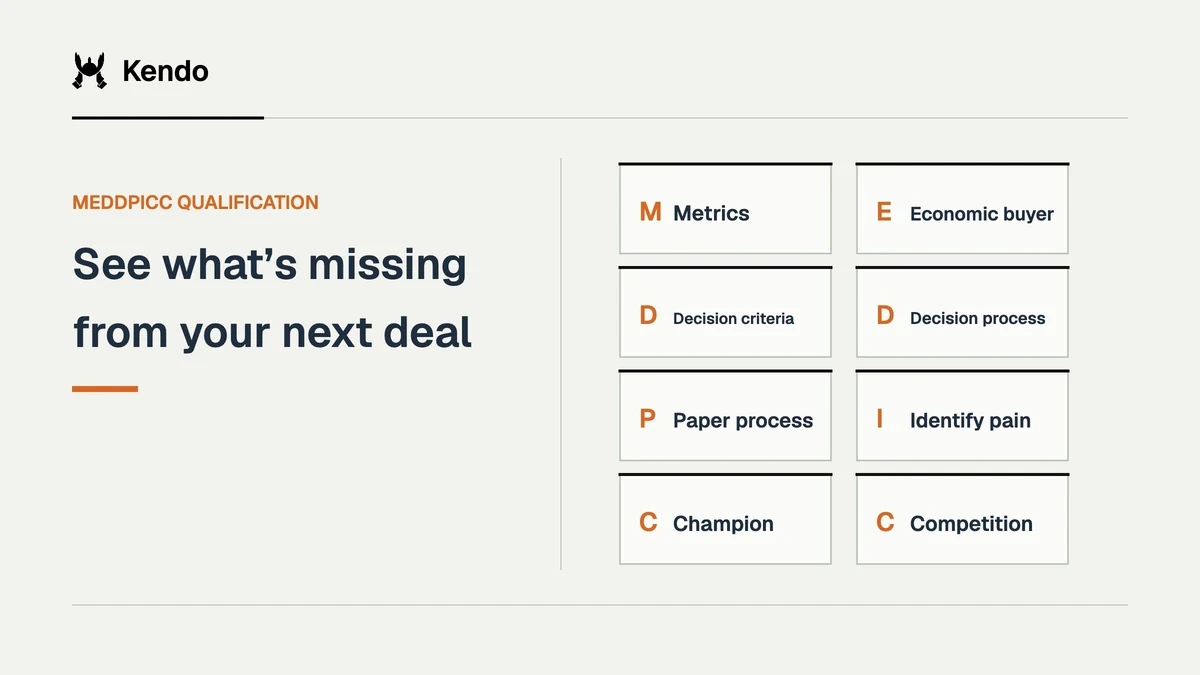
BANT (Budget, Authority, Need, Timing) is fine for simpler deals. Enterprise needs more. MEDDIC adds the rigor: Metrics, Economic buyer, Decision criteria, Decision process, Identify pain, and Champion.
And for genuinely complex deals, the MEDDPICC sales methodology adds the two elements that kill enterprise deals when ignored: the Paper Process (procurement, security, legal) and Competition.
It is no accident that the methodology behind today's billion-dollar software run-rates, used by the sales orgs at Snowflake, CrowdStrike, and Wiz, is MEDDPICC. It was built for exactly this kind of deal.
Here is the part most training skips. Teaching the acronym is easy. Getting reps to actually run it on a live deal is the hard part.
So use a rubric. The one below turns MEDDPICC from a definition into a per-deal risk check a rep or manager can score in a pipeline review.
The Enterprise Deal-Qualification Rubric (MEDDPICC)
Score every enterprise deal against these eight pillars. Green means de-risked. Red means the deal is exposed, and that is your next coaching conversation, not a forecast you bank on.
Pillar
What it answers
Green (de-risked)
Red (deal at risk)
Metrics
What measurable outcome does the buyer get?
Quantified ROI the champion can defend to finance
"They'll see value" with no numbers
Economic buyer
Who controls the budget?
Identified, and your rep has met them
Reps only talking to influencers
Decision criteria
How will they choose?
Documented, and you helped shape them
Guessing what the committee weighs
Decision process
What are the steps to a signature?
Mapped, with dates and owners
"Sometime next quarter, probably"
Paper process
What do procurement, security, legal require?
Surfaced early, timeline built in
Discovered in week 10, blows the close date
Identify pain
What real problem forces a change?
A compelling reason to act now
A nice-to-have with no urgency
Champion
Who sells internally for you?
Tested; they'll go to the economic buyer
A friendly contact who won't push
Competition
Who else, including "do nothing"?
Known, with a differentiated position
Blind to the alternatives, including status quo
The rubric is the asset. The discipline of running it on every deal is what separates a forecast from a wish. Reps build that discipline through reps, so practice qualifying conversations against a realistic buyer until the questions are automatic. The full eight-pillar breakdown lives in the MEDDPICC methodology guide.
5
Navigating Procurement, Security, and Legal (the Paper Process)
This is the section almost no training covers, and it is where enterprise deals go to die slowly. The selling is done, the committee is sold, and then the deal vanishes into procurement for six weeks while your rep wonders what happened.
The paper process is trainable. Reps need to surface the procurement timeline early, get ahead of a security review (a SOC 2 questionnaire, data-handling questions, a vendor assessment), and keep momentum while legal redlines the contract.
None of that is selling in the classic sense. All of it decides whether you close this quarter or next year.
The Last Mile: Where Won Deals Stall
The committee said yes. Now the deal runs a gauntlet that has nothing to do with selling, and an unprepared rep can lose weeks or a quarter at each gate.
Verbal Yes
The committee is sold. The selling feels done.
Won on merit
Procurement
Vendor forms, approvals, and a timeline a rep never asked about.
Stall risk
Security Review
SOC 2 questionnaire, data-handling, a vendor assessment that can veto.
Stall risk
Legal Redlines
The MSA goes back and forth while momentum quietly bleeds out.
Stall risk
Signed Contract
Closed this quarter, not next year, if the gates were surfaced early.
Closed
The training takeaway: reps who surface the procurement timeline and security requirements back in discovery clear these gates on schedule. Reps who meet them in week 10 blow the close date.
The point for training: if your program ends at "handle the objection and ask for the sale," your reps are unarmed for the last and longest mile of an enterprise deal.
6
Orchestrating Internal and Customer Teams
Enterprise reps don't sell alone. They pull in solutions engineers for the technical evaluation, security and legal for the reviews, executives for the exec-to-exec moments, and customer success for implementation.
On the buyer side, they coordinate a committee that, as we saw, frequently doesn't agree with itself.
That orchestration, knowing who to bring in and when, on both sides of the table, is a senior skill. It is the difference between a rep who runs a deal and a rep who gets run over by one. Good enterprise training treats the rep as the conductor of a complex, multi-month, multi-party process, not a lone closer.
How to Onboard and Ramp Enterprise Reps
Enterprise reps ramp slowly, and pretending otherwise is how you set them up to fail. The average B2B SaaS account executive now takes 5.7 months to ramp, up from 4.3 in 2020 (The Bridge Group, 2024), one reason SaaS sales training programs get their own playbook. For genuinely enterprise reps on long, complex cycles, plan for two to three quarters before full productivity.
There is a simple reason. A useful rule of thumb is that ramp time roughly equals your sales cycle plus onboarding. If your enterprise cycle is nine months, a rep can't prove they can close until they have lived through one.
So the goal of a ramp program isn't to fake productivity early. It is to build competence fast and protect your marquee accounts while the rep gets there.
Here is a ramp built for that reality.
1-30
Days 1-30: Foundation
Goal: build competence before any live account
Command of the space: product, ICP, and the competitive landscape, deep enough to hold an executive conversation.
The system: your sales process, the methodology, and the MEDDPICC rubric (how you qualify here).
Scored practice: discovery and exec-pitch reps against realistic buyers before any live account.
Gate
Pass a knowledge and qualification assessment.
31-60
Days 31-60: Guided Execution
Goal: real accounts, with backup
Shadow and co-sell: ride along on live enterprise deals; co-sell on real accounts with a senior rep.
Account planning: build a real account plan and map a real committee.
Supervised reps: run discovery and a first business case under supervision.
Gate
A complete, scored account plan and a multi-threaded committee map.
61-90
Days 61-90: Supervised Ownership
Goal: own deals under oversight
Own a slate: a small set of real opportunities with manager oversight.
Drill the hard moments: the CFO business case, a procurement push, a champion who goes dark.
Score the pipeline: weekly reviews scored against the MEDDPICC rubric.
Gate
Clean qualification discipline and in-range scores on monitored calls.
Q2+
Quarter 2 and Beyond: Full Ramp
Goal: autonomy and continuity
Carry a full enterprise pipeline with standard oversight.
Close first deals or show defensible, qualified progression.
Move into the continuous coaching and reinforcement rhythm.
Make the Foundation Phase a Required Practice Path
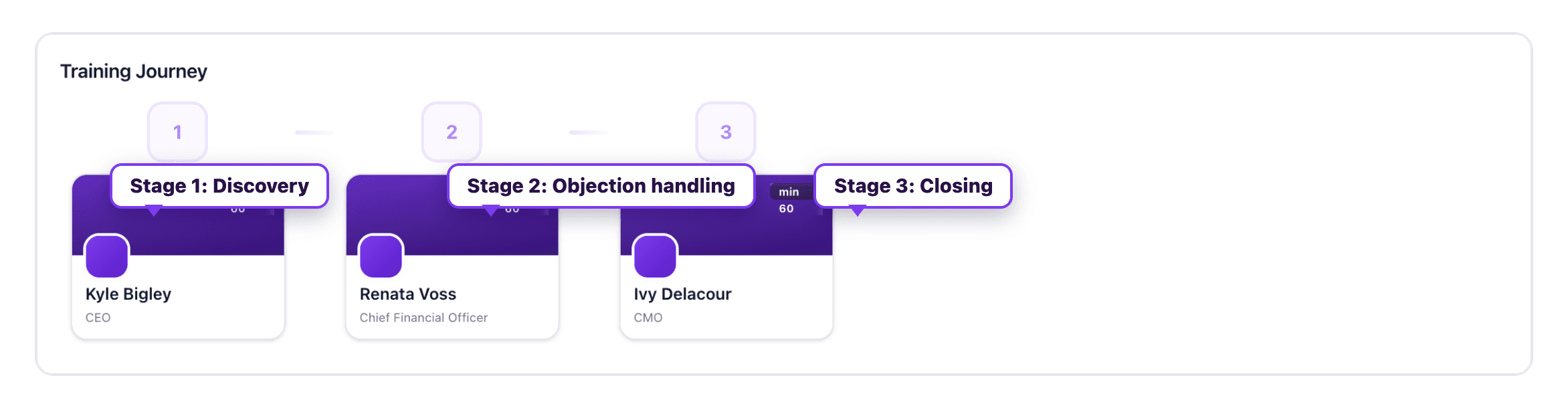
The "scored practice before any live account" in days 1 to 30 can be a fixed sequence a rep has to clear, not an ad-hoc role play. In Kendo, a training path stages the hard enterprise conversations in order, each against a realistic buyer, so the foundation phase is a repeatable program instead of a guess.
Kendo · New Rep Onboarding Path
A real Kendo onboarding path: three required AI roleplays a rep clears in order, Discovery, then Objection handling with a CFO, then Closing, before a single live enterprise account is on the line.Screenshot: Kendo (product)
Then, before you put a rep on a genuinely strategic account, run them through a readiness check. Calendar time is not competence, and a marquee logo is the wrong place to find out a rep can't multi-thread. Enterprise teams that need to formalize that decision can compare software for proving a rep is ready before the account is at risk.
The Enterprise Rep Readiness Scorecard
Six observable signals that a rep is ready for a real enterprise account. Score each one. A miss is a coaching assignment, not a reason to hand them a seven-figure deal and hope.
Readiness dimension
Ready for an enterprise account when...
Not yet (send back to practice)
Executive-level command
Holds a peer-level business conversation with a VP or CFO and frames value in their terms
Pitches features; freezes or defers when an executive pushes
Multi-threading
Maps the committee and earns access to the economic buyer, not just a friendly contact
Single-threads to one champion and stalls there
Discovery and business case
Builds a quantified ROI case the champion can defend to finance
"They'll see the value" with no numbers behind it
Qualification discipline
Runs MEDDPICC on every deal and walks from deals that fail it
Happy-ears forecasting; can't name the economic buyer or decision process
Paper process
Surfaces procurement, security, and legal early and builds the timeline around them
Gets blindsided by a security review or procurement step late
Scored practice and live calls
Hits the practice bar and scores in range on first monitored enterprise calls
Below the practice minimum or off on structure and qualification
The catch with running this by hand is time. Spot-checking a few reps a week leaves most of the cohort ungraded, which is exactly the gap a practice platform closes. AI call scoring against custom scorecards applies the same readiness bar to every rep, so the gate gets enforced consistently instead of by whoever the manager had time to listen to.
If compressing this whole curve is the goal, the deeper playbook on how to reduce sales ramp time is the right next read.
Make It Stick: Practice, Reinforcement, and Coaching
Here is the uncomfortable truth about most enterprise sales training: it does not stick. B2B reps forget roughly 70% of what they learn within a week, and the majority within a month, the pattern of the Ebbinghaus forgetting curve. Run the best enterprise selling workshop on Monday, and by month-end most of it is gone.
That is fatal for enterprise specifically. A simple skill you use every day stays sharp through repetition.
But the hardest enterprise moments come up rarely and matter enormously: the CFO business case, the procurement standoff, the security review. A rep might face a real CFO once a quarter. If their only practice was a one-time role play in onboarding, they are improvising on a seven-figure deal.
So the training has to be built around reps, not events. That means spaced practice against a realistic buyer, plus feedback that catches the gap before it costs a deal.
The classic version doesn't scale. Managers are busy, and no peer wants to play a hostile CFO for the tenth time.
This is the gap AI roleplay closes. It is where Kendo fits as the practice and coaching layer on top of whatever methodology you teach.
You build a custom AI prospect that behaves like your real buyers: a skeptical CFO, a procurement lead, a technical evaluator, even a multi-person committee scenario. Reps run the hardest conversation as many times as they need before a live account is on the line.
Kendo supports custom prospects by call type, ICP, sales cycle, industry, and personality, across 40+ languages. Then it scores each call against your scorecard, so reps know exactly what to fix on the next rep.
Every Practice Call Comes Back Reviewed, Not Just Recorded
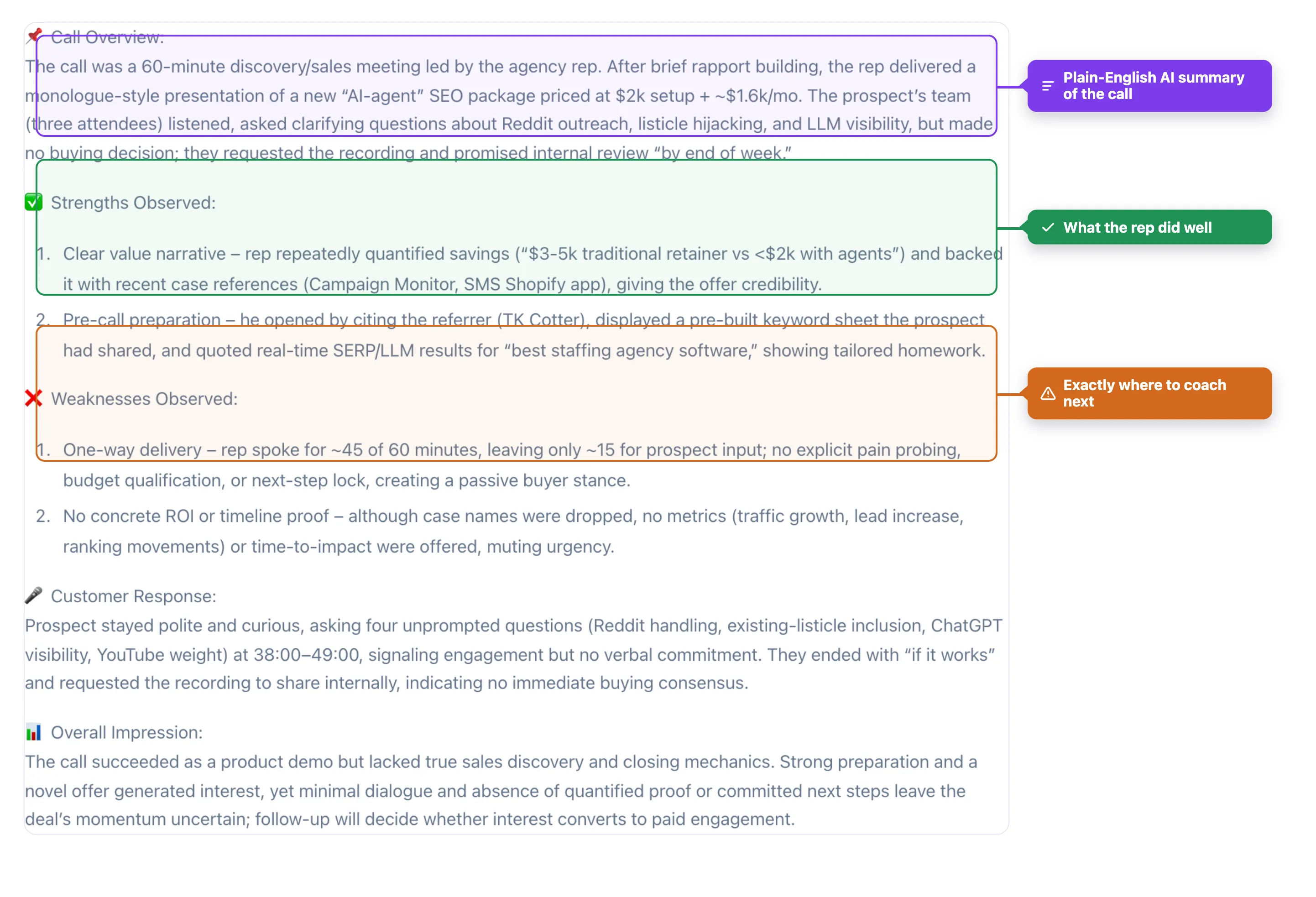
Kendo auto-reviews each scored call and writes a plain-English read of what the rep did well and exactly where to coach, against a custom scorecard by call type or role. For an enterprise rep, that is a sales-focused critique of the discovery or business-case conversation, not a raw transcript.
Kendo · Scored-Call AI Summary
Kendo's AI review of a scored practice call: a plain-English summary, the strengths the rep showed, and exactly where to coach next, generated automatically after the call.Screenshot: Kendo (product)
Reps Get Specific, Next-Call Feedback on the Hard Moments
After a scored practice call, a rep can ask Kendo's AI Coach how to improve and get back prioritized, concrete fixes, not a vague number. On an enterprise call it points to the exact habits that lose committees, so the next CFO or procurement conversation is better, not just measured.
Kendo AI CoachFeedback on your last call
YouHow do I improve this CFO business-case call?
Three things to fix on your next call
1Quantify the business case
You framed value qualitatively. Lead with the ROI math a CFO can defend internally, for example "12-month payback, then $1.4M saved a year."
2Confirm the economic buyer
You never tested who signs. Ask directly: "Besides you, who else has to approve the budget, and can we get them on the next call?"
3Surface the paper process
Procurement and security never came up. Name the timeline now: "When we get to yes, what does your security and procurement review usually take?"
An example of Kendo AI Coach feedback on a scored enterprise practice call. Reps act on the specifics, not a number.
A Leader Sees Ramp and Readiness by Rep, Not by Guess
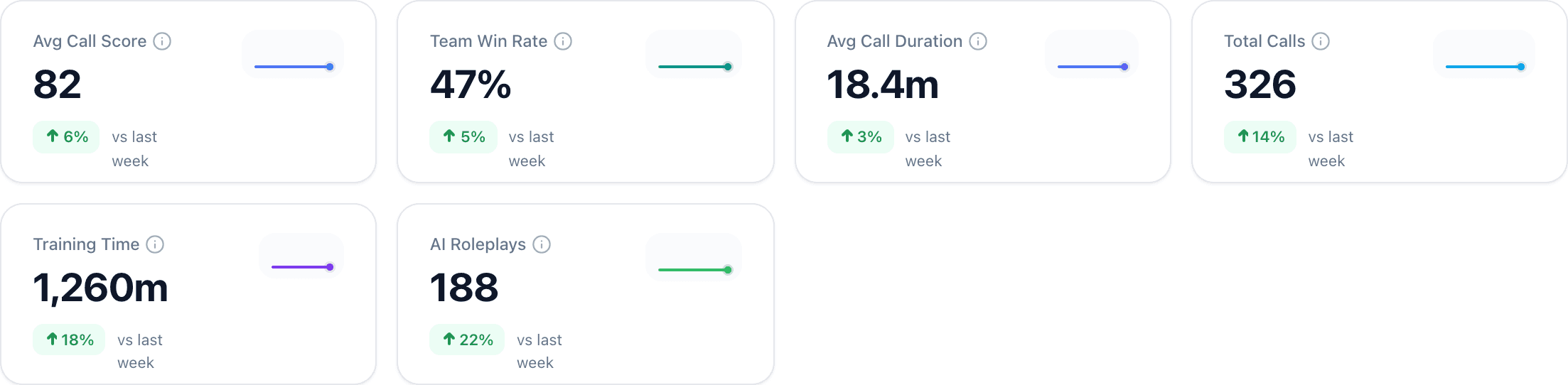
Those scores roll up into one team view, so a leader can see who is ready for a real account and who still needs reps. If you are weighing where to run that practice, the rundown of the best AI sales roleplaying tools is the place to start.
Kendo · Sales Overview Dashboard
Kendo rolls every practice rep and scored call into a team scoreboard, so a leader can see ramp and readiness by rep instead of guessing.Screenshot: Kendo (product, illustrative figures)
The mechanism is simple: reps build the reflexes on AI prospects instead of burning your real pipeline to learn. Here is what that looks like when a team puts practice in front of live calls.
Customer Story · United Insurance Pros
Reps Ramp 75% Faster When Practice Comes Before Live Calls
United Insurance Pros put reps through AI practice before their first live call. Onboarding went from 45 days to 14 days, and reps hit baseline performance in 14 days instead of 45+. The same put-practice-first sequence is what compresses an enterprise rep's ramp.
After Kendo (14 days)Before Kendo (45+ days)
Result: 7-day ramp-up + 7 days to baseline performance = 14 days total vs 45+ days before.
45 → 14 days
Time to baseline
75% faster
Ramp to baseline
$3,000+/mo
Saved per agent
"Typically we would see about a 45-day period where people would dip their foot in the water and slowly improve and then level off at their performance level. Now that's 14 days. So it's the 7-day ramp-up and then 7 days to be where they're going to be at their baseline."Waylon Artrip, Founder, United Insurance Pros
The same pattern shows up on close rates, not just ramp. Globe Life moved brand-new agents from around 33% to 60%+ close rates by putting them through scored practice and feedback instead of letting them learn on live prospects. Different metric, same lesson: practice plus feedback is what turns training into performance.
Build vs. Buy: Choosing Enterprise Sales Training
You have two real paths, and the right answer is usually a blend.
Buy a methodology. Established programs (the MEDDIC and MEDDPICC camps, value-selling and complex-deal methodologies from the well-known firms) give you a proven framework and a shared vocabulary.
That is worth it when you have no methodology, or a different one in every rep's head. The honest limitation: a workshop is an event, and we just saw what happens to event-based learning. The framework is necessary, not sufficient.
Build an internal program. Bigger orgs codify their own enterprise motion: their ICP, their deals, their objections, their account plans. More relevant, more work to maintain, and only as good as the people running it.
Either way, the missing layer is the same: reps and reinforcement. Whether you bought MEDDPICC or built your own playbook, your reps still need to run it out loud, many times, on realistic buyers, with feedback, until it is automatic.
That is the layer a practice platform supplies. The best sales training software doesn't replace your methodology or your trainers. It makes what they teach show up on live deals.
Even well-funded programs trip on the same predictable traps.
Mistake 1: Training Reps to Single-Thread
Most training implicitly teaches reps to find a contact and run the deal through them. On enterprise deals that is the number-one way to lose.
Fix: Make multi-threading a graded skill. Require a committee map and proof of access to the economic buyer before a deal counts as qualified.
Mistake 2: Teaching Frameworks Without Live Reps
A MEDDPICC slide deck is not MEDDPICC. Reps forget the acronym in a month and never run it on a deal.
Fix: Make qualification a weekly habit. Score every deal against the rubric in pipeline reviews, and have reps practice qualifying conversations until the questions are automatic.
Mistake 3: Ignoring the Paper Process
Training ends at "ask for the sale," and reps get ambushed by procurement, security, and legal in the final stretch.
Fix: Train the paper process like a sales stage. Reps should surface the procurement timeline and security requirements in discovery, not in week 10.
Mistake 4: Running SMB Training for Enterprise Reps
The same generic program for a transactional SDR and an enterprise AE wastes everyone's time and leaves the AE unprepared for committees and long cycles.
Fix: Build an enterprise-specific track: committee selling, business cases, MEDDPICC, procurement, multi-threading. Different sport, different program.
Mistake 5: Stopping at Onboarding
Reps graduate, lose the structured practice and coaching, and the hardest skills decay fast (most of it gone within a month).
Fix: Keep practice and call scoring running past onboarding. Reinforcement is not optional for skills reps use rarely and need cold.
Spin up your toughest enterprise buyer and train a rep on them in 10 minutes with Kendo
Build a skeptical CFO, a procurement lead, or a full committee, run the hardest conversation live, and review the score before a real account is on the line. Pricing starts at $55/mo per seat.
Enterprise sales training is the program that prepares reps to win large, complex, six and seven-figure deals. Those deals are decided by a buying committee of 6 to 10 people (Gartner), run for months, and are gated by procurement, security, and legal. Beyond pitch and demo skills, it teaches executive-level selling, multi-threading the committee, champion building, deep qualification with a framework like MEDDPICC, and how to navigate the paper process.
SMB training makes someone good at a single conversation. Enterprise training makes someone good at orchestrating a decision across a committee, over a long, procurement-gated cycle, on a high-value contract. The skills are different: multi-threading instead of one-call closing, business cases for finance, champion enablement, and qualification frameworks like MEDDIC and MEDDPICC instead of BANT. Running enterprise reps through SMB-grade training is one of the most common reasons complex deals stall in "no decision."
Plan for two to three quarters before full productivity. The average B2B SaaS account executive takes about 5.7 months to ramp (The Bridge Group, 2024), and enterprise reps on longer cycles often take more. A useful rule of thumb is that ramp roughly equals your sales cycle plus onboarding, so a nine-month cycle means a rep can't fully prove out until they have lived through one. Structured practice before live accounts is the most reliable way to compress that curve.
For genuinely complex enterprise deals, MEDDPICC is the stronger fit because it adds the two elements that kill big deals when ignored: the Paper Process (procurement, security, legal) and Competition. MEDDIC is a solid foundation and works well for mid-market and less complex deals. Many teams start with MEDDIC and add the extra pillars as deals get larger and more procurement-heavy. The deeper breakdown is in the MEDDPICC sales methodology guide.
Yes, and it is arguably more valuable for enterprise than anywhere else. The hardest enterprise moments (a CFO business case, a procurement standoff, a multi-stakeholder objection) come up rarely and matter enormously, so reps need repetition they can't get on live deals. AI roleplay lets a rep practice against a custom buyer (a skeptical CFO, a procurement lead, a full committee) as many times as they need, with scored feedback, before a real account is at stake. Kendo customers who put practice before live calls cut ramp time sharply, including United Insurance Pros going from 45 days to 14 days.
Stop Losing Complex Deals to "No Decision"
Enterprise selling is a different sport, so enterprise training has to be a different program. Pitch and demo skills won't carry a rep through a 7-person committee, a months-long cycle, and a procurement gauntlet.
Executive selling, multi-threading, champions, MEDDPICC qualification, and the paper process will. That is the discipline that turned a struggling PTC sales floor into the $1B engine that birthed MEDDIC, and it is what keeps deals out of the 38% that die in "no decision."
But knowing the playbook isn't the bottleneck. Reps are. You can teach MEDDPICC in a day. Getting a rep to run it on a live $400K deal, hold their own with a CFO, and keep a champion engaged takes practice and reinforcement, the part most training skips.
Two things you can do this week:
Score one stalled deal against the MEDDPICC rubric above. The red cells will tell you exactly why it's stuck.
Run one rep through your hardest committee conversation as a practice rep, and review the score before they take it live.
Then give your reps the reps. Kendo AI is the practice and coaching layer that makes enterprise training stick: custom AI buyers for your exact committee, scored against your scorecard, so reps build the reflexes on AI prospects instead of on your most valuable accounts.
Practice the enterprise committee before the real accountBuild the CFO, procurement lead, or full buying committee, then score the rep before a marquee deal is on the line.
Luke has helped train more than 5,000 sales reps. He started as a frontline closer, scaled a high-ticket sales-training company, and founded Closer Cartel and AI Insiders before building Kendo to fix the tools he wished he'd had: realistic AI roleplay and automated call review for fast-moving sales teams. He writes about sales training, ramp speed, objection handling, and applying AI across the revenue org.