
High-Ticket Sales Training: How to Train Reps to Close Bigger Deals
Big deals are won on buyer confidence, not pressure. Here's what high-ticket training must teach, how to build it, and how to drill the hardest conversations so they hold when a six-figure deal gets tense.
High-ticket selling is a different sport. The deals are bigger, the buyers are sharper, and the cost of a mishandled call is measured in five and six figures, not a lost trial.
So here is the uncomfortable part: most high-ticket sales training teaches the playbook and never runs a single scrimmage. Reps memorize the framework, watch a few recordings, and then get handed a $40,000 opportunity to "learn on." That is exactly how you torch margin and confidence at the same time.
This guide is the operator's version. Not a "become a closer" pitch, not a glossary. It covers what high-ticket sales training should actually teach, how to build a program that does not evaporate in a month, and how to drill the hardest conversations before they go live.
What this guide covers:
- The 5 skills high-ticket training has to build (and why "always be closing" loses these deals)
- How to build a program that sticks instead of fading the week after onboarding
- A 4-move drill for reframing "it's too expensive" without discounting
- A readiness scorecard so you stop clearing reps for big deals on a hunch
- Why AI roleplay is becoming the fastest way to rep high-stakes calls without risking real ones
High-ticket sales training is the structured work of building the specific skills premium deals demand (trust before the pitch, consultative discovery, ROI and business-case fluency, the nerve to hold price, and disciplined follow-up) and then rehearsing them until they hold under pressure. Big deals are won on buyer confidence, not pressure, and that confidence has to be trained and practiced, not just explained once.
What High-Ticket Sales Training Actually Is (and Why It's Different)
High-ticket sales means selling premium-priced offers where the buying process itself, not just the price tag, is the hard part. The exact number varies by market. Many people draw the line around $2,000 to $5,000, but the behavior really changes north of $10,000, and enterprise deals run from $50,000 into seven figures.
What does not change is the buyer. At these price points, people slow down, loop in their colleagues, and scrutinize risk before they sign anything.
And they are increasingly comfortable spending big without a traditional sales process. Per the McKinsey B2B Pulse (2024), 73% of B2B buyers will spend more than $50,000 through self-serve digital or remote channels, and 39% will spend over $500,000 that way.
The deal size no longer requires a handshake. It requires a reason to trust you.
The bigger shift is who you are actually selling to. A high-ticket deal is rarely one person. The typical B2B buying group now runs 6 to 10 decision-makers (Gartner), each arriving with their own research.
Finance, IT, procurement, the end user, the executive sponsor. That is a consensus sale across a committee stretched over weeks or months, not a single buyer you charm in one call.
Here is the practical contrast every rep needs to feel in their bones.
| Dimension | Transactional Selling | High-Ticket Selling |
|---|---|---|
| Decision-makers | One, sometimes two | A buying group of 6 to 10 (Gartner) |
| Timeline | Days to a couple of weeks | Weeks to many months |
| What wins | Speed, urgency, a clean pitch | Trust, fit, and decision confidence |
| The real objection | Price | Risk and internal approval |
| Cost of a bad call | A lost deal | A burned six-figure opportunity |
| Rep mindset | Always be closing | Diagnose, then prescribe |

So what actually decides these deals? Not pressure. Confidence. Gartner found that B2B customers with high decision confidence are 10 times more likely to make a high-quality, low-regret purchase, and 2.6 times more likely to buy more.
The same research shows 80% of sellers who used a "sense making" approach (helping the buyer make sense of conflicting information) closed those high-quality, low-regret deals.
Read that again, because it is the whole thesis. Your job in a high-ticket deal is to make a careful, skeptical buyer feel genuinely confident in a hard decision. High-ticket sales training is how you build reps who can do that on purpose, every time, instead of by accident.
What High-Ticket Sales Training Should Teach: The 5 Skills
If you only teach product and a pitch, you have trained a rep for a transaction, not a high-ticket deal. These are the five skills that actually move premium opportunities, and the order matters.
-
1
Trust and Credibility Before the Pitch
By the time a high-ticket buyer talks to you, they have already done their homework. 61% of B2B buyers say they prefer a rep-free buying experience (Gartner, 2025). They are not avoiding you because they hate salespeople. They are avoiding you because most reps add nothing the website already told them.
That is the bar now. If a rep cannot say something the buyer could not Google, the meeting was a waste of a slot.
Training has to build reps who earn the conversation: who know the buyer's industry, reference real outcomes from similar companies, and sound like a peer instead of a brochure.
It matters more than it sounds, because going it alone tends to backfire on the buyer. Gartner found purchase regret is 23% higher for rep-free buyers than for those who work with a seller. A great rep is the antidote to a lonely decision.
-
2
Consultative Discovery That Earns the Right to Recommend
The fastest way to lose a high-ticket deal is to pitch before you understand. The rep who "always be closing" loses to the rep who takes 45 minutes to actually figure out what the buyer is trying to solve. For annuity teams, the annuity sales training guide applies that discovery-first approach to client goals, access-to-money questions and explanations grounded in the contract.
This is the heart of consultative selling: diagnose before you prescribe. The same insight built The Challenger Sale (Dixon and Adamson), where teaching the buyer something new beats simply being responsive.
The data backs it hard. RAIN Group studied more than 700 B2B purchases worth $3.1 billion, and the top two factors separating winners from second place were "educated me with new ideas" and "collaborated with me." Not "had the best price."
Train reps to run layered discovery, to ask the second and third question instead of jumping on the first pain, and to slow down when they sense buying interest. Counterintuitive, and exactly why it has to be practiced.
-
3
ROI and Business-Case Fluency
A high-ticket buyer almost never has unilateral authority to spend. Your champion loves it, then has to go sell it to a CFO who has never met you. If your rep has not armed that champion, the deal dies in a finance review you never see.
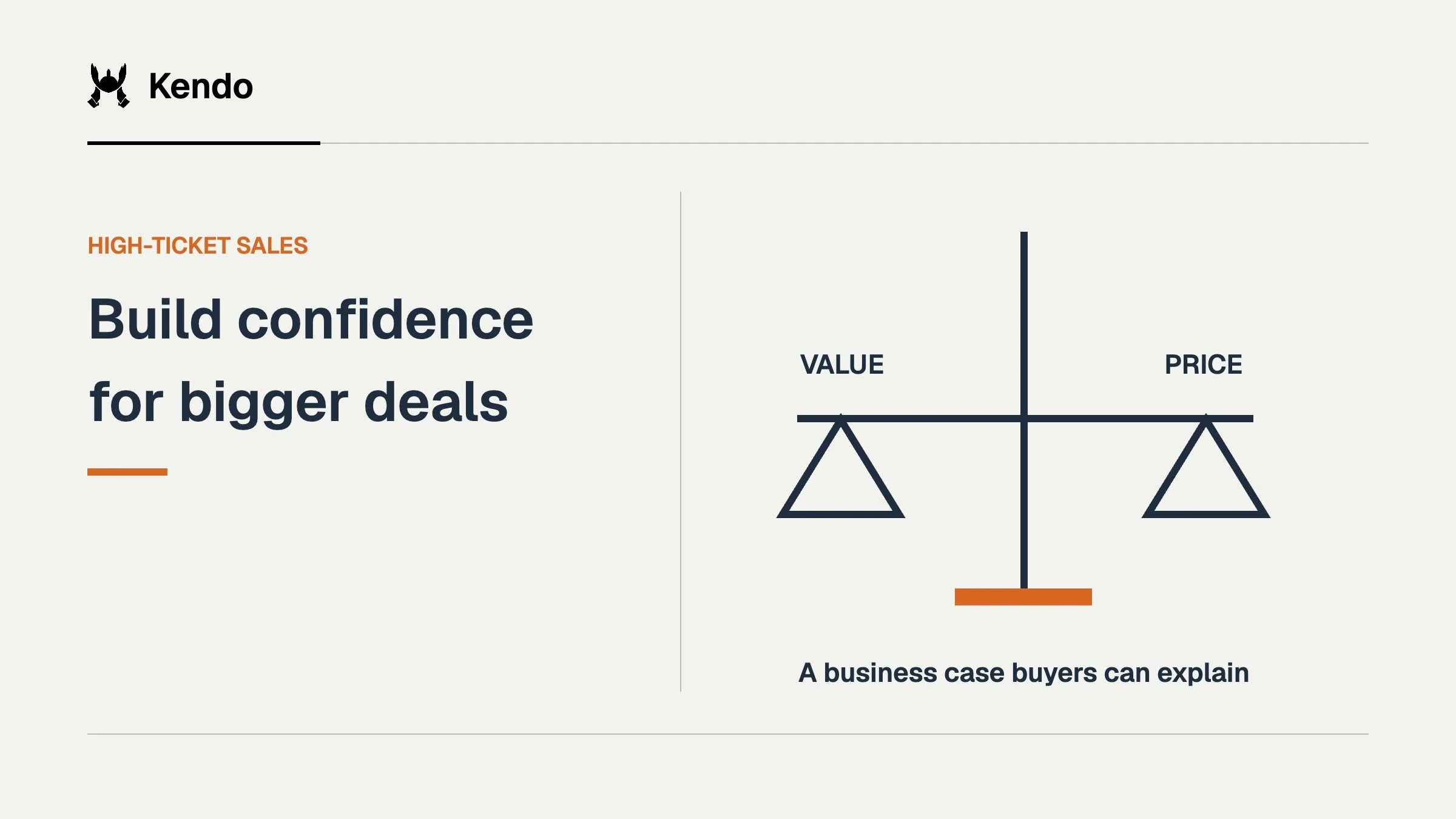
So ROI fluency is a core high-ticket skill, not a nice-to-have. Reps need to quantify the cost of inaction in the buyer's own numbers: what 12 months of the current problem costs, against the one-time price of fixing it.
Done right, the recommendation comes with a written business case the champion can forward upward without the rep in the room.
This is where qualification frameworks like MEDDIC or BANT earn their keep: they force reps to find the economic buyer and quantify the metrics before they propose. When the ROI is grounded in the buyer's figures, the price stops being a surprise.
-
4
Holding Price and Reframing "Too Expensive"
The "that's a lot of money" moment. A trained rep diagnoses it instead of flinching.GIF via Giphy Thirty minutes into a great demo, the buyer says "that's a lot of money." This is the moment that separates trained high-ticket reps from everyone else.
The untrained rep flinches and reaches for a discount, vaporizing margin to force a close that was not actually stalled. The trained rep knows something most people miss: at high price points, "too expensive" is almost never about the number. It is about risk, approval, or unproven ROI.
The research backs this hard. In The JOLT Effect, Matthew Dixon and Ted McKenna studied 2.5 million sales calls and found 40% to 60% of lost deals die to customer indecision, not to a competitor or the price (Dixon and McKenna, 2022). The fear is messing up, not the cost.
So you do not fix the price objection with a clever one-liner. You fix it with a drill reps have run so many times the response is automatic. Here is the one to teach.
The Price-Objection Drill: the Sticker-Shock Reframe
Four moves, run in order, until they are reflex. Built to rep the "that's a lot of money" moment without reaching for a discount.
1Pause & Validate
"Fair, it's a real investment." Don't flinch. The reaction is a buying signal.
2Diagnose
Budget, approval, ROI, or trust? "Is it the number, or getting it approved?"
3Reframe as ROI
Tie price to their own figures. The investment is a fraction of the cost.
4Re-anchor
"What does another 12 months of this problem cost you?" Usually far more.
The thread through all four moves: never discount, diagnose.- Pause and validate, do not flinch. "Totally fair, it's a real investment." A price reaction is a buying signal, not a no. Reps who panic here teach the buyer that the price was negotiable.
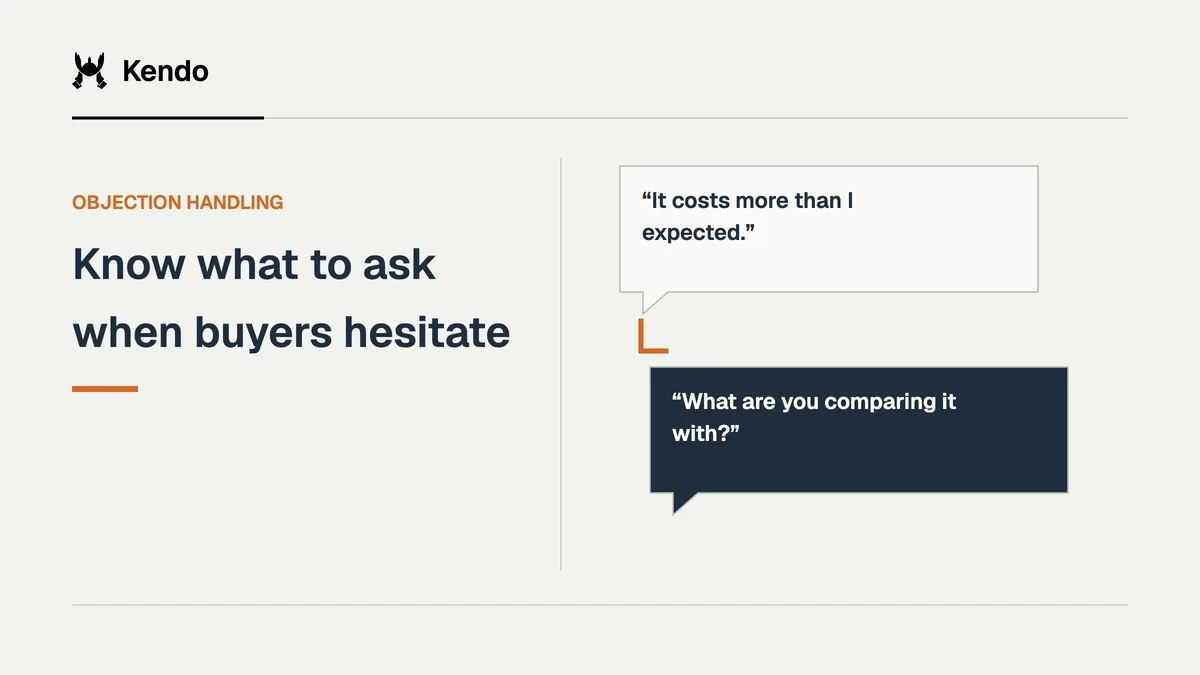
- Diagnose the real objection. Ask: is this a budget ceiling, an approval problem, an ROI question, or a trust question? "When you say it's a lot, is it the number itself, or getting it approved internally?" You cannot answer an objection you have not located.
- Reframe price as risk and ROI. Tie it back to their own figures and the case built together. "Earlier, the gap came out to roughly $X a month in lost pipeline. The investment is a fraction of that." With skill 3 in place, this is the easy part.
- Re-anchor on the cost of inaction. "Set the price aside for a second: what does another 12 months of this problem cost you?" The honest answer is usually far bigger than the deal.
A quick worked exchange
Buyer: "Honestly, that's a lot more than I expected."
Rep: "Fair, it's a real number. Quick question, is it the figure itself that's the problem, or is it getting it through finance?"
Buyer: "It's mostly finance. I'd have to justify it."
Rep: "Then let's build that justification together. The gap is costing about $30K a quarter. I'll put the one-pager together so you can walk your CFO through the math, not just the price."
That is not a discount. That is a rep handling the moment that kills most high-ticket deals. The hard part is not the four moves. It is repping them until they hold when a real buyer pushes back. For the full system, the deeper guide on objection handling breaks down more patterns.
-
5
Follow-Up and Multi-Threading Discipline
High-ticket deals do not close on the first call, and they rarely close on the second. 80% of sales require five or more follow-ups, yet 44% of reps give up after one (a number commonly cited from Marketing Donut). At high price points, that gap is where pipeline goes to die.
Two disciplines have to be trained here, and most programs train neither. The first is multi-threading: building relationships across the buying group instead of betting the deal on one champion who might get reorged out next quarter.
This is not a soft skill. When Gong analyzed 1.8 million deals, the contrast was stark.
Why Single-Threaded High-Ticket Deals Die
Closed deals had twice the buyer contacts of lost ones. Spreading across the committee was the difference.
Single-threaded
Rep ChampionOne relationship carries the whole deal. The champion leaves and the deal dies with them.
Multi-threaded
Rep Champion Finance IT End user+130%win rate, deals over $50K
Relationships across the committee survive any one person leaving.Source: Gong Labs analysis of 1.8 million new-business deals, 2024.
The second discipline is systematic follow-up: a real cadence with a reason for every touch, not "just checking in." A deal that goes quiet for two weeks is not lost, but the rep who treats follow-up as optional will lose it anyway.
How to Build a High-Ticket Training Program (Without It Evaporating)
Here is the brutal truth about most sales training: it does not stick. B2B reps forget roughly 70% of what they learn within a week and the majority within a month, the pattern of the Ebbinghaus forgetting curve. You can run the best high-ticket workshop of all time on Monday, and by month-end most of it is gone.
That is not a content problem. It is a reinforcement problem. A better binder will not fix it. Reps and feedback will.
So build the program like an athlete trains, not like a student crams:
- Codify your real motion first. Write down how your best rep actually wins a high-ticket deal, plus your ten most common objections and the exact "too expensive" patterns your buyers use. You cannot train a process you have not made explicit.
- Sequence the learning. Trust and discovery before ROI and price-holding. Do not dump everything in a week-one firehose that reps will forget by week two.
- Make scored practice non-negotiable. Reps have to rehearse the price reframe and a multi-stakeholder discovery out loud, scored, before they run a live high-ticket call.
- Close the loop with call review. Score real calls against the skills above so coaching lands on the actual gap, not a vibe.
- Reinforce after onboarding. The skills decay. Keep practice and review running, or you will be retraining the same reps in 90 days.
If you are also evaluating an outside curriculum to anchor all this, the roundup of the best sales training programs is a useful next read before you commit budget. And if you would rather buy a platform than build the practice layer in-house, compare the options in our roundup of the best sales training software.
How to Practice High-Ticket Conversations Before They're Live
You would never let a pilot learn on a full plane. But high-ticket teams do the equivalent constantly: they let a new rep learn on a real $50,000 opportunity, then act surprised when it gets coached live and lost.
The old fix was manager-led roleplay or pairing with a veteran. It does not scale, the feedback is inconsistent, and a busy AE practicing with a busy manager twice a month is not enough reps to build anything. That is the bottleneck high-ticket training has always hit.
AI roleplay broke that bottleneck. Instead of waiting on a manager, a rep can spin up a custom AI buyer (a skeptical CFO, a procurement gatekeeper, a multi-stakeholder committee) and drill the exact conversation on demand.
This is where Kendo fits. You build custom AI prospects for your specific deal: the industry, the offer, the call type, the personality.
So a rep can run discovery, then run the price reframe against a buyer who actually pushes back with "that's a lot of money," and get scored on how they handled it. It is the scrimmage high-ticket training has always been missing.
The practical advantage is that teams can practice the toughest deal in the pipeline before a single real dollar is on the line. For a platform comparison, start with the breakdown of the best AI sales roleplaying tools, or zoom out to the wider category of AI sales tools if you are also evaluating prospecting and call-intelligence software.
Reps Get Specific, Next-Call Feedback on the Price Reframe
After a scored roleplay or a real call, a rep can ask Kendo's AI Coach how to handle the price moment better and get back prioritized, concrete fixes, not a vague score.
It points to the exact habit that gave away margin and the language to use instead, so the next high-ticket call holds.
You dropped 12% the second they paused. Hold the number and diagnose first: ask whether it is the figure or getting it approved.
You quoted list price. Tie it to the $30K-a-quarter gap they named earlier so the investment reads as a fraction of the cost.
You let the call end on price. Close with what another 12 months of the problem costs, which is usually far bigger than the deal.
A real example of Kendo AI Coach feedback on a scored high-ticket call. Reps act on the specifics, not a number.
The payoff is not theoretical. It shows up in named outcomes.
High-Ticket Reps Ramp 75% Faster When They Practice First
By requiring 3 to 5 hours of AI practice before the first live call, onboarding went from 45 days to 14 days, and agents reached full baseline in 14 days instead of 45 or more. The same reps-before-real-deals discipline is exactly what high-ticket teams need.
Result: 7-day ramp-up + 7 days to baseline = 14 days total vs 45+ days before, with $3,000+ per agent per month saved on wasted leads.
"Typically we would see about a 45-day period where people would dip their foot in the water and slowly improve and then level off. Now that's 14 days. So it's the 7-day ramp-up and then 7 days to be where they're going to be at their baseline."Waylon Artrip, Founder, United Insurance Pros
The mechanism is simple and it transfers straight to high-ticket: reps build the reflexes on AI buyers instead of on your most valuable real opportunities.
How to Tell a Rep Is Ready for High-Ticket Deals
Most managers decide a rep is ready the same lazy way: "they have been here a quarter, throw them on the big accounts." That is how a six-figure deal becomes a training exercise.
Readiness for high-ticket is not a date on the calendar. It is a set of observable behaviors. Use this scorecard before you put any rep on a premium deal, and treat every missed row as a drill assignment, not a reason to send them in anyway.
The High-Ticket Readiness Scorecard
Six observable signals that tell you a rep is ready for premium deals. Score each before you clear them, and drill any row they miss.
| Readiness Dimension | Cleared for High-Ticket Deals When... | Not Yet (Drill This First) |
|---|---|---|
| Trust and credibility | Sounds like an industry peer; references relevant outcomes without notes | Sounds like the website; adds nothing a buyer couldn't Google |
| Consultative discovery | Runs layered discovery and surfaces the real pain, not the first symptom | Pitches early; questions are shallow or generic |
| ROI and business case | Builds a written ROI case the champion forwards to finance unassisted | Talks features; leaves the champion to justify it alone |
| Holding price | Handles "too expensive" with the reframe, no reflex discount | Flinches and drops price to force the close |
| Follow-up and multi-threading | Runs a real cadence and has more than one contact in the account | Single-threaded on one champion; follow-up is "just checking in" |
| Live-call readiness | First scored practice calls hit the bar on structure and listening | Below the practice minimum or below the score threshold |
This is exactly what Kendo automates. Roleplay scores and automated call review apply the same bar to every rep, so "ready for high-ticket" means the same thing across the whole team.
One Readiness Board for the Whole Team
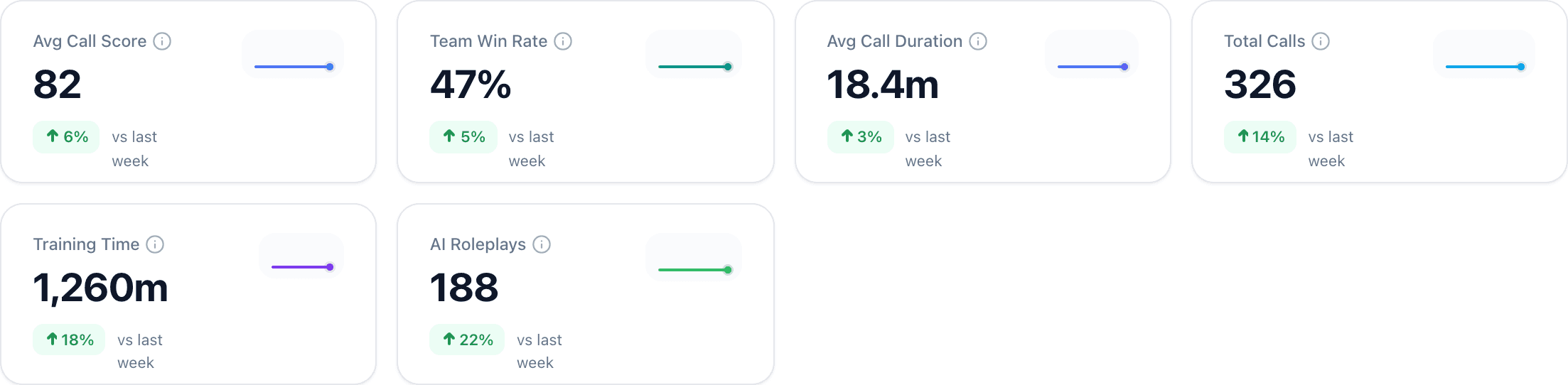
Instead of a manager's memory of who they happened to listen to, Kendo rolls every rep's scored calls and practice onto one Sales Overview: average call score, team win rate, and practice time, each with the week-over-week move.
Globe Life put brand-new agents through repeated roleplay on the script, the rebuttals, and the close, and watched their close rate nearly double in six months. Reps and feedback, not a one-time class.
"Our closing rate for brand new agents has been almost close to double with the use of Kendo just because they're getting that repetition, they're getting the rebuttals, they have the practice."Jess Chang, Partner, Globe LifeRead the full case study →
Common High-Ticket Training Mistakes (and How to Fix Them)
Even well-built programs trip on the same traps. Here are the five that cost the most.
Mistake 1: Teaching the Playbook, Never Scrimmaging
Reps can recite your methodology and still freeze on a real call. Knowledge is not skill.
Fix: Build mandatory, scored practice into the program. Reps rehearse the hard conversations out loud and pass a competency bar before they run a live high-ticket deal.
Mistake 2: Training "Always Be Closing" Into Deals That Punish It
Pressure tactics work on transactions and actively repel high-ticket buyers, who read them instantly as a reason to distrust you.
Fix: Train patience and diagnosis. Reward reps for slowing down, qualifying hard, and walking away from bad-fit deals instead of forcing them.
Mistake 3: Treating "Too Expensive" as a Price Problem
Reps who hear sticker shock and reach for a discount give away margin on deals that were not actually about price.
Fix: Drill the Sticker-Shock Reframe above until diagnosing the real objection (risk, approval, ROI, trust) is automatic.
Mistake 4: Letting Reps Learn on Real High-Ticket Leads
Your most valuable opportunities are the worst possible practice field.
Fix: Move the reps to AI roleplay. Skvarla Insurance did, and saw 5 to 20% production gains practicing on a $10 AI warm-up instead of burning $30 to $50 real leads.
Mistake 5: Stopping at Onboarding
The skills decay fast (about 87% gone within a month, per Gartner). A rep who was sharp in week one is rusty by quarter's end without reinforcement.
Fix: Keep practice and call review running as an ongoing rhythm, not a one-time event.
High-Ticket Sales Training FAQ
It is training that builds the specific skills premium deals demand (trust before the pitch, consultative discovery, ROI and business-case fluency, holding price, and disciplined follow-up) and then rehearses them. High-ticket buyers are sophisticated and the deals are too valuable to let reps learn on, so the training has to transfer to real calls, not just live in a slide deck.
Codify your real winning motion and your top objections, sequence the learning so trust and discovery come before price-holding, make scored practice non-negotiable (roleplay the price reframe and a multi-stakeholder discovery before live calls), then close the loop with call review and reinforce after onboarding so the skills do not decay.
Five: earning trust before the pitch, diagnostic consultative discovery, ROI and cost-of-inaction fluency, the nerve to hold price and reframe "too expensive" as risk, and follow-up plus multi-threading discipline across a 6-to-10-person buying group.
Do not flinch and do not discount. Pause and validate, diagnose whether it is really budget, approval, ROI, or trust (usually not the number), reframe the price as risk and ROI in the buyer's own figures, and re-anchor on what 12 more months of the problem costs. The Price-Objection Drill above is built to rep exactly this sequence.
It works when it sticks, and it sticks through practice and feedback, not a one-time class (reps forget around 70% of what they learn within a week, in the pattern of the Ebbinghaus forgetting curve). Kendo customers who put practice before live calls prove it: United Insurance Pros took agent onboarding from 45 days to 14 days, and Globe Life moved new agents from around 33% to 60%+ close rates.
Where to Start (and Where Kendo Fits)
You do not need to rebuild your entire training program this week. You need to close the gap between what your reps know and what they can do when a big deal gets tense.
Start here: take the hardest high-ticket buyer in your pipeline, build that exact persona, and have a rep run the price reframe against them once. You will learn more about that rep's real readiness in ten minutes than in a month of watching them sit through slides.
That is the whole point of high-ticket sales training. The framework is the easy part. The reps are what win the deal, and you cannot let a new rep get their reps in on a $50,000 opportunity.
Kendo AI is where your team drills the high-stakes conversations (discovery, the ROI case, the "too expensive" moment, the follow-up) before a single real dollar is on the line. Call review then tells you exactly who is ready and who needs another round.
Knowledge without reps is just theory. In high-ticket, theory is expensive.
Kendo AI helps sales teams practice high-stakes calls, score real conversations, and coach every rep against the same standard.
See how Kendo AI works →