
How to Use AI in Sales: Real Examples and Where to Start (2026)
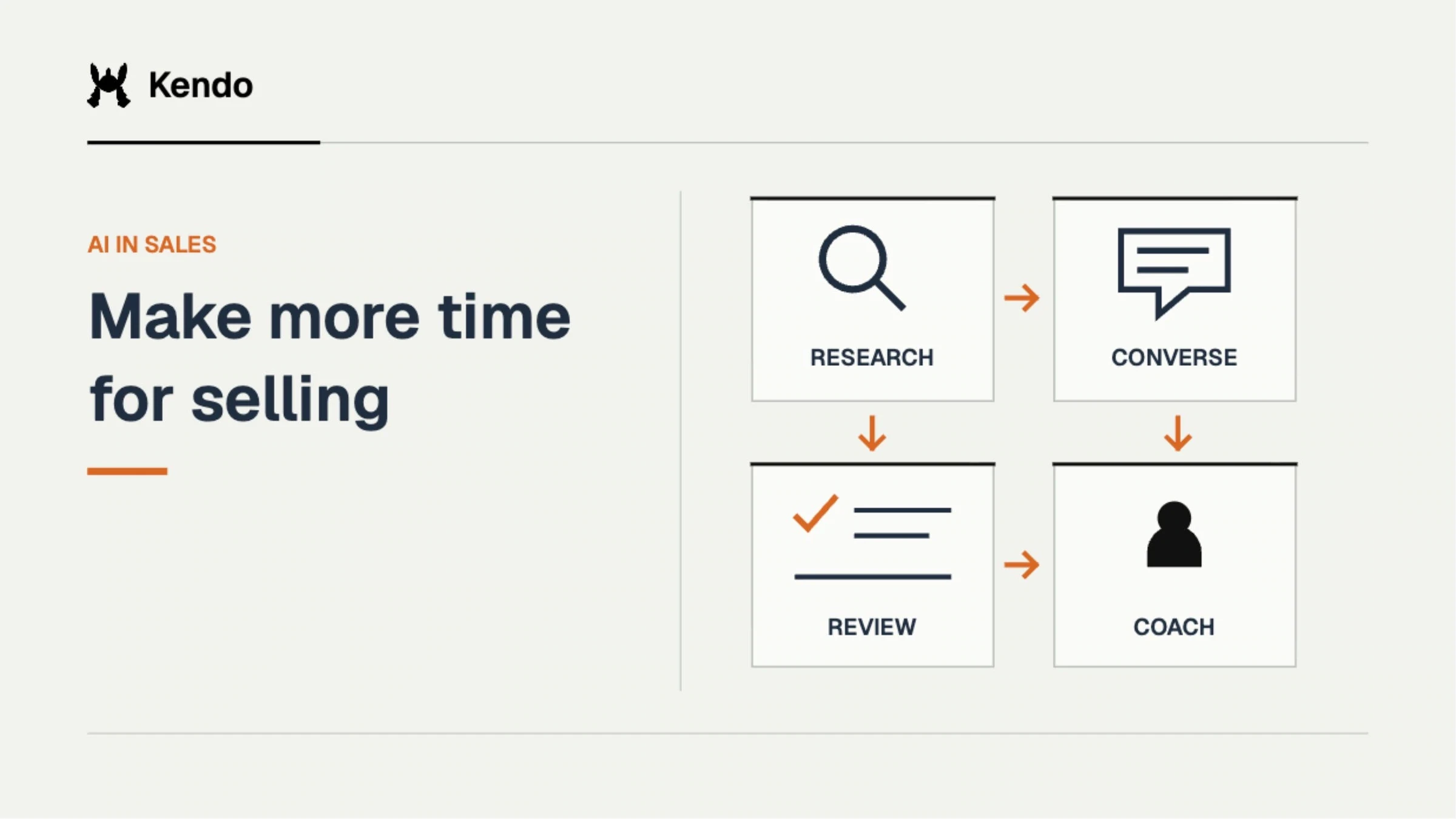
Everyone says use AI. Almost nobody shows you the concrete version. Here are the 12 ways teams actually use AI across the sales workflow, a real example and the forefront tools at every stage, plus a scorecard for where to start.
Sales teams that lean hard on AI generate 77% more revenue per rep than the ones that don't, a six-figure gap per seat, according to Gong's State of Revenue AI report from December 2025. That number came out of 7.1 million sales opportunities across more than 3,600 companies, so it isn't a vendor talking point. It's the new baseline.
Here's the problem. Everyone tells you to "use AI in sales" and almost nobody shows you the concrete version. You get a wall of buzzwords, a glossary, or a thinly veiled ad, and you still don't know what your team should actually do on Monday.
This guide fixes that. It walks all 12 real use cases across the sales workflow, names the tools that lead each one, and grounds every stage in how teams actually run it. Then you get a scorecard for where to start and an honest section on where AI still needs a human.
Here's what you'll walk away with:
- The 12 ways sales teams actually use AI right now, each with a real example and the forefront tools
- A Where-to-Start Scorecard that ranks the use cases by payoff and effort for your team
- Proof it works, including named customer results, not just stats
- A straight answer on what AI still gets wrong in sales
Using AI in sales in 2026 means putting AI on the work that eats your reps' time and your managers' attention: lead scoring, prospecting, outreach, call analysis, coaching and practice, forecasting, deal risk, CRM grunt work, content, proposals, hiring, notetaking, and enablement. The goal isn't "more AI." It's getting reps back to selling and managers coaching with data instead of gut feel. Start with one high-payoff use case, prove the ROI in a quarter, then expand.
What "Using AI in Sales" Actually Means in 2026
Two years ago, AI in sales meant a clunky chatbot and a "write me an email" prompt. That era is over.
There are really two kinds of AI in your sales stack now. Assistive AI sits next to a rep and does the heavy lifting on demand: drafts the email, summarizes the call, scores the pitch. Agentic AI runs a task end to end with less hand-holding, like an AI SDR that qualifies inbound leads and books meetings while your team sleeps. Most teams use a mix, and the mix is no longer experimental.
It's mainstream. McKinsey's 2024 State of AI survey found 65% of organizations regularly use generative AI in at least one business function, up from about a third the year before, and marketing and sales was the most common place they put it. Salesforce's State of Sales research puts AI adoption at 87% of sales organizations, and Gartner expects 60% of B2B seller work to run through conversational or generative AI by 2028, up from under 5% in 2023.
The 12 Ways Sales Teams Actually Use AI (With Real Examples)
AI shows up across the entire sales motion. Here's the full map, front to back, with what AI actually does at each stop, a concrete example, and the forefront tools teams reach for.
-
1
Lead Scoring and Predictive Prioritization
Lead scoring rates every account so reps work the 10s first, not the list top to bottom.GIF via Giphy Most reps waste their best hours on accounts that were never going to buy. AI lead scoring fixes the order of operations.
It ranks leads and accounts by likelihood to convert, blending firmographic and technographic fit with behavioral and intent signals. In B2B this increasingly means account scoring for ABM, not just individual-lead scoring, so reps work the accounts that are actually in-market.
The move: instead of a rep working the list top to bottom, AI surfaces the 20 accounts showing real buying signals this week, a pricing-page visit, a relevant hire, a funding round, and pushes those to the top.
The forefront tools here are 6sense for account-based predictive scoring and intent, the enterprise ABM standard, and MadKudu for predictive scoring built around product-led motions with transparent, non-black-box models. HubSpot and Salesforce Einstein both ship native predictive scoring if you'd rather stay inside your CRM.
-
2
Prospecting, Outreach, and AI SDRs
This is the broadest category in the stack, and where most of the AI-SDR hype lives. Reps spend less than a third of their week actually selling, according to Salesforce's State of Sales research, with the rest lost to admin, research, and internal meetings. Prospecting is where AI buys that time back.
AI builds target lists against your ICP, enriches contact and company data, and drafts personalized outreach off real signals like funding, job changes, and tech stack. The most autonomous version is the "AI SDR" agent that researches, sequences, and books meetings with light human oversight.
The move: AI assembles a list against your ICP, enriches every contact, and drafts a different first line for each one off a recent signal. The rep reviews, fixes the two that sound off, and sends.
The forefront tools are Clay for programmable data enrichment and AI research (waterfall enrichment across 50+ sources, the "build-your-own-prospecting-engine" leader) and Apollo for an all-in-one database, sequencing, and dialer. Outreach and Salesloft lead on sequencing and engagement. AI-SDR agents like 11x and Artisan exist, but vet them before you hand over the keys; 11x drew scrutiny in 2025 over how it represented its customer roster, so treat the autonomous-agent category as promising, not proven.
The build-your-own alternative: a growing number of founders and operators skip Clay and assemble the same workflow from cheaper parts. Pull a lead list from Apollo or ListKit, layer intent from Bombora and company data from Crunchbase, then point Claude, Claude Code, or Codex at it to enrich records, scrape sites, score accounts, and personalize outreach. It handles much of what Clay does at a fraction of the cost.
-
3
Personalized Outreach at Scale
Personalized outreach at scale: AI drafts a different opener for every prospect and the rep just hits send.GIF via Giphy Generic outreach is dead, and "personalization at scale" used to be a contradiction. AI made it real, as long as you keep a human in the loop.
This is the execution layer on top of prospecting: not just who to reach, but what to say and how often. AI researches the account, writes off the specific signal, and sequences the follow-ups so nothing slips, all at a volume manual reps can't match.
The move: instead of firing the same template at 200 contacts, AI drafts a different opener for each one. A founder gets a line about their Series B; a VP of Ops gets a line about the hiring spree on their careers page. The rep skims, fixes what sounds off, and sends.
For this layer, Clay drives the research and signal-based personalization, and Apollo runs the multichannel sequencing and sending. Outreach and Salesloft are the heavier engagement platforms if you're running high-volume cadences.
Here's where most AI-in-sales advice gets lazy: it tells you to automate outreach and walks away. AI should draft, humans should approve. Fully automated send-it-all outreach burns domains and reads like a robot. The reps winning with this use AI for the draft and their own judgment for the send.
-
4
Call Analysis and Conversation Intelligence
Conversation intelligence does the math on every call, surfacing what worked and what to fix.GIF via Giphy Every sales call is full of signal, and almost none of it used to get captured. A manager listened to maybe four calls a week and called it coaching.
Conversation intelligence flips that. AI records, transcribes, and analyzes every call, then surfaces the objections that came up, the next steps that got committed, the talk-to-listen ratio, and the moments a deal turned. Managers stop guessing and start seeing.
The move: a rep finishes a discovery call. By the time they're back at their desk, AI has summarized it, flagged that they talked 70% of the time, and pointed out the budget objection they skated past instead of handling. That's a coaching moment that would have been invisible a year ago.
The category leaders are Gong, which has expanded from conversation intelligence into full revenue intelligence, and Chorus by ZoomInfo, the other established platform, now sold inside ZoomInfo's data platform. Those two lean toward pipeline analytics and rep behavior across the revenue cycle.
Kendo Turns Every Call Into Coaching You Can Act On
Kendo auto-reviews each recorded call and writes a plain-English summary of what the rep did well and exactly where to coach, then scores the call 1 to 100 against a custom scorecard by call type, offer, or role. Managers stop scrubbing recordings, and unlike a plain transcriber, the output is a sales-focused read on the conversation. The breakdowns of sales call analysis software and conversation intelligence platforms show how much tools differ on coaching depth versus pure recording.
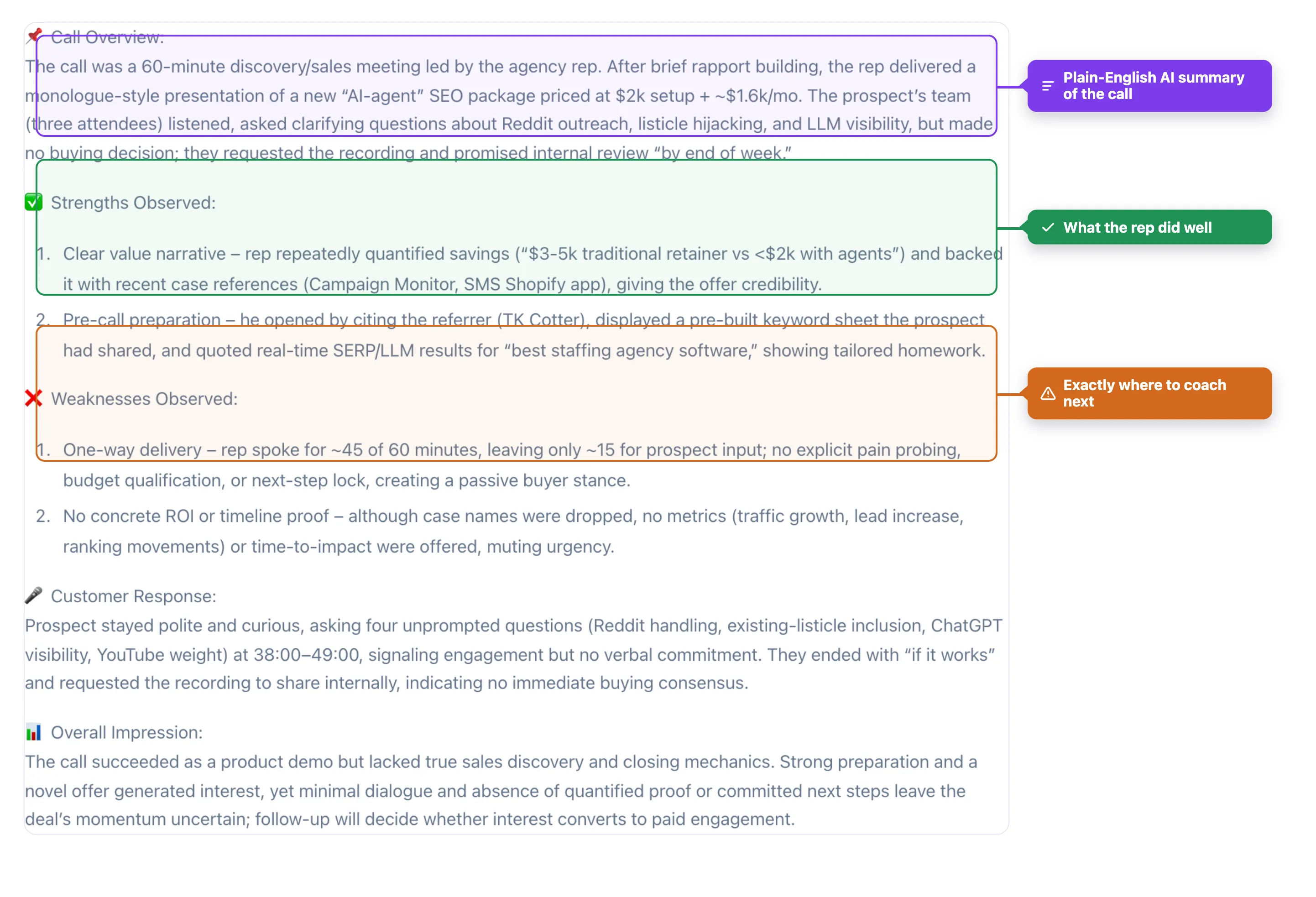
Kendo's AI review of a real discovery call: a plain-English summary, the strengths the rep showed, and exactly where to coach next, generated automatically after the call.Screenshot: Kendo (product) -
5
Coaching and Rep Practice (AI Roleplay)
Call analysis tells a rep what went wrong. Practice is how they fix it before the next live call. This is the use case with the hardest proof behind it, and it's where AI changes the math most.
The bottleneck in coaching has always been manager time. You can't roleplay with every rep every day. AI roleplay removes that ceiling: reps practice against realistic AI buyers that throw real objections, resistance, and pushback, as many reps as they want, before they ever touch a live lead. Pair that with AI call scoring against a custom scorecard, and a new rep builds the reflexes on a simulation instead of on your pipeline.
The move: a brand-new agent runs the full script against an AI prospect, handles the rebuttals, gets graded, and only goes live once the score clears the bar. The objections in practice are the same ones they'll hear on the phone.
The forefront tools are Kendo and Hyperbound. Kendo offers fully customizable AI prospects (call type, product, personality, voice, industry, sales cycle, ICP) with 15+ voice models and 40+ languages, plus automated call review on the same platform. Hyperbound is a strong roleplay-and-coaching option with a large simulation library. Second Nature is another, with avatar-based roleplay.
Reps Get Specific, Next-Call Feedback in Seconds
After any analyzed call, a rep can ask Kendo's AI Coach how to improve and get back prioritized, concrete fixes, not a vague score. It points to the exact habits costing deals and the language to use instead, so the next call is better, not just measured.
Kendo AI CoachFeedback on your last callYouHow can I improve this call?Three things to fix on your next call1 Cut talk time from 72% to 50%Insert a pulse-check question every few minutes so the prospect surfaces concerns early instead of nodding along.
2 Tighten the closeReplace "let us know by end of week" with a real next step and a deadline, for example, "I have one pilot slot opening Tuesday, does it make sense to lock it in?"
3 Add proof numbersSwap vague claims for specifics like "our last client saw 34 qualified leads in 90 days at $18 per lead"; concrete numbers beat case names.
A real example of Kendo AI Coach feedback on a scored call. Reps act on the specifics, not a number.
This isn't theory. Globe Life put new agents on AI roleplay to drill the script, the rebuttals, and the close, and watched brand-new agent close rates climb from around 33% to 60%-plus in about six months. As Jess Chang, a partner there, put it, the closing rate nearly doubled "just because they're getting that repetition, they're getting the rebuttals, they have the practice." The full before-and-after is right below.
Customer Story · Globe LifeNew-Agent Close Rates Went From 33% to 60%-PlusGlobe Life moved new-agent practice onto AI roleplay and nearly doubled brand-new agent close rates in about six months, while leaders stopped burning hours every day on one-on-one roleplays.
"Our closing rate for brand new agents has been almost close to double with the use of Kendo just because they're getting that repetition, they're getting the rebuttals, they have the practice."Jess Chang, Partner, Globe Life
Result: brand-new agent close rates climbed from around 33% to 60%-plus in roughly six months. Nearly doubled, off the same script and the same leads, just more practice.
▶ Live demo · 1 minWatch a rep rehearse a hard objection with live AI roleplay before the real call.Kendo roleplays let reps practice realistic sales conversations in a controlled environment, then get feedback on what they did well, where they lost momentum, and how to improve before speaking with real prospects. In this one the AI buyer pushes hard on SOC 2, ISO 27001, and proof the tool actually cuts compliance work, and the rep has to handle it on the spot, before any of it lands on a live deal.
AI roleplay plus automated call review is what Kendo was built for, so reps practice and managers coach without burning leads or hours. The breakdown of the best AI sales roleplaying tools covers what separates a realistic practice partner from a scripted chatbot.
-
6
Forecasting and Pipeline Visibility
AI forecasting beats the crystal ball. It reads pipeline signals instead of guessing the number.GIF via Giphy Most forecasts are a rep's gut feeling laundered through a spreadsheet. AI makes them defensible.
Instead of relying on stage labels and optimism, AI weighs historical deal data, rep activity, buyer engagement, and deal velocity to predict what will actually close, and flags the gap between the commit and reality early enough to do something about it.
The move: a deal sits at "verbal commit" in the CRM, but the AI notices the buyer hasn't opened an email in 11 days and no next meeting is booked. It flags the deal as slipping while there's still time to multi-thread and save it, instead of finding out at end of quarter.
The forefront tools are Clari for AI revenue forecasting and orchestration (a Leader in Gartner's 2025 Revenue Action Orchestration Magic Quadrant, now merged with Salesloft) and BoostUp, now Terret, the rebranded RevOps and forecasting platform. Gong Forecast is a major player too, weighing 300+ signals. Salesforce ties AI use to roughly 28% better forecast accuracy in its State of Sales research. If forecasting is your weak spot, the roundup of sales forecasting tools breaks down what actually moves accuracy.
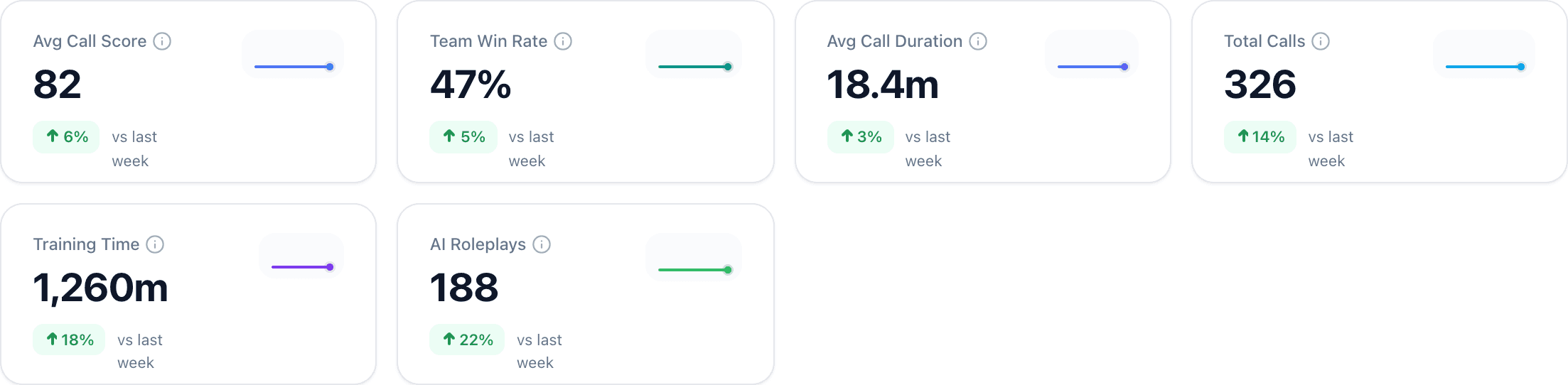
Forecasting and pipeline visibility run on data like this: Kendo's Sales Overview rolls call scores, team win rate, and activity into one week-over-week view.Screenshot: Kendo (product, illustrative figures) Kendo isn't a forecasting tool, but the call-quality and win-rate signals it captures are exactly the leading indicators a forecast leans on. Clean, scored call data in feeds a more defensible number out.
-
7
Deal Risk and Next-Best-Action
A deal quietly on fire and nobody flagged it. AI surfaces the risk before renewal day.GIF via Giphy Closely related, but worth its own stop: AI doesn't just predict the number, it tells a rep which deal to save today.
It watches the patterns that quietly kill deals, the champion who went silent, the single-threaded relationship with no exec sponsor, the opportunity with no next step booked, and surfaces the next best action before the deal flatlines.
The move: AI flags that a six-figure opportunity is single-threaded and the only contact stopped replying. The rep gets a nudge to multi-thread before the deal dies in silence, which is exactly the kind of risk a structured qualification method is built to catch.
Gong (deal boards and risk signals tied to real buyer activity) and Clari (opportunity scores, smart deal summaries, AI-guided CRM suggestions) lead here too. If your team doesn't have a shared language for deal risk, MEDDPICC qualification gives you one, and AI is what keeps it honest by flagging the deals that quietly fail the criteria.
-
8
CRM Data Entry and Activity Capture
Back to where we started: reps barely sell. Salesforce's research pegs it at roughly 70% of the week on non-selling tasks, and a huge chunk of that is CRM data entry. This is the least exciting use case and one of the highest-payoff.
AI logs calls, updates deal stages, captures emails and meetings to the right records, and cleans the stale opportunities clogging the pipeline, automatically, off the call and calendar data it already has.
The move: a rep finishes a call and doesn't touch the CRM. AI logs the call, updates the stage, captures the email thread to the right opportunity, and adds the next step. The rep approves it in 15 seconds and moves on.
The forefront tools are Salesforce Einstein Activity Capture, which auto-logs emails and events to the activity timeline and saves reps 20 to 30 minutes a day, and People.ai, the enterprise revenue-activity capture layer that feeds pipeline and forecasting. Clean this up and you don't just save time. You make forecasting and deal-risk better, because those models are only as good as the CRM data feeding them.
-
9
Content, Email, and Proposal Generation
Staring at a blank proposal? AI drafts the first version so reps start from something.GIF via Giphy Reps used to write every asset by hand. Now generative AI drafts the cold-email sequence, the follow-up, the call script, the one-pager, and the tailored deck, and coaches reps on email quality in real time.
The distinction from prospecting matters: that use case is about who to reach and how to send at scale; this one is about what to write and how good the writing is.
The move: a rep pastes a campaign brief, and AI returns a full multi-persona sequence. As they edit, an inbox coach scores the email, strips the spam-trigger words, and tightens the ask to lift reply rates.
The forefront tools are Regie.ai for end-to-end generative outreach content and sequences, and Lavender for real-time AI email coaching inside the inbox. Email drafting is one of the most-adopted AI uses in sales, which is part of why adoption sits at 87%. Sellers expect AI to cut email drafting time by about 36% once it's fully in the workflow, per Salesforce.
-
10
Hiring, Screening, and Onboarding New Reps
Most "AI in sales" articles skip this one, and it's where the biggest leaks are. A bad sales hire costs you months. A slow ramp burns leads every single day.
AI screens candidates for real selling skill, not just résumés, before managers spend interview time. Then it compresses ramp by letting new reps build reps on simulations before they touch live pipeline. For sales specifically, the highest-signal screen is a recorded roleplay, not a generic video interview.
The move: a candidate gets a link, completes a one-time AI roleplay, and the scored call lands in the hiring team's library, no candidate account needed. New hires then log required roleplay hours before their first live call.
The forefront tools split by job. HireVue leads on structured video interviewing and pre-employment assessment for high-volume hiring. Kendo is the sales-native option: candidate screening via a shared roleplay link, plus new-hire ramp through required practice on AI prospects that behave like your real buyers. For the wider field, the roundup of the best sales training software compares the platforms that build rep skill, not just track it.
New Reps Ramp on a Structured Practice Path, Not Ride-Alongs
Instead of shadowing a senior rep and hoping it sticks, new hires move through a Kendo training path: a fixed sequence of required AI roleplays they have to clear before a live lead is on the line. Each stage targets a specific skill against a realistic buyer, so sales onboarding becomes a repeatable program, not a guess.
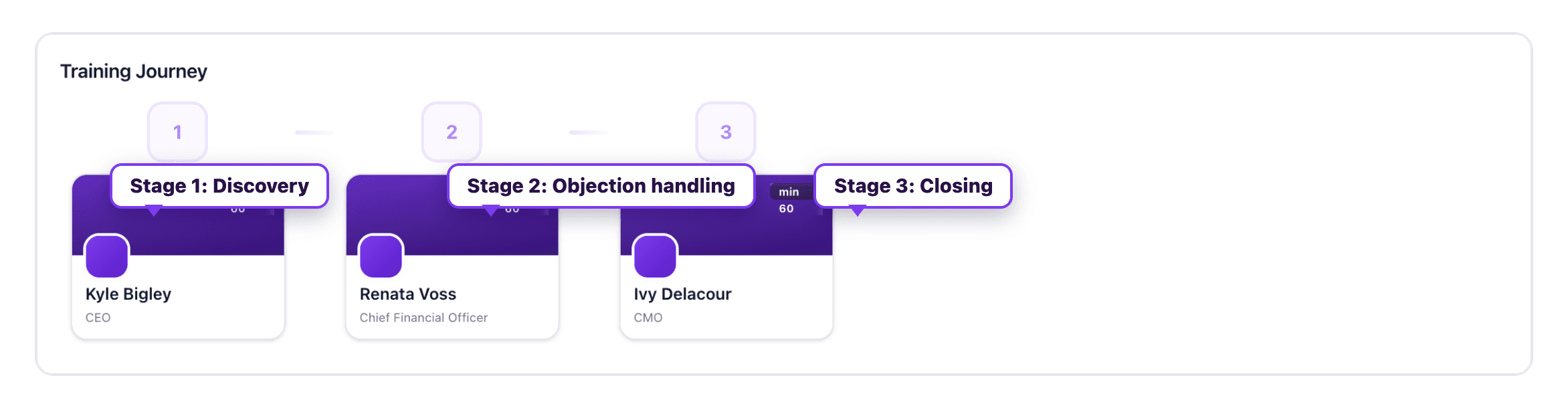
A real Kendo onboarding path: three required AI roleplays a new rep clears in order, Discovery, then Objection handling, then Closing, before a single live lead is on the line.Screenshot: Kendo (product) The proof is hard to argue with. United Insurance Pros cut the time it takes new agents to reach baseline from 45 days to 14 days, saving more than $3,000 per agent per month in wasted leads, by requiring 3 to 5 hours of AI practice before live calls. If ramp speed is the goal, the deeper playbook on how to reduce sales ramp time is the natural next read.
-
11
Meeting Notetaking, Recaps, and Scheduling
AI takes the notes and writes the recap, so reps stay in the conversation instead of scribbling.GIF via Giphy The lightweight, horizontal cousin of conversation intelligence: AI joins the call, transcribes it, summarizes it, extracts action items, and handles the scheduling back-and-forth, so reps leave a call with the admin already done.
The difference from call analysis is depth. Notetakers are recap-focused and work across every meeting type; conversation intelligence is sales-specific scoring, coaching, and deal analytics.
The move: AI joins the discovery call, drops a clean recap and next steps into the CRM the second it ends, and books the follow-up from the rep's calendar without a single email thread.
The forefront tools are Fireflies.ai, an AI notetaker built for sales workflows with strong CRM sync and cross-meeting search, and Otter.ai, the category pioneer, best for real-time live captions. Worth noting: Kendo isn't a notetaker, but it ingests calls from Fireflies, Fathom, and Zoom to score and coach them, so your notetaker can feed straight into your coaching layer.
-
12
Sales Enablement and Knowledge Search
The last use case fixes the "where is that deck" problem. AI surfaces the right content, answer, or play for a rep at the moment of need, instant answers on product, pricing, and competitors from approved sources, plus the deal-stage-appropriate collateral.
The move: mid-deal, a rep asks "what's our latest security one-pager and how do we beat [competitor] on data residency?" and AI returns the approved answer and the right asset, instead of sending them digging through a shared drive.
The forefront tool is Seismic, which merged with Highspot in February 2026 and now operates as the combined enablement category leader, with AI content recommendations, auto-generated docs, digital sales rooms, and context-aware knowledge search. Our platform-by-platform comparison shows where that offering, Mindtickle, Allego, and specialist tools differ. Treat that as one platform, not two rival ones. This is a content-management layer, distinct from the coaching and practice tools above, and it sits at the heart of any AI sales enablement stack.
A quick word on AI agents, since you'll hear about them constantly: the most autonomous versions of these use cases, the AI SDR that runs the early funnel or the AI sales manager that monitors performance, handle volume and busywork. The judgment work still belongs to your reps. For the full landscape, the roundup of the best AI sales tools maps the categories.
The Proof Generalizes Beyond One Team
Globe Life (the close-rate jump charted up in the coaching section) isn't a one-off. The same mechanic, reps building the reflexes on AI instead of on live pipeline, shows up across very different teams.
United Insurance Pros cut the time new agents take to reach baseline from 45 days to 14 days, saving more than $3,000 per agent per month in wasted leads, by requiring three to five hours of AI practice before live calls. Skvarla Insurance saw 5 to 20% production gains team-wide, with reps warming up on a $10 AI session instead of torching a $30 to $50 lead to learn. Different teams, same result: the practice happens on AI, not on your pipeline.
The AI-in-Sales Where-to-Start Scorecard
So you're sold. Where do you actually start?
This is the question every other guide skips. They hand you 12 or 15 use cases and wish you luck. But you can't deploy all of them at once, and you shouldn't try. The teams getting real ROI from AI are pragmatic: they pick one use case with clear measurement, deploy it on a quarter timeline, prove the return, and only then move to the next.
This scorecard ranks the use cases by payoff and effort so you can sequence them for your team. Score the rows for your own situation, start with the highest payoff-to-effort row, and treat it as a sequencing tool, not a leaderboard.
The AI-in-Sales Where-to-Start Scorecard
Rank the use cases by payoff and effort for your team, then start with the highest payoff-to-effort row that matches your biggest bottleneck.
| Use Case | Payoff | Effort to Deploy | Data You Need | Best First If... |
|---|---|---|---|---|
| Lead scoring & prioritization | High | Medium | CRM history, intent signals | Reps work bad-fit accounts and miss in-market ones |
| Prospecting & AI SDRs | High | Low | Your ICP, public account data | Pipeline is thin and prospecting eats the week |
| Personalized outreach | Medium-High | Low | Prospect signals, your messaging | Reply rates are flat and outreach feels generic |
| Call analysis | High | Medium | Recorded calls | Managers can't review enough calls to coach |
| Coaching & practice (roleplay) | High | Low | Your scripts, objections, ICP | You hire, ramp, or onboard new reps |
| Forecasting | High | Medium-High | Clean CRM history, activity data | Your forecast misses and you don't know why |
| Deal risk & next-best-action | Medium-High | Medium | CRM + engagement data | Deals stall and die without warning |
| CRM data entry & capture | Medium | Low | Call, calendar, CRM access | Reps drown in admin and the CRM is messy |
| Content & proposal generation | Medium-High | Low | Your messaging, past assets | Reps rewrite the same emails and decks by hand |
| Hiring, screening & onboarding | High | Low | Your scripts, a roleplay scenario | You're hiring and bad hires or slow ramp hurt |
| Notetaking & scheduling | Medium | Low | Calendar, meeting access | Reps lose the hour after every call to admin |
| Enablement & knowledge search | Medium | Medium-High | Approved content library | Reps can't find the right deck or answer fast |
Then run the loop that actually works:
- Pick one use case with a metric you can measure (reply rate, ramp time, close rate, forecast accuracy).
- Deploy it on a quarter timeline, not a two-year transformation.
- Prove the ROI, then expand to the next row.
If you're hiring or ramping reps, practice and coaching is usually the strongest first move on this board: it's low-effort to stand up, the payoff shows directly in close rates and ramp time, and the proof above is hard to argue with. A roundup of sales coaching software is a good place to compare options.
Where AI Still Needs a Human
Here's the part the vendor blogs skip. AI is a force multiplier, not a replacement, and pretending otherwise gets you burned. Gartner expects 75% of B2B buyers to prefer a human-led sales experience over AI through 2030, which tells you where the line is.
AI Makes Things Up
Generative models will confidently invent a stat, a feature, or a detail about a prospect. Every AI-drafted email and research brief needs a human read before it goes out. The cost of one hallucinated claim in front of a buyer is higher than the time AI saved writing it.
Trust and Hard Conversations Are Human Work
AI can draft the follow-up, but it can't read the room when a champion goes cold for political reasons, navigate a tense negotiation, or build the kind of relationship that survives a pricing fight. Buyers still buy from people they trust.
Garbage In, Garbage Out
AI forecasting, lead scoring, and deal-risk models are only as good as your CRM data. If your pipeline is full of stale, mislabeled, half-logged deals, the AI will give you confident, wrong answers. Fix the hygiene before you trust the predictions.
Busy Is Not the Same as Selling
It's easy to bolt on ten AI tools and feel productive while none of them move the number. The discipline is to put AI where it compounds, practice, coaching, deal risk, the admin tax, and ignore the rest until it earns a slot.
The teams winning with AI in sales aren't the ones using the most of it. They're the ones who let AI do the busywork and kept their people on the judgment.
How to Get Started With AI in Sales (Without the Hype)
You don't need a transformation initiative. You need a first move.
- Audit where your reps lose time and deals. Is it call prep? Generic outreach? Managers who can't coach enough? Stalled deals? Slow ramp? A messy CRM? That bottleneck is your starting point.
- Pick the highest payoff-to-effort row from the scorecard above that matches the bottleneck.
- Deploy it on a quarter, with one metric you'll judge it on.
- Measure honestly, then expand. If it moved the number, add the next row. If it didn't, fix it or drop it.
The budgets are already there; the discipline isn't. Highspot's GTM Performance Gap Report found just 28% of companies say AI is improving performance, despite 77% investing in it. The teams that sequence it well, instead of buying everything at once, are the ones who'll see the Gong-sized revenue gap open up in their favor.
AI in Sales FAQ
No. AI replaces tasks, not the job. It takes over research, drafting, call summaries, CRM entry, and forecasting math, the work reps don't want to do anyway, and gives that time back to selling. What AI can't do is build trust, run a tense negotiation, or read the politics of a buying committee, and Gartner expects 75% of B2B buyers to still prefer a human-led experience through 2030. The reps who win pair AI's speed with their own judgment. AI SDRs can handle high-volume early-funnel work, but the deals that matter still close human to human.
Pick one use case with a metric you can measure, deploy it on a quarter timeline, prove the ROI, then expand. Don't try to roll out ten tools at once. The fastest wins are usually the low-effort, high-payoff ones: AI for prospecting, outreach drafts, or rep practice and coaching. Match your first move to your biggest bottleneck, whether that's thin pipeline, coaching capacity, slow ramp, or a messy CRM.
The most common are lead scoring, prospecting and AI SDRs, personalized outreach, call analysis and conversation intelligence, coaching and AI roleplay practice, forecasting, deal-risk alerts, CRM data capture, content and proposal generation, hiring and onboarding, meeting notetaking, and enablement search. Leading tools include 6sense and Clay for the top of funnel, Gong and Clari for calls and forecasting, and Kendo for roleplay practice and call review. Each one targets a specific point in the workflow where reps lose time or managers lose visibility.
The data says yes when it's used well. Gong's December 2025 research found teams that deeply use AI generate 77% more revenue per rep than those that don't, and are 65% more likely to increase win rates. McKinsey has tied AI investment to material revenue gains in marketing and sales. The catch is "used well": teams that pick a measurable use case and prove ROI see returns; teams that buy tools they never adopt don't.
Three things. It hallucinates, so AI-drafted emails and research need a human check before they go out. It depends on clean data, so AI forecasting and lead scoring are only as reliable as your CRM. And it can't do relationship work, the trust, the hard conversations, the committee politics. Treat AI as the layer that handles the busywork, and keep your people on the judgment calls.
Put AI Where It Compounds
The teams pulling ahead with AI in sales aren't doing anything magic. They put AI on the work that drains reps, lead scoring, prospecting, drafting, call analysis, forecasting, CRM grunt work, and they put it on the work that compounds, practice and coaching, where every rep who gets better stays better.
So this week, do one thing: run the scorecard against your team, find your highest payoff-to-effort row, and start there. If you hire or ramp reps, the strongest first move is almost always practice and call review, because the proof is direct and the lift shows up in close rates and ramp time, the way it did for Globe Life and United Insurance Pros.