
Most teams looking for a Chorus by ZoomInfo alternative are not unhappy with call recording. They are unhappy with the bill, the two-year contract, and the feeling that the product stopped moving after ZoomInfo bought it.
That is a fair reason to shop. But it raises a better question than "what else records calls?" Conversation intelligence tells you what your reps did wrong on the call you already ran. It does not make the next call go better. For a lot of sales orgs, that gap is the actual problem.
So this is not another generic roundup. We compared 13 Chorus alternatives on the things that decide a switch: real features, real pricing, AI depth, and which kind of buyer each one actually fits. Some are heavier conversation intelligence platforms. Some are cheaper recorders. A few, including ours, attack the problem from the other end by training reps before the call instead of grading them after.
If you want the wider category first, our breakdown of the best conversation intelligence software maps where each type of tool fits. If coaching workflows are the deciding factor, our look at the platforms teams shortlist alongside Jiminny narrows that lane. Otherwise, let's get into it.
The Real Map: Review the Last Call, or Train the Next One
Every tool here sits somewhere on two questions: does it review calls you already ran or train the call before it happens, and is its pricing public or quote-only. That is the choice underneath the whole list.
In short
- The best Chorus alternative depends on why you are leaving. Gong is the enterprise upgrade for deal intelligence, Avoma is the mid-market value pick for conversation intelligence, and Kendo AI is the choice for teams whose real bottleneck is rep skill, because it trains reps before the call and reviews every call after. Pricing, fit, and the full list are below.
Pricing, features, and product details below were verified on June 4, 2026, against vendor pages and public reviews. Specifics can change after publication, so confirm current pricing with each vendor.
Chorus Alternatives at a Glance
This table is a decision aid, not a leaderboard. Ratings are from G2 unless noted. Pricing is the public starting point where a vendor publishes one, and "Custom / quote" where it does not.
| Rank | Tool | Best For | Pricing (starting) | Rating Signal | Best-Fit Note |
|---|---|---|---|---|---|
| 1 | Kendo AI RECOMMENDED | Rep readiness and improvement | Public: $55/mo per seat | 4.8/5 (G2) | Trains reps before the call, reviews every call after |
| 2 | Gong | Enterprise revenue intelligence | Custom / quote | 4.7/5 (6,470+) | Deepest deal intelligence if the budget supports it |
| 3 | Avoma | Mid-market conversation intelligence | Public: $19/seat/mo (annual) | 4.6/5 (1.3K+) | Chorus-grade CI with public pricing |
| 4 | Hyperbound | Enterprise AI roleplay | Custom / quote | 4.9/5 (250+) | Practice trained on millions of hours of B2B calls |
| 5 | Mediafly Coach360 | Coaching inside an enablement suite | Custom / quote | 4.4/5 (1.3K+) | Fit if you already buy Mediafly |
| 6 | Salesloft | Engagement plus CI in one place | Custom / quote | 4.5/5 (4.2K+) | Now merged with Clari; one workspace for outreach and CI |
| 7 | Mindtickle | Full-spectrum enablement | Custom / quote | 4.7/5 (2.2K+) | Training, content, and CI from one vendor |
| 8 | Fireflies.ai | Lightweight transcription | Free; paid from $10/seat/mo (annual) | 4.7/5 (700+) | 200+ integrations, low price |
| 9 | Fathom | Solo users and small teams | Free; paid from $15/user/mo (annual) | 5.0/5 (6.5K+) | Generous free tier, unlimited recordings |
| 10 | Second Nature AI | AI avatar roleplay | Custom / quote | 4.6/5 (500+) | Avatar-based practice as a complement |
| 11 | PitchMonster | Scalable AI roleplay | Custom / quote | 4.9/5 (10+) | Speech coaching and custom scorecards |
| 12 | Allego | Distributed team coaching | Custom / quote | 4.6/5 (670+) | Video peer learning and digital sales rooms |
| 13 | Sybill.ai | SMB behavioral analysis | Free; paid from $36/user/mo | 4.8/5 (140+) | Tracks non-verbal buyer engagement |
Where Chorus Falls Short According to Users Online
Chorus by ZoomInfo is a genuinely capable conversation intelligence platform, and that is not in dispute. Its call recording and transcription are solid, the tracker system is mature, and pulling ZoomInfo contact and company data into the conversation record is a real advantage for teams already on ZoomInfo.
But when we reviewed public feedback from G2, Capterra, and TrustRadius reviews, Reddit threads, and ZoomInfo's own product and pricing pages, the same friction points came up again and again for teams weighing a move. Here is what users online flag most often:
- Pricing is high and bundled, and not public. ZoomInfo does not publish Chorus pricing on its product page; the site offers a demo only. Third-party sources consistently report a minimum around $8,000 per year for three seats, with each additional seat near $1,200 per year, and reviewers describe pressure to fold Chorus into a broader ZoomInfo contract that pushes total spend up fast. [Sources: ZoomInfo Chorus product page; pricing reports on MarketBetter and Convo]
- Innovation reportedly slowed after the ZoomInfo acquisition. ZoomInfo acquired Chorus in 2021. Multiple reviewers say the product has felt behind faster-moving competitors since, and that Gong has pulled ahead on deal intelligence. [Sources: G2 reviews, comparison roundups on Revenue.io]
- There is a learning curve. New users describe the platform as not immediately intuitive, with meaningful onboarding and training time before teams get value. [Source: G2 reviews]
- Recording and notetaker reliability is hit or miss. Users report the bot occasionally failing to join on time and difficulty locating specific past recordings. [Sources: G2 and TrustRadius reviews]
- Transcription accuracy and AI summaries can miss. Reviewers cite transcription errors and AI summaries that sometimes drop context or surface inaccurate next steps, with accuracy often described in the 80 to 90 percent range. [Sources: G2 reviews, third-party reviews on MarketBetter]
- Navigation and search feel clunky. The interface and search are frequently called dated, with results too broad to quickly find a specific historical call. [Source: G2 reviews]
If two or three of those sound like your week, the 13 alternatives below are worth a serious look. The honest first move is to figure out why you are leaving, because that decides where you should land.
First, Why Are You Leaving Chorus?
The right replacement depends almost entirely on the reason you are shopping. Most lists make you reverse-engineer that. This one does not. Use this to jump to the pick that fits your actual problem.
Match the Reason You Are Leaving to the Right Landing Spot
Pick the row that sounds most like your team. The recommendation is the tool built for that specific problem, not the loudest name on the list.
| If you are leaving Chorus because... | Look at | Why |
|---|---|---|
| Reps keep making the same mistakes call after call | Kendo AI | Practice against AI buyers before the call, plus automatic review after |
| You want deeper deal and pipeline intelligence at enterprise scale | Gong | The most-cited upgrade path for deal intelligence |
| You need real conversation intelligence on a mid-market budget | Avoma | Chorus-grade CI with public, per-seat pricing |
| You mostly just want clean recordings and summaries | Fathom or Fireflies.ai | Strong free tiers at a fraction of the cost |
| You want outreach and CI in one workspace | Salesloft | Engagement plus native conversation intelligence |
| You want training, content, and CI from one vendor | Mindtickle | A single enablement platform end to end |
Kendo AI: The #1 Chorus Alternative for Teams That Want Better Reps
Best overallTrain reps before the call against realistic AI buyers, then automatically review every live call after.
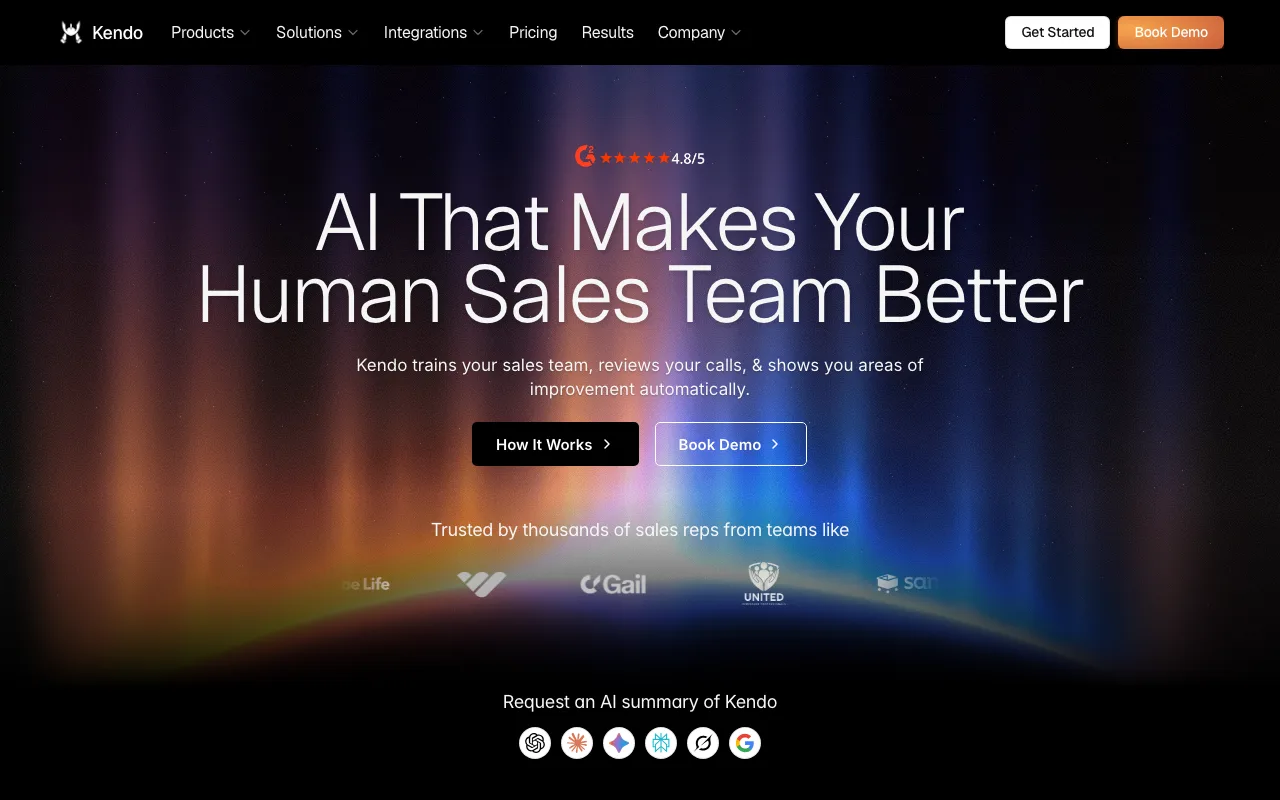
We will be upfront: you are on our site, so of course we rank Kendo first. Read the case anyway, because the difference is not a feature checklist, it is a different theory of what fixes sales performance.
Chorus tells you what your reps did wrong on the call you already ran. Kendo trains them to do it right before they pick up the phone, then automatically reviews every live call after to make sure the training stuck. Built by sales people for sales teams, it pairs hyper-realistic AI roleplay with automated call reviews and a continuous coaching loop, without ZoomInfo bundling pressure, a two-year contract, or a six-figure quote.
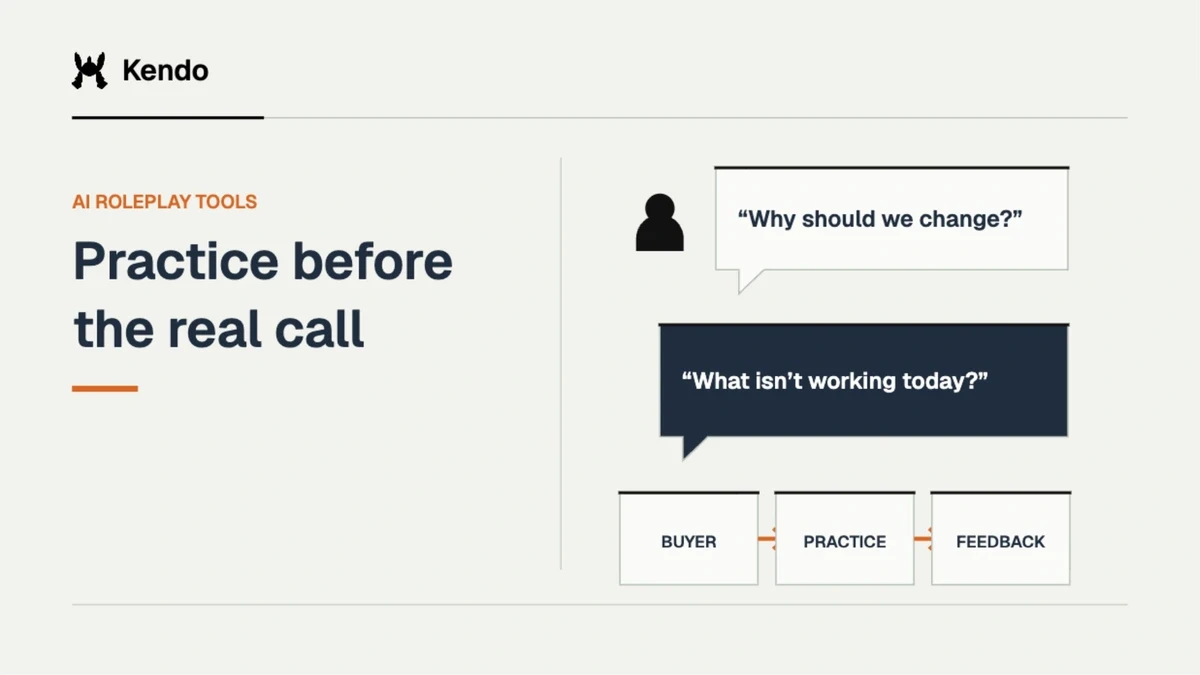
This is what practicing on Kendo looks like. The AI buyer pushes hard on SOC 2, ISO 27001, and proof the tool cuts compliance work, and the rep has to handle it on the spot, before any of it lands on a live deal.
Kendo AI vs. Chorus: The Key Differences
| Feature | Kendo AI | Chorus by ZoomInfo |
|---|---|---|
| Pricing | Public: from $55/mo per seat | No public pricing; quote only |
| Free access | 180 roleplay minutes/mo per seat on Pro | Demo only; no self-serve tier |
| AI roleplay | Native, low-latency AI prospects for live practice | Not offered; analyzes recorded human calls |
| Call scoring | Automated on every call against custom scorecards | Conversation intelligence on recorded calls |
| Implementation | Self-serve, usable the same day | Multi-week; reviewers report a learning curve |
| Primary focus | Train before the call, review after | Retrospective call analysis and coaching |
| Contract | Monthly billing, no lock-in | Reportedly two-year agreements |
| Innovation pace | Frequent product updates | Reportedly slowed since the ZoomInfo acquisition |
Kendo's edge is practice plus review. Reps train against AI buyers that raise real objections, push back on price, and respond like actual prospects. Then every live call is scored against your scorecards, and Kendo assigns targeted training to fix whatever is still going wrong. The full loop lives in one platform.
Key Features
- Live AI roleplay. Reps practice on AI buyers instead of burning real leads, with objections that feel like the calls they take every day.
- Custom prospect builder. Build the exact buyer profiles your team targets: title up to CEO, industry, company size, and multilingual voices across 40+ languages.
- Real objection library. Drill budget pushback, competitor mentions, timing stalls, and trust barriers, plus unlimited custom scenarios for your market, the same skills covered in our sales objection handling guide.
- Automated call reviews. Your custom scorecards applied to 100% of recorded calls, with strengths, weaknesses, and trends per rep and no manager bottleneck.
- Real-time scoring and analytics. Instant feedback on pacing, talk time, and objection handling, feeding Kendo Agent so leaders see exactly where to coach.
Kendo Pricing Starts at $55/Month
Kendo publishes its pricing, which is the whole point next to a quote-only incumbent. Plans are per seat, billed monthly or annually, with roughly 17% off for annual billing (two months free). Most teams report a 5 to 15% lift in close rates, which tends to cover the cost inside the first month.
| Pro $55/mo per seat | Max $100/mo per seat | Enterprise Custom |
|---|---|---|
| AI roleplay, AI call reviews, advanced metrics, AI sales manager, 180 roleplay minutes/mo per seat. Best for solo reps or small teams. | Everything in Pro, with 480 roleplay minutes/mo per seat. Best for teams that want maximum usage. | Everything in Max, plus a human account manager, custom AI models, custom scoring, and VIP support. Built for teams of 10+. |
See full plan details on the Kendo pricing page.

United Insurance Pros cut new-agent ramp from 45 days to 14 days
New agents trained on Kendo before touching a live lead. Ramp to baseline performance went from 45 days to 14 days on 3 to 5 hours of AI practice before the first live call.
Result: 7-day ramp-up + 7 days to baseline performance = 14 days total vs 45+ days before.
"Typically we would see about a 45-day period where people would dip their foot in the water and slowly improve and then level off at their performance level. Now that's 14 days. So it's the 7-day ramp-up and then 7 days to be where they're going to be at their baseline."Waylon Artrip, Founder, United Insurance Pros
Why Sales Teams Pick Kendo Over Chorus
Chorus is built on the idea that reviewing what already happened will fix what happens next. Kendo is built on the idea that the fastest way to better calls is better reps, prepared before the call and reviewed after. That is the bet, and the close-rate and ramp numbers above are why teams make it.
You can also use Kendo well beyond core roleplay: screen sales candidates with a realistic AI roleplay before you hire, keep the team sharp with daily 10 to 15 minute practice, and run objective performance reviews off consistent call scores. See more customer results here.
Gong: The Enterprise Revenue Intelligence Standard
The category leader for deal intelligence and forecasting, and the upgrade most teams benchmark against.
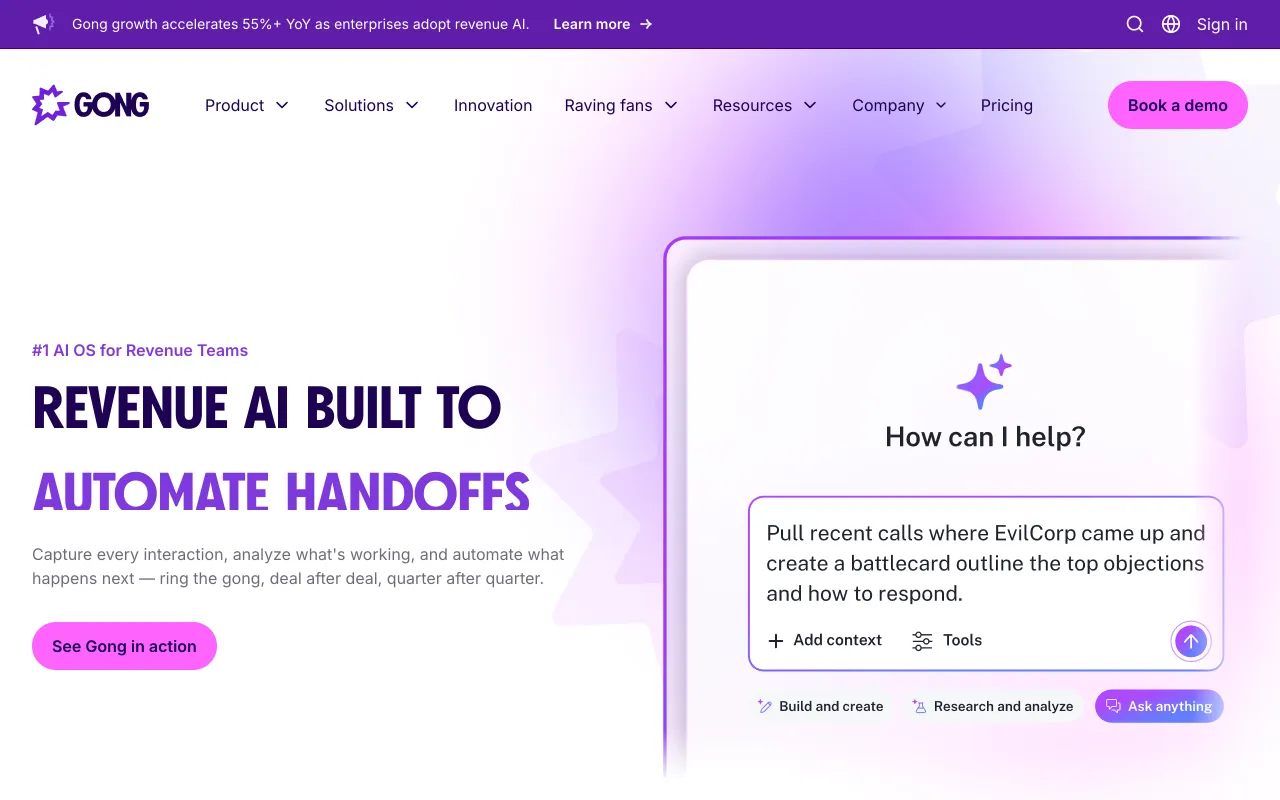
Gong is the category leader for revenue intelligence. It captures calls, emails, and meetings, then applies AI to surface deal risk, forecast revenue, and find coaching moments at enterprise scale. For teams that want more deal intelligence than Chorus and have the budget, Gong is the upgrade most of them benchmark against. It is also the destination reviewers name most often when they leave Chorus citing slowed innovation.
Against Chorus: Gong is widely seen as ahead on deal and pipeline intelligence and product velocity. It also added AI Trainer, a practice environment that generates roleplays from real interactions already captured in Gong, though that is post-call practice built on past calls rather than live, pre-call training.
Key Features
- Deep conversation intelligence: records, transcribes, and analyzes calls and emails for topics, sentiment, and objections.
- Revenue forecasting: AI forecasts built on hundreds of interaction signals rather than manual CRM entry.
- Deal intelligence: flags risks like a silent economic buyer and tracks competitive mentions across the pipeline.
- AI Trainer: roleplay simulations generated from authentic calls.
- Enterprise ecosystem: deep native integrations with Salesforce, HubSpot, Dynamics, Slack, Zoom, and Teams.
Pricing: Gong vs. Chorus by ZoomInfo vs. Kendo
Neither Gong nor Chorus publishes pricing. Gong's own pricing page confirms the model is per-user licenses plus a platform fee, with integrations included.
| Gong | Chorus by ZoomInfo | Kendo AI (for reference) | |
|---|---|---|---|
| Public pricing | No; quote only | No; quote only | Yes; from $55/mo per seat |
| Reported cost | ~$1,400 to $1,600 per user/yr foundation, plus a $5,000 to $50,000/yr platform fee (third-party) | ~$8,000/yr min for 3 seats; ~$1,200/seat/yr after (third-party) | $55/mo Pro, $100/mo Max, Enterprise custom (first-party) |
| Contract | Annual, often multi-year | Reportedly two-year | Monthly or annual, no lock-in |
Gong and Chorus figures are third-party estimates; both vendors quote privately. Kendo pricing is from kendo.ai.
Heads up · Based on user reviews
- Platform fee surprises: reviewers report a mandatory platform fee on top of seats, often not surfaced early in the sales process.
- Forced bundling: module bundling can push spend above what a team actually needs.
- Seat inflexibility: seats generally cannot be reduced mid-contract, and renewals carry annual uplifts.
- Built for scale: the math is hard to justify under roughly 20 reps.
For a closer look, see our Gong alternatives breakdown and the head-to-head Kendo vs. Gong comparison.
Avoma: Mid-Market Conversation Intelligence Without the Enterprise Tax
Chorus-grade conversation intelligence with public per-seat pricing and no multi-year commitment.
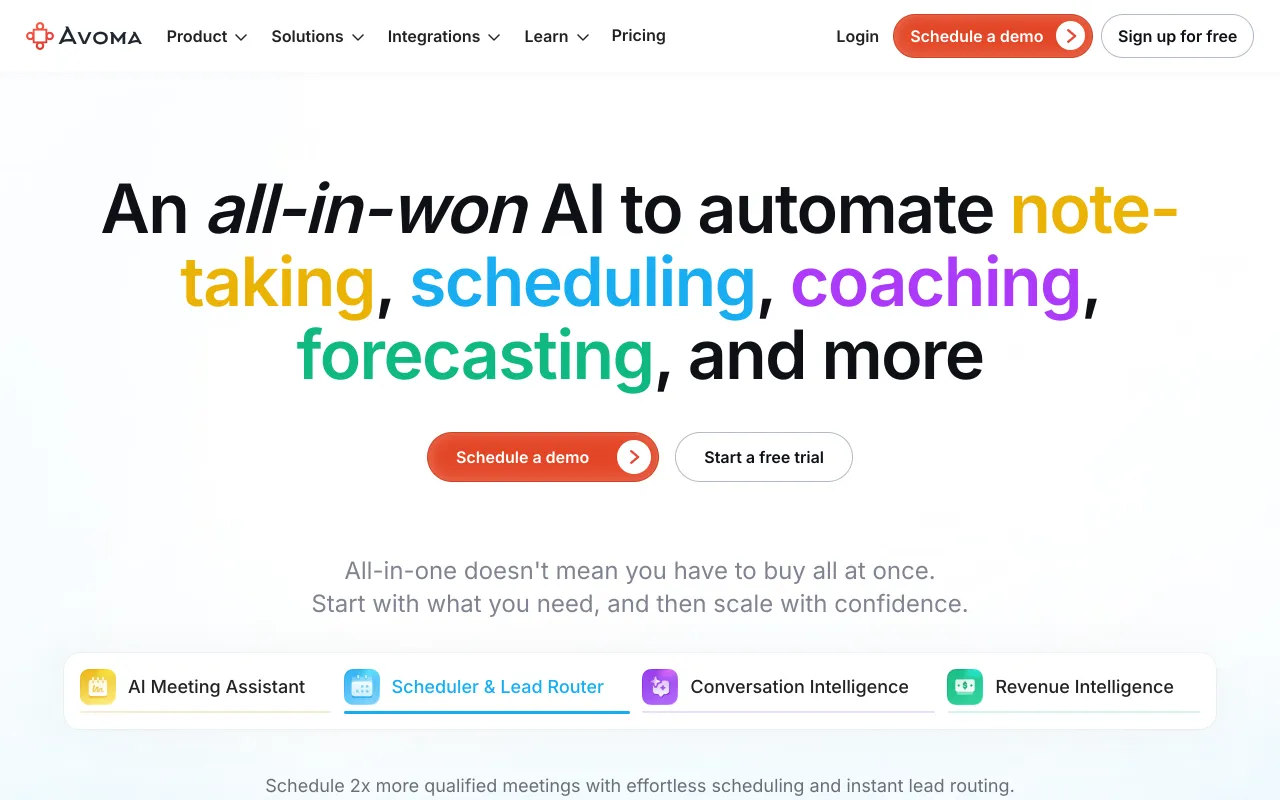
Avoma is an AI meeting assistant and conversation intelligence platform built for customer-facing teams at startups and scaleups. It bundles recording, transcription, AI notes, and revenue intelligence at price points that work for teams of 10 to 50 reps. It is the alternative most often cited for getting Chorus-grade capability without ZoomInfo bundling.
Against Chorus: the headline difference is transparency. Avoma publishes per-seat pricing, lets viewers in free, and does not require a multi-year commitment, which removes most of the friction that sends people looking past Chorus in the first place.
Key Features
- AI meeting assistant: schedules, records, and transcribes calls with AI notes and action items.
- Conversation intelligence add-on: coaching scorecards, talk-pattern insights, and keyword tracking.
- Revenue intelligence add-on: forecasting, methodology tracking for MEDDPICC, SPIN, and BANT, and deal-risk signals.
- CRM sync: pushes conversation data to Salesforce and HubSpot within minutes.
- Custom note templates: flexible AI summaries shaped to your internal workflow.
Pricing: Avoma vs. Chorus by ZoomInfo vs. Kendo
Avoma's pricing is public. The base plan is per recorder seat; conversation and revenue intelligence are paid add-ons, so the real cost lands above the headline once you add them.
| Avoma | Chorus by ZoomInfo | Kendo AI (for reference) | |
|---|---|---|---|
| Public pricing | Yes | No; quote only | Yes |
| Starting price | $19/seat/mo annual ($29 monthly); viewers free | ~$8,000/yr min for 3 seats (third-party) | $55/mo per seat |
| Add-ons | CI add-on $29/seat/mo annual ($35 monthly); revenue intelligence priced the same | Bundled into ZoomInfo contract | Call review and roleplay included in plan |
Avoma and Kendo figures are first-party; Chorus is third-party reported. Verified June 4, 2026.
Heads up · Based on user reviews
- Recording reliability: the top recurring complaint is the bot occasionally failing to join or dropping mid-call.
- Add-ons stack up: once you add CI and revenue intelligence, the effective per-seat cost climbs well past the $19 headline.
- Transcription dips with noise: accuracy drops with crosstalk or background noise.
For the broader set, see our Avoma alternatives comparison.
Hyperbound: Enterprise AI Sales Roleplay at Scale
Buyer simulations trained on 2M+ hours of real B2B calls, focused on practice before the call.
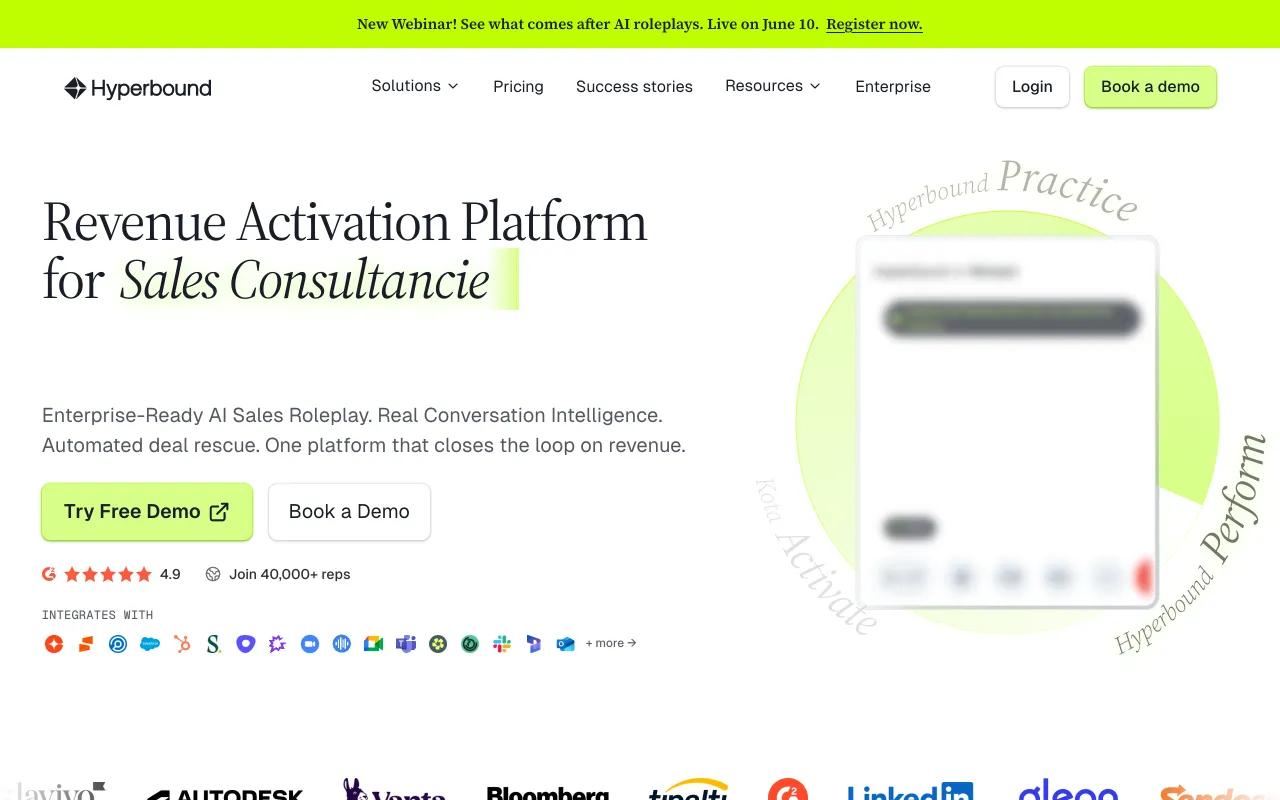
Hyperbound is an AI sales training platform built around buyer simulations trained on more than two million hours of real B2B sales conversations. Like Kendo, the focus is practice before the call rather than analysis after. It is positioned for enterprise teams that want to pair practice with real-call data from existing CI tools, including Chorus itself.
Against Chorus: these are complements more than competitors. Chorus analyzes calls; Hyperbound drills the rep beforehand. If your reason for leaving is "reps are not improving," a roleplay platform addresses that directly in a way CI never will.
Key Features
- AI roleplay simulations: cold calls, gatekeepers, discovery, and demos against AI buyers mapped to specific pain points.
- AI real-call scoring: scores live calls against your methodology, such as MEDDIC or BANT.
- Rapid persona builder: turns an ICP description into an interactive AI buyer in minutes.
- Multilingual support: 25+ languages with users across 40+ countries.
- Gamified leaderboards: skill-based rankings to drive practice.
Pricing: Hyperbound vs. Chorus by ZoomInfo vs. Kendo
Hyperbound does not publish pricing; a demo is required. Chorus does not publish pricing either. Kendo does.
| Hyperbound | Chorus by ZoomInfo | Kendo AI (for reference) | |
|---|---|---|---|
| Public pricing | No; demo required | No; quote only | Yes; from $55/mo per seat |
| Reported cost | Custom; enterprise reportedly starts near $15,000/yr (third-party) | ~$8,000/yr min for 3 seats (third-party) | $55/mo Pro, $100/mo Max |
| Free option | Free tier with a set of pre-built bots | Demo only | 180 roleplay minutes/mo on Pro |
Hyperbound and Chorus figures are third-party reported. Kendo is first-party.
Heads up · Based on user reviews
- Manager tooling is thinner than the rep-facing tooling.
- Full value assumes a stack: much of the payoff depends on integrating with existing Gong, Salesloft, or Chorus data.
- Heavier than small teams need: it is optimized for mid-market and enterprise.
If roleplay is the real need, our Hyperbound alternatives and the full best AI sales roleplay tools guide are the right next reads, or compare the two directly in Kendo vs. Hyperbound.
Across Kendo customers: 5-15% higher close rates, ramp cut from 45 days to 14, and $3,000+ saved per rep.
See the results →
Mediafly Coach360: Coaching Inside a Broader Enablement Suite
The conversation intelligence and coaching product formerly known as ExecVision, now inside Mediafly.
Mediafly Coach360 is the conversation intelligence and coaching product formerly known as ExecVision, which Mediafly acquired in 2022 and folded into its Revenue360 suite. If you still see "ExecVision" on an old shortlist, this is where it went, and our ExecVision alternatives guide covers the field that grew up around it. The product analyzes recorded calls, surfaces coachable moments, and supports manager-led coaching at enterprise scale.
Against Chorus: Coach360 makes the most sense if you already buy, or are evaluating, Mediafly's broader content management and value-selling tools. As a standalone Chorus swap it is narrower, and the focus is analysis rather than proactive training.
Key Features
- Conversation libraries: store and organize past calls for onboarding and benchmarking.
- Coaching intelligence: track and measure coaching effectiveness with structured workflows.
- Performance dashboards: monitor call trends, QA compliance, and rep progress.
- Smart alerts: notifications driven by conversation intelligence.
- Suite integration: available inside Mediafly Revenue360 alongside content and value selling.
Pricing: Mediafly Coach360 vs. Chorus by ZoomInfo vs. Kendo
Neither Mediafly Coach360 nor Chorus publishes pricing.
| Mediafly Coach360 | Chorus by ZoomInfo | Kendo AI (for reference) | |
|---|---|---|---|
| Public pricing | No; quote only | No; quote only | Yes; from $55/mo per seat |
| Model | Quote-based, tied to call volume, users, and integrations | Quote-based, often bundled into ZoomInfo | Transparent per-seat |
| Contract | Annual | Reportedly two-year | Monthly or annual |
Coach360 and Chorus are quote-only; Kendo pricing is first-party.
Heads up · Based on user reviews
- It is part of a suite: the standalone product now lives inside Mediafly Revenue360, which is more than a CI-only buyer needs.
- Analysis, not practice: the focus is reviewing calls, not training reps before them.
- Pricing is opaque: plan on a sales conversation to get real numbers.
Salesloft: Revenue Orchestration with Native Conversation Intelligence
Sales engagement, conversation intelligence, deal management, and forecasting in one workspace.
Salesloft combines sales engagement, conversation intelligence, deal management, and forecasting in one workspace, with a "Rhythm" engine that prioritizes seller actions on live deal signals. One important status update: Salesloft and Clari completed their merger on December 3, 2025, and now operate as a single company. Packaging and renewal terms are being reshaped under that combined roadmap, so confirm current plan structure before you sign.
Against Chorus: Salesloft is the better fit if you want outreach and CI in the same tool rather than a standalone analyzer. If you only want conversation intelligence, it is more platform than you need.
Key Features
- Cadence builder: one of the more polished multi-step sequence tools, with email, calls, social, and branching logic.
- Conversations module: native call recording, transcription, and AI coaching insights.
- Deals module: health scoring, pipeline tracking, and opportunity-level visibility.
- Rhythm engine: AI prioritization of the highest-impact next action per rep.
- Salesforce sync: bi-directional activity sync.
Pricing: Salesloft vs. Chorus by ZoomInfo vs. Kendo
Salesloft does not publish pricing, and neither does Chorus.
| Salesloft | Chorus by ZoomInfo | Kendo AI (for reference) | |
|---|---|---|---|
| Public pricing | No; quote only | No; quote only | Yes; from $55/mo per seat |
| Reported cost | ~$125 to $165 per user/mo list; dialer is a paid add-on (third-party) | ~$8,000/yr min for 3 seats (third-party) | $55/mo Pro, $100/mo Max |
| Contract | Annual; reviewers report firm renewal terms | Reportedly two-year | Monthly or annual, no lock-in |
Salesloft and Chorus figures are third-party reported. Kendo is first-party.
Heads up · Based on user reviews
- Firm contract terms: reviewers report tight cancellation windows and annual price increases.
- Dialer costs extra: the dialer is a paid add-on on top of the platform.
- Sync and performance gripes: Salesforce sync issues and performance complaints appear in 2025 reviews.
- Post-merger uncertainty: packaging is in flux after the Clari merger, so terms may shift.
Mindtickle: Full-Spectrum Revenue Enablement
Training, content management, conversation intelligence, AI roleplay, and readiness analytics in one platform.
Mindtickle is a unified AI sales enablement platform that merges training, content management, conversation intelligence, AI roleplay, and readiness analytics. Large enterprises use it to onboard at scale; Cisco, for example, ran a 2025 global pitch program with Mindtickle's AI Copilot across roughly 7,200 sellers and reported a 31% lift in average deal size. For teams that want CI and everything else from one vendor, it is the most credible all-in-one alternative to Chorus.
Against Chorus: Mindtickle is broader by design. It is a fit when you are consolidating training, content, and CI into one contract, and overkill when you only want focused conversation intelligence.
Key Features
- AI Copilot: meeting prep, AI call summaries, and deal insights in the flow of work.
- AI roleplays and call intelligence: generative roleplay practice plus analysis of real calls.
- Unified enablement hub: training, certifications, content, and analytics in one place.
- Digital sales rooms: buyer portals for sharing content and tracking engagement.
- Enterprise security: SOC 2 Type 2, ISO 27001, and GDPR compliance with 100+ integrations.
Pricing: Mindtickle vs. Chorus by ZoomInfo vs. Kendo
Mindtickle does not publish list pricing, and neither does Chorus.
| Mindtickle | Chorus by ZoomInfo | Kendo AI (for reference) | |
|---|---|---|---|
| Public pricing | No; quote only | No; quote only | Yes; from $55/mo per seat |
| Reported cost | ~$30 to $50 per user/mo; ~$92,000 average annual contract (third-party) | ~$8,000/yr min for 3 seats (third-party) | $55/mo Pro, $100/mo Max |
| Contract | Annual or multi-year | Reportedly two-year | Monthly or annual |
Mindtickle and Chorus figures are third-party reported. Kendo is first-party.
Heads up · Based on user reviews
- Breadth is overkill for a focused CI or training need.
- Services often required: professional services are common for roleplay scenario design and CRM data sync.
- Implementation takes weeks depending on content migration.
For a head-to-head, see Kendo vs. Mindtickle.
Fireflies.ai: Lightweight Transcription with Deep Integrations
An AI meeting assistant that trades enterprise deal intelligence for breadth of integrations and a very low price.
Fireflies.ai is an AI meeting assistant that joins calls, transcribes them, generates summaries, and pushes data to your CRM and project tools. It is used across a huge base of companies and trades enterprise deal intelligence for breadth of integrations and a very low price.
Against Chorus: Fireflies is a fraction of the cost and integrates almost everywhere, but it is a meeting assistant, not a revenue intelligence platform. It is a strong fit when you want transcripts and summaries flowing into your stack, not deep deal analytics.
Key Features
- Auto-join bot: joins Zoom, Teams, Google Meet, and more.
- Ask Fred copilot: query meeting history in natural language with cited answers.
- Customizable templates: summary formats for sales calls, standups, and client meetings.
- 200+ integrations: native sync with Salesforce, HubSpot, and Pipedrive.
- Conversation intelligence: sentiment, topic tracking, and talk-time ratios.
Pricing: Fireflies.ai vs. Chorus by ZoomInfo vs. Kendo
Fireflies publishes pricing. Chorus does not.
| Fireflies.ai | Chorus by ZoomInfo | Kendo AI (for reference) | |
|---|---|---|---|
| Public pricing | Yes | No; quote only | Yes |
| Starting price | Free; Pro $10/seat/mo annual ($18 monthly); Business $19/seat/mo annual ($29 monthly) | ~$8,000/yr min for 3 seats (third-party) | $55/mo per seat |
| Enterprise | $39/seat/mo, annual only | Quote, often bundled | Custom |
Fireflies and Kendo figures are first-party; Chorus is third-party reported. Verified June 4, 2026.
Heads up · Based on user reviews
- Accuracy dips with heavy accents and crosstalk.
- Free tier is limited: AI summaries are capped on the free plan.
- Storage caps on lower tiers can force deleting old recordings.
- AI credit costs and upsell prompts come up in reviews.
Fathom: Free Meeting Recording for Solo Users and Small Teams
One of the most generous free tiers in the category, with unlimited recordings and the highest G2 rating among meeting tools.
Fathom is an AI meeting recorder with one of the most generous free tiers in the category and the highest G2 rating among meeting tools. It records, transcribes, highlights, and summarizes Zoom, Google Meet, and Teams calls, with unlimited recordings on the free plan.
Against Chorus: for teams under about 20 reps that do not need enterprise deal intelligence, Fathom covers most of the day-to-day value at a fraction of the cost. It is not a like-for-like analytics replacement, but it nails recordings and summaries.
Key Features
- Fast AI summaries: delivered within about 30 seconds of a call ending.
- Ask Fathom: natural-language search across your meeting history.
- Clean Zoom experience: no separate bot joining as a visible participant on Zoom.
- CRM sync on paid tiers: native HubSpot and Salesforce sync.
Pricing: Fathom vs. Chorus by ZoomInfo vs. Kendo
Fathom publishes pricing. Chorus does not.
| Fathom | Chorus by ZoomInfo | Kendo AI (for reference) | |
|---|---|---|---|
| Public pricing | Yes | No; quote only | Yes |
| Starting price | Free, unlimited recordings; Team $15/user/mo annual ($19 monthly) | ~$8,000/yr min for 3 seats (third-party) | $55/mo per seat |
| Higher tier | Business $25/user/mo annual ($34 monthly) for CRM sync and coaching | Quote, often bundled | Max $100/mo |
Fathom and Kendo figures are first-party; Chorus is third-party reported. Verified June 4, 2026.
Heads up · Based on user reviews
- Free plan is light: it lacks CRM integrations and deeper analytics.
- Summaries need a check: AI summaries occasionally need a quick accuracy review.
- Storage limits on paid tiers can force deletions.
- Not enterprise depth: less deal intelligence than Gong or Chorus.
Second Nature AI: AI Avatar Roleplay Training
AI roleplay training through interactive avatars, generated automatically from your decks and playbooks.
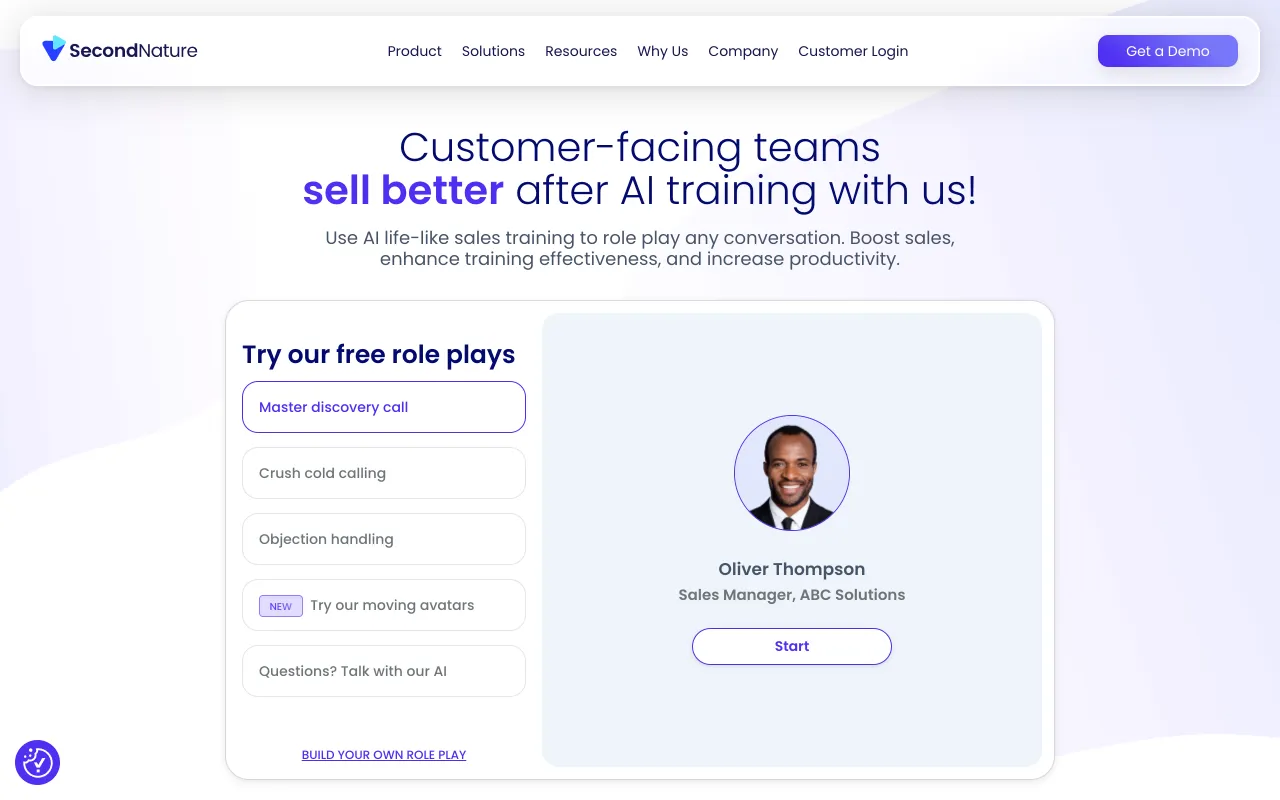
Second Nature provides AI roleplay training through interactive avatars with moving expressions. It ingests your decks, recordings, and playbooks to generate roleplay scenarios automatically, and is used by large brands for onboarding and skill development.
Against Chorus: like the other roleplay tools here, this is a complement, not a CI replacement. It addresses rep readiness, which is the gap CI leaves open. Where Kendo emphasizes adaptive, human-like buyers and automated review of live calls, Second Nature centers on structured avatar simulations.
Key Features
- Interactive avatars: lifelike virtual buyers with two-way verbal responses.
- Custom scenarios: generated in minutes from your uploaded materials.
- Multi-format input: websites, recorded calls, videos, decks, and knowledge articles.
- Methodology templates: SPIN, MEDDPICC, and BANT frameworks built in.
- Performance scoring: automated feedback aligned to your rubric.
Pricing: Second Nature AI vs. Chorus by ZoomInfo vs. Kendo
Second Nature does not publish pricing, and neither does Chorus.
| Second Nature AI | Chorus by ZoomInfo | Kendo AI (for reference) | |
|---|---|---|---|
| Public pricing | No; demo required | No; quote only | Yes; from $55/mo per seat |
| Model | Quote-based, shared after a consultation | Quote-based, often bundled | Transparent per-seat |
| Free access | Demo only | Demo only | 180 roleplay minutes/mo on Pro |
Second Nature and Chorus are quote-only; Kendo is first-party.
Heads up · Based on user reviews
- Strict scoring: reviewers report inconsistent grading on similar answers.
- Responses can drift: AI replies occasionally feel off-topic or robotic.
- Setup work: building scenarios requires uploading company-specific material.
For the direct comparison, see Kendo vs. Second Nature.
PitchMonster: Scalable AI Roleplay with Custom Scorecards
A "sales Grammarly" for spoken conversations, built to scale to thousands of roleplays per day.
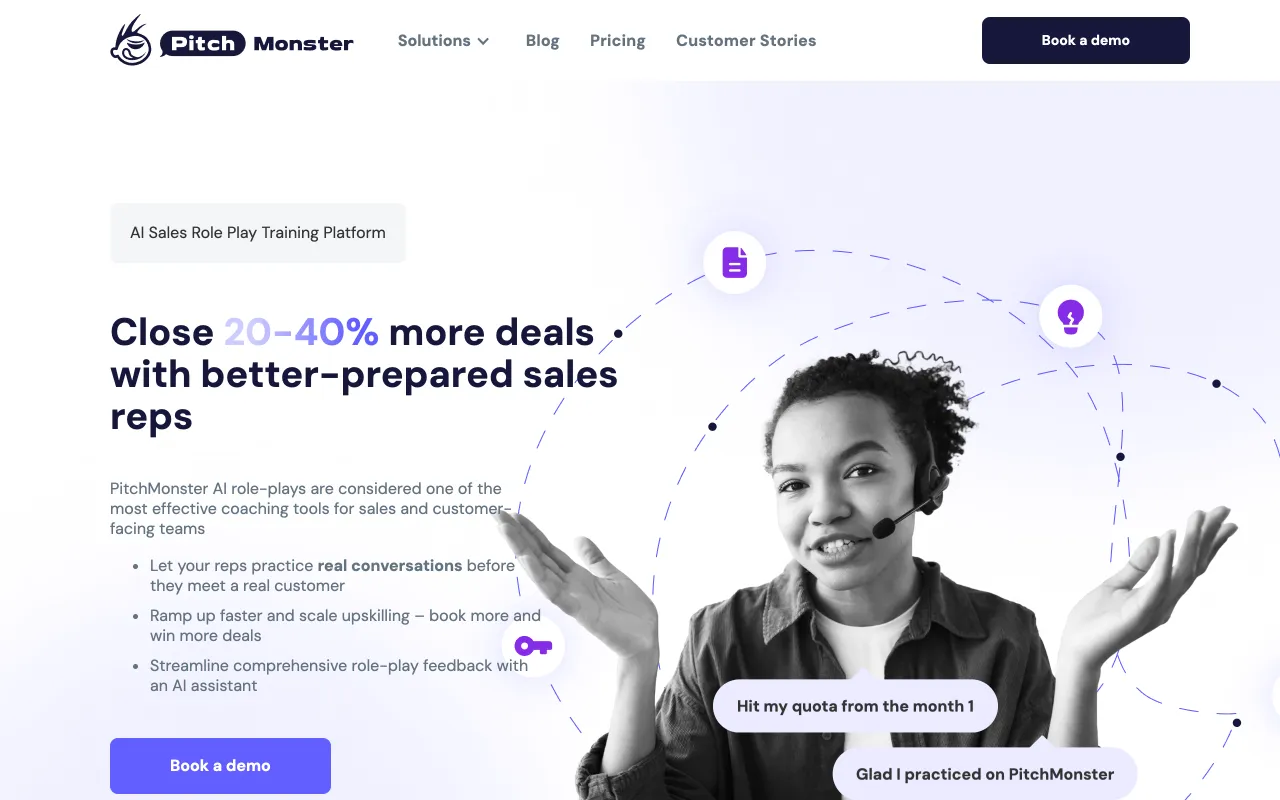
PitchMonster positions its AI feedback like a "sales Grammarly" for spoken conversations, built to scale from a handful of roleplays to thousands per day with consistent scoring. Teams use it for high-volume training, hiring assessments, and ongoing reinforcement.
Against Chorus: another practice-first tool rather than a CI platform. It is specialized in roleplay, so it solves the readiness problem but does not replace conversation intelligence on live deals.
Key Features
- Pre-built scenarios: ready-made cold call, discovery, and objection drills.
- AI speech coaching: flags filler words, pacing, and clarity gaps.
- Custom scorecards: your coaching standards or built-in metrics.
- Gamified leaderboards: skill-based rankings to drive engagement.
- On-demand scale: unlimited self-paced roleplays without manual oversight.
Pricing: PitchMonster vs. Chorus by ZoomInfo vs. Kendo
PitchMonster does not publish standard pricing, and neither does Chorus.
| PitchMonster | Chorus by ZoomInfo | Kendo AI (for reference) | |
|---|---|---|---|
| Public pricing | No; demo required | No; quote only | Yes; from $55/mo per seat |
| Reported cost | ~$4,800/yr minimum (third-party) | ~$8,000/yr min for 3 seats (third-party) | $55/mo Pro, $100/mo Max |
| Model | Tailored to team size and use case | Bundled into ZoomInfo | Transparent per-seat |
PitchMonster and Chorus figures are third-party reported. Kendo is first-party.
Heads up · Based on user reviews
- Manual at scale: building many custom scenarios feels manual.
- Small review base: a thinner G2 sample than larger competitors.
- Roleplay only: specialized in practice, not broad CI.
For the direct comparison, see Kendo vs. PitchMonster.
Allego: Video-Based Coaching for Distributed Teams
A revenue enablement platform with a video-first approach, recognized as a Gartner Magic Quadrant Leader.
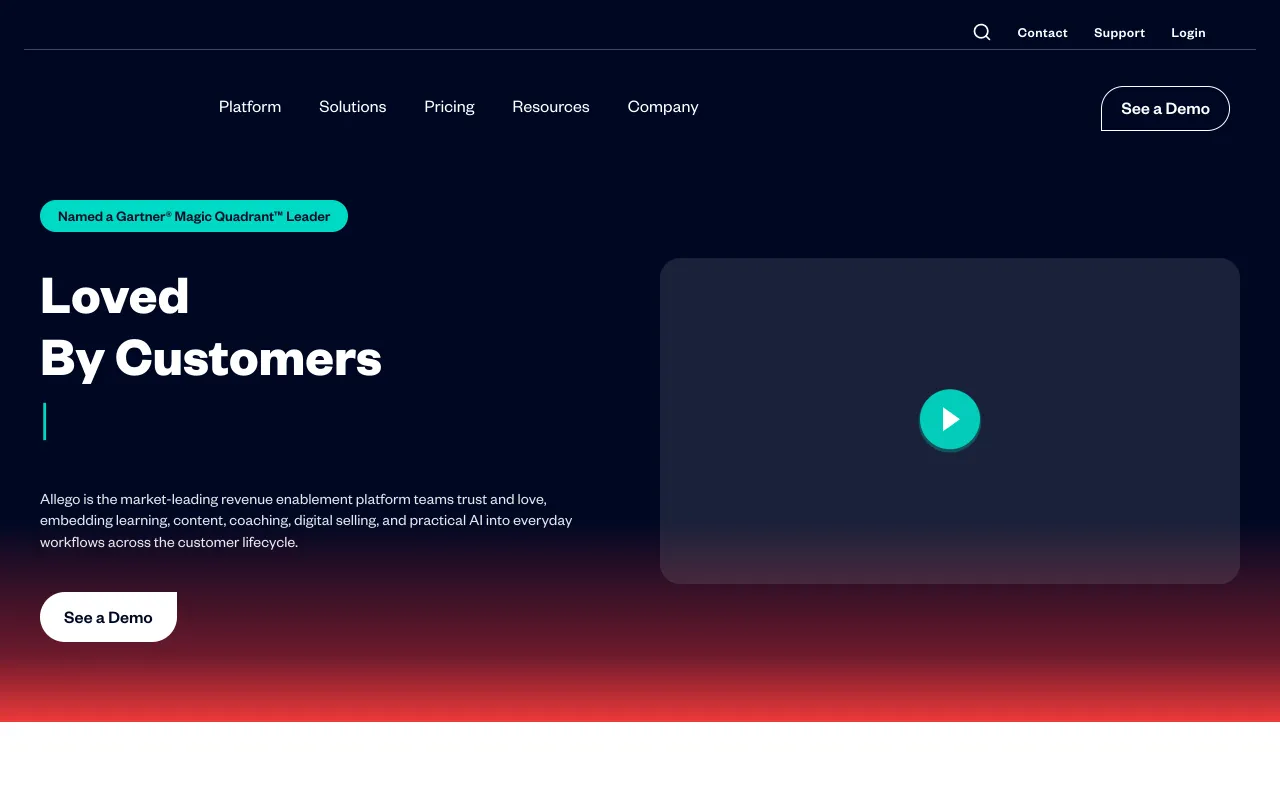
Allego is a revenue enablement platform that unifies learning, content, and coaching, with particular strength for distributed teams. Its video-first approach lets reps record and submit pitches for asynchronous review, and it is recognized as a Leader in the 2025 Gartner Magic Quadrant for Revenue Enablement Platforms.
Against Chorus: Allego is broader than CI and leans into video coaching and peer learning. It is a fit for distributed teams that want training and content alongside conversation analysis, and more than a team wants if it only needs a standalone CI tool.
Key Features
- AI-powered coaching: asynchronous video feedback plus a dialog simulator for practice.
- Peer learning: capture and share best-practice recordings from top reps.
- Conversation intelligence: records and analyzes live calls for talk ratios and sentiment.
- Digital sales rooms: branded microsites for sharing content with buyers.
- Enablement AI: real-time guidance, content recommendations, and meeting summaries.
Pricing: Allego vs. Chorus by ZoomInfo vs. Kendo
Allego does not publish pricing, and neither does Chorus.
| Allego | Chorus by ZoomInfo | Kendo AI (for reference) | |
|---|---|---|---|
| Public pricing | No; quote only | No; quote only | Yes; from $55/mo per seat |
| Reported cost | ~$630 per user/yr list, with steep volume discounts (third-party) | ~$8,000/yr min for 3 seats (third-party) | $55/mo Pro, $100/mo Max |
| Contract | Annual | Reportedly two-year | Monthly or annual |
Allego and Chorus figures are third-party reported. Kendo is first-party.
Heads up · Based on user reviews
- Search could be better: reviewers want easier retrieval of specific materials.
- Broad for a CI-only need: the wider feature set is more than some teams use.
- Quote-only pricing: expect a sales conversation.
If coaching is the priority, our best sales coaching software guide puts Allego next to Mindtickle and Kendo.
Sybill.ai: Behavioral AI Meeting Assistant for Small Business
An AI sales assistant that adds a behavioral layer, tracking buyer engagement, sentiment, and non-verbal cues.
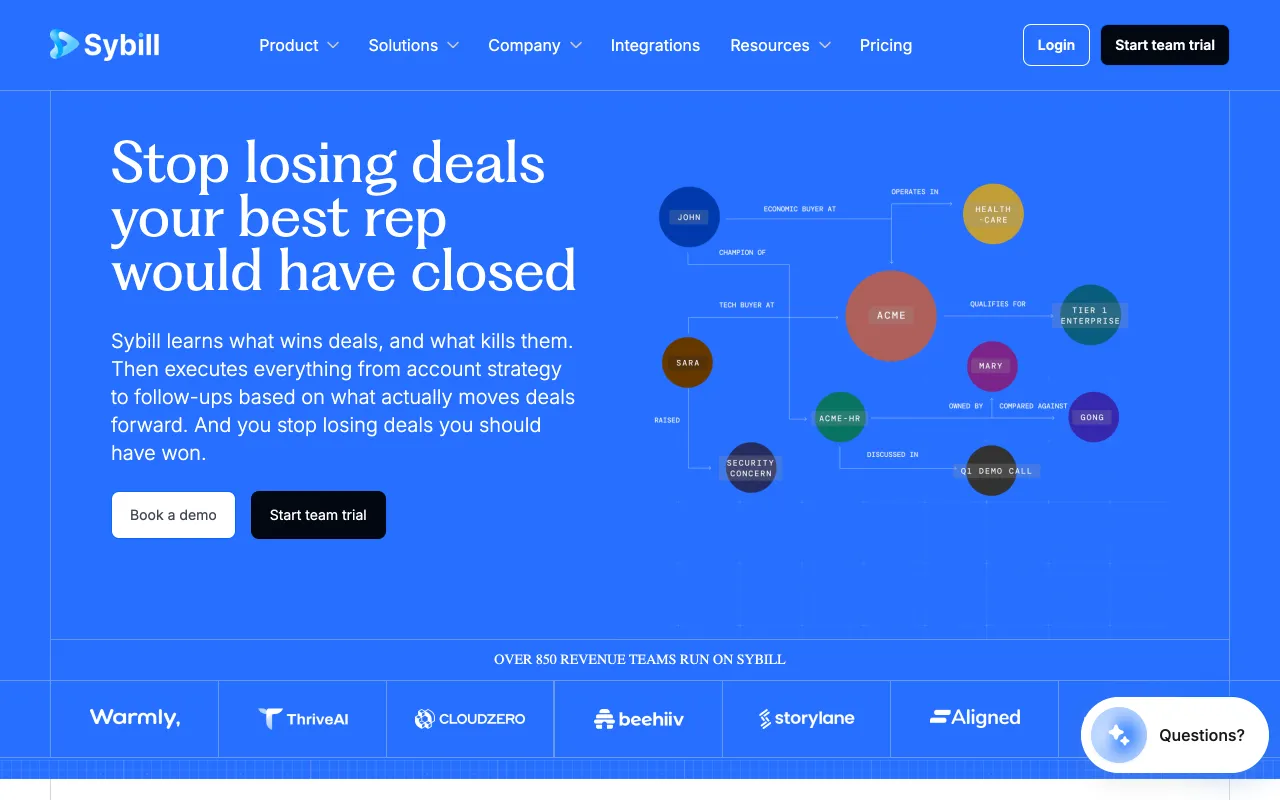
Sybill.ai is an AI sales assistant that records meetings, generates summaries, and adds a behavioral layer, tracking buyer engagement signals, sentiment, and non-verbal cues across video calls. It is built for small-business and mid-market teams that want CI without enterprise pricing.
Against Chorus: Sybill is lighter and cheaper, with public starter pricing, and its behavioral read on buyer engagement is a genuine differentiator. It does not match Chorus on enterprise deal intelligence.
Key Features
- Behavioral analysis: tracks engagement and sentiment shifts to flag deal-closing moments.
- Magic Summaries: structured notes, action items, and draft follow-up emails.
- CRM sync: bi-directional connections to Salesforce and HubSpot.
- Coaching insights: surfaces patterns from top-performer calls.
- Public starter pricing: one of the few CI-adjacent tools with transparent entry pricing.
Pricing: Sybill.ai vs. Chorus by ZoomInfo vs. Kendo
Sybill publishes pricing. Chorus does not.
| Sybill.ai | Chorus by ZoomInfo | Kendo AI (for reference) | |
|---|---|---|---|
| Public pricing | Yes | No; quote only | Yes |
| Starting price | Free; Pro $36/user/mo; Business $108/user/mo | ~$8,000/yr min for 3 seats (third-party) | $55/mo per seat |
| Enterprise | Custom | Quote, often bundled | Custom |
Sybill and Kendo figures are first-party; Chorus is third-party reported. Verified June 4, 2026.
Heads up · Based on user reviews
- Smaller review base than Chorus, Gong, or Avoma.
- Lighter on enterprise deal intelligence.
- Best for SMB: most reviewers come from the small-business segment.
The Verdict: Which Chorus Alternative Should You Choose?
The honest answer is that it depends on the problem you are actually solving. Three picks cover most teams leaving Chorus.
- Gong is the clearest upgrade for enterprise teams with 50+ reps that want the deepest deal intelligence on the market and have the budget to support a per-seat-plus-platform-fee model. It is the destination most teams name when they leave Chorus over slowed innovation.
- Avoma is the mid-market value pick. You get Chorus-grade conversation intelligence with public, per-seat pricing and no multi-year lock-in, which removes the exact friction that sends people shopping.
- Kendo AI is the choice when your real bottleneck is rep skill, not call analytics. If reps make the same mistakes call after call, ramp drags past 30 days, and managers still miss most conversations, more reports on past calls will not fix it. Kendo trains reps before the call against realistic AI buyers, automatically reviews every call after, and assigns targeted coaching to close the gap, at transparent pricing and with results inside the first month.
If you are choosing where to run that practice, the best AI sales roleplay tools guide is the right next read before you commit.
Ready to see the train-before, review-after loop in action? Watch the 5-minute Kendo demo or see Kendo pricing to compare it against your current Chorus quote.
Chorus Alternatives FAQ
It depends on why you are leaving. For enterprise deal intelligence, Gong is the most-cited upgrade. For mid-market conversation intelligence with public pricing, Avoma is hard to beat. For teams whose real problem is rep readiness, Kendo AI is the standout because it trains reps before the call and reviews every call after, rather than only analyzing what already happened.
The recurring reasons in public reviews are high and bundled pricing with no public rate card, a sense that innovation slowed after ZoomInfo acquired Chorus in 2021, a learning curve, and occasional recording, transcription, and search issues. For teams that mainly wanted better reps, the deeper issue is that conversation intelligence reviews calls but does not improve them.
ZoomInfo does not publish Chorus pricing; the product page offers a demo only. Third-party sources report a minimum near $8,000 per year for three seats, with additional seats around $1,200 per year, typically on a two-year contract. Treat those as reported figures and confirm with ZoomInfo directly.
For recordings and AI summaries, Fathom has a free tier with unlimited recordings, and Fireflies.ai starts at $10 per seat per month on annual billing. Both are meeting assistants rather than full revenue intelligence platforms, so they fit teams that want transcripts and summaries more than enterprise deal analytics.
It depends on the job. If you bought Chorus to analyze and coach live deals, a roleplay tool is a complement. If you bought it hoping reps would improve, a platform like Kendo is the more direct fix, because it builds the skill before the call. Kendo also reviews live calls automatically, so it covers both sides of the loop in one place.
ExecVision is now Mediafly Coach360. Mediafly acquired ExecVision in 2022 and folded it into its Revenue360 suite. It still does conversation intelligence and coaching, now inside Mediafly's broader enablement platform.

Luke Alexander is the founder of Kendo AI, where he's helped train more than 5,000 sales reps. He started in sales as a frontline closer, scaled a high-ticket sales-training company, and founded Closer Cartel and AI Insiders before building Kendo to fix the tools he wished he'd had: realistic AI roleplay and automated call review for fast-moving sales teams. He writes about sales training, ramp speed, objection handling, and applying AI across the revenue org.