
9 Best B2B Sales Training Programs for 2026
A B2B deal is a months-long campaign run against a committee of six to ten people. Here are 9 programs that actually train for that, judged on B2B fit, format, coverage, the honest tradeoff, and pricing, plus where AI roleplay practice fits.
A B2B deal is a months-long campaign against six to ten decision-makers (Gartner), and any one of them can stall the buying process.
Training also has to stick. Harvard Business Review reports that reps forget most of a one-off workshop within a quarter, the Ebbinghaus forgetting curve shows most of it fades within weeks without reinforcement, and only about 28% of reps hit quota (Salesforce State of Sales).
Start with the fit matrix, then read the entries that match the gap in your pipeline.
There is no single "best" B2B sales training program, because teams have different gaps. For a recurring-revenue system pick Winning by Design, for enterprise value messaging Force Management, for buying-committee insight selling Challenger, for durable consultative selling Sandler or RAIN Group. Then add a practice layer so the methodology survives the first real deal.
The B2B Sales Training Fit Matrix
Nine programs all sound good in isolation. The real question is which one closes your gap. Find the gap that is actually hurting your pipeline, then read that entry first.
The B2B Sales Training Fit Matrix
Each program mapped to the gap it closes, the B2B buyer it fits, how it is delivered, and whether pricing is public. Find your gap, then read that entry first.
| Program | Primary Gap It Closes | B2B Buyer It Fits Best | Delivery | Pricing Public? |
|---|---|---|---|---|
| Kendo AI | The practice gap (knowing vs doing) | Any B2B team that wants the methodology to stick | AI roleplay platform | Yes |
| Winning by Design | Recurring-revenue motion + GTM system | $5M-$100M ARR SaaS building a repeatable engine | Blended (live + LMS) | Yes (courses) |
| Force Management | Value messaging + enterprise qualification | Enterprise SaaS, $50K+ ACV, 6+ month cycles | Workshops + platform | No |
| Challenger | Reframing the buyer + committee consensus | Teams losing to status quo across many stakeholders | Workshops + eLearning | No |
| Sandler | Consistent process + lasting behavior change | Teams that need a durable system, not a one-off | Ongoing sessions | No |
| RAIN Group | Consultative discovery + impact case | Professional services and relationship-driven B2B | Multi-modal | No |
| Corporate Visions | "Why change" messaging + skill gaps | Teams stuck in "no decision" or competitive deals | Modular + assessments | No |
| MEDDIC Academy | Deal qualification discipline | Enterprise reps who need MEDDIC/MEDDPICC fast | Self-paced + vILT | Yes |
| JB Sales | Prospecting + tactical deal execution | SDR/AE teams who want plays they can run today | On-demand + live | Yes |
What Makes B2B Sales Training Different
If a program was built for retail or transactional selling, it will not survive a B2B deal. The complexity is structural, not cosmetic.
- Buying committees, not buyers. Six to ten stakeholders [Gartner], each with a different fear. Training has to teach multi-threading and stakeholder-specific value, not a single pitch.
- Long cycles. Months of discovery, demos, security reviews, and procurement. Skills have to hold across the gap, which is why reinforcement matters more than a one-time event.
- Methodology depth. Qualification frameworks like MEDDIC and MEDDPICC, value-messaging systems, and consultative discovery exist because B2B deals are too complex to wing.
- A real business case. You are selling ROI to people who answer to a board. Reps need to build and defend it, often without you in the room.
- Procurement and "no decision." The most common competitor in B2B is the buyer doing nothing. Good training teaches reps to create urgency and navigate the buying process itself.

The deeper context on cycle length and committee dynamics is worth a read if you are mapping this for your team: start with the B2B sales cycle and the B2B sales techniques that actually win complex deals.
Evaluation Criteria
Nine programs, one consistent lens. Each pick is judged on the same six criteria, and every entry below references them.
- B2B fit. Does it train for complex, committee-driven, multi-month deals, or is "B2B" just a label?
- Methodology depth. Is there a real, repeatable system (qualification, discovery, value, deal control), or just motivation?
- Format and reinforcement. Live, virtual, self-paced, blended, and crucially, what happens after the workshop ends.
- Enterprise readiness. Can it handle multi-region teams, custom curricula, and high-ACV complexity?
- Honest pricing. Is pricing public, or quote-based? First-party numbers are included where they exist; private pricing is labeled clearly.
- Proof. Customer outcomes, win-rate movement, or research behind the method.
Disclosure: Kendo is ranked first as the practice layer that makes every other program on this list stick, not as a replacement curriculum. The other eight are evaluated on their own merits, cons included, and any of them can be the right first pick when the core gap is methodology.
Kendo AI
The practice layerNot a curriculum. The daily AI roleplay reps run so whatever methodology you pick survives a live committee.
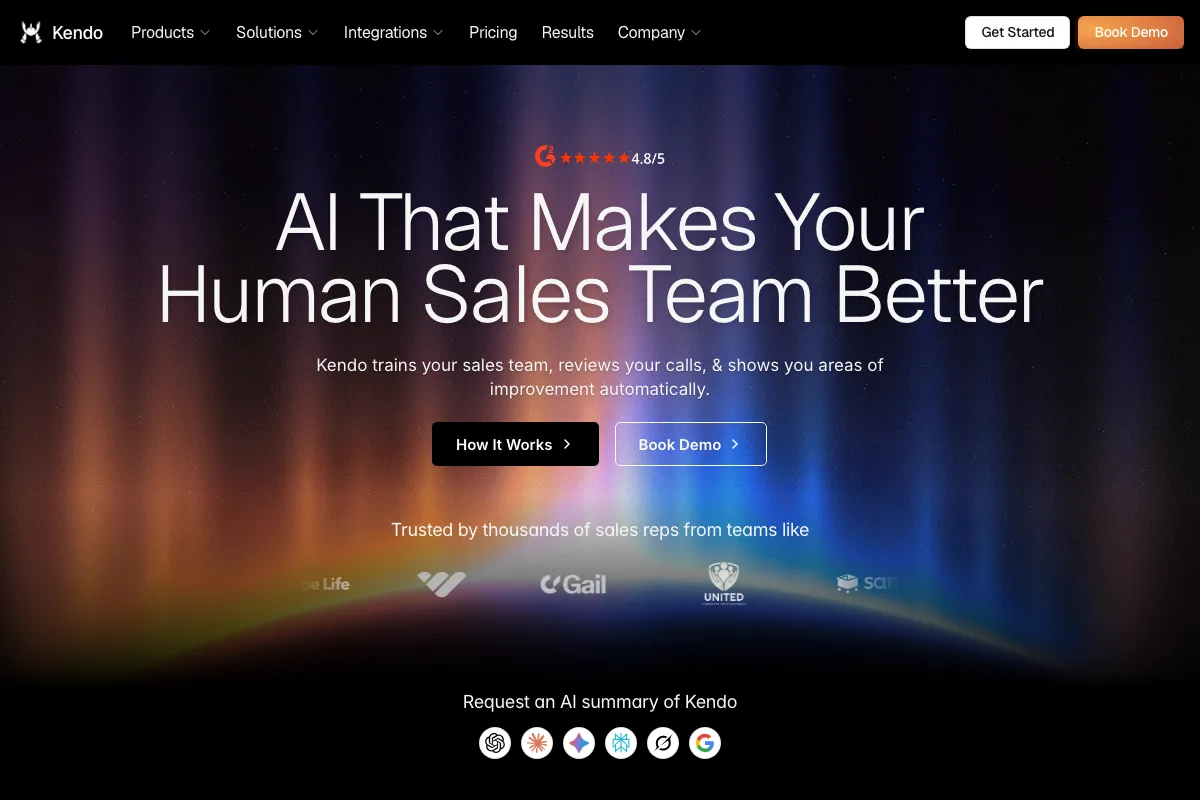
Kendo homepage, June 2026: the daily AI roleplay and call-scoring practice layer reps run before a live committee.
Disclosure: Kendo is included because it is the practice layer, not a curriculum replacement. The eight curriculum programs below are evaluated on their own merits, and any of them can be the right first pick when the core gap is methodology.
Every methodology here teaches reps what to say. None of them gives reps the reps to say it under pressure, against a CFO who pushes back, a technical buyer who goes deep, and a champion who goes quiet.
That is the practice gap, and it is where good training quietly dies. Kendo is the layer that fills it: software for deliberate practice, not classroom curriculum.
Here is how it works. You build custom AI prospects that mirror a real buying committee, by ICP, industry, sales cycle, call type, and personality. Reps then drill technical discovery and multi-threaded objections on demand, before a single live deal is at stake.
After every rep, automated call review scores the conversation against your own scorecard and tells the rep exactly what to fix next. That is deliberate practice aimed at the exact MEDDPICC discovery or Command of the Message pitch a program just taught.
Weighing the practice layer on its own? Our roundup of the best AI sales roleplay tools compares Kendo against the other simulators head to head.
This is what practicing on Kendo looks like. The AI buyer pushes hard on SOC 2, ISO 27001, and proof the tool cuts compliance work, and the rep has to handle it on the spot, before any of it lands on a live deal.
Key Coverage
- AI roleplay with custom B2B prospects (ICP, call type, sales cycle, personality, 40-plus languages).
- Automated call review and custom 1-to-100 scorecards on real and practiced calls.
- AI coaching and rep skill profiles, plus integrations with Fathom, Zoom, Slack, Fireflies, Zapier, and an open API.
Consider before choosing
- Kendo is the reinforcement, not the framework. If your reps have never learned a qualification or value methodology, pair Kendo with one of the curriculum picks below first, then use Kendo to make it stick.
- It is software, so adoption matters. Teams that mandate a practice minimum get the results; casual users do not.
Pricing
Pricing is transparent and per seat. Pro is $55 per seat per month with 180 roleplay minutes, Max is $100 with 480 minutes, and Enterprise is custom for teams of ten or more that want custom AI models and done-for-you setup. See full per-seat pricing.
| Pro $55/mo per seat | Max $100/mo per seat | Enterprise Custom |
|---|---|---|
| AI roleplay, AI call reviews, advanced analytics, AI sales manager + coach, 180 roleplay minutes/seat per month | Everything in Pro, 480 roleplay minutes/seat per month, for teams that want maximum usage | Teams of 10+, custom AI models, custom scoring, DFY setup, dedicated account manager |
Winning by Design
Best for SaaS GTMThe methodology shop for B2B SaaS teams that want a repeatable recurring-revenue engine, not a one-day pep talk.
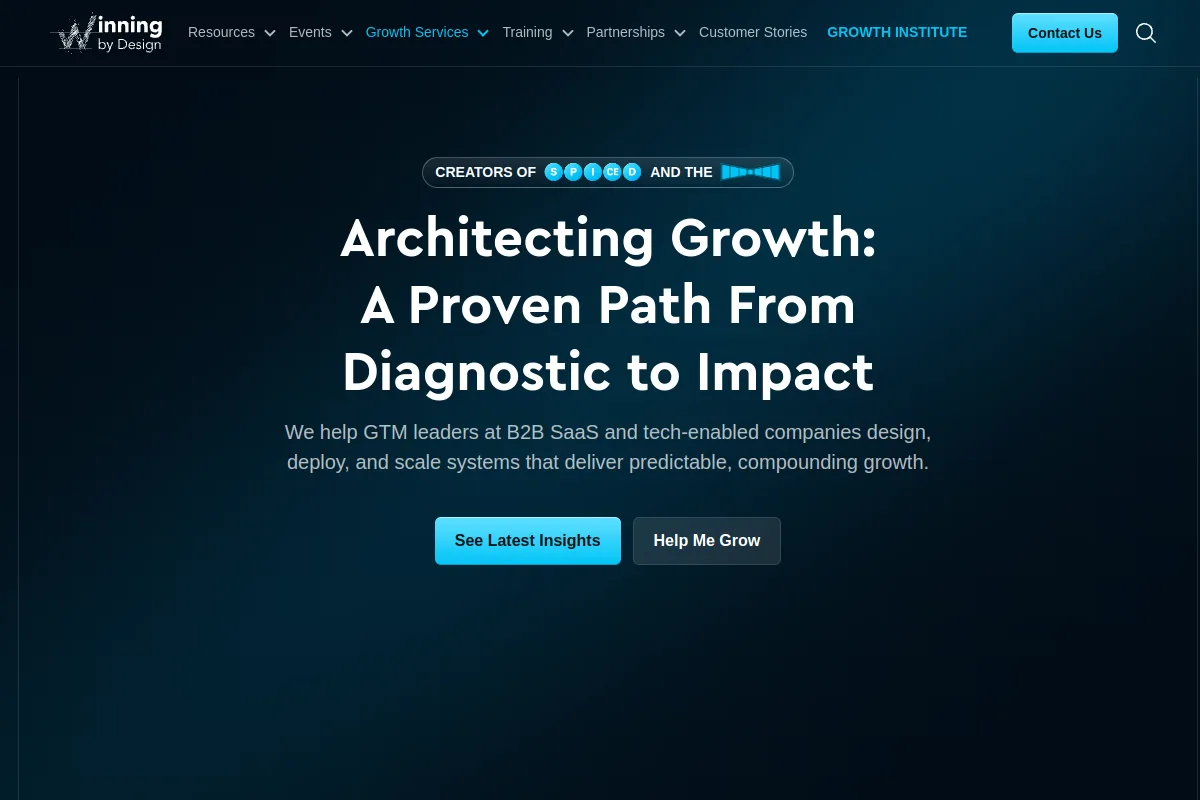
Winning by Design homepage, June 2026. Screenshot via thum.io; trademarks belong to Winning by Design.
Winning by Design built its name on selling that respects how subscription businesses actually grow. Its SPICED discovery framework and Bowtie revenue model are designed for recurring revenue, putting net revenue retention and post-sale expansion at the center instead of the one-time win.
Training blends live, facilitator-led workshops with self-paced Revenue Academy courses, plus the REKS coaching framework to keep it alive after the session.
For a B2B SaaS team selling into committees over months, the payoff is a shared language across sales and customer success. SPICED gives both sides one discovery vocabulary, so the hand-off from new logo to expansion is clean instead of a fumble. No other pick here is built so squarely on recurring-revenue economics.
Key Coverage
- Role-based paths for SDRs, AEs, CSMs, managers, and executives, from prospecting up to Revenue Architecture.
- SPICED discovery and the Bowtie model for full-funnel, retention-first selling.
- Blended delivery pairing live instruction with Revenue Academy LMS reinforcement.
Consider before choosing
- Time and discipline intensive. Lengthy sessions are hard to fit during a crunch quarter, and moving from blueprint to daily execution takes real internal effort.
- Pricing scales fast. Individual Revenue Academy courses run roughly $1,500 per person for individual contributors and around $2,500 for manager or facilitator tracks, and full team engagements reach the high five and six figures. [Source: winningbydesign.com / third-party, June 2026]
- Teaches the system, not the reps. It hands you the framework but does not run reps live, so the execution lands on your reinforcement.
Running SPICED across your team? Have reps drill an actual SPICED discovery on demand with daily practice via Kendo's live AI roleplay, then spin up your toughest buyer until the framework holds.
Force Management
Best for enterpriseBuilt for the enterprise deals where the wrong message to the wrong stakeholder costs you six figures.
Force Management homepage, June 2026. Screenshot via thum.io; trademarks belong to Force Management.
Force Management is what enterprise sales orgs reach for when deals are big, technical, and multi-threaded. Its flagship Command of the Message aligns the whole go-to-market team around one buyer-focused value narrative.
So SDRs, AEs, sales engineers, and account managers all articulate value the same way to every audience in the committee. Pair that with MEDDPICC qualification and you get the message and the deal-control discipline in one system. Databricks, MongoDB, and Snowflake have trained their teams on it.
Reinforcement runs through Ascender, a platform with daily content, ongoing curriculum, and live events, which is what stops the workshop from fading. For high-ACV B2B, this is about as complete as methodology training gets.
If qualification is your specific gap, our guides to MEDDIC and MEDDPICC go deeper on the frameworks Force Management trains.
Key Coverage
- Command of the Message value-messaging framework for the entire customer-facing org.
- MEDDPICC qualification and deal-control discipline for complex pipelines.
- Ascender platform for sustained reinforcement and adoption.
Consider before choosing
- It is a transformation, not a course. This is go-to-market change, so it asks for executive sponsorship and a change-management mindset to land.
- Pricing is private. The company says cost depends on scope, customization, team size, and reinforcement needs; third-party sources put enterprise engagements in the mid-five to low-six figures. [Source: forcemanagement.com, June 2026; third-party range]
- Overkill for small, transactional teams. The depth is wasted if your deals are simple and single-threaded.
Challenger
For teams losing deals to "no decision" because nobody on the committee feels the cost of staying put.
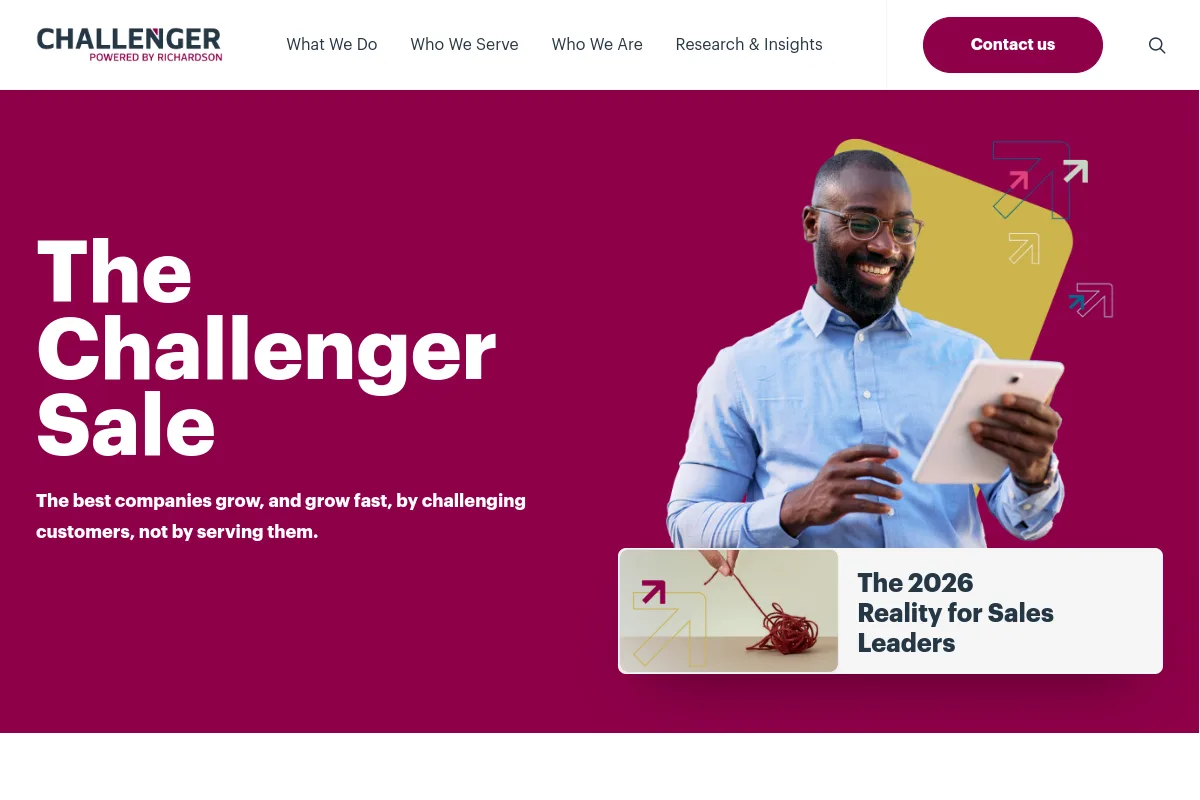
Challenger homepage, June 2026, now badged "powered by Richardson." Screenshot via thum.io; trademarks belong to Challenger / Richardson.
Challenger is the insight-selling standard, and it earned that from research, not slogans. The model came out of a study of roughly 6,000 sales professionals that found top performers do not just solve a stated problem, they reframe how the buyer sees it.
In a committee deal, that is the skill that builds consensus. A Challenger rep tailors a business case to each stakeholder and creates enough constructive tension to move a group off the status quo.
One note for accuracy, since the market shifted: Challenger was acquired by Richardson Sales Performance in 2024. The IP originated inside CEB, which Gartner later acquired, then was carved out as a standalone company in 2018. The methodology, workshops, eLearning, and diagnostics remain intact under the new owner.
Key Coverage
- The teach-tailor-take-control model for insight-led, consensus-building selling.
- Stakeholder mapping and business-case construction for multi-person committees.
- Workshops plus the Activation platform, eLearning, and assessment tools.
Consider before choosing
- It lives or dies on coaching. Done badly, Challenger curdles into reps who argue with prospects instead of teaching them, so reinforcement quality is everything.
- Pricing is private and quote-based, and the post-acquisition portfolio is broad, so scope exactly which modules you are buying. [Source: challengerinc.com / Gartner Peer Insights, June 2026]
- Expect a dip before the climb. It is a mindset shift that takes time to land across a team.
Sandler
A durable, reinforcement-first system for teams that want lasting behavior change, not a motivational sugar high.
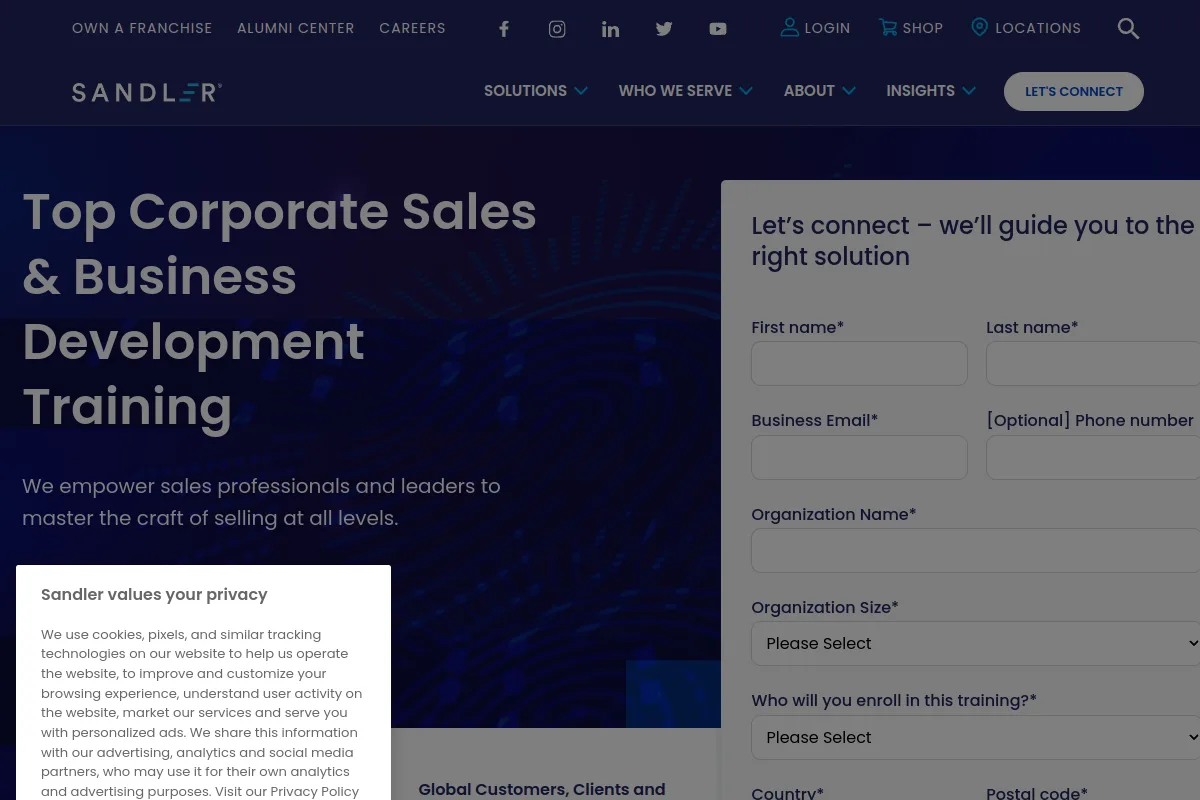
Sandler homepage, June 2026. Screenshot via thum.io; trademarks belong to Sandler.
Sandler has refined the same core idea since 1967, and it basically invented the "reinforcement training" the rest of this list now copies. The Sandler Selling System breaks a deal into clear stages, with signature concepts like Up-Front Contracts and the Pain Funnel.
So reps qualify hard and uncover real pain before they ever present. For complex B2B, the up-front contract is quietly powerful: it sets explicit expectations with every stakeholder, which keeps a multi-threaded deal from drifting.
The real differentiator is the ongoing reinforcement model delivered through a global network of 250-plus training centers. Instead of one workshop, reps get continuous sessions that build on prior learning, which is how behavior actually sticks.
For the framework in depth, see our guide to the Sandler sales methodology and the broader consultative selling approach it sits inside.
Key Coverage
- Consultative, pain-first qualification built on the Pain Funnel.
- Up-front contracts to set expectations and filter for real opportunities early.
- Continuous reinforcement through ongoing sessions, not a single event.
Consider before choosing
- General, not SaaS-native. The pain-first qualification maps onto committee deals, but you layer on the software-specific parts yourself: recurring-revenue economics, trials, and technical demos.
- Franchise variability. Because it is delivered through a franchise network, instruction quality can vary by trainer and location, and pricing is custom and quote-based. [Source: sandler.com, June 2026]
- Long-term commitment. It asks for ongoing investment, and the mindset shift can cause a temporary dip before performance climbs.
RAIN Group
Consultative and insight selling for relationship-driven B2B, with the reinforcement coaching most programs skip.
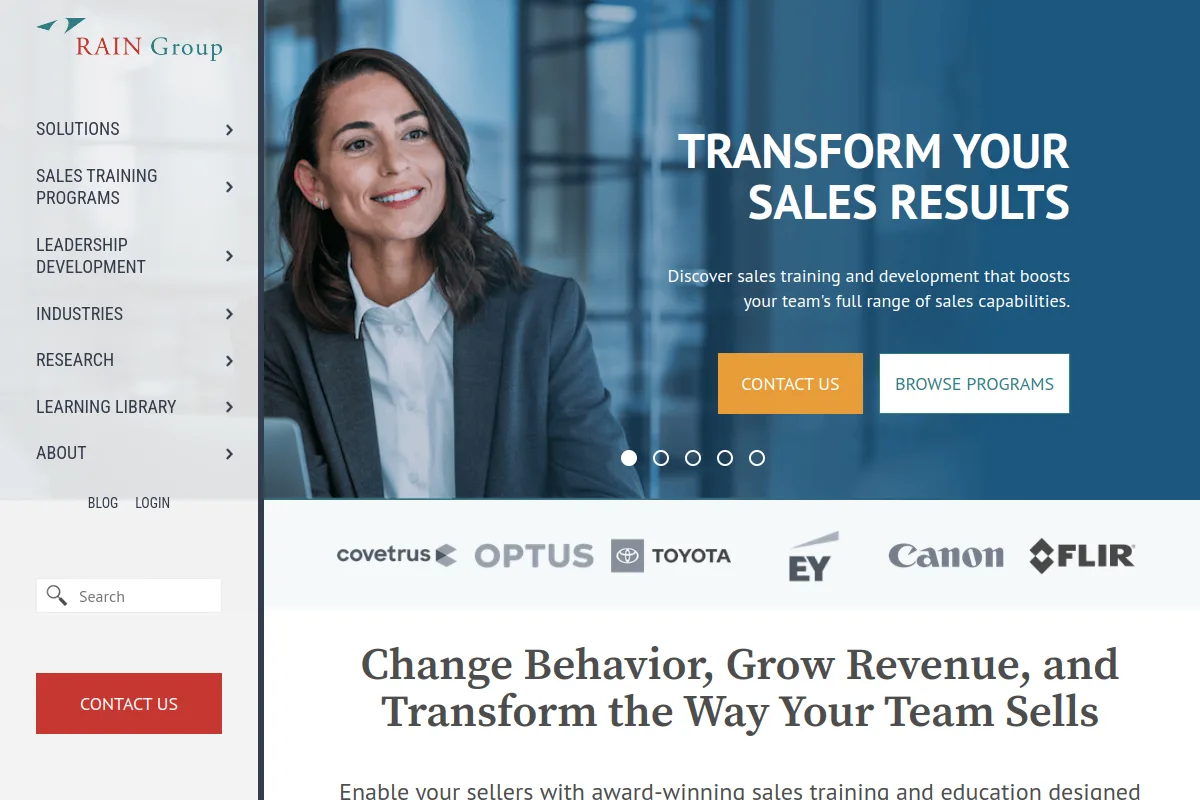
RAIN Group homepage, June 2026. Screenshot via thum.io; trademarks belong to RAIN Group.
RAIN Group trains the kind of selling where the relationship is the deal. Its RAIN Selling model runs across 16 modules: needs discovery, rapport and trust, crafting value, the financial impact case, objections, and influencing different buyer personas.
That is exactly the toolkit for a complex, multi-stakeholder conversation. The approach, popularized in the firm's book Rainmaking Conversations, is consultative at its core and leans into insight selling for buyers who expect a point of view.
What sets RAIN apart for B2B is the back half. The program includes roughly 12 weeks of reinforcement coaching after the initial training, which directly attacks the 90-day forgetting curve that wrecks most one-off workshops [rainsalestraining.com, June 2026].
Delivery is genuinely flexible: in-person, virtual, hybrid, or self-study with reinforcement layered on. It is a strong fit for professional services, financial services, and any B2B sale where trust drives the close.
Key Coverage
- RAIN Selling across 16 modules, from discovery and rapport to impact case and stakeholder influence.
- Insight selling for buyers who expect the rep to bring a perspective.
- Multi-modal delivery plus about 12 weeks of reinforcement coaching.
Consider before choosing
- Lower brand recognition in pure tech-sales circles than Challenger or Force Management, so internal buy-in may take a beat.
- Pricing is private and quote-based, with no public figures, so you need a scoping conversation to budget. [Source: rainsalestraining.com, June 2026]
- Sharpens the conversation, not the reps. Like every methodology program here, it does not give reps unlimited live reps; that part is on you.
 Across Kendo customers: 5-15% higher close rates, 70% faster ramp, and $3,000+ saved per rep.
See the results →
Across Kendo customers: 5-15% higher close rates, 70% faster ramp, and $3,000+ saved per rep.
See the results →
Corporate Visions
Research-backed messaging and skill training for teams whose deals die in "no decision."
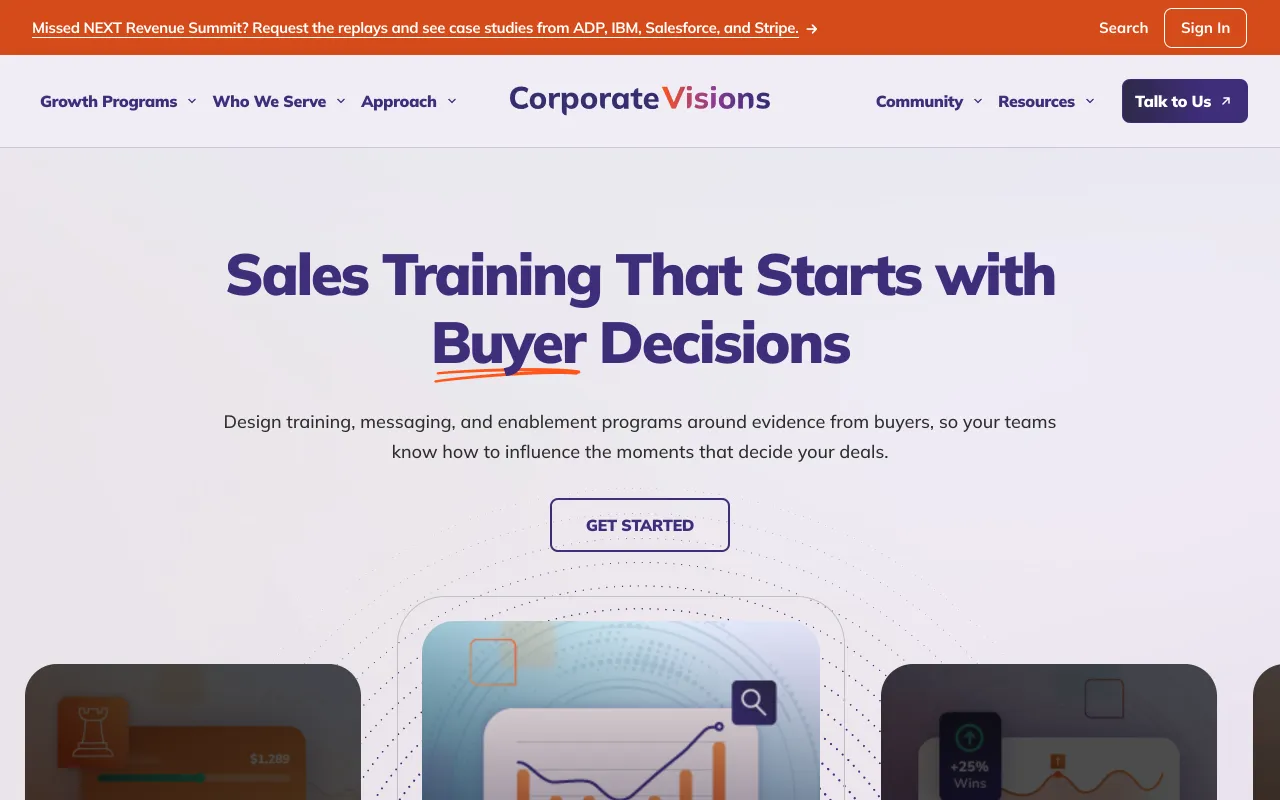
Corporate Visions homepage, June 2026. Clean homepage capture; trademarks belong to Corporate Visions.
Corporate Visions is the evidence-based pick. Its frameworks are grounded in more than 150,000 B2B buying decisions, and the firm specializes in the messaging that decides whether a buyer changes at all.
That "why change" focus is the right medicine for the most common B2B loss, the prospect choosing to do nothing. It trains reps to build urgency and tell a story buyers believe, remember, and act on across acquisition, expansion, and renewal.
In January 2026 the company launched competency-based training and Precision Skills Assessments on its Great 8 framework, so teams can pinpoint exactly where each seller falls short.
In one pilot, sellers who scored highest on a few key competencies posted win rates more than 15 points higher than the lowest scorers. That measurement-first approach makes it easy to prove the training is working.
Key Coverage
- "Why change" and "why now" messaging for acquisition, expansion, and renewal.
- The Great 8 competency framework with Precision Skills Assessments to find skill gaps.
- Modular, situational workshops trained to the specific moments that change buyer decisions.
Consider before choosing
- Messaging and skills first, not one end-to-end methodology. Teams that want a single named system to run a whole pipeline (the way MEDDPICC or Sandler operate) may need to pair it with one.
- Pricing is private and quote-based with no public figures. [Source: corporatevisions.com, June 2026]
- The assessment layer needs managers who use it. The competency model is powerful but adds a measurement habit your team has to actually maintain.
Once the "why change" message is built, reps have to land it live. Drill it with daily practice via Kendo's live AI roleplay: spin up a skeptical economic buyer on demand and pressure-test the story before a real deal hears it.
MEDDIC Academy
Best for qualificationThe fastest, most transparent path to qualification discipline for enterprise B2B reps.
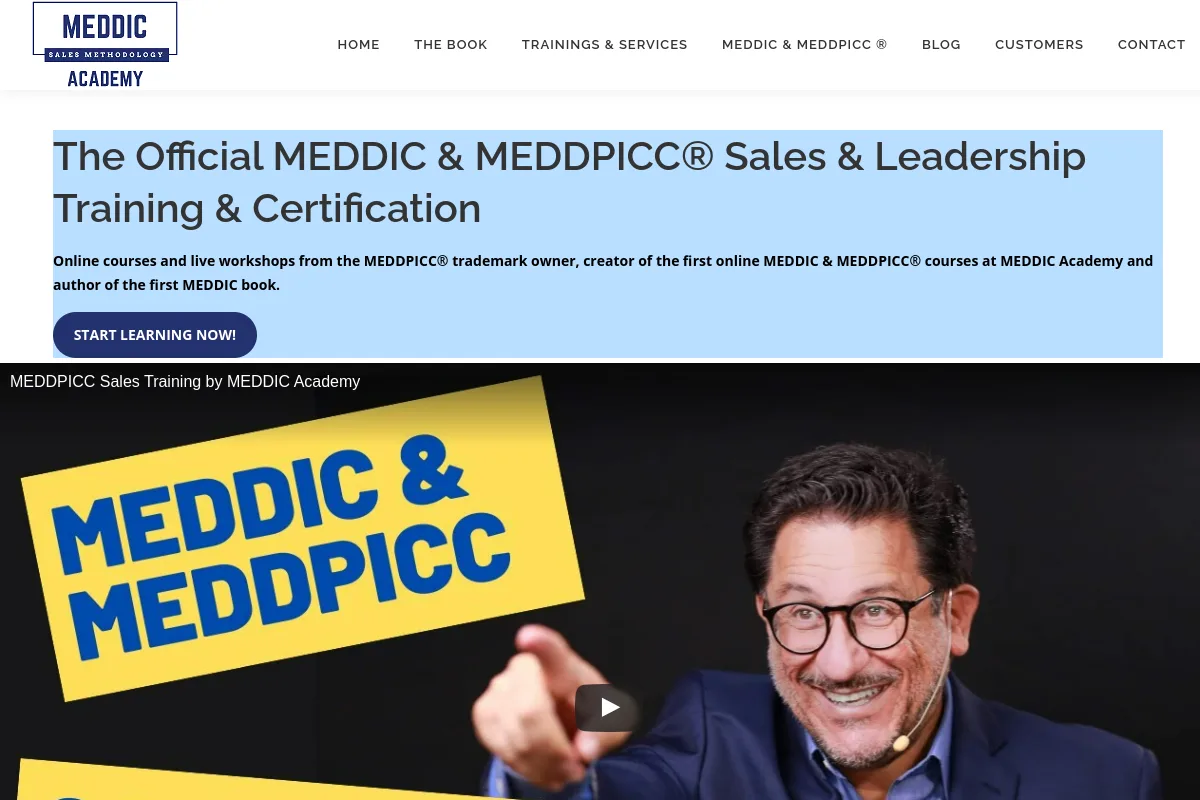
MEDDIC Academy homepage, June 2026. Screenshot via thum.io; trademarks belong to MEDDIC Academy.
When a B2B deal stalls, weak qualification is usually why, and MEDDIC Academy exists to fix exactly that. It delivers self-paced training in the MEDDIC and MEDDPICC frameworks.
Those are the systems enterprise teams use to pressure-test deals on Metrics, Economic buyer, Decision criteria and process, Identify pain, Champion, and (in MEDDPICC) Paper process and Competition.
For committee deals, that is the discipline that surfaces deal risk early instead of on the forecast call when it is too late.
Two things make it stand out on a list full of "contact us." First, it is refreshingly transparent on price: the Full MEDDPICC certification is $297, Advanced is $597, the Managers track is $1,173, and there is a free intro course [meddic.academy, June 2026].
Second, MEDDIC Academy is the registered owner of the MEDDPICC trademark and the only provider authorized to issue official MEDDPICC certification, so the credential actually means something.
Key Coverage
- Self-paced MEDDIC and MEDDPICC courses for individual contributors, managers, and trainers.
- Official, test-based MEDDPICC certification.
- Topic-level training such as developing champions and qualifying the economic buyer.
Consider before choosing
- Deliberately narrow. This is qualification training, not a full-cycle program covering prospecting, discovery technique, demos, and negotiation, so it complements a broader methodology rather than replacing one.
- Self-paced video only. The knowledge sticks only if reps actually apply it on live deals, which is the gap a practice layer fills. [Source: meddic.academy, June 2026]
MEDDPICC is only worth the cert if reps run it on a call. Turn the video into reps with daily practice via Kendo's live AI roleplay, then spin up your toughest economic buyer and qualify them in real time.
JB Sales (JBarrows)
Tactical, high-energy plays a B2B rep can run on today's calls, from prospecting to close.
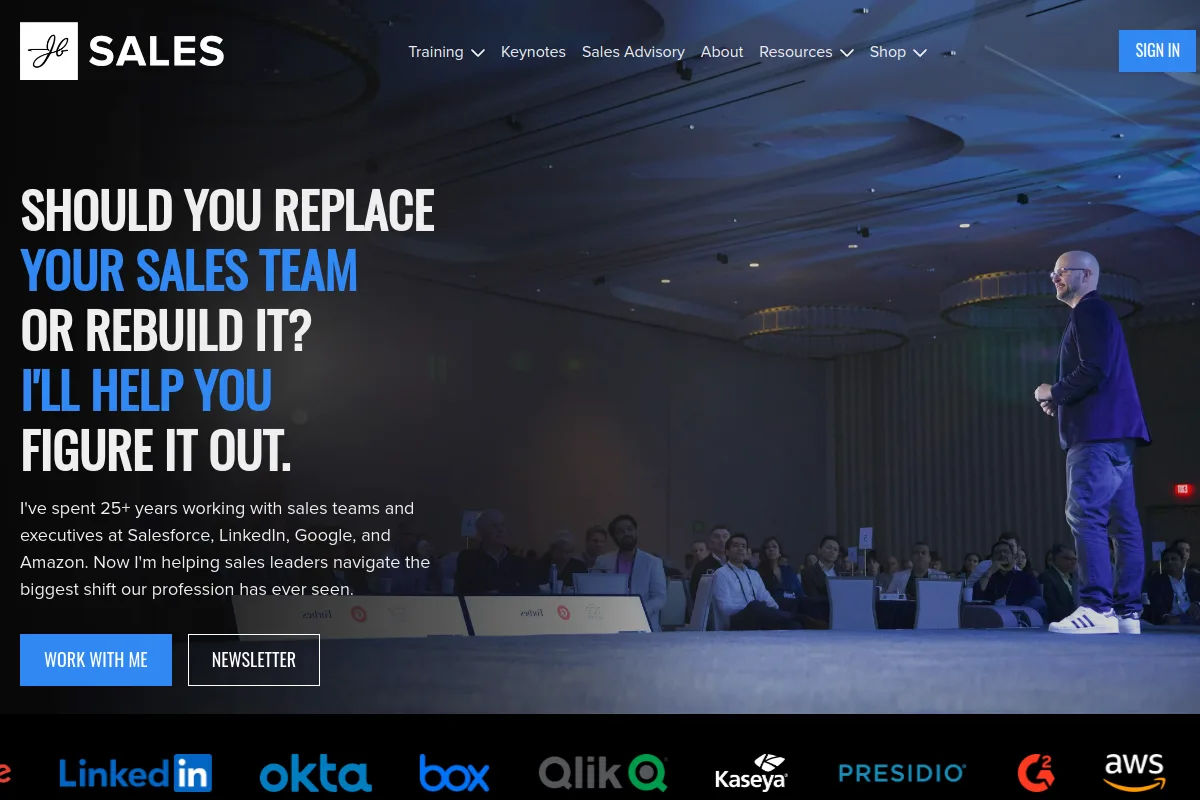
JB Sales homepage, June 2026. Screenshot via thum.io; trademarks belong to JB Sales / John Barrows.
JB Sales, John Barrows' training company, is for reps who want a play they can use 15 minutes after watching, not a philosophy. Flagship programs like Filling the Funnel (prospecting) and Driving to Close (meeting execution and negotiation) come from real tech-sales experience.
So the prospecting and deal-control tactics map cleanly onto modern B2B cycles. Barrows advises teams at Salesforce and LinkedIn, and the membership now bundles SalesGPT tools for folding AI into research and messaging.
For a B2B team, this is the execution layer that sharpens day-to-day reps: better cold outreach, tighter meeting control, cleaner objection handling. Pricing is unusually clear for this list, with an All-Inclusive Annual Membership starting around $365 per year, plus team programs that bundle access [learn.jbarrows.com, June 2026].
Key Coverage
- On-demand programs for prospecting, objection handling, and deal control, with certifications.
- Filling the Funnel and Driving to Close as the flagship tactical courses.
- SalesGPTs and a full tactical content library, plus live workshops for teams.
Consider before choosing
- Tactics, not strategy. Recurring-revenue economics, account expansion, and formal qualification frameworks sit outside the scope, so treat it as an execution layer over a methodology, not the methodology itself.
- Results hinge on the reps. Like any on-demand library, it pays off only if reps actually practice and apply it, not just watch. [Source: learn.jbarrows.com / jbarrows.com, June 2026]
The Practice Layer in Action: United Insurance Pros
A methodology is the play. Reps are how it survives contact with a live deal. United Insurance Pros is the clearest proof of what the practice layer does once the training is in place.
With Kendo, new reps got productive 75% faster
After adding daily AI roleplay before live calls, new agents reached baseline performance in 14 days instead of 45+, and onboarding shrank from 45 days to 14 days, by logging 3 to 5 hours of practice first.
Result: 7-day ramp-up + 7 days to baseline performance = 14 days total vs 45+ days before.
"Typically we would see about a 45-day period where people would dip their foot in the water and slowly improve and then level off at their performance level. Now that's 14 days. So it's the 7-day ramp-up and then 7 days to be where they're going to be at their baseline."Waylon Artrip, Founder, United Insurance Pros
Before Kendo, onboarding new agents meant getting them certified and thrown into the fire, burning 30 to 50 calls at a 3% close rate while they learned on real leads.
The mechanism after Kendo is not magic. Reps build the reflex on AI prospects instead of on your pipeline, and managers stop guessing who is ready.
The same pattern shows up across Kendo customer results: 5 to 15% higher close rates, 70% faster ramp, and $3,000-plus saved per rep. If slow ramp is your pain specifically, the playbook on how to reduce sales ramp time goes deeper.
Pick by Your Gap, Not by Brand
There is no single "best" B2B sales training program, because teams have different gaps. Match the pick to the hole in your pipeline.
- Choose Winning by Design if you run a recurring-revenue motion and want one GTM system and discovery language across sales and CS.
- Choose Force Management if you sell high-ACV enterprise deals and need consistent value messaging plus MEDDPICC qualification across the whole team.
- Choose Challenger if you keep losing to the status quo and need reps who can reframe the buyer and build committee consensus.
- Choose Sandler or RAIN Group if you want a durable, reinforcement-first consultative system, with RAIN leaning toward relationship-driven and professional-services B2B.
- Choose Corporate Visions if your deals stall in "no decision" and your real gap is "why change" messaging and measurable skill development.
- Choose MEDDIC Academy if qualification discipline is the gap and you want transparent, certified MEDDIC or MEDDPICC training fast.
- Choose JB Sales if your reps need tactical prospecting and deal-execution plays they can run this week.

Then, whichever curriculum you pick, add the practice layer at number one so it survives the first real deal. Reps drill the exact methodology against realistic AI buyers, and call scoring proves they can run it before a live committee is on the line.
Frequently Asked Questions
It depends on your gap. For a recurring-revenue GTM system, Winning by Design leads. For enterprise value messaging and qualification, Force Management is the standard. For reframing buyers in committee deals, Challenger. For durable consultative selling, Sandler and RAIN Group. The common thread across all nine: methodology only pays off once reps can execute it live, which is why teams pair a curriculum with a practice layer like Kendo, starting at $55 per seat per month.
It ranges widely. Self-paced certification is the most transparent: MEDDIC Academy's Full MEDDPICC is $297, and JB Sales membership starts around $365 a year. Methodology course bands are public for some, such as Winning by Design at roughly $1,500 to $2,500 per person. Enterprise programs like Force Management, Challenger, Sandler, RAIN Group, and Corporate Visions are quote-based and commonly run into the five and six figures for full team engagements. Software-based practice platforms like Kendo start at $55 per seat per month.
The complexity of the B2B deal itself: multi-threading a buying committee of six to ten stakeholders, qualifying with frameworks like MEDDIC or MEDDPICC, building and defending an ROI business case, navigating procurement, and beating the "no decision" that kills most deals. Generic closing tips ignore all of it. Strong B2B programs train discovery, value messaging, qualification, deal control, and negotiation across long, multi-stakeholder cycles.
No, and that is the point. Methodology programs teach reps what to say and how to think about a deal. AI roleplay platforms like Kendo measure whether reps can actually execute under pressure, with unlimited reps and objective scoring after every call. The two work together: the methodology supplies the framework, the practice builds the muscle memory so it holds in a live committee deal.
Tie it to behaviors and outcomes, not completion rates. Track qualification discipline (are deals scored on real criteria), discovery depth, objection-handling success, multi-threading across the committee, ramp time for new hires, and win rate, especially against "no decision." Teams that add reinforcement practice after a course retain far more than teams running one-off workshops, and most see measurable movement within 30 to 60 days.

Luke Alexander is the founder of Kendo AI, where he's helped train more than 5,000 sales reps. He started in sales as a frontline closer, scaled a high-ticket sales-training company, and founded Closer Cartel and AI Insiders before building Kendo to fix the tools he wished he'd had: realistic AI roleplay and automated call review for fast-moving sales teams. He writes about sales training, ramp speed, objection handling, and applying AI across the revenue org.